
Thoughts on Mary: sinless

  • Thread starter Thread starter OldeThom
  • Start date Start date
Status
Not open for further replies.
. . . CONTINUED from Tertullian

“One Lord God does [the Church] acknowledge, the Creator of the universe, and Christ Jesus (born) of the virgin Mary, the Son of God the Creator; and the Ressurection of the flesh; the law and the prophets she unites in one volume with the writings of the evangelists and the apostles, from which she drinks in her faith.” (ANF: Vol. III, The Prescription Against Heretics, Chapter 36)

“I revere the fullness of His Scripture, in which He manifests to me both the Creator and the creation. In the gospel, moreover, I discover a Minister and Witness of the Creator, even His Word. But whether all things were made out of any underlying Matter, I have as yet failed anywhere to find. Where such a statement is written, Hermogenes’ shop must tell us. If it is nowhere written then let it fear the Woe which impends on all who add to or take away from the written word.” (ANF, Vol. III, Against Hermogenes, Chapter 22)

“What Scripture does not note, it denies.” (ANF, Vol. IV, On Monogamy, Chapter 4)

“Silence! Silence on such blasphemy. Let us be content with saying that Christ died, the Son of the Father; and let this suffice, because the Scriptures have told us so much. For even the apostle, to his declaration - which he makes not without feeling the weight of it - adds, “according to the Scriptures” in order that he may alleviate the harshness of the statement by the authority of the Scriptures.” (ANF: Vol. III, Against Praxeas, Chapter 3)

Hippolytus of Rome (c. 170-c. 236)

“There is, brethren, one God, the knowledge of whom we gain from the Holy Scriptures, and from no other source. For just as a man, if he wishes to be skilled in the wisdom of this world, will find himself unable to get at it in any other way than by mastering the dogmas of philosophers, so all of us who wish to practise piety will be unable to learn its practice from any other quarter than the oracles of God. Whatever things, then, the Holy Scriptures declare, at these let us took; and whatsoever things they teach, these let us learn; and as the Father wills our belief to be, let us believe; and as He wills the Son to be glorified, let us glorify Him; and as He wills the Holy Spirit to be bestowed, let us receive Him. Not according to our own will, nor according to our own mind, nor yet as using violently those things which are given by God, but even as He has chosen to teach them by the Holy Scriptures, so let us discern them.” (ANF, Vol. V. Against the Heresy of One Noetus, 9.)

GOD BLESS YOU AND KEEP YOU!
 
chosensinner,

What, pray tell, leads you to believe that any Catholic on this site does not revere Scripture?
 
I am not being sarcastic- I am being very real- and I simply care enough to provide you with just a bit of encouragement. Please do not abandon Sola Scriptura- for not only is it biblical- logical- and theologically sound; IT IS HISTORICAL.

/QUOTE]

Sola Scriptura is not bibilical, It is man’s created logic. It is man’s created theology. Lastly, it is not historic in any sense. Sola Scriptura has been proven wrong time and again on this forum. The people that support Sola Scriptura always fade off when they lose. They then start another thread and try to bring it back. If you wish to start another thread on it I would love to discuss it again.
 
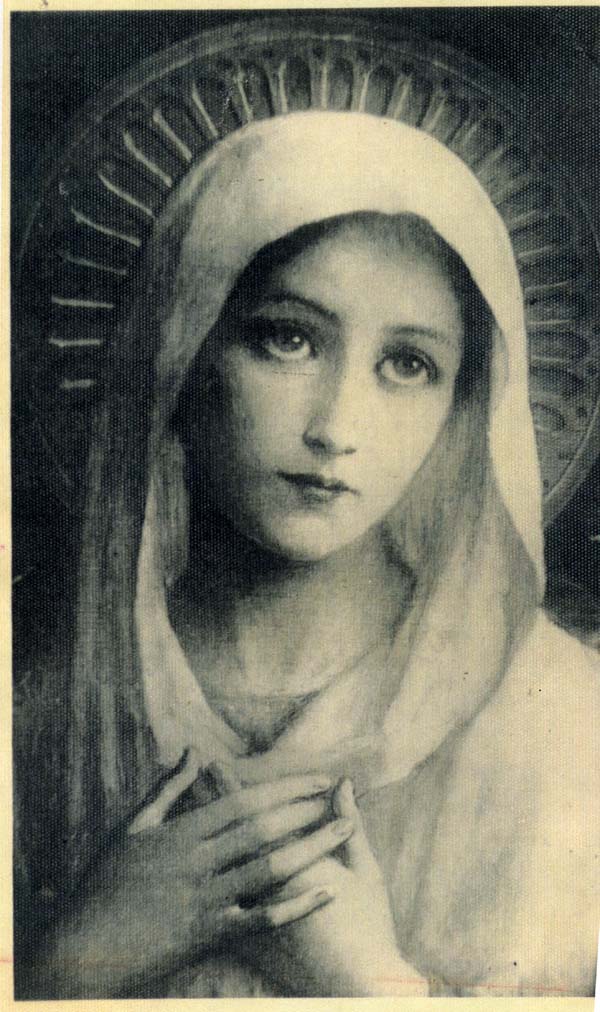
Ah Eliza10 - alas I am not an art revisionist, I am a realist; Mary was not white, “fluffy”, dressed in riches or had a halo over or around her head, she was simply a young Jewish girl: strong, thin, poor and simple. Although if I had to chose, I’d select Carucci’s Visitation (the second painting in last post)…
Ah, yes, i see what you mean. There is much beauty in the paintings but something always lacks. Like people!

I think Mary dressed simply yet very beautifully. How else would God dress his Lily? Like the woman in Proverbs 31 who bought finest purple for her family. Mary probably wove her own clothes with absolute perfection in her work, not from vanity, but because Full of Grace could not help but do all she did with perfection and love. Surely she took most excellent care of the few simple things she had, as all her work was a prayer. In fact all she had was surrounded in the light of love and holiness and perfection. All was blessed.

When you saw her you saw beauty. A visionary once asked Mary why she was so beautiful. Mary answered, “Because I love.” Yes, God is love, and the Bearer of God, who was* full *of the grace of God, certainly embodied the love of God and the peace of God, at all times in her contenance.

In the second painting in the first post I see the astonished Mary’s face has also peace and love on it. The fleshy look of Rubens is that painters style, seen also in his angel, but not how I see Mary. But the expression of that Mary - very good. In her eyes is peace and love. The Angel in both carries a lily, to honor her perfect purity.

In the first painting of that post, Mary looks down, showing us her modesty, a trait she had in perfection. Also that artist depicts a lovely femininity in Mary, which surely was perfect in her.

In the second painting of the second post that you mentioned, I like the love in both of their eyes. I think a reason why the Annunication is a moment so cherished because of the mystery of the work of the Holy Spirit in that moment.

As far as being “white”, if you mean Caucasian looking, I argue that the Jewish people do have many looks, swarthy being only one of them. In our times we take objection to a Mary looking anything but what we think of as stereotypically Jewish, with olive skin and dark hair and eyes, becasue we are very sensitive to prejudice. But we do have reports from Jesus’ time where Jesus and Mary were reported as having lighter skin, and red-gold hair, which was then and is still not unheard of for true Jews. david was a redhead, and they are usually fair. Mary was from the House of David. Just a thought. Also we have Holy Shroud evidance of Jesus’ light hari color. I commented on the looks of Jesus and Mary in another post, if you want to see it: forums.catholic-questions.org/showthread.php?t=219763 There is a link to a website with quotes from Jesus’ time about what Mary and Jesus looked like.

Also I think Mary was simple but in the most profound way. And one of course could not see a halo, as we would paint one to depict it, but one would see her and think “Full of grace!” “Holy!”, and certainly “Purity”, if one had spiritual eyes awt all. You know you have met holy people and reactred with a knowing of their holiness. It was like that with Mary, I believe.

I imagine her being thin, and strong but not from rushed heavy activity but from regular activity of the simple life. No rags though, no poverty look, just simple.

Those are my thoughts on what Mary must have looked like. I paint, and God willing someday I will paint her as I see but I do not feel up to the task now. Meanwhile I “collect” in my favortites file of the computer many pictures of Mary, none of which satisfy me enough. But all that I save have something about them that seems right, even though she be too fleshy, too dark, to frail. I thik she must have been astonishing to behold in her both frailness an strength. Some perfect combination of those.

Here is another from my collection - the tenderness in her face from the close and constant contemplation of Perfect Love! :

 
. . . CONTINUED from Tertullian

“One Lord God does [the Church] acknowledge, the Creator of the universe, and Christ Jesus (born) of the virgin Mary, the Son of God the Creator; and the Ressurection of the flesh; the law and the prophets she unites in one volume with the writings of the evangelists and the apostles, from which she drinks in her faith.” (ANF: Vol. III, The Prescription Against Heretics, Chapter 36)

“I revere the fullness of His Scripture, in which He manifests to me both the Creator and the creation. In the gospel, moreover, I discover a Minister and Witness of the Creator, even His Word. But whether all things were made out of any underlying Matter, I have as yet failed anywhere to find. Where such a statement is written, Hermogenes’ shop must tell us. If it is nowhere written then let it fear the Woe which impends on all who add to or take away from the written word.” (ANF, Vol. III, Against Hermogenes, Chapter 22)

“What Scripture does not note, it denies.” (ANF, Vol. IV, On Monogamy, Chapter 4)

“Silence! Silence on such blasphemy. Let us be content with saying that Christ died, the Son of the Father; and let this suffice, because the Scriptures have told us so much. For even the apostle, to his declaration - which he makes not without feeling the weight of it - adds, “according to the Scriptures” in order that he may alleviate the harshness of the statement by the authority of the Scriptures.” (ANF: Vol. III, Against Praxeas, Chapter 3)

Hippolytus of Rome (c. 170-c. 236)

“There is, brethren, one God, the knowledge of whom we gain from the Holy Scriptures, and from no other source. For just as a man, if he wishes to be skilled in the wisdom of this world, will find himself unable to get at it in any other way than by mastering the dogmas of philosophers, so all of us who wish to practise piety will be unable to learn its practice from any other quarter than the oracles of God. Whatever things, then, the Holy Scriptures declare, at these let us took; and whatsoever things they teach, these let us learn; and as the Father wills our belief to be, let us believe; and as He wills the Son to be glorified, let us glorify Him; and as He wills the Holy Spirit to be bestowed, let us receive Him. Not according to our own will, nor according to our own mind, nor yet as using violently those things which are given by God, but even as He has chosen to teach them by the Holy Scriptures, so let us discern them.” (ANF, Vol. V. Against the Heresy of One Noetus, 9.)

GOD BLESS YOU AND KEEP YOU!
Note also Mary being born without sin is Bibilical. One only has to read the entire Bible in context.

Catholics do not need to rely only on the Bible; however, in this case it is very clear.
 
chosensinner;4120158:
I am not being sarcastic- I am being very real- and I simply care enough to provide you with just a bit of encouragement. Please do not abandon Sola Scriptura- for not only is it biblical- logical- and theologically sound; IT IS HISTORICAL.

/QUOTE]

Sola Scriptura is not bibilical, It is man’s created logic. It is man’s created theology. Lastly, it is not historic in any sense. Sola Scriptura has been proven wrong time and again on this forum. The people that support Sola Scriptura always fade off when they lose. They then start another thread and try to bring it back. If you wish to start another thread on it I would love to discuss it again.
Did you not read the abundance of material I gave you from the church fathers? Did you not see repeatedly “Scripture alone” and “Scripture only” and “from Scripture and no other source” ???

This thread is not about sola scriptura - that is true- But in speaking with my Baptist brother, it is my duty to call his attention to the historicity of the principle of Sola Scriptura.

In doing this- he may get back to the real issue, and establish a proper foundation for evaluating Roman Dogmas. Any one can get swooped up on studying after apologists who hurl non-biblical tradition at you with good logic- BUT this can only happen if you have already abandoned the Final Authority of the Holy Scriptures as being alone infallible and inerrant- and therefore fully sufficient for the Faith- as Irenaeus said- “The Holy Scriptures are the ground and pillar of our Faith.” AND as Tertullian said- “What the Scriptures do not note- they deny.”

I stand with Tertullian in this one thing- “Take away, indeed, from heretics the wisdom which they share with the heathen, and let them support their inquiries from the Scriptures alone: they will then be unable to keep their ground.”

Did you really read all that I have provided before you spoke up?
 
Chosensinner, I’ve looked at Protestant arguments about the Early Church Fathers before, trying to portray them as saying that Mary was not Immaculately Conceived, and each time I’ve seen the full quotation rather than one or two sentences, it falls apart.

In the debate you’re quoting from, Martin was throwing single line quotes at the Catholic by the bushel, without Pacwa having any chance to respond to them all.

Pacwa was encountering the same thing in the debate, as he mentioned, " …and one of the things about Bernard’s statement is that he does not deny the Immaculate Conception as it’s understood, he denied in his statement-- that you’re quoting there…if you’ll quote the rest of it– that she was immaculate before she was conceived. And St. Thomas Aquinas makes the same denial. Neither Thomas nor Bernard believed that Mary was sinless before she was conceived."

In the debate, Martin threw a bushel of one-liners in a clump, and Pacwa didn’t have them all lined up on paper with full context to refute one at a time. You have to look at the context, and whenever I’ve done that on Protestant arguments and quotations on the matter, it always unravels.

Besides, there are a lot of Early Church Fathers supporting Catholic doctrine about Mary. Some of these are the same as those supposedly supporting Sola Scriptura and rejecting the Immaculate Conception. Some are early and some in later centuries. Take these as examples:

St. Athanasius

He (Christ) took it (His body) from a pure and unstained Virgin, who had not known man. (On the Incarnation of the Word, 8; Gambero, 102)

O noble Virgin, truly you are greater than any other greatness. For who is your equal in greatness, O dwelling place of God the Word? To whom among all creatures shall I compare you, O Virgin? You are greater than them all O Covenant, clothed with purity instead of gold! You are the Ark in which is found the golden vessel containing the true manna, that is, the flesh in which divinity resides. (Homily of the Papyrus of Turin, 71, 216; Gambero, 106)

St. Ephraem

Mary and Eve, two people without guilt, two simple people, were identical. Later, however, one became the cause of our death, the other the cause of our life (Op. syr. II, 327; Ott, 201)

The Virgin Mary is a symbol of the Church, when she receives the first announcement of the gospel . . . We call the Church by the name of Mary, for she deserves a double name. (Sermo ad noct. Resurr.; Gambero, 115)

Thou and thy mother are the only ones who are totally beautiful in every respect; for in thee, O Lord, there is no spot, and in thy Mother no stain. (Nisibene Hymns, 27, v. 8; Ott, 201)

St. Cyril of Jerusalem

Pure and spotless is this birth. For where the Holy Spirit breathes, all pollution is taken away, so that the human birth of the Only-begotten from the Virgin is undefiled. (Catechetical Lectures, XII, 31-32; Gambero, 140)

St. Gregory Nazianzen

He was conceived by the Virgin, who had first been purified by the Spirit in soul and body; for, as it was fitting that childbearing should receive its share of honor, so it was necessary that virginity should receive even greater honor. (Sermon 38, 13; Gambero, 162-163)

St. Gregory of Nyssa

It was, to divulge by the manner of His Incarnation this great secret; that purity is the only complete indication of the presence of God and of His coming, and that no one can in reality secure this for himself, unless he has altogether estranged himself from the passions of the flesh. What happened in the stainless Mary when the fulness of the Godhead which was in Christ shone out through her, that happens in every soul that leads by rule the virgin life. (On Virginity, 2; NPNF 2, Vol. V, 344)

[T]he power of the Most High, through the Holy Spirit, overshadowed the human nature and was formed therein; that is to say, the portion of flesh was formed in the immaculate Virgin. (Against Apollinaris, 6; Gambero, 153)

St. Ambrose

. . . Mary, a Virgin not only undefiled but a Virgin whom grace has made inviolate, free of every stain of sin. (Commentary on Psalm 118, 22, 30; Jurgens, II, 166)

What is greater than the Mother of God? What more glorious than she whom Glory Itself chose? What more chaste than she who bore a body without contact with another body? (Virginity, II, 6; NPNF 2, Vol. X, 374)

St. Epiphanius

Mary, the holy Virgin, is truly great before God and men. For how shall we not proclaim her great, who held within her the uncontainable One, whom neither heaven nor earth can contain? (Panarion, 30, 31; Gambero, 127)

St. Jerome

‘There shall come forth a rod out of the stem of Jesse, and a flower shall grow out of his roots.’ The rod is the mother of the Lord–simple, pure, unsullied; drawing no germ of life from without but fruitful in singleness like God Himself… Set before you the blessed Mary, whose surpassing purity made her meet to be the mother of the Lord. (Letter XXII. To Eustochium, 19, 38; NPNF 2, Vol. VI, 29, 39; cf. Gambero, p. 213: “whose purity was so great that she merited to be the Mother of the Lord”)

Indeed how inferior they are, in terms of holiness, to blessed Mary, Mother of the Lord! (Contra Pelagianos, 1, 16; Gambero, 212)
 
St. Cyril of Alexandria

Hail, Mary Theotokos, Virgin-Mother, lightbearer, uncorrupt vessel . . . Hail Mary, you are the most precious creature in the whole world; hail, Mary, uncorrupt dove; hail, Mary, inextinguishable lamp; for from you was born the Sun of justice . . . Through you, every faithful soul achieves salvation. (Homily 11 at the Ecumenical Council of Ephesus; Gambero, 243, 245)

I see the assembly of the saints, all zealously gathered together, invited by the holy Mother of God, Mary, ever-virgin . . . We hail you, O Mary Mother of God, venerable treasure of the entire world, inextinguishable lamp, crown of virginity, scepter of orthodoxy, imperishable temple, container of him who cannot be contained . . . Through you, the Holy Trinity is glorified; the precious Cross is celebrated and adored throughout the world; heaven exults, the angels and archangels rejoice, the demons are put to flight, the devil, the tempter, falls from heaven, the fallen creation is brought back to paradise, all creatures trapped in idolatry come to know of the truth. (Homily IV Preached at Ephesus Against Nestorius; Gambero, 247-248)

Theodotus

“Hail, O full of grace, the Lord is with you, you are blessed” (Lk 1:28), O most beautiful and most noble among women. The Lord is with you, O all-holy one, glorious and good. The Lord is with you, O worthy of praise, O incomparable, O more than glorious, all splendor, worthy of God, worthy of all blessedness . . . spouse of God, divinely nourished treasure. To you I announce neither a conception in wickedness nor a birth in sin; instead, I bring the joy that puts an end to Eve’s sorrow. To you I proclaim neither a trying pregnancy nor a painful delivery . . . Through you, Eve’s odious condition is ended; through you, abjection has been destroyed; through you, error is dissolved; through you, sorrow is abolished; through you, condemnation has been erased. Through you, Eve has been redeemed. (On the Mother of God and the Nativity; Gambero, 271)

A virgin, innocent, spotless, free of all defect, untouched, unsullied, holy in soul and body, like a lily sprouting among thorns. (Homily VI, 11; O’Carroll, 339)

If iron, once joined to fire, immediately expels the impurities extraneous to its nature and swiftly acquires a likeness to the powerful flame that heats it, . . . how much more, in a superior way, did the Virgin burn when the divine fire (the Holy Spirit) rushed in? She was purified from earthly impurities, and from whatever might be against her nature, and was restored to her original beauty, so as to become inaccessible, untouchable, and irreconcilable to carnal things. (Homily 4, 6; Gambero, 264)

Innocent virgin, spotless, without defect, untouched, unstained, holy in body and in soul, like a lily-flower sprung among thorns, unschooled in the wickedness of Eve . . . clothed with divine grace as with a cloak . . . (Homily 6, 11; Gambero, 268)

Pope St. Leo the Great

For the uncorrupt nature of Him that was born had to guard the primal virginity of the Mother, and the infused power of the Divine Spirit had to preserve in spotlessness and holiness that sanctuary which He had chosen for Himself . . . (Sermon XXII: On the Feast of the Nativity, Part II; NPNF 2, Vol. XII)

St. Sophronius

Others before you have flourished with outstanding holiness. But to none as to you has the fullness of grace been given. None has been endowed with happiness as you, none adorned with holiness like yours, none brought to such great magnificence as yours; no one was ever possessed beforehand by purifying grace as were you . . . And this deservedly, for no one came as close to God as you did; no one was enriched with God’s gifts as you were; no one shared God’s grace as you did. (In SS Deip. Annunt. 22; O’Carroll, 329)

St. Andrew of Crete

Today humanity, in all the radiance of her immaculate nobility, receives its ancient beauty. The shame of sin had darkened the splendour and attraction of human nature; but when the Mother of the Fair One par excellence is born, this nature regains in her person its ancient privileges and is fashioned according to a perfect model truly worthy of God. . . . The reform of our nature begins today and the aged world, subjected to a wholly divine transformation, receives the first fruits of the second creation. (Homily 1 on Mary’s Nativity; O’Carroll, 180)

. . . alone wholly without stain . . . (Canon for the Conception of Anne; Graef, 152)

St. John Damascene

O most blessed loins of Joachim from which came forth a spotless seed! O glorious womb of Anne in which a most holy offspring grew. (Homily I on the Nativity of Mary; O’Carroll, 200; cf. Graef, 154; Gambero, 402)

(Graef, 154)
She is all beautiful, all near to God. For she, surpassing the cherubim, exalted beyond the seraphim, is placed near to God. (Homily on the Nativity, 9; Gambero, 403)
 
I’m sorry if some of these are repeats. They certainly are some of the earliest references.

The Ascension of Isaiah

“[T]he report concerning the child was noised abroad in Bethlehem. Some said, ‘The Virgin Mary has given birth before she was married two months.’ And many said, ‘She has not given birth; the midwife has not gone up to her, and we heard no cries of pain’” (Ascension of Isaiah 11 [A.D. 70]).

The Odes of Solomon

"So the Virgin became a mother with great mercies. And she labored and bore the Son, but without pain, because it did not occur without purpose. And she did not seek a midwife, because he caused her to give life. She bore as a strong man, with will . . . " (Odes of Solomon 19 [A.D. 80]).

Justin Martyr

“[Jesus] became man by the Virgin so that the course which was taken by disobedience in the beginning through the agency of the serpent might be also the very course by which it would be put down. Eve, a virgin and undefiled, conceived the word of the serpent and bore disobedience and death. But the Virgin Mary received faith and joy when the angel Gabriel announced to her the glad tidings that the Spirit of the Lord would come upon her and the power of the Most High would overshadow her, for which reason the Holy One being born of her is the Son of God. And she replied ‘Be it done unto me according to your word’ [Luke 1:38]” (Dialogue with Trypho the Jew 100 [A.D. 155]).

Irenaeus

“Consequently, then, Mary the Virgin is found to be obedient, saying, ‘Behold, O Lord, your handmaid; be it done to me according to your word.’ Eve, however, was disobedient, and, when yet a virgin, she did not obey. Just as she, who was then still a virgin although she had Adam for a husband—for in paradise they were both naked but were not ashamed; for, having been created only a short time, they had no understanding of the procreation of children, and it was necessary that they first come to maturity before beginning to multiply—having become disobedient, was made the cause of death for herself and for the whole human race; so also Mary, betrothed to a man but nevertheless still a virgin, being obedient, was made the cause of salvation for herself and for the whole human race. . . . Thus, the knot of Eve’s disobedience was loosed by the obedience of Mary. What the virgin Eve had bound in unbelief, the Virgin Mary loosed through faith” (Against Heresies 3:22:24 [A.D. 189]).

“The Lord then was manifestly coming to his own things, and was sustaining them by means of that creation that is supported by himself. He was making a recapitulation of that disobedience that had occurred in connection with a tree, through the obedience that was upon a tree *. Furthermore, the original deception was to be done away with—the deception by which that virgin Eve (who was already espoused to a man) was unhappily misled. That this was to be overturned was happily announced through means of the truth by the angel to the Virgin Mary (who was also [espoused] to a man). . . . So if Eve disobeyed God, yet Mary was persuaded to be obedient to God. In this way, the Virgin Mary might become the advocate of the virgin Eve. And thus, as the human race fell into bondage to death by means of a virgin, so it is rescued by a virgin. Virginal disobedience has been balanced in the opposite scale by virginal obedience. For in the same way, the sin of the first created man received amendment by the correction of the First-Begotten” (ibid., 5:19:1 [A.D. 189]).

Tertullian

“And again, lest I depart from my argumentation on the name of Adam: Why is Christ called Adam by the apostle [Paul], if as man he was not of that earthly origin? But even reason defends this conclusion, that God recovered his image and likeness by a procedure similar to that in which he had been robbed of it by the devil. It was while Eve was still a virgin that the word of the devil crept in to erect an edifice of death. Likewise through a virgin the Word of God was introduced to set up a structure of life. Thus what had been laid waste in ruin by this sex was by the same sex reestablished in salvation. Eve had believed the serpent; Mary believed Gabriel. That which the one destroyed by believing, the other, by believing, set straight” (The Flesh of Christ 17:4 [A.D. 210].

Pseudo-Melito

“If therefore it might come to pass by the power of your grace, it has appeared right to us your servants that, as you, having overcome death, do reign in glory, so you should raise up the body of your Mother and take her with you, rejoicing, into heaven. Then said the Savior [Jesus]: ‘Be it done according to your will’” (The Passing of the Virgin 16:2–17 [A.D. 300]).*
 
Ephraim the Syrian

“You alone and your Mother are more beautiful than any others, for there is no blemish in you nor any stains upon your Mother. Who of my children can compare in beauty to these?” (Nisibene Hymns 27:8 [A.D. 361]).

Ambrose of Milan

“Mary’s life should be for you a pictorial image of virginity. Her life is like a mirror reflecting the face of chastity and the form of virtue. Therein you may find a model for your own life . . . showing what to improve, what to imitate, what to hold fast to” (The Virgins 2:2:6 [A.D. 377]).

“The first thing which kindles ardor in learning is the greatness of the teacher. What is greater [to teach by example] than the Mother of God? What more glorious than she whom Glory Itself chose? What more chaste than she who bore a body without contact with another body? For why should I speak of her other virtues? She was a virgin not only in body but also in mind, who stained the sincerity of its disposition by no guile, who was humble in heart, grave in speech, prudent in mind, sparing of words, studious in reading, resting her hope not on uncertain riches, but on the prayer of the poor, intent on work, modest in discourse; wont to seek not man but God as the judge of her thoughts, to injure no one, to have goodwill towards all, to rise up before her elders, not to envy her equals, to avoid boastfulness, to follow reason, to love virtue. When did she pain her parents even by a look? When did she disagree with her neighbors? When did she despise the lowly? When did she avoid the needy?” (ibid., 2:2:7).

“Come, then, and search out your sheep, not through your servants or hired men, but do it yourself. Lift me up bodily and in the flesh, which is fallen in Adam. Lift me up not from Sarah but from Mary, a virgin not only undefiled, but a virgin whom grace had made inviolate, free of every stain of sin” (Commentary on Psalm 118:22–30 [A.D. 387]).

Augustine

“Our Lord . . . was not averse to males, for he took the form of a male, nor to females, for of a female he was born. Besides, there is a great mystery here: that just as death comes to us through a woman, life is born to us through a woman; that the devil, defeated, would be tormented by each nature, feminine and masculine, as he had taken delight in the defection of both” (Christian Combat 22:24 [A.D. 396]).

“That one woman is both mother and virgin, not in spirit only but even in body. In spirit she is mother, not of our head, who is our Savior himself—of whom all, even she herself, are rightly called children of the bridegroom—but plainly she is the mother of us who are his members, because by love she has cooperated so that the faithful, who are the members of that head, might be born in the Church. In body, indeed, she is the Mother of that very head” (Holy Virginity 6:6 [A.D. 401]).

…

“Having excepted the holy Virgin Mary, concerning whom, on account of the honor of the Lord, I wish to have absolutely no question when treating of sins—for how do we know what abundance of grace for the total overcoming of sin was conferred upon her, who merited to conceive and bear him in whom there was no sin?—so, I say, with the exception of the Virgin, if we could have gathered together all those holy men and women, when they were living here, and had asked them whether they were without sin, what do we suppose would have been their answer?” (Nature and Grace 36:42 [A.D. 415]).

Timothy of Jerusalem

“Therefore the Virgin is immortal to this day, seeing that he who had dwelt in her transported her to the regions of her assumption” (Homily on Simeon and Anna [A.D. 400]).

John the Theologian

“[T]he Lord said to his Mother, ‘Let your heart rejoice and be glad, for every favor and every gift has been given to you from my Father in heaven and from me and from the Holy Spirit. Every soul that calls upon your name shall not be ashamed, but shall find mercy and comfort and support and confidence, both in the world that now is and in that which is to come, in the presence of my Father in the heavens’” (The Falling Asleep of Mary [A.D. 400]).

“And from that time forth all knew that the spotless and precious body had been transferred to paradise” (ibid.).

Gregory of Tours

“The course of this life having been completed by blessed Mary, when now she would be called from the world, all the apostles came together from their various regions to her house. And when they had heard that she was about to be taken from the world, they kept watch together with her. And behold, the Lord Jesus came with his angels, and, taking her soul, he gave it over to the angel Michael and withdrew. At daybreak, however, the apostles took up her body on a bier and placed it in a tomb, and they guarded it, expecting the Lord to come. And behold, again the Lord stood by them; the holy body having been received, he commanded that it be taken in a cloud into paradise, where now, rejoined to the soul, [Mary’s body] rejoices with the Lord’s chosen ones and is in the enjoyment of the good of an eternity that will never end” (Eight Books of Miracles 1:4 [A.D. 584]).

“But Mary, the glorious Mother of Christ, who is believed to be a virgin both before and after she bore him, has, as we said above, been translated into paradise, amid the singing of the angelic choirs, whither the Lord preceded her” (ibid., 1:8).
 
Did you not read the abundance of material I gave you from the church fathers? Did you not see repeatedly “Scripture alone” and “Scripture only” and “from Scripture and no other source” ???

This thread is not about sola scriptura - that is true- But in speaking with my Baptist brother, it is my duty to call his attention to the historicity of the principle of Sola Scriptura.

In doing this- he may get back to the real issue, and establish a proper foundation for evaluating Roman Dogmas. Any one can get swooped up on studying after apologists who hurl non-biblical tradition at you with good logic- BUT this can only happen if you have already abandoned the Final Authority of the Holy Scriptures as being alone infallible and inerrant- and therefore fully sufficient for the Faith- as Irenaeus said- “The Holy Scriptures are the ground and pillar of our Faith.”
And as the scripture itself says, the CHURCH is the pillar of truth. These two beliefs, and the belief in Tradition’s role also as the pillar of the truth, are non-contradictory.
AND as Tertullian said- “What the Scriptures do not note- they deny.”
If the interpretation you’re settling on this statement is to be held to, then you have no chance at all of reaching heaven, because the Bible does not specifically say you will go to heaven. It says believers will, not specifically you, and if something is not made clear in the Bible it can’t be real, right?

For instance, atoms don’t exist, right? And electrons don’t exist. And Luther and all the Reformers never lived. Because they weren’t noted in the Bible.

This interpretation, Sola Scriptura, makes no sense, and it turns Tertullian’s words into nonsense if interpreted in that way.

Here’s a fuller selection of this quote, which was about marriage and monogomy.
Tertullian:
Still, God’s institution, after once for all suffering violence through Lamech, remained firm to the very end of that race. Second Lamech there arose none, in the way of being husband to two wives. What Scripture does not note, it denies. Other iniquities provoke the deluge: (iniquities) once for all avenged, whatever was their nature; not, however, “seventy-seven times,”[1] which (is the vengeance which) double marriages have deserved.
One interpretation of this is that nothing the Scripture fails to mention exists or is true. That interpretation is the Sola Scriptura interpretation that attacks Sacred Tradition and Sacred Magesterium- and even God’s ability to say anything to anybody that isn’t written in the Bible, if one thinks about it carefully. Which is why many of the early Protestants denied the validity of any private revelation, and some today still do.

A more logical interpretation, in view of the context, is that Tertullian was saying that the rising of a Second Lamech would be extremely important to the message of this passage, so its not being mentioned here equals a denial in this case. If it was interpreted as you’re suggesting, to deny the reality of anything not mentioned in the Scripture, none of us could logically exist. For you and I aren’t mentioned.
I stand with Tertullian in this one thing- “Take away, indeed, from heretics the wisdom which they share with the heathen, and let them support their inquiries from the Scriptures alone: they will then be unable to keep their ground.”
Take away from heretics the wisdom they share with the heathen, not the wisdom they share with Christians, which was their Sacred Tradition at the time of Tertullian. He believed in that Tradition, along with St. Paul before the canon was established. He was here objecting to the belief systems of the heathens, the pagan Roman Empire and Greeks, being considered valid argumentative resource by heretics (who were defined at that time, as they are at this time in the Catholic Church, as those who deviate from the doctrines taught by the Church).

His reference here to “Scriptures alone,” is not a denial of Sacred Tradition in the least. Scriptures alone here is opposed to the teachings of the heathens, not the teachings of the Early Church Fathers.
 
Here are just few quick ones that support Mary.

Origen calls her worthy of God, immaculate of the immaculate, most complete sanctity, perfect justice, neither deceived by the persuasion of the serpent, nor infected with his poisonous breathings (“Hom. i in diversa”);

Ambrose says she is incorrupt, a virgin immune through grace from every stain of sin ("Sermo xxii in Ps. cxviii);

Maximus of Turin calls her a dwelling fit for Christ, not because of her habit of body, but because of original grace (“Nom. viii de Natali Domini”);

Theodotus of Ancyra terms her a virgin innocent, without spot, void of culpability, holy in body and in soul, a lily springing among thorns, untaught the ills of Eve, nor was there any communion in her of light with darkness, and, when not yet born, she was consecrated to God (“Orat. in S. Dei Genitr.”).

In refuting Pelagius St. Augustine declares that all the just have truly known of sin “except the Holy Virgin Mary, of whom, for the honour of the Lord, I will have no question whatever where sin is concerned” (De naturâ et gratiâ 36).

it is evident and notorious that she was pure from eternity, exempt from every defect (Typicon S. Sabae);

she was formed without any stain (St. Proclus, “Laudatio in S. Dei Gen. ort.”, I, 3);

she was created in a condition more sublime and glorious than all other natures (Theodorus of Jerusalem in Mansi, XII, 1140);

when the Virgin Mother of God was to be born of Anne, nature did not dare to anticipate the germ of grace, but remained devoid of fruit (John Damascene, “Hom. i in B. V. Nativ.”, ii).

St. Ephraem “Most holy Lady, Mother of God, alone most pure in soul and body, alone exceeding all perfection of purity …, alone made in thy entirety the home of all the graces of the Most Holy Spirit, and hence exceeding beyond all compare even the angelic virtues in purity and sanctity of soul and body . . . . my Lady most holy, all-pure, all-immaculate, all-stainless, all-undefiled, all-incorrupt, all-inviolate spotless robe of Him Who clothes Himself with light as with a garment . … flower unfading, purple woven by God, alone most immaculate” (“Precationes ad Deiparam” in Opp. Graec. Lat., III, 524-37).

This was from New Advent. I put it here just to give a quick rebuttal as I do not want anyone to think the early Church Father’s did not support Mary.

My original statement is that it is biblical if one reads the Bible in its entrirety and does not take individual verses out of context.
 
… The Catholic Faith and the Bible are in 100% agreement. .
Amen! But I don’t think Chosensinner will respond to that, or to any of your other questions. Because where is his good will? When he refers to “Roman Dogmas”, I say there’s a graduate from the Chick Cartoon Institute.

But thank you, Perry, for your good work proclaiming the truth here.

Its called Catholic doctrine, Chosensinner. Catholic. As in Universal. As in One, Holy, Catholic and Apostolic Church. Catholic. You know it, but prefer instead to name it “Roman”, on this Catholic forum. Its cheeky. Your good will is missing.
… I was a Protestant. I know the falseness of Protestant teaching very well. It is a man made theology. .
Amen to that, too.

…http://bi.gazeta.pl/im/7/2617/m2617477.jpg
 
And as the scripture itself says, the CHURCH is the pillar of truth. These two beliefs, and the belief in Tradition’s role also as the pillar of the truth, are non-contradictory.

For instance, atoms don’t exist, right? And electrons don’t exist. And Luther and all the Reformers never lived. Because they weren’t noted in the Bible.

This interpretation, Sola Scriptura, makes no sense, and it turns Tertullian’s words into nonsense if interpreted in that way.

Here’s a fuller selection of this quote, which was about marriage and monogomy.

His reference here to “Scriptures alone,” is not a denial of Sacred Tradition in the least. Scriptures alone here is opposed to the teachings of the heathens, not the teachings of the Early Church Fathers.
THE CHURCH IS THE PILLAR OF WHAT- the Truth.

Yes and what is the design of a Pillar? Obviously to hold something up- right? Well if the Church is the pillar of the truth- then we ask : what is the truth? Jesus answers this question in John 17- “Thy word is truth.”

So why do Catholics not simply hold up the word of God? Why all the inventions?

ATOMS OBVIOUSLY EXIST-

The Bible teaches that God created all things- so if I find out that there are such things as atoms- then I know God created them too. Here is the point- The Bible does not contain everything that is true- but everything the Bible contains is true. And The written word is fully sufficient for sinners to receive eternal life- and be saved. This is biblical- and cannot be argued.

INTERPRETING THE FATHERS ARE WE???

I understand that this reference was given to prove that if these heathens teach that which the scriptures do not teach, and are in conflict with- those teachings are to be rejected.

However- DO you suppose that he is setting a double standard?

Is this a rule for the heathen only- or for the Church of the Living God as well? Obviously it applies to us as well- even and especially today.

Honestly- I am not interested in “interpreting” the fathers as if they are infallible- they are not. But even if they were- like your Pope who speaks from the chair- WE would still need an infallible interpreter to properly interpret the infallible interpreter. There is much to much nonsense and disagreement even as to what the Canons of Trent are actually saying- for me to consider relying upon your teaching magisterium. I have the word of God- and the Spirit of God is my witness.

And so I simply gave you sufficient evidence that the fathers would stand on scripture alone as the determiner of any dogmas whatsoever. These fathers as well as I are fallible- and so I - with them- would point all men to the Scriptures. This is the only safe and respectable way to go about evaluating whether a particular practice honors God or not.
 
Hey there Chosen - Why don’t you save it for a more meaningful thread where your fire will do some “good.” The OP was asking a question you obviously don’t have the answer for so why waste your words?

Peace,

Gail
 
…scripture alone as the determiner of any dogmas whatsoever…
Wow, if you want to argue Scripture Alone there are a plethera of threads on that subject here on the forum. Jump on in. Do a search. Also you will find lots on Once Saved Always Saved. But since Thom is a regular Mass attendee, I think he has moved well beyond the Protestant arguments you present here, and is asking the deeper questions now.

I wonder what your reaction would be to reading Scott and Kimberly Hahn’s Rome Sweet Home. Certainly the title would have no appeal to you. If you are a truth-seeker like him, you might find it rather shocking. He also once hung all his faith on those extra-biblical Protestant dogmas of Solo Scriptura and OSAS.

Botticelli’s Augustine:
…http://feastofsaints.com/augustine.jpg
 
Amen! But I don’t think Chosensinner will respond to that, or to any of your other questions. Because where is his good will? When he refers to “Roman Dogmas”, I say there’s a graduate from the Chick Cartoon Institute.

But thank you, Perry, for your good work proclaiming the truth here.

Its called Catholic doctrine, Chosensinner. Catholic. As in Universal. As in One, Holy, Catholic and Apostolic Church. Catholic. You know it, but prefer instead to name it “Roman”, on this Catholic forum. Its cheeky. Your good will is missing.

Amen to that, too.

…http://bi.gazeta.pl/im/7/2617/m2617477.jpg
Sorry to offend you guys- but I am Catholic- for my faith is the universal faith of all the true church. You are Roman Catholic- that is- a contaminated portion of the Church stuck in idolatry. If we cannot be honest with eachother- then why are we here?

If I would love you truly- I must tell you the truth. And so why attack my “good will” and be the judge of my motives? You are misled by the hardness of your own heart.

The truth is this- I am doing what God would have me do- speak according to the Truth of His gospel- seeking to please God and not men- honoring Jesus Christ alone- no popes and those who would usurp his authority.

Dont get mad- just keep it real. Let’s get down to business.

You have something from the Bible that you want to discuss?

Do it. I am here for you. But don’t play games and throw out personal attacks and falsley judge motives.

It takes more love than you realize to do what I am doing.
 
Wow, if you want to argue Scripture Alone there are a plethera of threads on that subject here on the forum. Jump on in. Do a search. Also you will find lots on Once Saved Always Saved. But since Thom is a regular Mass attendee, I think he has moved well beyond the Protestant arguments you present here, and is asking the deeper questions now.

I wonder what your reaction would be to reading Scott and Kimberly Hahn’s Rome Sweet Home. Certainly the title would have no appeal to you. If you are a truth-seeker like him, you might find it rather shocking. He also once hung all his faith on those extra-biblical Protestant dogmas of Solo Scriptura and OSAS.

Botticelli’s Augustine:
…http://feastofsaints.com/augustine.jpg
Actually I already read Rome sweet home- and I read Karl Keatings book, Catholics and Fundamentalist. I also watch EWTN and pray for those people on The Journey Home- they have been decieved. I like Mitch Pacwa- he is a nice man- though he is lost in Rome. Believe me- I have done my fair share of research- and I did not wish to start a debate on Sola Scriptura-I was simply reminding our Baptist friend to get back to the foundation of the faith- Jesus Christ and His word.
 
Status
Not open for further replies.
Back
Top