Titus description of St. Paul: flattering or insulting?

  • Thread starter Thread starter minichibi
  • Start date Start date
Status
Not open for further replies.
M

minichibi

Guest
In the Acts of Paul, Titus describes Paul as “a man little of stature, thin-haired upon the head, crooked in the legs, of good state of body, with eyebrows joining, and nose somewhat hooked, full of grace: for sometimes he appeared like a man, and sometimes he had the face of an angel”. Is that flattering? Insulting? It is a weird description for sure… 😊
 
In the Acts of Paul, Titus describes Paul as “a man little of stature, thin-haired upon the head, crooked in the legs, of good state of body, with eyebrows joining, and nose somewhat hooked, full of grace: for sometimes he appeared like a man, and sometimes he had the face of an angel”. Is that flattering? Insulting? It is a weird description for sure… 😊
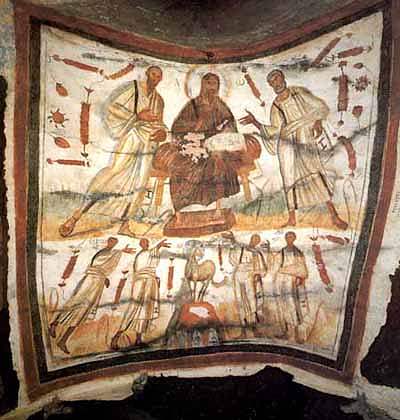
Not exactly directly related to this, but I’d also like to point out the portrayals of Peter and Paul in early Christian art are so consistent (Peter is almost always this bearded man with the full head of hair, while Paul is this balding guy with a long-ish pointy beard) that they may well be historically grounded. From the Old Catholic Encyclopedia:

With the exception of St. Peter and St. Paul, according to Wilpert, the Apostles show no specially individualistic traits, some are portrayed with beard, some without, but merely for the sake of variety. The two chief Apostles, on the other hand, are always easily recognized and are of marked individuality. St. Peter appears as a man of great energy, with a short, thick beard, and close cut, curly hair, which in the earlier frescoes is partly, in the later wholly, gray. St. Paul is represented as the Apostle of intellect, bald, and with long, pointed beard, dark brown in colour. With slight changes this type of the two Apostles was always represented in cemeterial frescoes, mosaics, and sculptured sarcophagi, and in fact persists to the present day. Indeed so familiar were Roman Christians with the conventional appearances of their favourite Apostles that, save in a few cases, the artists never thought it necessary to inscribe their names underneath their pictures, even when represented with other saints whose names are given. From this persistence of type Wilpert regards it as probable that, if the Romans did not actually possess portraits of Sts. Peter and Paul, at least a tradition existed as to their general appearance, and that catacomb representations of them conform to this tradition. The historian Eusebius informs us that he had heard of “likenesses of the Apostles Peter and Paul” as well as of Our Lord, being preserved in paintings (Church History VII.16).

(Please Note: This uploaded content is no longer available.)


http://gbgm-umc.org/umw/corinthians/images/peterpaul.jpg

(Please Note: This uploaded content is no longer available.)

Recently the State Bureau of Investigations (Landeskriminalamt) of North Rhine-Westphalia attempted to reconstruct how Paul might have looked like based on this and other possible data, and this is what they came up with:

http://www.welcometohosanna.com/PAU...ulImages/PaulusTarsus_Face_reconstruction.jpg

The eyebrows don’t join though. 😛
 
As for the descriptions of Paul in the Acts of Paul, I’d say that they are “flattering,” if rather stereotypical. The hooked nose and the meeting eyebrows were signs of manliness (Herakles for instance is sometimes described as having a hooked nose); short people get things done (there was an ancient stereotype that tall people are slow and clumsy - which is why generals and emperors could be described as being “short”); crooked legs pointed to resoluteness and fearlessness. Otho (one of the four emperors during the chaos after Nero’s death) for instance was described as being “of medium height, bow-legged, and with splay feet but almost as fastidious about appearance as a woman …. and a well-made toupee covered his practically bald head.” Suetonius describes Augustus Octavian as follows:

In person he was handsome and graceful, through every period of his life. But he was negligent in his dress; and so careless about dressing his hair, that he usually had it done in great haste, by several barbers at a time. His beard he sometimes clipped, and sometimes shaved; and either read or wrote during the operation. His countenance, either when discoursing or silent, was so calm and serene, that a Gaul of the first rank declared amongst his friends, that he was so softened by it, as to be restrained from throwing him down a precipice, in his passage over the Alps, when he had been admitted to approach him, under pretence of conferring with him. His eyes were bright and piercing; and he was willing it should be thought that there was something of a divine vigour in them. He was likewise not a little pleased to see people, upon his looking steadfastly at them, lower their countenances, as if the sun shone in their eyes. But in his old age, he saw very imperfectly with his left eye. His teeth were thin set, small and scaly, his hair a little curled, and inclining to a yellow colour. His eye-brows met; his ears were small, and he had an aquiline nose. His complexion was betwixt brown and fair; his stature but low; though Julius Marathus, his freedman, says he was five feet and nine inches in height. This, however, was so much concealed by the just proportion of his limbs, that it was only perceivable upon comparison with some taller person standing by him.

 
As for the descriptions of Paul in the Acts of Paul, I’d say that they are “flattering,” if rather stereotypical. The hooked nose and the meeting eyebrows were signs of manliness (Herakles for instance is sometimes described as having a hooked nose); short people get things done (there was an ancient stereotype that tall people are slow and clumsy - which is why generals and emperors could be described as being “short”); crooked legs pointed to resoluteness and fearlessness. Otho (one of the four emperors during the chaos after Nero’s death) for instance was described as being “of medium height, bow-legged, and with splay feet but almost as fastidious about appearance as a woman …. and a well-made toupee covered his practically bald head.” Suetonius describes Augustus Octavian as follows:

In person he was handsome and graceful, through every period of his life. But he was negligent in his dress; and so careless about dressing his hair, that he usually had it done in great haste, by several barbers at a time. His beard he sometimes clipped, and sometimes shaved; and either read or wrote during the operation. His countenance, either when discoursing or silent, was so calm and serene, that a Gaul of the first rank declared amongst his friends, that he was so softened by it, as to be restrained from throwing him down a precipice, in his passage over the Alps, when he had been admitted to approach him, under pretence of conferring with him. His eyes were bright and piercing; and he was willing it should be thought that there was something of a divine vigour in them. He was likewise not a little pleased to see people, upon his looking steadfastly at them, lower their countenances, as if the sun shone in their eyes. But in his old age, he saw very imperfectly with his left eye. His teeth were thin set, small and scaly, his hair a little curled, and inclining to a yellow colour. His eye-brows met; his ears were small, and he had an aquiline nose. His complexion was betwixt brown and fair; his stature but low; though Julius Marathus, his freedman, says he was five feet and nine inches in height. This, however, was so much concealed by the just proportion of his limbs, that it was only perceivable upon comparison with some taller person standing by him.
Totally opposite to our modern “standards”… 😊

Ennio Fantastichini and Johannes Brandrup certainly aren’t a good representation of Peter and Paul. 😉 But I have to admit I enjoyed the movie.😊
 
Thanks for all the good information, as usual, Patrick.
 
In the Acts of Paul, Titus describes Paul as “a man little of stature, thin-haired upon the head, crooked in the legs, of good state of body, with eyebrows joining, and nose somewhat hooked, full of grace: for sometimes he appeared like a man, and sometimes he had the face of an angel”. Is that flattering? Insulting? It is a weird description for sure… 😊
Why does it have to be either? He is attempting to be accurate, I think.
 
Ditto² 👍

You know what would be interesting? A movie based on the apocryphal Acts of the Apostles 😃
Is there anything like that out there? 🙂
The Acts of Philip would render a big epic! 😃
 
Why does it have to be either? He is attempting to be accurate, I think.
I don’t know about ‘accurate’, since it’s really mostly a list of stock positive attributes (aside from the thinning hair I guess ;)). In modern parlance, it would be very much like claiming that Paul was a charming, fit six-footer with toned abs, large biceps and good bone structure. 😃
 
I don’t know about ‘accurate’, since it’s really mostly a list of stock positive attributes (aside from the thinning hair I guess ;)). In modern parlance, it would be very much like claiming that Paul was a charming, fit six-footer with toned abs, large biceps and good bone structure. 😃
It would be funny if someone made a biography of Paul using “modern” standards of positive attributes to describe his real attributes, just imagine the contrast… 😊
 
Ditto² 👍

You know what would be interesting? A movie based on the apocryphal Acts of the Apostles 😃
Is there anything like that out there? 🙂
The Acts of Philip would render a big epic! 😃
I don’t know; I pretty much consider many modern works like Ben-Hur or Quo Vadis or the Close to Jesus series to be the modern-day equivalents to this type of apocryphal literature, so I’d probably consider them as good candidates. 😃
 
I think it might interest you to know BTW that this description of Paul might be the genesis of the purported description of Jesus from Josephus.

There was a quote attributed to St. Andrew of Crete which goes like this. “But moreover the Jew Josephus in like manner narrates that the Lord was seen having meeting eyebrows, goodly eyes, long-faced, crooked (epikyphos), well-grown.” (There is the “meeting eyebrows” attribute again!) What is bemusing however is that despite Andrew’s attribution, it does not appear in any manuscript of Josephus known to us; nor would Josephus have plausibly made such a remark, who almost never gives physical descriptions of people, only doing so when the information is essential to his story.

For the record, this apocryphal quotation from Josephus reminds me of the non-actor (Enrique Irazoqui) who played Jesus in Pier Paolo Pasolini’s Il Vangelo secondo Matteo. 😃

http://www.2012movies.co.uk/wp-content/uploads/2012/03/matthew-290x290.jpg

Anyways, this description of Jesus as “crooked” was interpreted by a few people to mean that Jesus may have been hunchbacked a la Quasimodo. Robert Eisler, in his work The Messiah Jesus and John the Baptist according to Flavius Josephus (extract here), decided to flesh this supposed quote out by reconstructing how the passage may have looked like if written by Josephus. Some unfortunately took it at face value and since then, you now hear the idea that ‘Josephus (explicitly) describes Jesus as a hunchback’ now and again. Here is the Eisler quote in question as it is commonly presented:

Both his nature and his form were human: for he was a man of simple appearance, mature age, short growth, three cubits tall [about 4 and a half feet, based on the Jewish cubit], with scanty hair, but having a line in the middle of the head after the fashion of the Naziraeans, eyebrows meeting above the nose so that the spectators could take fright, with a long face, a long nose, and with an undeveloped beard, dark skin, and hunchbacked.

The most interesting thing about this is how the meeting eyebrows is now something negative, something “spectators could take fright.” Same goes for the rather negative tone of Jesus’ supposed physical characteristics.
 
Status
Not open for further replies.
Back
Top