Trudging through Mark's Gospel

  • Thread starter Thread starter patrick457
  • Start date Start date
Status
Not open for further replies.
P

patrick457

Guest
This is, admittedly, the second of two threads which I devote to the Gospel of Mark. Whereas the first one is more a sort of word-by-word commentary drawn from diverse and manifold sources (to put it in a fancy manner; in simple words: I ‘stole’ a lot from what I read :D), I intend this one to be more of an informal set of impressions and reflections of what I read, with a little of other stuff mixed in. And even then, please don’t expect much of the spiritual and theological: while I expect there would be times when both would show up, this thread is more oriented towards a literal, historical and literary reading of Mark. Not exactly the best way to approach the Text, but I feel that that’s all I can write now.

I don’t know whether this thread will suffer the same fate as most of my other threads (being abandoned midway), but I’ll try to keep this as long as I still have the motivation to write. Of course, what I mentioned above is not set in stone: the direction and orientation might change as time progresses.
 
Patrick I have enjoyed reading your posts and have just read Mark very recently so I am looking forward to this discussion. God bless.
 
Without further ado:

http://www.westernorthodox.com/stmark/images/stmarklion

**BEGINNING OF THE GOOD-NEWS OF JESUS CHRIST, [SON OF GOD]**As it is written in Isaiah the prophet:

Behold! I send my messenger before your face,
Who shall make ready your way.
A voice shouting in the wastelands:
“Prepare the way of the Lord,
straight make his paths.
”​

Mark’s Gospel begins with a proclamation of it being the euangelion, or ‘good-news’ (we get the term gospel from Old English godspel ‘good news’). Is it the good news of Jesus, or about Jesus, or both? Or is Jesus* Himself* the good news, as some exegetes have proposed?

Much has been made of the absence of the term yiou [tou] Theou “Son of God” from early manuscripts of Mark (more in-depth information here about verses 1-3 in particular). It is still debated as to whether the phrase was present in the original autograph of Mark. But original or not, the theme of Jesus being “Son of God” indeed runs strong throughout the Gospel, as we would see later.

As is often noted, the terms euangelion and son of God was drenched in meaning in a Roman political context of the time: it denoted a message predicated on an action accomplished by the ‘divine’ Caesar or a proclamation connected to him. An inscription triumphantly proclaims the birth of Augustus Octavian in very lofty, exalted language:

Since providence, which has ordered all things of our life and is very much interested in our life, has ordered things in sending Augustus, whom she filled with virtue for the benefit of men, sending him as a savior both for us and for those after us, him who would end war and order all things, and since Caesar by his appearance surpassed the hopes of all those who received the good tidings, not only those who were benefactors before him, but even the hope among those who will be left afterward, and the birthday of the god was for the world the beginning of the good tidings (euangelion) through him; and Asia resolved it in Smyrna.

When Julius Caesar was formally deified as Divus Iulius ‘divine Julius’ in 42 BC, Octavian henceforth became divi filius (“son of [a] god”), a title which would prominently be used by the latter as a convenient tool to advance his political position and which would be emblazoned on his coins and that of his successors, thus ensuring its widespread publicity.

http://www.utexas.edu/courses/ancientfilmCC304/lecture23/images/18octavian.jpg

In the ancient world, politics and religion were in many ways intertwined, any ideas about a separation of Religion and State being long far off into the future. By writing about the euangelion of Jesus the ‘son of God’, it seems that Mark at once taps into Jewish tradition where figures such as the beloved righteous and the leaders of the people are ‘sons of God’, ‘anointed’ and chosen by the Lord (cf. Psalm 2:7 “Thou art my son, this day have I begotten thee”), while at the same time providing a sharp contrast between Caesar the emperor and Jesus the Christ, with an attack against the former: by radically proclaiming Jesus as the ‘real deal’, he makes it clear that the Caesar wasn’t.

The quote is attributed to ‘Isaiah’ in the Alexandrian text-type, but in reality the quote is an amalgam of Isaiah and Malachi, with a little from Exodus thrown in (Exodus 23:20a; Isaiah 40:3; Malachi 3:1). The anti-Christian philosopher Porphyry in the 3rd century in fact sneered at this supposed ‘error’, as do some people today. For the record, a variant reading in the Byzantine text attributes it meanwhile to the more general ‘the prophets’, while yet another reading attributes it to Malachi!

For the record, this page attempts to address this attribution. To quote in part:

In Matt. 27:9-10, more than one prophet is cited in a quote; yet only one is mentioned by name. In 2 Chron. 36:21, the first part of the verse is drawn from Lev. 26:34-35, the second is from Jer. 25:12, yet only Jeremiah is listed.

What does this tell us? That it was an accepted practice to list the prophet who was making the main point. Composite attributions suit a common practice of Jewish exegetes. Z. H. Chages in The Student’s Guide to the Talmud [172ff] relates a practice of the rabbis of quoting various persons under one and the same name. The rabbis “adopted as one of their methods that of calling different personages by one and the same name if they found them akin in any feature of their characters or activities or if they found a similarity between any of their actions.”

Thus for example Malachi and Ezra are said to be the “same person” (Meg. 15a) because they both say similar things (Mal. 2:2, Ez. 10:2). Chages gives examples of as many as three people being treated as one person because of such similarities.

 
Mark’s Gospel begins with a proclamation of it being the euangelion, or ‘good-news’ (we get the term gospel from Old English godspel ‘good news’). Is it the good news of Jesus, or about Jesus, or both? Or is Jesus* Himself* the good news, as some exegetes have proposed?
subjective/objective genitives…
found this note in the NET bible:

The beginning of the gospel of Jesus Christ 2, the Son of God.

2 tn The genitive in the phrase τοῦ εὐαγγελίου ᾽Ιησοῦ Χριστοῦ (tou euangeliou Iesou Christou, “the gospel of Jesus Christ”) could be translated as either a subjective genitive (“the gospel which Jesus brings [or proclaims]”) or an objective genitive (“the gospel about Jesus Christ”). Either is grammatically possible. This is possibly an instance of a plenary genitive (see ExSyn 119–21; M. Zerwick, Biblical Greek, §§36–39). If so, an interplay between the two concepts is intended: The gospel which Jesus proclaims is in fact the gospel about himself.

whether a genitive is obj/subj is an issue in NT
like Rev 1.1 “The revelation of Jesus Christ…” is it about Jesus or from Jesus…
many think its plenary, ie, both.


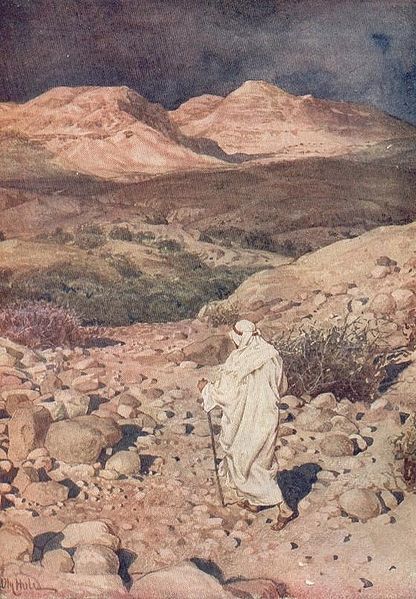
John the Baptizer appeared in the wasteland, preaching a baptism of repentance to remission of sins, and going out to him were the whole country of Judaea and all the Jerusalemites, and they were being baptized by him in the river Jordan, confessing their sins, and John was clothed with camel’s hair and a belt of leather around his waist, and was eating locusts and honey of the field, and was preaching, saying, “He comes – one mightier than I – after me, of whom I am not worthy, having bent down, to loosen the strap of his sandals! I baptized you with water, but he will baptize you with the Holy Spirit.”

And it came to be in those days, Jesus came from Nazaret of the Galilee, and was baptized in the Jordan by John; and immediately coming up from the water, he saw the heavens tearing apart and the Spirit like a dove descending on him; and a voice [came] from the heavens: “You are my son, the beloved! In you I take delight.” And immediately the Spirit drives him out into the wasteland, and he was in the wasteland forty days being tested by Satan and was with the wild animals, and the angels were ministering to him.

And after John had been handed over, Jesus came into the Galilee, preaching the good-news of [the kingdom of] God, [and saying] that the time is filled up and the kingdom of God is drawing near – “Repent, and believe in the good-news!”

An attempt has been made to capture how the text runs in the original Greek: the commencement of Jesus’ adult ministry is narrated in not too many words, with the speed of a NASCAR racer. Mark appropriately begins his gospel with the forerunner: thus we first ‘meet’ John even before Jesus actually makes an appearance.

The narrator cleverly uses the same words to describe Jesus and John, thus highlighting the parallel between the two: both John and Jesus “preach” (kerysso), are “handed over” (paradidomi), and eventually killed. So even before we get to Holy Week, we now have a subtle foreshadowing to Jesus’ fate.

Some commentators believe that chiastic structures underlie Mark’s narrative. (A chiasmus is a figure of speech in which two or more clauses are related to each other through a reversal of structures in order to make a larger point; the application of the concept of chiasmus on a higher level, applied to motifs, turns of phrase, or whole passages, meanwhile, is called chiastic structure.) This passage also seems to be a similar case. According to one proposal, from Decoding Mark (2003) by John Dart:

A (1:1-6): Messenger/message. Beginning of the good-news of Jesus Christ [son of God]…I send my messenger** (angelos) before your face…prepare the way of the Lord…John the Baptizer appeared in the wasteland, proclaiming a baptism of repentance to remission of sins…John was clothed with camel’s hair…and was eating locusts.
B (1:7-9a): Recognition. “He comes – one mightier than I…I baptized you with water, but he will baptize you with the Holy Spirit.”
C (9b): Jesus came from Nazaret of the Galilee
D (9c): and was baptized
C’ (9d): in the Jordan by John​
B’ (1:10-11): Recognition. coming up from the water, he saw the heavens tearing apart and the Spirit like a dove descending on him…“You are my son, the beloved!”​
A’ (1:12-14): Messenger/message. The Spirit drives him out into the wasteland, and he was in the wasteland forty days being tested by Satan and was with the wild animals, and the angels (angelos) were ministering to him. And after John had been handed over, Jesus came into the Galilee, preaching the good-news of [the kingdom of] God.​
 
In the Gospel, the very first character in the story we meet is John the Baptizer, a mysterious preacher who “appears” in the deserts of Judaea. The euangelion of Jesus as Mark understands it then begins with him, connected in the tradition with the prophet Elijah, who is foretold by Malachi (4:5-6) to come before the “great and terrible day of Yhwh.” (Is it any wonder that Mark chooses to merge Isaiah with Malachi?) Mark describes John as wearing clothing made out of camel hair and leather, similar to the garments Elijah wore (2 Kings 1:8). Also, like Elijah, John apparently pops up abruptly into the narrative with no fanfare - he is simply just ‘there’ (cf. 1 Kings 17:1).

As is mentioned earlier, the role of John as forerunner is such that Mark even carefully chooses the same set of words for John and Jesus, as if to highlight the connection between the two: kerysso and paradidomi. In the gospel the appointed fate of Elijah-John is the very same pattern that prefigures Jesus’ own doom - and it is also this fate that Jesus teaches His disciples to accept.
 
http://www.biblestudy.org/question/picture-of-jordan-river-where-john-the-baptist-baptized.jpg

The narrator notes that John preaches a ‘baptism’. Johannine baptism seems to derive from the Jewish custom of ritual immersion. Full-body ritual washing (tevilah), usually done by immersing oneself on a pool of water known as a miqveh, is performed mainly for ritual purification and had many applications: you would immerse yourself if you had become ritually impure due to bodily fluids or contact with unclean persons, animals or objects. Priests, because of the need for them to be pure on a daily basis, took ritual baths frequently. The Pharisees too stressed the need for all Jews, not just priests, to be pure, as part of their “kingdom of priests and a holy nation” mentality, and so encouraged tevilah. The community in Qumran, who emphasized ritual purity as the most critical way to pursue a holy life and to prepare for the eschatological battle between the Sons of Light (them) and the Sons of Darkness (everyone else), performed numerous immersions over the space of a single day. Pilgrims to the Temple in Jerusalem first bathed before going inside the sacred precincts. Workers who made wine and olive oil would have also needed to bathe in order to make ritually pure products for discriminating consumers.

Such was the importance of ritual immersion that miqvaoth dating from the time of Jesus were found all over villages in the Holy Land: in Jerusalem alone, 48 pools were found in the Temple Mount excavations alone, with many others in the Upper City. It was literally everywhere in 1st century Judaism. So what was it that made John’s baptism different?

The narrative goes on to state that John was “preaching a baptism of repentance to remission of sins.” The Jewish historian Josephus writes of John in the context of the latter’s death (cf. Antiquities 18.5.2 116-119):

[John] was a good man and had urged the Jews to exert themselves to virtue, both as to justice toward one another and reverence towards God, and having done so join together in washing. For immersion in water, it was clear to him, could not be used for the forgiveness of sins, but as a sanctification of the body, and only if the soul was already thoroughly purified by right actions.
 
Patrick, I recently put together a harmony and comparison of the Gospels in which the Gospel of Mark is broken down with the other Gospels and compared with them. It may be a helpful tool for your project. It is in the Aquinas Study Bible.
 
http://www.biblestudy.org/question/picture-of-jordan-river-where-john-the-baptist-baptized.jpg

The narrator notes that John preaches a ‘baptism’. Johannine baptism seems to derive from the Jewish custom of ritual immersion. Full-body ritual washing (tevilah), usually done by immersing oneself on a pool of water known as a miqveh, is performed mainly for ritual purification and had many applications: you would immerse yourself if you had become ritually impure due to bodily fluids or contact with unclean persons, animals or objects. Priests, because of the need for them to be pure on a daily basis, took ritual baths frequently. The Pharisees too stressed the need for all Jews, not just priests, to be pure, as part of their “kingdom of priests and a holy nation” mentality, and so encouraged tevilah. The community in Qumran, who emphasized ritual purity as the most critical way to pursue a holy life and to prepare for the eschatological battle between the Sons of Light (them) and the Sons of Darkness (everyone else), performed numerous immersions over the space of a single day. Pilgrims to the Temple in Jerusalem first bathed before going inside the sacred precincts. Workers who made wine and olive oil would have also needed to bathe in order to make ritually pure products for discriminating consumers.

Such was the importance of ritual immersion that miqvaoth dating from the time of Jesus were found all over villages in the Holy Land: in Jerusalem alone, 48 pools were found in the Temple Mount excavations alone, with many others in the Upper City. It was literally everywhere in 1st century Judaism. So what was it that made John’s baptism different?

The narrative goes on to state that John was “preaching a baptism of repentance to remission of sins.” The Jewish historian Josephus writes of John in the context of the latter’s death (cf. Antiquities 18.5.2 116-119):

[John] was a good man and had urged the Jews to exert themselves to virtue, both as to justice toward one another and reverence towards God, and having done so join together in washing. For immersion in water, it was clear to him, could not be used for the forgiveness of sins, but as a sanctification of the body, and only if the soul was already thoroughly purified by right actions.
Patrick, surely you don’t trust Josephus. He is a liar and a traitor to the Jewish nation.
 
(Please Note: This uploaded content is no longer available.)

A lot of people have been puzzled over Josephus’ words. On the face of it, he seems to state a contradiction against what the Gospels relate: a baptism μὴ ἐπί τινων ἁμαρτάδων παραιτήσει χρωμένων, ἀλλ᾽ ἐφ᾽ ἁγνείᾳ τοῦ σώματος “not for the forgiveness of sins, but as a sanctification of the body.” As a result, there have been a number of explanations proposed for this seeming discrepancy: for instance, that the Gospels, rather than reporting about a repentance-baptism, should be interpreted instead as reflecting Aramaic usage that could mean repentance which brought forgiveness (inner cleanliness), which then resulted in an immersion for external bodily purity. Or that the Evangelists have simply read back the Christian understanding of baptism into John’s. Or that Josephus was simply describing John’s ummersions according to what he knew of practices by other Jewish groups, such as the Essenes. Alternatively, he was explaining John’s baptism in terms that could be palated more by his gentile readers. Or else, it was Josephus’ effort to put John’s baptism in the common Jewish understanding of cleanliness. There are other possible opinions besides this.

Personally though, I think that one could also appeal to how the ‘not…but’ construction can mean. In Jewish usage, ‘not…but’ can often mean ‘not only…but much more…’ We can see an example of this usage in the 2nd-century BC Letter of Aristeas:

The king bestowed great praise upon him and asked the tenth, What is the highest form of glory? And he said, “To honour God, and this is done not with gifts and sacrifices but with purity of soul and holy conviction, (τοῦτο δ᾿ ἐστὶν οὐ δώροις οὐδὲ θυσίαις, ἀλλὰ ψυχῆς καθαρότητι καὶ διαλήψεως ὁσίας,) since all things are fashioned and governed by God in accordance with His will. Of this purpose you are in constant possession as all men can see from your achievements in the past and in the present.”

The speaker (or rather, the author of the work) is not rejecting gifts and sacrifices; on the contrary, he approved of them. I think this could also be the case here: if Josephus was using the ‘not…but’ in a similar fashion, his words should thus be understood in this way: “not just for the forgiveness of sins, but also, moreover, as a sanctification of the body, and only if the soul was already thoroughly purified by right actions.” This is actually close to how William Whiston rendered the relevant passage: “not in order to the putting away [or the remission] of some sins [only], but for the purification of the body; supposing still that the soul was thoroughly purified beforehand by righteousness.”
 
One major difference between John’s baptismal rite and standard Jewish ritual ablutions was that the latter was generally a self-administered affair: John’s rite therefore, which makes a distinction between ‘baptizer’ and ‘baptized’, is a deliberate break with convention.

We are not entirely sure of the method in which John actually performed baptisms, and it is not certain that the mode is always the same in all situations. However, factors such as the basic meaning of the verb baptizo, the death-resurrection imagery present in later Christian baptism (Romans 6:3-5), the fact that John chose a deep and permanent river, and the Jewish custom of ritual baths may indicate immersion (cf. Mark 1:10 and parallels “and immediately coming up from the water”).

(Please Note: This uploaded content is no longer available.)

John’s garb and diet reinforces further his prophetic image. The phrase ζώνην δερματίνην περὶ τὴν ὀσφὺν αὐτοῦ “a belt of leather around his waist” is a verbatim quotation from 2 Kings 1:8, describing Elijah’s belt. The preceding phrase ἐνδεδυμένος τρίχας καμήλου, while not echoing the Septuagint of that verse, represents a likely meaning of the Hebrew אִ֚ישׁ בַּ֣עַל שֵׂעָ֔ר (“a man characterized by hair”, Greek ἀνὴρ δασὺς “a hairy man”) as one wearing a cloak of animal hair. It is therefore clear that John is presented as / intended to present himself as a prophet (cf. Zechariah 13:4-5 where “a hairy cloak” is given as a distinctive garb of a prophet), perhaps as the returning Elijah, as we have noted beforehand.

John had a rather simple diet, albeit a nutritious one. While some commentators have interpreted locusts as referring to carob beans (aka St. John’s bread) here, a literal reading is also possible, since locusts are the only type of edible insect in the Mosaic law (Leviticus 11:20-23). Even today in fact, locusts are and were eaten as a delicacy in some cultures. In Japan for example, locusts boiled in soy sauce and sugar are known as inago-tsukudani.
 
Didn’t the book of Mark inspire the Carpocratian movement in the second century?
 
Didn’t the book of Mark inspire the Carpocratian movement in the second century?
Well, according to the Mar Saba Letter (which contains purported fragments of the Secret Gospel of Mark), supposedly written by Clement of Alexandria to someone named Theodoros, the Carpocratians claimed to possess a secret variant of the Gospel. While ‘Clement’ in the letter does admit that a more ‘spiritual’ version of the Gospel exists, written by Mark for “those being perfected,” he asserts that the version promoted by the Carpocratians is a fake, a corruption of the original. To illustrate this, two short excerpts from the ‘genuine’ gospel are supplied by the author.
 
We are told that “whole country of Judaea and all the Jerusalemites” came to see John. While this is more likely a hyperbolic remark, it does indicate that John enjoyed popularity to the point that even people from afar went to him.

He did not just baptize: John, according to Mark, also preaches about ὁ ἰσχυρότερός μου “one stronger than I” that is soon to come. The choice of words here brings to mind the Parable of the Strong Man (3:27) which would appear later in the narrative. The term is not in itself very specific, though it clearly indicates superiority in some way. Whatever the case, John portrays himself as inferior, that he even considers himself not fit to be a servant.

Taking off the master’s sandals is in reality a job reserved for slaves, though interestingly the task is considered to be too low for a Jewish servant (Mekhilta on Exodus 21:2), and is specifically excluded from the otherwise menial duties of a rabbi’s disciple (b. Ket. 96a). John thus places himself below either, portraying himself as not fit to do what is too demeaning even for them.
 
Status
Not open for further replies.
Back
Top