
Two Claims on Christ's Tomb

  • Thread starter Thread starter RKS89
  • Start date Start date
Status
Not open for further replies.
Magness was referring to the argument made by both James Cameron and Simcha Jacobovici that the Talpiot tomb in Jerusalem was Jesus’ family tomb.

She’s right: Jesus was a native of Nazareth, not Jerusalem, so it would make sense that the family tomb would be in Nazareth. That is, if they - or some ancestor - had enough money to have one made (it usually cost a lot of money to commission one): she is also right in saying that many people were just buried in the ground (just like many people today).

Under normal circumstances (i.e. had Jesus lived a ‘normal’ life), He would have been buried in His native town of Nazareth, either in a family burial cave or, if they did not own one, in an earthen grave with some sort of headstone. But we know that what happened to Jesus was not ‘normal circumstances’: He died as a convicted criminal and was buried, in great hurry, by a benefactor in a donated/borrowed, yet-unused tomb that is not His or His family’s.
 
Last edited:
Do we know if a criminal’s burial would have been different? I mean, would we expect to see the body of a convicted and publicly executed criminal handled differently, or was it turned over to the family (if there were one) after? I’d not thought about the fact that Jesus would have “normally” been buried in his hometown.
 
So, just to be clear, you agree with me that based on what she’s talking about, she disagrees with Cameron and Jacobovici when they said Talpiot was Jesus and His family’s tomb, right?
 
Well, in many areas crucifixion victims were denied proper burial: they were simply left to rot on their crosses or eventually dumped into some garbage heap somewhere. That was a part of the shame of crucifixion.

But in Judaea, the Jews made (and even today, still make) a big deal about burying dead bodies, even those of total strangers. Deuteronomy 21 says:
When someone is convicted of a crime punishable by death and is executed, and you hang him on a tree, his corpse must not remain all night upon the tree; you shall bury him that same day, for anyone hung on a tree is under God’s curse. You must not defile the land that the LORD your God is giving you for possession.
It is because of this command in Deuteronomy that some think that the Jews were granted a concession from the normal practice of crucifixion. Instead, it could be more likely that in Palestine, crucified victims were allowed to be buried as soon they were dead. Unlike in other parts, leaving the bodies unburied would have been more the exception rather than the rule. The historian Josephus in one place even said that “the Jews used to take so much care of the burial of men, that they took down those that were condemned and crucified, and buried them before the going down of the sun” (War 4.317).

Craig Evans in his article Jewish Burial Traditions and the Resurrection of Jesus points out:
The Digesta [a summary of Roman law] refers to requests to take down bodies of the crucified. Josephus himself makes this request of Titus (Life 75 §420–421). Of course, Roman crucifixion often did not permit burial, request or no request. Non-burial was part of the horror—and the deterrent—of crucifixion. But crucifixion—during peacetime—just outside the walls of Jerusalem was another matter. Burial would have been expected, even demanded. The evidence thus far reviewed strongly encourages us to think that in all probability Jesus was indeed buried and that his corpse and those of the two men crucified with him would not have been left hanging overnight and perhaps indefinitely, or at most cast into a ditch or shallow grave, exposed to animals. Quite apart from any concerns with the deceased men or their families, the major concern would have had to do with the defilement of the land and the holy city. Politically, too, it seems unlikely that on the eve of Passover, a holiday that celebrates Israel’s liberation from foreign domination, Pilate would have wanted to provoke the Jewish population. Moreover, it is equally improbable that the ruling priests, who had called for Jesus’ death, would have wanted to appear completely indifferent to Jewish sensitivities, either with respect to the dead or with respect to corpse impurity and defilement of the land. It seems most probable that the priests would have raised no objections to the burial of the three men. Indeed, they probably would have arranged to have them buried, before nightfall, in tombs reserved for executed criminals.
 
‘Normally’ in the sense that had Jesus lived a ‘normal’ life He probably wouldn’t have left Nazareth or stayed far away from it. Come to think of it, had Jesus not been resurrected I think there could be a possibility that His corpse (or His bones) might have been - if Joseph didn’t just give his own tomb to His family - taken back to Nazareth, if they had a family tomb in there.
 
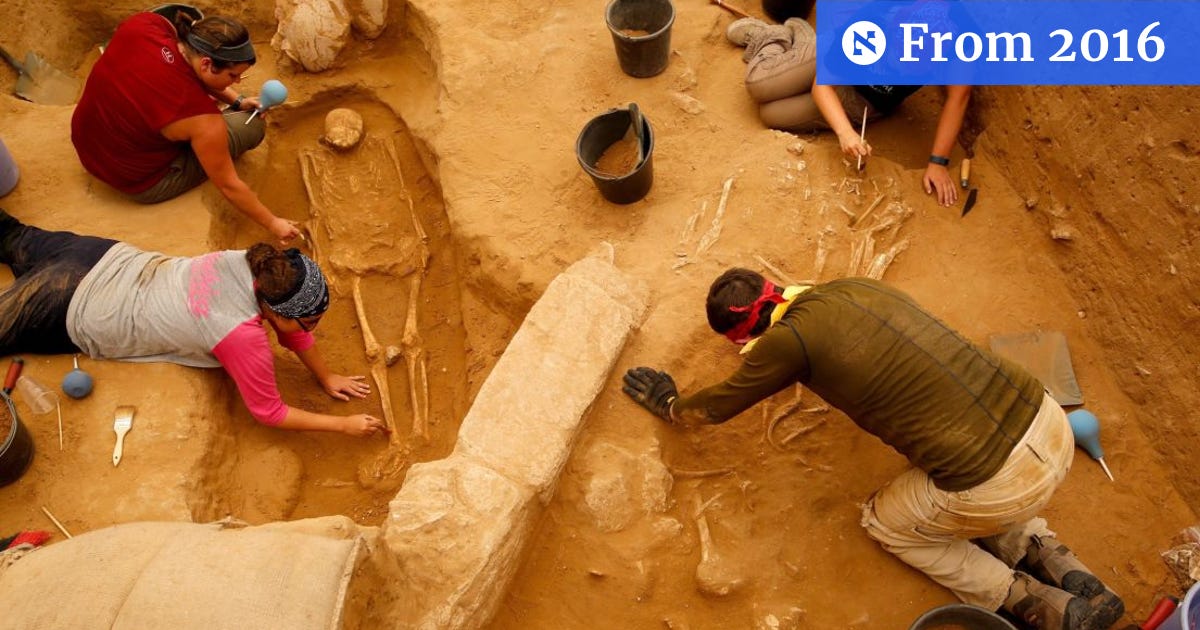
In fact, even today archaeologists working in the Holy Land face resistance from ultra-orthodox Jewish groups because they keep digging out the bones of dead people (especially if the dead involved were Jewish), which is thought to be a violation of the repose of the dead. That’s just how seriously they take these things.


https://www.haaretz.com/israel-news/old-bones-that-never-lie-1.283785

 
He seems to have put a lot of time into the subject. Very impressive!
 
That’s a good point, Boomerang … I was thinking of “freshly hewn tomb” and was caught up in jiminy crickets … wouldn’t they want to have this somewhere else …and not really looking at the land /site may have been in family for a long period of years. Thanks.
 
Weird question here, but I have OCD and the whole Talpiot tomb thing sent me into a real tailspin. The links you’re providing about archaeological digs especially the one about the one particular Jewish guy, Rabbi Yeshuah Ben Levi,(sp) in your article, Old Bones That Never Lie aren’t AT ALL about Jesus, are they? And are you positive Jesus ascended to heaven and isn’t and wasn’t in any of these graves? Not the Talpiot tomb, not any of them?
I mean, are you positive we Christians won’t get some surprise one day and learn they found Jesus?
 
Last edited:
What do you mean “ if that makes you feel better”? Are you not really positive and just trying to reassure me?
 
I am positive. Otherwise I wouldn’t be Catholic.
 
Last edited:
Weird question here, but I have OCD and the whole Talpiot tomb thing sent me into a real tailspin.
Don’t be disturbed by rumors. There will always be rumors and opinions. Pay them no mind. Just remember the words Our Lord asked St. Faustina to write down: “Jesus, I trust in you”.
 
Do we know if a criminal’s burial would have been different? I mean, would we expect to see the body of a convicted and publicly executed criminal handled differently, or was it turned over to the family (if there were one) after?
That we do know. The bodies were intentionally left on display after death. That’s exactly why Joseph needed permission from Pilate to claim the body. It’s also one of the reasons why scholars disagree on the exact details of Roman crucifixion; because almost no graves exist to be examined.
I’d not thought about the fact that Jesus would have “normally” been buried in his hometown.
We can be mostly certain that’s not the case. The Jewish custom is to bury as soon as possible. Transporting a body to Capernaum (125 miles) or Nazareth (90 miles) would have been extremely unusual.
 
Right, that was my first line of thinking. I mean even if you disagree theologically with Catholics, I just don’t see how you circumvent the fact that people have been going there an awfully long time. It’s not likely they were mistaken or forgot.

But my wife’s pastor goes well out of his way to take shots at Catholicism so I was doubtful of the claim from the getgo.
An amazing thing about the Holy Land is that the more modern archeologists actually study the land, and the more they uncover, the more the evidence actually supports the traditional sites. Which is exactly the opposite of what one would imagine.

Some people like to think that the Christians of the 4th century (Constantine’s time) just made-up these spots and put churches there.

A good example of this is the house of the High Priest. Archeologists thought it was impossible that the traditional Christian site was the real one. It made no sense. It did not fit with all the evidence they had. There was just no other explanation; it had to be the wrong site.

Then, in the late 20th century, street workers discovered a new tunnel. It went straight from the “supposed” site of the High Priest’s house to beneath the Temple. They also found buttons and bells from priestly vesture that had been lost in that tunnel.

Modern day people mistakenly think that ancient people were not as smart as we are, or not as concerned with historical accuracy—that they just found convenient sites and said “this happened here” without having any real information. In reality, it makes perfect sense to say that the earliest Christians (the ones who actually witnessed those events first-hand) remembered where those events happened, and they passed that information along to future generations until permanent structures were actually built on those same sites; becoming pretty much established by the time of Constantine & Helena in the early to mid 4th century.

The end result is that the traditional Catholic/Orthodox sites of the Holy Land are usually proved to be the true sites by modern archeological science rather than disproven.
 
Status
Not open for further replies.
Back
Top