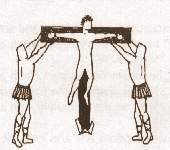
Uppercase T Cross

  • Thread starter Thread starter jakepw
  • Start date Start date
Status
Not open for further replies.
I finally tracked down the documentary in question (Simcha Jacobovici’s Biblical Conspiracies: Secrets of the Crucifixion - look it up).

They talk about the shape of the cross on the second half of the program - the first half is dedicated to the so-called Abba tomb in Jerusalem. The ‘Abba tomb’, to sum, is a 1st-century BC tomb from northern Jerusalem discovered in 1971, its claim to fame being an Aramaic inscription written in paleo-Hebrew letters (quite unusual for that time period) giving the owner’s name: “Abba son of the priest Eleazar son of Aaron the High Priest.” Abba describes how he was born in Jerusalem, but was subsequently “tortured and persecuted,” and then exiled to Babylonia. He has subsequently returned to Jerusalem bearing the remains of a certain “Mattathias son of Judah” to bring them to final burial in this cave.

In addition to the inscription, archeologists found a decorated ossuary - a limestone box containing the bones of the deceased - in a niche under the floor of the cave. Aside from (obviously) human bones, archaeologists found three nails inside the box.

Now, for a little digression.

In 63 BC, Pompey intervened in a civil war in the Hasmonean Kingdom between brothers Hyrcanus II and Aristobulus II. He conquered Judaea and appointed Hyrcanus - the weaker of the two brothers, and thus likely to be a more reliable ally - high priest (the Hasmoneans were both high priests and kings - but Hyrcanus was only given the title of high priest) with the one holding real power being Hyrcanus’ chief adviser Antipater the Idumaean (Herod’s father).

In 49 BC a civil war erupted between Pompey and Julius Caesar. At first, Hyrcanus and Antipater supported Pompey (whom they were indebted to), as most from the east did, but when it became clear that Caesar was winning, Antipater prompted Hyrcanus to switch allegiances. In gratitude for the help given to Caesar, he restored some degree of political authority to Hyrcanus II, appointing him as ethnarch of the Jews in 47 BC and Antipater procurator of Judea. A few years later, Antipater appointed his sons Phasael and Herod military governors of Jerusalem and the Galilee respectively.

When Caesar was assassinated in 44 BC, Antipater (and Hyrcanus) rooted for Cassius (one of the conspirators). But when Mark Antony and Octavian (the future Augustus) defeated both Brutus and Cassius in 42 BC, Hyrcanus, along with Antipater’s sons (Antipater was assassinated himself the year before) changed their allegiance.

This is where Mattathias/Antigonus comes in. In 40 BC, Mattathias offered money to the Parthian army to help him recapture the Hasmonean realm. He managed to taking control of Jerusalem and had himself crowned king by the Parthians. Herod managed to escape (eventually reaching Rome), but Phasael and Hyrcanus were taken prisoner. Phasael committed suicide, while Hyrcanus was disfigured - which made him ineligible to be high priest. During his reign, Antigonus was busy trying to free Judaea from Roman clutches. In the meantime, Herod ingratiated himself with Mark Antony and Octavian; he succeeded in having the Roman Senate proclaim him as ‘king of the Jews’. Now with Roman backing, Herod marched back to Palestine with Roman military help, finally taking the city in 37 BC.

And that’s basically how Herod the Great became king. What happened to Antigonus, you ask? He was captured and led to Antioch, where he was scourged, crucified and then beheaded under the orders of Mark Antony.
 
(Continued)

For some scholars, the remains at the tomb (there were actually two ossuaries, both with bones) rung a bell: especially the inscription’s reference to Abba bringing with him the remains of “Mattathias son of Judah.” Could one of these people be Mattathias Antigonus II, son of Judah Aristobulus II?

The first person to study the bones was the anthropologist Dr. Nicu Haas, from the Hebrew University of Jerusalem. (Those of you who are familiar with Jehohanan, the man with the nail stuck in his heelbone, he’s the same person who first studied the heelbone.) Dr. Haas determined that the individual was likely beheaded due to a sharp blow to the cervical vertebrae and that the individual was a male in his 30s. If this was true, then we likely do have the remains of Mattathias Antigonus II in our hands. However, a second study of the bones by Dr. Patricia Smith (who also taught in the Hebrew University Medical School) led to the conclusion that the remains which Haas identified as that of a male was actually that of an elderly female.

That being said, the theory that the bones were the Hasmonean king’s, while mostly abandoned by the majority, did not die: recently, a few people began to question Dr. Smith’s reidentification of the bones and to uphold the original proposal.

The Abba Cave, Crucifixion Nails, and the Last Hasmonean King by James Tabor (pro side)
A Jerusalem tomb, ‘blind leading the blind’ or just another Day in Paradise? by Joe Zias (con side)

What the documentary does is basically present the viewpoint that it was Mattathias Antigonus’ bones. (And this was the least questionable part of the program IMO.) In good ol’ documentary fashion it then gives some speculation along the way cleverly presented as likely facts.

One example I really liked is its attempt to link Barabbas - Bar-Abba ‘son of Abba’ - with Abba the priest, the owner of the tomb. Since the program goes with the theory that Mattathias Antigonus was buried in the Abba tomb / the “Mattathias (Mattai) son of Judah (Yehud)” refers to the Hasmonean king, the implication is that Abba must have been a Hasmonean sympathizer and an anti-Roman, which would give some credible reason for Barabbas’ (here claimed to be his son) motives. I’ll admit, this is a rather nice hypothesis, but I think they’re being too hasty with linking Abba with Barabbas. It’s not like this was the only contemporary instance of the name אבא ‘Abba’ being found: the name and variants such as אבה Abah, אבי Abai, Ἀαβαὶ Aabai or Ἀα̣β̣αεί Aabaei is attested in a handful of other artifacts.
 
I’ve heard that Jesus’ cross was most likely not a lowercase, but an uppercase T shape. Is the shape something crucial to the faith? Are both beliefs allowed? If so, why are all crucifixes in a lowercase T shape?
Yes, these things are not De Fide doctrine. One thing you might want to consider however, is that in Luke 23:38 it says "There was also an inscription over him,“This is the King of the Jews.”
 
Again, this would not totally preclude a T cross, especially if you allow for the possibility that the sign was fitted into some sort of handle. So it would be a T cross that becomes a † with the addition of the sign.
That’s really quite a contortion just to avoid having a crossed t. It doesn’t make any sense that they would go to all of that effort just so it wouldn’t be a crossed t.
 
That’s really quite a contortion just to avoid having a crossed t. It doesn’t make any sense that they would go to all of that effort just so it wouldn’t be a crossed t.
Contortion, how so? Both T and t shapes are attested in ancient sources, and both shapes do not preclude having the inscription placed ‘over’ Jesus.
 
(Continued)

But there’s a reason why the first half focuses on the Abba tomb: “If these bones belong to Antigonus, it may allow us to discover for the first time how Jesus was crucified.” More specifically, focus was given to the nails found in the tomb.

One of the arguments put forth against the nails from the Abba tomb being used for crucifixion is that they were too short. To which supporters answer that (quoting James Tabor here, invoking Prof. Israel Hershkovitz) “these nails were driven into the palm, then either angled or bent into a hook, not to hold up the body but to keep the hands and arms in place–thus “tacking” or pinning the hands to the wood behind.” In other words, it supposes that the nails were not driven through the palm and that the hands were not nailed outward in front of the wood, as in popular depictions, but rather that the nails were driven through the back of the hand, most likely like this.


From Nikolai Ge’s Crucifixion (1892). Jacobovici in the program goes like, “This (the nail being driven from the back of the hand) runs so against every image [of crucixion] I’ve ever seen.” I suppose he had never seen Ge’s artwork. 😛 (Another example where Ge depicts Jesus in the same way here.)

They then combine this data with the fact that Jehohanan - the crucified man - was nailed in his ankles to conclude that: victims of crucifixion were nailed through the back of the hand and through each ankle.


But here’s the problem with this presentation (this is admittedly where I go against the majority): it assumes that all crucifixion victims were nailed in the same spots, and that the procedures were the same for each execution, as if there was a ‘standard procedure’ Roman executioners followed when they did these things. A recent scholar who published a study of crucifixion (Crucifixion in Antiquity, focusing mainly on reports of crucifixion and related punishments in Greco-Roman literature), Dr. Gunnar Samuelsson (his homepage here), had pointed out that maybe the scholarly approach up to now have been wrong. The general scholarly approach up to now (which this documentary exemplifies) is to mishmash details from various ancient executions involving a ‘cross’ or stauros into a single process known as ‘crucifixion’. Samuelsson argues that on the contrary, there was no set process for crucifixion - in fact, he opines that there was no single punishment called ‘crucifixion’ at all, but rather a category of ‘suspension (hanging) punishments’ which happened to share some basic terminology (stauros, crux, patibulum, etc.). Therefore, we should be looking at the various ‘crucifixions’ on their own terms rather than conflate all the details into one.

In other words, even if the documentary’s claim was right, and the bones in the Abba tomb were those of Mattathias Antigonus and that the nails were proof of his crucifixion, that does not automatically mean that Jesus was crucified in exactly the same way as he was, or that the nails used for Antigonus were of the same size and shape as Jesus’. For that matter, the way Jehohanan was crucified (with nails through each ankle) may not necessarily reflect how Jesus’ legs or feet were nailed (if they were nailed) either. In other words, you can’t combine these two or three separate executions together.
 
(Continued)

And now we go to the part mikekle was talking about: the part where Simcha and Dr. Hershkovitz test their theory of how Jesus was supposedly crucified (nails driven through the back of the hand) against some actual crosses. The Abba tomb was more or less just icing on the cake. Incidentally, I felt this was the weakest part of the program. You’ll know why soon.

The experiment basically consists of volunteers being put on one of three crosses - a t cross, a T cross, and an X cross resting on a pole behind it - and checking if these cross shapes would allow for their nails-through-back-of-the-hand reconstruction. (To their credit, the T cross looks like it was built using a mortise and tenon joint. :p)


Now a word about the X cross. This cross shape was simply introduced in the program as being “mentioned by some historical sources.” I’m pretty sure folks here will be familiar with it due to its association with St. Andrew - the cross he was crucified in was supposedly of this shape. But the thing is, I don’t know of any actual ancient source from the Roman period that speaks of an X-shaped cross. The thing is, the tradition about St. Andrew being crucified on an X cross was a late, medieval one: the earliest literary sources and artworks which purportedly describe and depict Andrew’s martyrdom do not show the cross as an X, but shaped like the one traditionally ascribed to Jesus; in other words, a t.


Crucifixio Andree, if it isn’t clear enough. 😛

In fact, in the apocryphal Acts of Andrew (mid-2nd century), the cross where Andrew was hung in is heavily implied as being t-shaped. In the work, Andrew, before he was crucified, praises his cross, likening it to the one Jesus was hung on. This is what he says:

“I know thy mystery, for the which thou art set up: for thou art planted in the world to establish the things that are unstable: and the one part of thee stretcheth up toward heaven that thou mayest signify the heavenly word: and another part of thee is spread out to the right hand and the left that it may put to flight the envious and adverse power of the evil one, and gather into one the things that are scattered abroad. And another part of thee is planted in the earth, and securely set in the depth, that thou mayest join the things that are in the earth and that are under the earth unto the heavenly things.”

By the medieval period though, a belief developed of Andrew deeming himself not worthy to be hung on a cross similar to that of Jesus’; so his executioners decided to use an X-shaped cross instead. (Does this pattern seem familiar to you? Yes, this is also the same scenario you have in the tale of St. Peter’s martyrdom!) It took a long time for this idea to firmly hold root: it is only by the 14th century that St. Andrew hanging on an X-cross became universal, but even then, Caravaggio in the late 16th century can still depict Andrew hanging on a t-shaped cross, in accordance with the earlier belief. Meanwhile, there’s an earlier painting which shows Andrew hanging from a tree. (As I mentioned earlier, there were also medieval artworks which show Jesus crucified on a tree. Maybe the artist had that in mind?)

They never really explained why the X cross was resting on a pole, but that’s actually an important part of Simcha’s thesis, as we’ll learn soon.
 
(Continued)

And now we go to the part mikekle was talking about: the part where Simcha Jacobovici and Dr. Hershkovitz test their theory of how Jesus was supposedly crucified (nails driven through the back of the hand) against some actual crosses. The Abba tomb was more or less just icing on the cake. Incidentally, I felt this was the weakest part of the program. You’ll know why soon.

The experiment basically consists of volunteers being put on one of three crosses - a t cross, a T cross, and an X cross resting on a pole behind it - and checking if these cross shapes would allow for their nails-through-back-of-the-hand reconstruction. (To their credit, the T cross looks like it was built using a mortise and tenon joint. :p)


Now a word about the X cross. This cross shape was simply introduced in the program as being “mentioned by some historical sources.” I’m pretty sure folks here will be familiar with it due to its association with St. Andrew - the cross he was crucified in was supposedly of this shape. But the thing is, I don’t know of any actual ancient source from the Roman period that speaks of an X-shaped cross. The thing is, the tradition about St. Andrew being crucified on an X cross was a late, medieval one: the earliest literary sources and artworks which purportedly describe and depict Andrew’s martyrdom do not show the cross as an X, but shaped like the one traditionally ascribed to Jesus; in other words, a t.


Crucifixio Andree, if it isn’t clear enough. 😛

In fact, in the apocryphal Acts of Andrew (mid-2nd century), the cross where Andrew was hung in is heavily implied as being t-shaped. In the work, Andrew, before he was crucified, praises his cross, likening it to the one Jesus was hung on. This is what he says:

“I know thy mystery, for the which thou art set up: for thou art planted in the world to establish the things that are unstable: and the one part of thee stretcheth up toward heaven that thou mayest signify the heavenly word: and another part of thee is spread out to the right hand and the left that it may put to flight the envious and adverse power of the evil one, and gather into one the things that are scattered abroad. And another part of thee is planted in the earth, and securely set in the depth, that thou mayest join the things that are in the earth and that are under the earth unto the heavenly things.”

By the medieval period though, a belief developed of Andrew deeming himself not worthy to be hung on a cross similar to that of Jesus’; so his executioners decided to use an X-shaped cross instead. (Does this pattern seem familiar to you? Yes, this is also the same scenario you have in the tale of St. Peter’s martyrdom!) It took a long time for this idea to firmly hold root: it is only by the 14th century that St. Andrew hanging on an X-cross became universal, but even then, Caravaggio in the late 16th century can still depict Andrew hanging on a t-shaped cross, in accordance with the earlier belief. Meanwhile, there’s an earlier painting which shows Andrew hanging from a tree. (As I mentioned earlier, there were also medieval artworks which show Jesus crucified on a tree. Maybe the artist had that in mind?)

They never really explained why the X cross was resting on a pole, but that’s actually an important part of Simcha’s thesis, as we’ll learn soon.

Before the experiment proper starts, Simcha has a little talk about how since according to the gospel Jesus was able to carry His cross, the cross couldn’t have been very heavy or tall contrary to the large, tall crosses in popular art. (This is where I think Simcha is correct.) He handwaves the explanation that Jesus could have simply carried only the crossbeam*, but I think his reasons for doing so are quite weak and doesn’t really address why he rejects it: “that doesn’t make any sense; the Romans crucified hundreds of thousands of people. They couldn’t have just sat there constructing crosses for each and every one of them at the site of crucifixion.”
  • The origins of this theory come from the fact that in some ancient sources, a victim who was to be crucified is said to have carried a device called a patibulum before he was hung on a crux. (In fact, in classical Latin texts, the individual never carried a crux, but a patibulum.) Since the word patibulum literally means a ‘spreader’, and people are said to ‘stretch out their arms’ on it and at one source, to “bring the patibulum to the crux,” it’s likely that the word refers to the horizontal ‘crossbeam’ which was in some occasions carried by the victim in a procession before it was affixed in some way to a crux - the vertical post - forming a complete cross.
 
(Continued)

Simcha thus argues that the cross Jesus was crucified in should be one that promoted a slow and agonizing death. No contest here. At which we follow to the experiment proper (conducted in the mountains near Jerusalem for extra authenticity :cool:) First, they had a volunteer tied to the Latin cross - first laid flat on the ground - and then try to raise the cross up. They discover however that it is difficult to raise up a Latin cross like you see in the movies, since the weight falls on the cross’ bottom and you need four or more people just to raise it up (very inefficient). Again, no contest. (The Passion of the Christ and the overly-grand raising of the cross scene comes to mind here: they needed that many soldiers to raise a single cross? ;))

Next, Dr. Israel Hershkovitz discusses three possible ways the hands could have been nailed. First they try the traditional method (nails go through the palms, hands nailed in ‘front’ of the cross): however, Dr. Hershkovitz argues that this method doesn’t neutralize the victim’s muscle strength: the victim could easily tear his hands off the nails. Plus, he argues that this position wouldn’t be able to hold the victim’s body weight for a long period of time. The second possibility was with the hands still in front, but with the nails entering the back of the hand rather than the palm: Dr. Hershkovitz says that in this method, the victim’s strength is neutralized, but the pull of the body weight would remain a problem and the end result would purportedly be the same.


(The second picture in this thread I drew)

The third option is to have the hands nailed to the back of the crossbeam (pic above). It was judged to be impossible, because they would have had to shorten the distance between the crossbeam and the footrest. (Now this is where I butt in: while it’s common to show Jesus’ feet resting on a sort of pedestal in Eastern icons and in many Western crucifixes, the ancient sources do not really mention any footrests, so this is technically a non-issue.) Dr. Hershkovitz admits that if instead of a footrest they had the ankles nailed to the sides of the vertical post - just as in Jehohanan’s case - the victim’s body weight would be supported for a time, but eventually the victim will still fall off the cross.

Now this is where I kind of want to quip: first off, why did they only bring the possibility of the ankles straddling the vertical at the third option? What about the first and second methods? I’m wondering if this simple alternative possibility will change anything in those first two options.

Second, you might notice from the pic in the last post that the crosses are missing something, something that’s attested in ancient sources: a sort of ledge or peg inserted halfway down the vertical post where the victim can ‘sit’. Would this not solve at least the dilemma of the pull of body weight?


The very form of the cross, too, has five extremities, two in length, two in breadth, and one in the middle, on which [last] the person rests who is fixed by the nails. (St. Irenaeus of Lugdunum (Lyons), Adversus Haereses 2.24.4)

And God by Moses shows in another way the force of the mystery of the cross, when He said in the blessing wherewith Joseph was blessed, “From the blessing of the Lord is his land; for the seasons of heaven, and for the dews, and for the deep springs from beneath, and for the seasonable fruits of the sun, and for the coming together of the months, and for the heights of the everlasting mountains, and for the heights of the hills, and for the ever-flowing rivers, and for the fruits of the fatness of the earth; and let the things accepted by Him who appeared in the bush come on the head and crown of Joseph. Let him be glorified among his brethren; his beauty is [like] the firstling of a bullock; his horns the horns of an unicorn: with these shall he push the nations from one end of the earth to another.” (Deuteronomy 33:13-17) Now, no one could say or prove that the horns of an unicorn represent any other fact or figure than the type which portrays the cross. For the one beam is placed upright, from which the highest extremity is raised up into a horn, when the other beam is fitted on to it, and the ends appear on both sides as horns joined on to the one horn. And the part which is fixed in the centre, on which are suspended those who are crucified, also stands out like a horn; and it also looks like a horn conjoined and fixed with the other horns. (St. Justin Martyr, Dialogue with Trypho 91)
 
(Continued)

They then try to hang the volunteer onto the T cross. While we get scenes of the volunteer carrying the crossbeam (for good measure) and the crossbeam being fitted into the vertical post (mortise-and-tenon) with the volunteer still tied to it, we have the narrator and Dr. Hershkovitz dismissing - summarily and casually, IMHO - the T cross as still not efficient enough. As per Dr. Hershkovitz, nailing the victim onto one is “difficult, inefficient, and hard to do.” (I’ll still bet it’s more efficient than a full Latin cross laid flat on the ground though. :p)


Dr. Hershkovitz concedes that a T cross still fits the forensic evidence - at least, the ‘evidence’ presented in this program (nails through back of the hands, nails through both ankles). The only real difficulty is again the problem of the body weight: the victim’s leg muscles will get tired, leading to suffocation within minutes. (Again, if one allows for the possibility of the ‘seat’ or ‘horn’, this wouldn’t be too insurmountable an issue IMHO.) The program claims that if the ‘third’ method (arms around the crossbeam, hands nailed on the back of the crossbeam) were followed, the victim would have to be raised so high that the heart could not keep up: death will be instantaneous.

This is where we move to the X cross-supported-by-a-vertical-beam. The documentary praises it (it’s very praised, you don’t even hear any cons about it ;)) as the most efficient and most practical form of the cross out of all the crosses studied: you didn’t even need dig a hole and plant it in the ground, just let the X (and the victim hanging on it) prop against the beam! Fair enough, but the program soon runs into a dilemma: why didn’t 2000 years of Christianity record Jesus being crucified on an X-shaped cross?

This is where Simcha’s argument basically runs like: the early Christian symbols such as the chi-rho or the iota-rho are actually representations of Jesus’ cross. It was only later that Christians supposedly forgot what they originally represented and interpreted them as abbreviations of “Christ” or “Jesus Christ.”

This is the weakest part of Simcha’s theory.

His thesis basically rests on the fact that ancient authors don’t quite agree on what the emperor Constantine saw before the Battle of the Milvian Bridge in 312: Lactantius claims (depending on how you translate him) that it was either the chi-rho or the staurogram (http://upload.wikimedia.org/wikipedia/commons/thumb/2/29/Christliche_Symbolik_(Menzel)_I_193_2.jpg/20px-Christliche_Symbolik_(Menzel)_I_193_2.jpg) and that he saw it in a dream, while Eusebius claims that it was “a cross of light” and that it was during noon.

The documentary seems to assume that the t or T cross shape originated with Constantine and that Christians originally used the chi-rho - the implication is, Constantine changed everything. (Quite unlikely, since Constantine himself adopted the chi-rho as his symbol, not to mention Christians have already been using the t or T long before Constantine! Honestly folks, this gave me headaches.) We then see Simcha in Nazareth in conversation with an archaeologist, Eitan Chamberlin. Over a modern depiction of the chi-rho, Simcha asks Mr. Chamberlin about the significance of the symbol; Mr. Chamberlin gives the standard answer (the chi-rho is an abbreviation of Christos) and points out that it is an early Christian symbol; in fact, it is depicted on the floor of the Church of the Annunciation (Minor gaffe: that was actually a staurogram.)


Simcha then proffers his pet theory, and dismisses the t or T cross as only becoming “a symbol of Christianity after crucifixion stopped, when people actually hadn’t seen crucifixion.” So we kinda loop back to post #20 and post #15. I wonder what Simcha Jacobovici would make of the Epistle of Barnabas or Justin Martyr or Irenaeus, or for that matter the Alexamenos graffiti or the crucifixion gemstone, maybe even Pseudo-Lucian or Alcimilla.

(9:7-8) Learn fully then, children of love, concerning all things, for Abraham, who first circumcised, did so looking forward in the spirit to Jesus, and had received the doctrines of three letters. For it says, “And Abraham circumcised from his household eighteen men and three hundred.” (Gen. 17:23) What then was the knowledge that was given to him? Notice that he first mentions the eighteen, and after a pause the three hundred. The eighteen is I (=10) and H (=8) - you have ‘Jesus’ (IHCOYC) - and because the cross was destined to have grace in the T (=300) he says “and three hundred.” So he indicates Jesus in the two letters and the cross in the other.

What shape was Jesus’ cross? We don’t know for sure. But Simcha Jacobovici could not just dismiss the weight of early Christian tradition that claims that it was a T or a t (and the non-Christian sources which corroborate this possibility) in support of his pet theory with so casual (and inaccurate) a remark.

That’s it from me. Apologies for the waste of bandwidth.
 
Status
Not open for further replies.
Back
Top