Upraised palms during the Our Father

  • Thread starter Thread starter Hound_Dog
  • Start date Start date
Status
Not open for further replies.
H

Hound_Dog

Guest
Hi, I hope this hasn’t been asked before but if it has forgive me. Many people during Mass raise their arms with their palms up during the Our Father. Many others do not. Others hold hands. Which is correct? Personally I don’t raise my arms and palms or hold hands. I guess I am old school maybe.🙂
 
Hi, I hope this hasn’t been asked before but if it has forgive me. Many people during Mass raise their arms with their palms up during the Our Father. Many others do not. Others hold hands. Which is correct? Personally I don’t raise my arms and palms or hold hands. I guess I am old school maybe.🙂
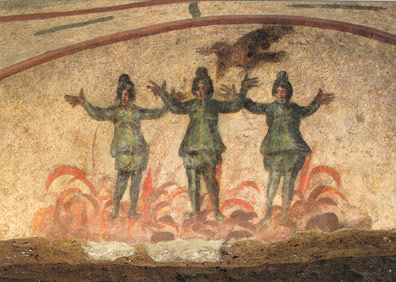
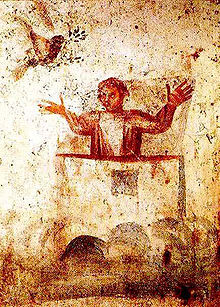
Neither do I. You have no way of knowing this (welcome to the forums), but this has been discussed constantly and ad nauseam here (there was a ban on discussing it for a while, which I think has been lifted). The posture is called the “orans position” (from the Latin word meaning “praying”), and if you were to do a search here like this one you could find all that has been said on it in the past.
 
Personally, I equate the people who pray the Our Father at Mass with their palms outstretched with those who sing the hymns louder than anyone else-(and often off-key).
Many seem to be saying “Look at how pious I am”.
 
I don’t think so.

Many who do it in our Churches are immigrants or first generation Canadians, so it seems to have been a custom in their home churches.
 
Personally, I equate the people who pray the Our Father at Mass with their palms outstretched with those who sing the hymns louder than anyone else-(and often off-key).
Many seem to be saying “Look at how pious I am”.
Well, I was just going to spectate on this thread, but…

The orans posture (and not linked!) was specifically asked for by our last Archbishop. So I do it.

What I do not do is stick my arms straight up in the air, wiggle my fingers, and sway while singing loud and off-key. Those people that do are, I believe, Charismatic Catholics. :confused:
 
Personally, I equate the people who pray the Our Father at Mass with their palms outstretched with those who sing the hymns louder than anyone else-(and often off-key).
Many seem to be saying “Look at how pious I am”.
This is very difficult to say, especially in parishes here in the Philippines, where everyone does it. 😃
 
This is very difficult to say, especially in parishes here in the Philippines, where everyone does it. 😃
Oops. I didn’t see the word, “outstretched.” It’s more like just open palms facing upward, but not with outstretched arms.
 
Well, I was just going to spectate on this thread, but…

The orans posture (and not linked!) was specifically asked for by our last Archbishop. So I do it.

What I do not do is stick my arms straight up in the air, wiggle my fingers, and sway while singing loud and off-key. Those people that do are, I believe, Charismatic Catholics. :confused:
People involved in Catholic Charismatic Renewal don’t necessarily do that (I’ve never seen anyone do that at a regular Sunday Mass). What an unnecessary and off-topic prejudicial remark.

The National Service Committee is a great place to look if you would like to learn more.
May God’s blessings Be upon you!
 
There is someone in mass who does that during the elevation of the host and chalice. I wasn’t sure if it was a charismatic renewal custom or not. He only comes to the TLM during the week, so I figured his regular parish has charismatic masses and that’s where he picked up the custom. But I guess I was wrong.

I used to either stretch out my arms or just leave them open, palms turned upwards, as a Protestant, especially in the Pentecostal or non-denominational churches. The non-denominational churches I attended were very charismatic. The meaning was opening yourself to the Father/Jesus/Holy Spirit as a vessel to do what God wants - whether it meant revelation, or the movement of the Spirit. It was also meant as a sign of humility before God too.
 
There is someone in mass who does that during the elevation of the host and chalice. I wasn’t sure if it was a charismatic renewal custom or not. He only comes to the TLM during the week, so I figured his regular parish has charismatic masses and that’s where he picked up the custom. But I guess I was wrong.
It is ancient Christian posture of prayer which is at the root and heart of the Roman Catholic church … goes back to the very beginning.

It seems to be one of those things (like facing east, and like the kiss of peace … a real kiss, not a handshake) which has been lost over time.

I you would like to learn more about the posture of prayer, there was a good book by Father Gabriel Bunge OSB which (as I recall) explained it pretty well.

http://t1.gstatic.com/images?q=tbn:ANd9GcT3e9mhdslcW7acqWY2DgBtNK7NBcTRsAo3MvD6Rjyrt3Zsq14TOw

http://t0.gstatic.com/images?q=tbn:ANd9GcSV9luAKelYHpsjrdp95U6_A_1vDXJRzdtnnzi-0Qimty14QR7ywQ
 
It is ancient Christian posture of prayer which is at the root and heart of the Roman Catholic church … goes back to the very beginning.

It seems to be one of those things (like facing east, and like the kiss of peace … a real kiss, not a handshake) which has been lost over time.
The orans, yes.


http://lib.haifa.ac.il/collections/art/med/2_13_sarcoph_orans.gif


Many people since antiquity have noted how the outstretched arms posture evokes a cross.

http://2.bp.blogspot.com/-unqMG4fARv4/Tk9jUIOSz7I/AAAAAAAAFFs/GuB6JKeYMvg/s1600/SabinaCrucify.jpg

I extended my hands and hallowed my Lord,
For the expansion of my hands is His sign.
And my extension is the upright cross.
Hallelujah.
  • Odes of Solomon, 27
 
I know a lot of traditionalists tend to get snarky about it so I do it as discreetly as possible with palms turned up and close to my chest. I particularly feel it’s most appropriate during the Collect, the Preface and the Lord’s Prayer.
 
It just reminds me of the Protestant churches and seeing them throw their hands up, screaming hallelujah or amen (while swaying back and forth) and seeing the looks on their face like they’re holier than thou. Its very fake and obviously, I’m not a fan of it being in the Catholic Church.
 
It just reminds me of the Protestant churches and seeing them throw their hands up, screaming hallelujah or amen (while swaying back and forth) and seeing the looks on their face like they’re holier than thou. Its very fake and obviously, I’m not a fan of it being in the Catholic Church.
I understand how you feel.

However it is very ancient posture and very correct. In different part of the world you will see Roman Catholics use it, especially monastics and hermits.

I think the problem most people have with it is that they have no personal memory of the poasture. The traditionalist movement did not actually have it’s origins in traditionalism, it was a reaction to what was perceived as a lack of diginity in worship. The response was yearning for what people knew or remembered, this was not so much traditionalism as it was nostalgia. This was my impression 25 or 30 years ago, we yearned for the 50’s once again.

Now we have a new generation of ‘traditionalist’ Roman Catholics who prefer the SSPX/FSSP Extraordinary Form of liturgy, and I don’t blame them one bit, but it is an really the only alternative they know, being unaware of early Roman Catholic church practices.
 
I prefer to have my hands together, I don’t mind if people want to raise their palms/hands/arms and think what is in their heart is between them and God. However, what I don’t like is seeing the altar servers standing one behind the other doing this and looking like that Hindu false goddess—one body and six arms!
 
I do this at the Our Father during Mass. I also use this posture during adoration of the Blessed Sacrament at times. I have difficulty kneeling in our chapel, so I stand in the back and use this posture for prayer and adoration. I am sort of weak these days, and really expect my arms to get tired, but they rarely seem to do so. Maybe God compensates for our age. I really do see this as a posture of adoration and I do not understand what the flap is about using it from the traditionalists. We have suffered from too much judgementalism in our churches.

I was recently at a church where the whole congregation said " My Lord and My God" at the elevation of the Body and Blood. I was startled, expecting silence. That was something I had always done silently to myself, so upon reflection, it seemed most appropiate that that adoration was done communally. Again, a difference, but done so reverently that I think it would have been an error to criticize.
 
The traditionalist movement did not actually have it’s origins in traditionalism, it was a reaction to what was perceived as a lack of diginity in worship.
This is one of the most perceptive posts I have read in a while. Permit me to add some thoughts.

It is insightful to note that the traditionalists movement was not rooted in “traditionalism,” of the kind that motivates the monks at Solesmes. As you say, it was a reaction against the new mass forms promulagated through the 70s.
The response was yearning for what people knew or remembered, this was not so much traditionalism as it was nostalgia. This was my impression 25 or 30 years ago, we yearned for the 50’s once again.
I would qualify the comment that this was mere nostalgia. They felt that the new mass forms were improper and they felt that the tridentine mass was right. While they knew the trid. mass from the 50s, they did not necessarilly associate it with the 50s. To them, it was simply the correct way to celebrate mass.
Now we have a new generation of ‘traditionalist’ Roman Catholics who prefer the SSPX/FSSP Extraordinary Form of liturgy, and I don’t blame them one bit, but it is an really the only alternative they know, being unaware of early Roman Catholic church practices.
Catholic traditionalists believe the tridentine rite to be the “gold standard” of liturgy for a severa reasons - one is universal familiarity, the second, equally important, is at least tepid episcopal tolerance.

However, an interesting trend is growing in Catholic traditionalism - increasingly, some traditionalists are asking for the rubrics that were used in the first half of the 20th century, which have their antecedents in the 16th and 17th century. This indicates that Catholic traditionalists are starting to linking theology with worship authentically.

This development might bring a smile to some within the monasteries of Mount Athos or St. Catherine’s. They could say with justification, “What took you so long?” since they have been systematically safeguarding traditions regarding worship (such as the painting of icons) since at least the 1600s, and the Russian Church attempted a genuine reconciliation with ancient tradition in the reforms that led to the Old Believer schism, much as Trent attempted to genuinely restore the mass to the best medieval forms. But the effort was interrupted by war and revolution in the west. So, Orthodoxy has a consistency of liturgical recension that goes back at least 400 years.

Ostensibly, Vatican 2 undertook to renew this process. Unfortunately, the process was affected by what could be called a kind of “primitivism.” The Fathers might have called it something else. This happened due to the deep seated Catholic aversion to adopting an Orthodox mindset about anything (here Orthodox = Greek), which is based on a fear that critical analysis based on a close reading of the Fathers and bishops of the later imperial period will comprimise concepts regarding the papacy. This retards Catholic liturgical renewal based on masses that Catholics actually used from the post Apostolic period through the 1100s, and particularly the Gregorian mass of the 6th and 7th centuries, which really was a golden age for the mass.

Many Orthodox observers observe that Catholic traditionalists up to now have followed exactly the reasoning as their contemporary Catholic bretheren! “Going back before Trent, et hic dracones sunt.”

Traditional minded Christians are going to have to revisit pre Tridentine thinking. Catholics, in particular, are going to have to reevalute ecclesiology in a post Christian society, as Greeks and other Orthodox had to do after 1453. We have a model for Christians to strive for, but it cannot be found in Trent, or in Florence, or in Avingnon. Catholics should ask why the Venerable Bede, writing in England, in the 8th Century, still referenced events by who were serving as consuls at Rome - 300 years after the last Western emperor was deposed. It is even more basic than the position of one’s hands during the paternoster, which Pope St. Gregory added to the mass.

 
Status
Not open for further replies.
Back
Top