Venerating saints body parts makes me uncomfortable

  • Thread starter Thread starter margaret_mander
  • Start date Start date
Status
Not open for further replies.
Yes I know we do but what I’m saying is some catholics seem to “over do” the whole saints relics thing without realizing it, do you see what I mean?
By whose standard do we measure “overdo”? People also say we “overdo” Medjugorje, Fatima, and Lourdes.
I’m not judging other peoples spiritually
I don’t think you mean to, but whenever we apply our own standard of “overdo” this can be the result.
I don’t think anyone’s getting what I mean I’m not judging other people who venerate saints relics I’m just saying picture your mother or siblings burnt head encased in a jar in your house, wouldn’t that make you feel uncomfortable?
Of course! But this is a cultural thing. In some ancient cultures, the revered family members were buried under the family hearth, where their bodies slowly dried. I am sure you are aware of Egyptian mummies, not all of which were buried in tombs.

Christianity has been influenced by early practices of the Church. Since Christianity was illegal for the first 300 years, they met and had Mass, baptisms and prayer in the catacombs and remote places (including tombs). Altars were often erected over saints, and Mass occurred surrounded by the bodies of saints.

view-source:Earliest known images of apostles discovered under Rome streets
I do believe in the saints and praying for their intersession to God I love them I just feel like if I was a saint looking down on people touching my dead body I’d be a little freaked out haha, also on a related note, aren’t we suppose to burry the dead?
One has to keep in mind that the continual teaching of the Church is that “Jesus is coming soon” and that there was an expectation that the bodies would be raised. In fact, this already occurred when Christ rose from the grave:

51 And behold, the curtain of the temple was torn in two, from top to bottom; and the earth shook, and the rocks were split; 52 the tombs also were opened, and many bodies of the saints who had fallen asleep were raised, 53 and coming out of the tombs after his resurrection they went into the holy city and appeared to many. Matt. 27

So there was an expectation that they may come to life immediately upon His return.

Yes, we are supposed to bury the dead, but this is a modern canonical law (especially that ashes are not to be kept in the house or scattered in various places). Of course there are sometimes no bodies to bury, as in 2011 Twin Towers, or when people die and are “buried” at sea.
 
Fair enough OP. You’re not required to go on pilgrimages or touch your medals and rosaries to the relics.
It’s perfectly fine to opt out of these devotional practices— it’s truly a case of “don’t like? don’t do” 🙂

Now, please indulge me while I get all historical/anthropological on you.
The human race has a long history of revering the dead bodies of its heroes, take for example the Egyptians and their mummies. Every culture has taboos surrounding desecrating graves, and do’s and donts around treatment of corpses.
Also, until the 1900s, death and post mortem care occurred in the home, surrounded by friends and family, not tucked out of sight in nursing homes and hospitals.

As for body parts, even in our culture we save clippings from “baby’s first haircut” into the baby book.
And the Victorians made jewelry out of teeth and hair of their dead family members and it was a strictly secular practice.

In the case of the martyrs, frequently it was the friends who collected and stored the remains because they were afraid that the governments would take and desecrate the deceased body.
But it was a different time and place.

Thanks for bearing with me and peace!
 
Does anyone have documents about why saints bodies are aloud to be put on display?
The care taken to preserve the relics is done to respect for them.

This veneration is balanced with the desire of the faithful to benefit from the relics, through which miracles are wrought.

11 And God did extraordinary miracles by the hands of Paul, 12 so that handkerchiefs or aprons were carried away from his body to the sick, and diseases left them and the evil spirits came out of them. Acts 19

Would you imagine any LESS reverence and care would be taken of their bodies? Imagine the value of a simple handkerchief!
I don’t understand the veneration of saint’s dead body parts either. Or the kissing of holy objects
It is no different than kissing a photo of a loved one. It is a sign of affection and respect.
I’ve heard of people chewing saint bones. Many people are going to kiss that cross. It’s about sanitation
Ew! I have never heard of that! As far as kissing crosses and statues, those that are commonly used in such veneration are cleaned. At my local parish, there is a statue of Mary holding the baby Jesus. People on their way out of the Church will kiss their fingers and touch the feet of Mary.

For people who are deeply reminded of the presence of a person through an image, it is not “all about sanitation”.
This is what I was meaning thank you not in a judgmental way but sometimes people seem to be over taken with certain things that take away from God (obviously not on purpose but I have personally seen peoples devotionals go “too far”)
We are not usually in a position to determine what takes a person further away from God. It may seem to us like it is excessive because it is not what we would do, but we can’t know the state of their heart.
Have you ever heard of saint expedite? … I’ve seen do things almost ritualistic like make a shrine to him, make him a pound cake (I think its pound cake)…
St. Expeditus.

Let’s not judge the Teachings of the Church by those who depart from them.

Have you ever talked to these people, to learn what their relationship with God is like?
 
I’ve read that with this ritual if you do it wrong you will be “punished”
Perhaps you can direct us to these sources. It does not sound like a Catholic source. The Saints don’t “punish” anyone, nor do they expect any material offerings of any kind. They want us to be closer to God.
I’m just saying some people I’ve seen take things too far and maybe not realize it just like that example.
Well, your thread title references venerating, yet you are giving an example of a superstition that is not Catholic, so maybe you are having a hart time telling the difference?
Yes its very frustration trying to explain that’s not Catholic
Why? Can’t one simply state that this is not Catholic, and move forward?
 
If this devotion makes you uncomfortable then you don’t have to do it. Veneration of the saints is permitted but it is not mandatory.
 
Many Catholics, especially from North America, find the veneration of saints’ body parts to be a little weird and uncomfortable. It is much more accepted in Europe, particularly in places like Italy where it is not uncommon to go into some shrine or church and find all kinds of saint body parts presented for veneration as relics, sometimes in visible glass cases or pinned to the wall. The tongue of St. Anthony is the one that stands out in my mind.

Before we went to see these type things on a pilgrimage trip, the priest gave us a little talk explaining what we would see and that some of us, not being from that culture, might find it gross and that it was okay to just skip it if we didn’t like it but remember that different cultures may feel differently than we do.

As someone already said, we do not worship saints, much less their body parts, and we only worship God. Venerating relics of saints is an optional devotion. If it bothers you, just don’t do it, but respect the people who choose to do so. Problem solved.
 
Last edited:
No, I’m not the one having a hard time telling the difference, its other people. And it gets frustrating explaining things that aren’t catholic when some people just want to tell you what you believe without even asking. I’m only human why are you taking everything I say so? I don’t know aggressively? I was asking about why we venerate saints dead bodies, I have gotten my answer and I understand better now
 
I wasn’t looking for a “if you don’t like it don’t do it”. I just wanted to understand better and if anyone else felt it was morbid or if too much of it seemed like worship, which was answered and now I understand
 
I’m not judging the teachings of the church by somethings certain people do. And I know their relationship with God is great the point is like I SAID. Some people do certain things they don’t KNOW is wrong, and saying
We are not usually in a position to determine what takes a person further away from God.
Is like saying you shouldn’t tell someone what they’re doing might be a sin because were being judgmental everyone needs to know if they’re doing something they aren’t suppose to that’s how Catholicism works
 
Last edited:
Glass coffin’s. Did they look real like sleeping?.
They generally do, but in a lot of cases there is also a wax mask put over the visible body parts so you do not see the actual body.

I know in the case of St. Clare we were told that only members of her order are allowed to go around to the back side of the coffin where you see her actual bones and not the covering.

By the way, we also have the body of St. John Neumann on display right in the United States in his shrine which is in Philadelphia. It is in a glass coffin under the altar.
 
Last edited:
Every time I see a relic I must think of the beauty of the fact that sometimes hundreds of years after this saint died, still many people pilgrim to him in deep love.
The bones and flesh is a sign for me that every single person, made of the same flesh and bones, could become a saint. It shows me a rather good and uplifting side of the human nature, not only the suffering, weak side.
Then I have to think of the past time where the saint lived. Such a different world, such different customs, ideas, happenings, and still we are able to get in touch.
To the relics that are not clearly the saint we think they are: I once read a beautiful statement of the church about it, saying that if he have at least the possibility to honestly believe that those relics are the descripted ones of the saint and there´s a tradition of pilgrimage, then it´s a sign of deep faith to honour them. The saints we want to adress are able to recieve our petitions, and why shouldn´t they work through places people gather to honour them?
 
Last edited:
No, I’m not the one having a hard time telling the difference, its other people. And it gets frustrating explaining things that aren’t catholic when some people just want to tell you what you believe without even asking.
I see what you mean! I don’t waste time on such people. I tell them, then I shrug it off and leave them to their errors.

Titus 3:10 As for a man who is factious, after admonishing him once or twice, have nothing more to do with him

It is frustrating. We recently had a thread about it.
I’m only human why are you taking everything I say so?
I never expected you not to be human, I am just responding to your posts. I apologize if I was offensive.
I was asking about why we venerate saints dead bodies, I have gotten my answer and I understand better now
Good!
Is like saying you shouldn’t tell someone what they’re doing might be a sin because were being judgmental everyone needs to know if they’re doing something they aren’t suppose to that’s how Catholicism works
Yes, of course, one of the spiritual mercies is to admonish the sinner. We have an obligation to instruct and correct our brethren. I don’t think there is anything wrong with you sharing your perceptions that something seems excessive to you, or if you know something is superstitious, like getting punished for not doing rituals to saints a certain way.
 
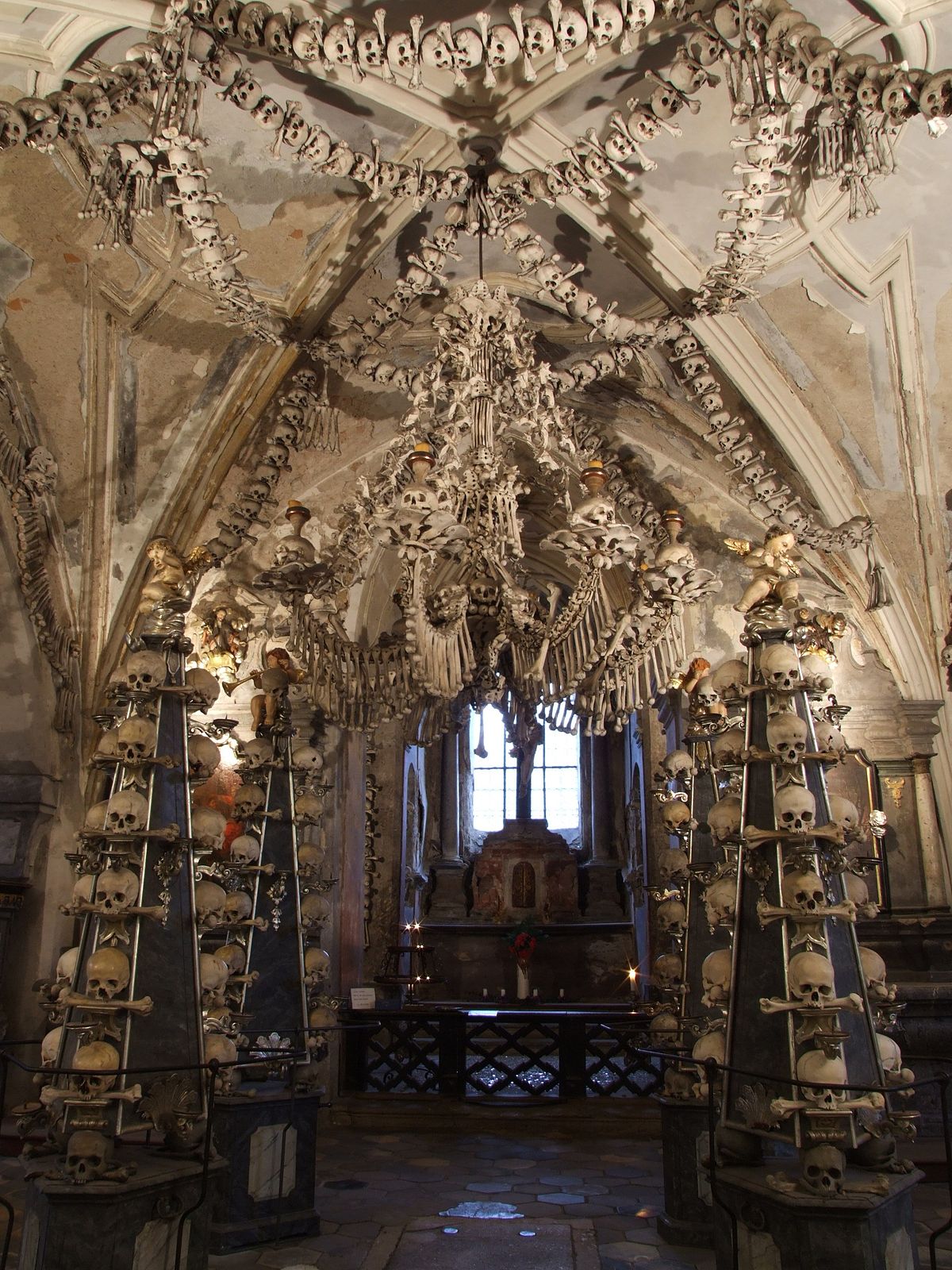
You would not like to ever visit the ‘Bone Church’. I understand your discomfort but I think that could come from the influence of modern secular culture.

Pagans tended to burn the body. Modern Americans do as well. In modern America you definitely see a revulsion of the body in the popularity of cremation and also in the decreasing popularity of open caskets.

There might also be an influence from urbanization and lack of contact with the cycle of life. Rural people experience death in animals from livestock and hunting. Many urbanites have less experience of this and, in my opinion, become more uncomfortable with anything related to death.

Regardless of the reasons I think our culture wants to ignore death as much as it can. Relics of the body stand in opposition to this.

 
In modern America you definitely see a revulsion of the body in the popularity of cremation and also in the decreasing popularity of open caskets.
I agree with you that people in the US have a hard time handling death, but I think the main driver for cremation is that it is much less expensive, especially if you are not a Catholic and can simply hold onto the ashes in an urn or scatter them in the woods or ocean or wherever, and thus don’t have to buy a place for interment.

As for open caskets, the main issue I have with them is that the body is in an unnatural state (usually heavily made up as well as embalmed), the body often does not look like the person did when they were alive, and the deceased is no longer in the body anyway. Having said all that, I still did open casket for my husband because I wanted to have the chance to sit with his body for just a while longer, although it was difficult for me. I knew he was no longer in that body but I just wanted to sit with it and be around his shell and remember when he was in it. The next time we see that body is when Jesus will resurrect it (as presumably it may rot away in the grave or be removed and dumped somewhere else centuries after I too am dead), so I was trying to think of that, rather than the fact that it was heavily made up and so forth.
 
Last edited:
Imagine a saint you just love. You love their story or they helped convert or interceded for you. Being before a relic from their body gives you a wow, they were really here, really flesh and blood on this Earth moment of awe. Intellectually we know they were real and here, but there is something so special about relics and remains that pluck these real saints out of foggy legend and meet us here on Earth.
 
I was touched by a bone fragment of Saint Francis of Assisi -
and I was flying high - for weeks !
Also, I met a India man - who worked with Mother Teresa - for years -
I shook his hand - that was a thrill too, for me.

I have not been to the Holy Land, but people say - that’s a thrill.
 
Touching the bones of a dead saint, even unintentionally, is associated with a miracle in the Old Testament:
And as a man was being buried, lo, a marauding band was seen and the man was cast into the grave of Elisha; and as soon as the man touched the bones of Elisha, he revived, and stood on his feet. (2 Kings 13:21)
Concerning this, it elsewhere says of Elisha:
Nothing was too hard for him,
and when he was dead his body prophesied.
As in his life he did wonders,
so in death his deeds were marvelous. (Sirach 48:13-14)
 
Last edited:
in a lot of cases there is also a wax mask put over the visible body parts so you do not see the actual body.
I’ve always wondered about this. If the body is incorrupted, then why does the body have a mask?
 
I agree. Body parts, no matter who they belonged to, are not for me.
 
Status
Not open for further replies.
Back
Top