
Veronica's Veil - True Account?

  • Thread starter Thread starter RaiseMeUp
  • Start date Start date
Status
Not open for further replies.
Gerald writes in very much the same vein as Gervase, in that he speaks about the three ‘authentic’ images of Jesus (Speculum ecclesiae, chap. 6):

[Gerald reports on the five basilicas of the patriarchate in Rome and] the two icons iconiis] of the Redeemer, the Uronica and the Veronica, one of which is to be found in the Lateran and the other in St. Peter’s. [After Christ’s Ascension, St. Luke was asked by Mary to paint an image of her son, which with her help was authenticated and approved in its physical details.] Thus he produced two or three, one of which is kept in Rome … in the Sancta Sanctorum. It is said that when the pope once dared to look at it, he lost his sight at that very instant. From then on, the image was covered entirely in gold and silver, except for the right knee, from which healing oil issues. This image is called Uronica, that is, the genuine essentialis].
Another image in Rome is called the Veronica after a matron of that name. [Once, when the Lord was coming out of the temple, this woman lifted] her robe peplum] and pressed it to his face. On it he left his image as an imprint. This image is likewise held in honor reverentia], except through the veils hanging in front of it nisi per velorum quae ante dependent, interpositionem]. … And some say that Veronica is a play on words vocabula alludentes], meaning the true icon veram iconiam] or the true image imaginem veram].
Now I shall deal with the vultus Lucanus [the *Volto Santo in Lucca] that was not painted but carved in wood with pious skill by Nicodemus. Four bishps … who were sent to Constantinople for relics … brought back this image together with an ampoule and the blood that flowed from the icon crucified by a Jew de iconia a Judaeo crucifixa].

Gerald’s version of the story is the closest to the one we have now: he identifies the Veronica as being Veronica’s peplum (originally denoting a tunic; also a veil-like sort of cloth), which she pressed to the face of Jesus as He was going out of the Temple. (There is no indication that it was during the Passion.) Unlike Gervase, Gerald distinguishes between this miraculously-formed portrait with the Lateran icon, which he dubs Uronica.

In 1207, the “sudarium” was publicly paraded and displayed by Pope Innocent III between St Peter’s and the Santo Spirito Hospital, who also granted indulgences to anyone praying before it. This is what the anonymous Gesta Innocentii III Papae (an account of the pope’s life) says about it:

At the said hospital, Innocent III inaugurated a solemn station Mass on the first Sunday after the octave of the Epiphany. The Christian populace gathered there to see and venerate the sudarium of the Lord, which which was carried by a procession from St. Peter’s to that place, singing hymns and psalms by torchlight. They also want to hear the sermon preached there by the Roman pontiff on the works of compassion and the remission of sins.
We, Honorius III (1216-27), decree that the likeness of Christ at St. Peter’s … shall be carried to the said hospital … in reverence, in a specially made reliquary of gold, silver, and jewels. There, in the presence of the pope, it shall be shown to the faithful according to their expectation.

Matthew Paris in his Chronica Majora (after 1245) relates a story about how when the procession was over, the Veronica miraculously turned and stood on its head upside-down. Taking it for a bad omen, the disturbed pope composed a special prayer with the indulgence attached.

On the Veronica and its authentication autenticatione]. As was customary, Pope Innocent … led the image effigiem] in procession from St. Peter’s to the hospital of Sto. Spirito. When the procession was over and people wanted to put the image back in its place, it turned round of its own accord se per se girabat], so that it stood on its head with the forehead below and the beard at the top. The pope was shocked, taking it as a bad omen triste presagium] and on the brothers’ advice wanted to make amends to God. He therefore composed an elegant prayer in honor of the image, to which he added a psalm with a number of verses [probably Ps. 4:7], and granted a ten days’ indulgence to all who said the prayer. … Many have commended the prayer and everything connected to it cum pertinenciis] for memorization memorie commendarunt] and, to arouse more devotion in themselves, have illustrated it as follows picturis effigiarunt hoc modo].
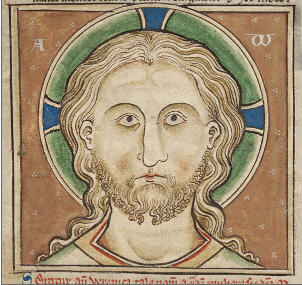


The name “Veronica” is derived from a woman of that name, at whose request Christ printed his face on the cloth. One should make the sign of the cross and say signans se igitur homo dicat]: The light of your countenance, O Lord, has appeared to us signatum]; [after Ps. 4:7. There follow Ps. 85:16; 26:18, 104:4, and 79:20 and the prayer said to have been composed by Innocent]. Lord, you have left behind for us, who are marked signatis] by the light of your face, the image imprinted on the cloth of Veronica sudario impressam imaginem] as your memento memoriale]. Grant, for the sake of your Passion and the cross, that we, as we now adore and venerate this on earth in a mirror and parable per speculum et in enigmate], shall one day see you face to face facie ad faciem] as judge on the good side securi].​
 
The parade became an annual event that on one such occasion in 1300 Pope Boniface VIII was inspired to proclaim the first Christian Jubilee in 1300. During this Jubilee the Veronica was publicly displayed and became one of the mirabilia urbis (“wonders of the City”) for the pilgrims who visited Rome. So great was the throng of people that an English Benedictine monk was actually crushed and fatally injured while attempting to see the relic. Pedro Tafur, a Spanish visitor at St. Peter’s in 1436, noted:

On the right hand [of the basilica] is a pillar as high as a small tower, and in it is the holy Veronica. When it is to be exhibited an opening is made in the roof of the church and a wooden chest or cradle is let down, in which are two clerics, and when they have descended, the chest or cradle is drawn up, and they, with the greatest reverence, take out the Veronica and show it to the people, who make concourse there upon the appointed day. It happens often that the worshippers are in danger of their lives, so many are they and so great is the press.

As mentioned, except for Petrus Mallius’ version of the Veronica’s origins, there was originally no explicit connection between the relic and the Passion in the more common versions of the story. In Jacobus de Voragine’s Golden Legend (ca. 1260), the entry for The Passion of the Lord (Good Friday) has a section about the legend of how Tiberius was cured by the image:

When Pilate had handed Jesus over to the Jews to be crucified, he was afraid that his condemnation of innocent blood might offend Tiberius Caesar, and dispatched one of his familiars to make a case for him to the emperor. Meanwhile, it was announced to Tiberius, who was seriously ill, that in Jerusalem there was a physician who cured all diseases by his word alone. Therefore the emperor, not knowing that Pilate and the Jews had put this physician to death, said to one of his intimates, whose name was Volusian: “Cross the sea as fast as you can, and tell Pilate to send this healer to me so that he may restore me to health.” Volusian came to Pilate and delivered the emperor’s command, but Pilate, terror-stricken, asked for a fortnight’s grace.
During this time Volusian made the acquaintance of a woman named Veronica, who had been in Jesus’ company, and asked her where he might find Jesus Christ. She answered: “Alas, he was my Lord and my God, and Pilate, to whom he was handed over through envy, condemned him and commanded that he be crucified.” Volusian was grieved at this and said: “I am deeply sorry that I cannot carry out the orders my master gave me.” Veronica answered: “When the Teacher was going about preaching and I, to my regret, could not be with him, I wanted to have his picture painted so that when I was deprived of his presence, I could at least have the solace of his image. So one day I was carrying a piece of linen to the painter when I met Jesus, and he asked where I was going. I told him what my errand was. He asked for the cloth I had in my hand, pressed it to his venerable face, and left his image on it. If you master looks devoutly upon this image, he will at once be rewarded by being cured.” “Can this image be bought for gold or silver?” Volusian asked. “No,” Veronica replied, “only true piety can make it effective. Therefore I will go with you and let Caesar look upon the image, after which I will return home.”

The 12th-century German poem known as Dit is Veronica has the man who was supposed to paint Jesus’ portrait as St. Luke. In the poem, Veronica tries to have a portrait of Him made three times, all of which end in failure. Eventually, Jesus Himself arrives in person and decides to eat at Veronica’s house. Before eating, He washes His face and, drying it on a towel, leaves an imprint of His face onto it.

The linking of the relic with the bearing of the cross in the Passion was first made by Roger d’Argenteuil’s prose retelling of the Bible in French (aka Bible en françois) in the 13th century, and gained further popularity following the internationally popular work, Meditationes Vitae Christi (Meditations on the Life of Christ) of about 1300 by a Pseudo-Bonaventuran author. In Roger’s version, Jesus, on His way to Calvary, passes by Veronica who was carrying her handkerchief (‘vernicle’) to sell at market. Veronica sees Jesus’ bloodied face, feels compassion for Him, and mops His face with the cloth, “and suddenly the face of Our Lord was portrayed in the veil just as if it were in flesh and bone.”​

The rest is history.
 
I was always taught in Catholic School the story of Veronica’s veil. The Passion of The Christ has act of Veronica’s Veil in it. And most recently, The Bible series from HS shows (although discretely) a woman wipe the Lord’s face and then try to offer Him some water before she is whipped away from Him. So is this a true account? I read some varying stories. I always thought she was literally there and wiped His face. :confused:
Come to think of it, that’s the one Catholic element which somehow finds its way in many (or should I say most) Jesus movies! In fact I only know of a few films which doesn’t have a Veronica-like figure in it. (I’m not counting the Visual Bible-style films which attempt to stick to only one gospel and to literally reproduce the text as written, nor films which give the way to Golgotha only a short shrift.) I remember BBC’s The Passion (incidentally a favorite of mine) from 2008; it doesn’t have Veronica, but there is a character who is like a composite of Veronica and Simon of Cyrene. He comes near to Jesus and wipes His face with his bare hands; Jesus thanks the man before the soldiers drive him away. So even there we could see the shadow of Veronica looming large.

I think one of the reasons why the version of the Veronica story we all know stuck (at the expense of the earlier versions) and the reason why filmmakers love it so is because it’s just perfect. It’s dramatic. It’s beautiful. Not to mention that it kind of fits the context and makes sense there. I mean, I sure find the story of this woman who bravely approaches the suffering Jesus and doing the least she can to alleviate His pain by wiping the blood and grime off His face to be loads more touching - not to mention that it makes for great sermon or meditation material! - than a story where, say, Jesus simply sits down for an artist or wipes His face on a piece of fabric all because a female disciple of His wanted a picture of Him for herself. 🤷 We may not know for sure what really happened (or whether something even happened at all) 2000 years ago but I do think that Roger d’Argenteuil et al. had really hit something big.
 
Just for comparison, here’s the story of King Abgar and the Holy Mandylion in its present, ‘canonical’ form. I’m not going through all the versions of the story this time; I’ll only say that the earliest versions of the story focus on the correspondence between Jesus and Abgar, with no image in sight (mention of which only pops up during the 5th-6th centuries).
2.bp.blogspot.com/-Wov-rDk4bXY/TknUBNsAbyI/AAAAAAAAEKU/A4aPIf95RbY/s1600/0429021.jpg
Jesus washed His face and wiped it on a cloth, leaving an imprint of His face onto it. He gave it to Abgar’s messenger Ananias (who was unsuccessfully trying to paint a portrait of Him) along with a letter that He will send a disciple of His afterwards.

greatshroudofturinfaq.com/images/abgarpanel.jpg
Abgar with the Mandylion and Thaddaeus (Addai), one of the seventy disciples and the one sent to completely cure Abgar of his leprosy.
 
Veronic’s veil is not in Scripture and is NOT a Church teaching (never has been).
Think what you want, but it is in all the Stations of the Cross in every Catholic Church all over the world.and has been taught to our children by our Catholic Schools. Now what would you call that!!! God Bless, Memaw
 
Think what you want, but it is in all the Stations of the Cross in every Catholic Church all over the world.and has been taught to our children by our Catholic Schools. Now what would you call that!!! God Bless, Memaw
Its not a case of thinking what I want. The FACT is that Veronica’s veil has NEVER been a Church teaching.
 
Not raised a Catholic, I was surprised in Jerusalem to see the stations of the cross, and one of them mentioning Veronica.

Someone should fix that. I suppose it would be a huge thing to undertake.

Is there a St. Veronica?
 
Come to think of it, that’s the one Catholic element which somehow finds its way in many (or should I say most) Jesus movies! In fact I only know of a few films which doesn’t have a Veronica-like figure in it. (I’m not counting the Visual Bible-style films which attempt to stick to only one gospel and to literally reproduce the text as written, nor films which give the way to Golgotha only a short shrift.) I remember BBC’s The Passion (incidentally a favorite of mine) from 2008; it doesn’t have Veronica, but there is a character who is like a composite of Veronica and Simon of Cyrene. He comes near to Jesus and wipes His face with his bare hands; Jesus thanks the man before the soldiers drive him away. So even there we could see the shadow of Veronica looming large.

I think one of the reasons why the version of the Veronica story we all know stuck (at the expense of the earlier versions) and the reason why filmmakers love it so is because it’s just perfect. It’s dramatic. It’s beautiful. Not to mention that it kind of fits the context and makes sense there. I mean, I sure find the story of this woman who bravely approaches the suffering Jesus and doing the least she can to alleviate His pain by wiping the blood and grime off His face to be loads more touching - not to mention that it makes for great sermon or meditation material! - than a story where, say, Jesus simply sits down for an artist or wipes His face on a piece of fabric all because a female disciple of His wanted a picture of Him for herself. 🤷 We may not know for sure what really happened (or whether something even happened at all) 2000 years ago but I do think that Roger d’Argenteuil et al. had really hit something big.
Hadn’t really thought it through before, but I believe you are right (about it’s inclusion in the films). Thank you for all the posts on the history of the veil - very fascinating! 👍
 
Its not a case of thinking what I want. The FACT is that Veronica’s veil has NEVER been a Church teaching.
I think you’re right. The fact that the later version of the Veronica story is perpetuated in the Stations is IMHO not a dogmatic statement that that’s how it happened (or that it happened), any more than the fact that it isn’t dogma that Jesus fell down three times. Nowhere in the gospels does it say that Jesus tripped and stumbled while carrying His cross, although the idea does have a high degree of historical verisimilitude. Besides, the original idea in medieval piety is that Jesus fell down on the way SEVEN times (“the seven falls of Christ” - does that ring a bell?) - the three falls in the classical Stations is all that is left of the original seven. (The other four were assimilated with the meeting with Mary, Simon of Cyrene, the women of Jerusalem, and Jesus being stripped off His clothes.)

Besides, the whole point of the Stations is not to dissect it for whatever shred of ‘historical accuracy’ it might contain, but as a meditation on Christ’s suffering and an attempt to spiritually follow Him.

Final comment. I’m glad that the House of Dives isn’t a ‘station’ anymore (as it was when Jean Zuallart published his book in the late 16th century - see my last post to figure out what the heck I’m talking about); otherwise we’d be here debating whether the parable of the rich man (= Dives) and Lazarus is factual (i.e. it happened in real life) or not. 😛
 
Not raised a Catholic, I was surprised in Jerusalem to see the stations of the cross, and one of them mentioning Veronica.

Someone should fix that. I suppose it would be a huge thing to undertake.

Is there a St. Veronica?
Well, why don’t you go over there and fix it and maybe thistle would go with you and help.
St. Veronica is listed in the book of Saints. Maybe the Church has been wrong all these centuries and you guys could be right. God Bless. Memaw
 
Not raised a Catholic, I was surprised in Jerusalem to see the stations of the cross, and one of them mentioning Veronica.

Someone should fix that. I suppose it would be a huge thing to undertake.

Is there a St. Veronica?
To be precise, Veronica is not listed in the Roman Martyrology (the official index of most saints of the Church) - or even in early martyrologies for that matter. She does have in the popular level the feastday of July 12th (also, February 4th). This is where stuff gets confusing, since while in some medieval sources you do have a Mass and a Divine Office for ‘Veronica’, sometimes what is meant is not so much the woman herself but the vera icona, the image of Jesus that is linked to her. (For example, De S. Veronica seu vultus Domini ‘Of St. Veronica/the holy Veronica, or the face of the Lord’).

Now Veronica’s (the woman/the image/both) feastday was celebrated during the Middle Ages in some places, with proper liturgical texts. In the 16th century, St. Charles Borromeo suppressed the feast of Veronica in Milan in the wake of the Counter-Reformation.
 
Now Veronica’s (the woman/the image/both) feastday was celebrated during the Middle Ages in some places, with proper liturgical texts. In the 16th century, St. Charles Borromeo suppressed the feast of Veronica in Milan in the wake of the Counter-Reformation.
To be more specific, the feast of Veronica (with special office) found its way into the Ambrosian missal printed in 1555 and 1560 (Missa in festo S. Veronicae matronae ‘Mass in the feast of St. Veronica, matron’). As mentioned however St. Charles eventually struck the feast out of the missal and calendar. The Roman Martyrology (first published in 1583 under Pope Gregory XIII), as I’ve said earlier, also fails to include her - especially since the earliest martyrologies do not list her either. In fact the only Veronicas listed in the Martyrology AFAIK are Blessed Veronica de Binasco (ca. 1445-1497; February 13th) and St. Veronica Giuliani (1660-1727; July 9th).

In many medieval missals (especially German ones), there is a usually a votive Mass dedicated to the veronica - but there they are understood to refer to the vera icona, the image of Christ’s face. (Votive Masses dedicated to the different instruments used in the Passion of Jesus - say, the cross or the nails or the crown of thorns - were quite popular at that time.) For instance:

Missale Moguntinum (Mainz, 1493): De facie Domini (Of the face of the Lord) / De s. Veronica, seu de vultu Domini (Of the holy Veronica, or of the face of the Lord)
Missale Pataviense (Passau): In solemnitatis imaginis Domini salvatoris / Officium sancte Veronice: hoc est de facie Iesu Xpi (In the solemnity of the image of the Lord Savior / Office of the holy Veronica, that is, of the face of Jesus Christ)
Missale Augustanum (Augsburg, 1555): Missa de vultu sancto seu Veronica (Mass of the Holy Face, or the Veronica)

In the missal and the gradual used at Paris meanwhile the votive Mass is labelled De S. Veronica Christi Domini, sive facie Jesu patientis pro feria tertia post quinquagesimam ‘Of the holy Veronica of the Lord Christ, or of the face of the suffering Jesus, for the Tuesday (lit. third feria) after Quinquagesima [Sunday]’ / Missa de sancta Veronica Domini, seu de vultu Christi patientis, qua celebratur feria tertia quinquagesima ‘Mass of the holy Veronica of the Lord, or of the face of the suffering Christ, which is celebrated on the Tuesday of Quinquagesima’.
 
Side-tracking a bit, but comparing Veronica to Simon of Cyrene, Veronica is still better off. Both aren’t listed in the Martyrology, but while Veronica at least is ascribed a feast day or two at the popular level, Simon doesn’t even seem to have any, at least in the West. (Although there is a St. Rufus - the guy St. Paul greets in Romans, and which is sometimes linked to Simon’s son of the same name - at November 21st.)

For the record, Longinus (the name given to the soldier who pierced Jesus’ side) is listed at October 16th (originally March 15th), the good robber at March 25th (same day as the Annunciation; kinda significant as some early Christians thought that Jesus died on the same day He was conceived), and Joseph of Arimathea at August 31st along with Nicodemus (formerly March 17th; Nicodemus originally August 3rd).
 
Well, why don’t you go over there and fix it and maybe thistle would go with you and help.
St. Veronica is listed in the book of Saints. Maybe the Church has been wrong all these centuries and you guys could be right. God Bless. Memaw
There have been several saints that have been removed from the calender because the historicity of their existence was in doubt. It doesn’t mean that the Church was “wrong” about anything; it simply means that they are trying to set the record straight.

You must realize that there are many myths and legends that have been built up around particular individuals and that it isn’t so simple to extract the truth from legend. St. George particularly comes to mind. Other than slaying a dragon (something that is in itself, rather doubtful) there is really nothing to confirm his life. What to do?

And your antagonism toward thistle is misdirected because he is absolutely correct that the Church does not and has not ever taught the literal earthly existence of St. Veronica. Her appearance in certain stations of the cross does not rise to the level of the teaching authority of the Church.
 
There have been several saints that have been removed from the calender because the historicity of their existence was in doubt. It doesn’t mean that the Church was “wrong” about anything; it simply means that they are trying to set the record straight.

You must realize that there are many myths and legends that have been built up around particular individuals and that it isn’t so simple to extract the truth from legend. St. George particularly comes to mind. Other than slaying a dragon (something that is in itself, rather doubtful) there is really nothing to confirm his life. What to do?

And your antagonism toward thistle is misdirected because he is absolutely correct that the Church does not and has not ever taught the literal earthly existence of St. Veronica. Her appearance in certain stations of the cross does not rise to the level of the teaching authority of the Church.
Pretty much the only thing we know about St. George that is most likely to be historical is that he was a soldier from Lydda (Palestine) and that he was martyred around the early 4th century during the persecution of Diocletian, and even then the exact details are confusing. He’s one of those saints who are either so obscure or who are so shrouded in legend (many early saints are prone to be either) that while their names remain, their actions are known only to God, as Pope Gelasius in the late 5th century said.
 
There have been several saints that have been removed from the calender because the historicity of their existence was in doubt. It doesn’t mean that the Church was “wrong” about anything; it simply means that they are trying to set the record straight.

You must realize that there are many myths and legends that have been built up around particular individuals and that it isn’t so simple to extract the truth from legend. St. George particularly comes to mind. Other than slaying a dragon (something that is in itself, rather doubtful) there is really nothing to confirm his life. What to do?

And your antagonism toward thistle is misdirected because he is absolutely correct that the Church does not and has not ever taught the literal earthly existence of St. Veronica. Her appearance in certain stations of the cross does not rise to the level of the teaching authority of the Church.
Maybe you can go help fix it too and tell the Church she has been wrong all these centuries. You must realize that the Church has never said she was wrong about this! I will continue to make the Stations as usual, and hope this doesn’t discourage others from doing the same. God Bless, Memaw
P.S. I am not antagonistic towards anyone!
 
Maybe you can go help fix it too and tell the Church she has been wrong all these centuries. You must realize that the Church has never said she was wrong about this! I will continue to make the Stations as usual, and hope this doesn’t discourage others from doing the same. God Bless, Memaw
P.S. I am not antagonistic towards anyone!
REPLY:

The Church has been wrong regarding a number of her “Traditions.” If you recall, the famous St. Christopher got the ax.

Has anybody noticed that the name Veronica comes from “vera” and “icon” or true image? That may be a hint regarding its legendary nature!
 
Status
Not open for further replies.
Back
Top