
Was King David a Priest? I Say Yes

  • Thread starter Thread starter TimothyH
  • Start date Start date
Status
Not open for further replies.
T

TimothyH

Guest
I think so. Or at a minimum, there is a connection with - possibly a prefigurement - of the common priesthood of Christ in which we all share. Here is what I think. I would welcome any comments.

Although both he and David were anointed by Samuel, I don’t think Saul was a priest. Of David however, the Bible says…

So the priest gave him holy bread, for no other bread was on hand except the showbread which had been removed from the LORD’S presence and replaced by fresh bread when it was taken away. (1 Samuel 21:7)

David and his men ate the Holy Bread, the Bread of the Presence from the temple, which only priests were allowed to eat. He ate this even though he was not yet anointed by Samuel. Jesus references event in Matthew 12.

At that time Jesus was going through a field of grain on the sabbath. His disciples were hungry and began to pick the heads of grain and eat them. When the Pharisees saw this, they said to him, “See, your disciples are doing what is unlawful to do on the sabbath.” He said to them, “Have you not read what David did when he and his companions were hungry, how he went into the house of God and ate the bread of offering, which neither he nor his companions but only the priests could lawfully eat? Or have you not read in the law that on the sabbath the priests serving in the temple violate the sabbath and are innocent? I say to you, something greater than the temple is here. If you knew what this meant, ‘I desire mercy, not sacrifice,’ you would not have condemned these innocent men. For the Son of Man is Lord of the sabbath.” (Matthew 12:1-8)

Jesus equates his own disciples violation of the sabbath with David’s eating of the Holy Bread, and even points out that the priests violate the sabbath by working “and are innocent.” In doing this, he is placing both himself and King David on the same level as the priests in the temple, saying that as the priests are innocent by virtue of their preisthood, so too is David and himself and his disciples. He then takes it a step further, stating that he is in fact greater than, and master of the sabbath.

The point is that Jesus says that the priests are innocent, and if King David and Jesus and his disciples are also innocent, they must be priests as well. It is, I think, a revelation to us of the common priesthood in which we all share.

When it was reported to King David that the LORD had blessed the family of Obed-edom and all that belonged to him, David went to bring up the ark of God from the house of Obed-edom into the City of David amid festivities. As soon as the bearers of the ark of the LORD had advanced six steps, he sacrificed an ox and a fatling. Then David, girt with a linen apron, came dancing before the LORD with abandon, (2 Samuel 6:12-14)

After David was annointed and made king, he brought back the Ark of the Covenant and it is clear that he sacrificed, something which subsequent to Mt. Sinai, only a priest would have done. He was also wearning an “Apron”, which is probably the ephod worn by the priests. A picture of the ephod (in yellow) is below. It look like an apron to me.

Eating the holy bread. Sacrificing. Wearing the ephod. So yes, I think David was a priest.


-Tim-
 
No, Kind David came form the lienage of Judah. It was the Levitic line that was the priests.

Perhaps someone who knows the bible can look up the genelogy of King David.

I do like the thought that he could be a pre-figurement of the common priesthood.

God bless.
 
Indeed, the genealogy of King David does not show any priests/Levites among his ancestors. He was a descendant of Judah so I’ve assumed he was of the tribe of Judah? He was the King of Judah, that much we know. After that, the other tribes of Israel chose him to be their king as well.

In any case, he was a King and as far as I know, kings and priests had two different roles in society. Priests were pretty busy guys in those days - don’t think they had time to do Kingly stuff as well.
 
I think that is what makes Jesus so more unique. He combined priest, prophet, and king in Himself, errrgh what I meant to say he fulfills all three of those roles par excellence.
 
I think so. Or at a minimum, there is a connection with - possibly a prefigurement - of the common priesthood of Christ in which we all share. Here is what I think. I would welcome any comments.

Although both he and David were anointed by Samuel, I don’t think Saul was a priest. Of David however, the Bible says…

So the priest gave him holy bread, for no other bread was on hand except the showbread which had been removed from the LORD’S presence and replaced by fresh bread when it was taken away. (1 Samuel 21:7)

David and his men ate the Holy Bread, the Bread of the Presence from the temple, which only priests were allowed to eat. He ate this even though he was not yet anointed by Samuel. Jesus references event in Matthew 12.

At that time Jesus was going through a field of grain on the sabbath. His disciples were hungry and began to pick the heads of grain and eat them. When the Pharisees saw this, they said to him, “See, your disciples are doing what is unlawful to do on the sabbath.” He said to them, "Have you not read what David did when he and his companions were hungry, how he went into the house of God and ate the bread of offering, which neither he nor his companions but only the priests could lawfully eat? Or have you not read in the law that on the sabbath the priests serving in the temple violate the sabbath and are innocent? I say to you, something greater than the temple is here. If you knew what this meant, ‘I desire mercy, not sacrifice,’ you would not have condemned these innocent men. For the Son of Man is Lord of the sabbath." (Matthew 12:1-8)

Jesus equates his own disciples violation of the sabbath with David’s eating of the Holy Bread, and even points out that the priests violate the sabbath by working “and are innocent.” In doing this, he is placing both himself and King David on the same level as the priests in the temple, saying that as the priests are innocent by virtue of their preisthood, so too is David and himself and his disciples. He then takes it a step further, stating that he is in fact greater than, and master of the sabbath.

The point is that Jesus says that the priests are innocent, and if King David and Jesus and his disciples are also innocent, they must be priests as well. It is, I think, a revelation to us of the common priesthood in which we all share.

When it was reported to King David that the LORD had blessed the family of Obed-edom and all that belonged to him, David went to bring up the ark of God from the house of Obed-edom into the City of David amid festivities. As soon as the bearers of the ark of the LORD had advanced six steps, he sacrificed an ox and a fatling. Then David, girt with a linen apron, came dancing before the LORD with abandon, (2 Samuel 6:12-14)

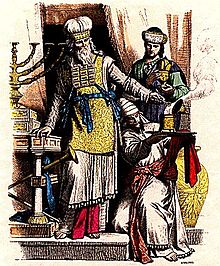
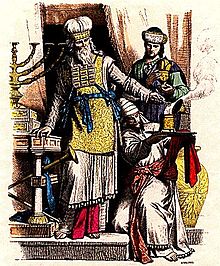
After David was annointed and made king, he brought back the Ark of the Covenant and it is clear that he sacrificed, something which subsequent to Mt. Sinai, only a priest would have done. He was also wearning an “Apron”, which is probably the ephod worn by the priests. A picture of the ephod (in yellow) is below. It look like an apron to me.

Eating the holy bread. Sacrificing. Wearing the ephod. So yes, I think David was a priest.
http://upload.wikimedia.org/wikipedia/commons/thumb/c/c2/PLATE4DX.jpg/220px-PLATE4DX.jpg

-Tim-
No he was not a priest.

oce.catholic.com/index.php?title=King_David
 
In any case, he was a King and as far as I know, kings and priests had two different roles in society. Priests were pretty busy guys in those days - don’t think they had time to do Kingly stuff as well.
In fact Saul was “deposed” as king by God specifically because he disobeyed the command and took on the priestly role of offering the sacrifice, rather than waiting for the priests.
 
I appreciate everyon’s replies.

Most of the repliesfocus on David’s geaneology, which does not trace back to the Levites. I’m sure David was of the tribe of Judah, as was his descendent Jesus. I know that Levites were the ordinary and normal means by which Israel recieved her priests but Jesus was not of the tribe of Levi and he is our Great High Priest. Why can’t David, as a type of Christ, also be a priest, or at least assume priestly roles as a forshadowing of Christ?

Only puzzleannie’s response addresses my point about sacrifice. And I think that further proves that David was a priest (or at least a forshadowing of Christ’s great high priesthood). If Saul assumed the priestly role and was deposed for it, then why not David? David clearly sacrificed and yet was not deposed. Does this not prove the validity or God’s acceptance of his having assumed a priestly role?

No one has addressed David’s wearing of the ephod. I’ll admit that there is wiggle room here as the Bible is not explicit in stating that it was the priestly ephod, but only that it was a linen apron. But the similarities are striking, especially in light of the fact that David sacrificed.

Not only does the Bible clearly have David assuming the actions and role of a priest in certain circumstances, but it also states explicitly that he was a prophet. The link to the Original Catholic Encyclcopedia provided by thistle states:

David was not merely king and ruler, he was also a prophet. “The spirit of the Lord hath spoken by me and his word by my tongue” (II Kings, xxiii, 2) is a direct statement of prophetic inspiration in the poem there recorded. St. Peter tells us that he was a prophet (Acts, ii, 30).

If a prophet, then why not a priest? Did he not eat the Bread of the Presence that only a priest could lawfully eat?

I still say yes, he was a priest, or at a minimum, he was assuming priestly roles as a prefigurement of Christ

-Tim-
 
"Have you not read what David did when he and his companions were hungry, how he went into the house of God and ate the bread of offering, which neither he nor his companions but only the priests could lawfully eat? Or have you not read in the law that on the sabbath the priests serving in the temple violate the sabbath and are innocent?
Even Jesus Himself claims that David and his companions COULD NOT eat the bread because they weren’t priests.

What more proof do you need?
 
I appreciate everyon’s replies.

Most of the repliesfocus on David’s geaneology, which does not trace back to the Levites. I’m sure David was of the tribe of Judah, as was his descendent Jesus. I know that Levites were the ordinary and normal means by which Israel recieved her priests but Jesus was not of the tribe of Levi and he is our Great High Priest. Why can’t David, as a type of Christ, also be a priest, or at least assume priestly roles as a forshadowing of Christ?

Only puzzleannie’s response addresses my point about sacrifice. And I think that further proves that David was a priest (or at least a forshadowing of Christ’s great high priesthood). If Saul assumed the priestly role and was deposed for it, then why not David? David clearly sacrificed and yet was not deposed. Does this not prove the validity or God’s acceptance of his having assumed a priestly role?

No one has addressed David’s wearing of the ephod. I’ll admit that there is wiggle room here as the Bible is not explicit in stating that it was the priestly ephod, but only that it was a linen apron. But the similarities are striking, especially in light of the fact that David sacrificed.

Not only does the Bible clearly have David assuming the actions and role of a priest in certain circumstances, but it also states explicitly that he was a prophet. The link to the Original Catholic Encyclcopedia provided by thistle states:

David was not merely king and ruler, he was also a prophet. “The spirit of the Lord hath spoken by me and his word by my tongue” (II Kings, xxiii, 2) is a direct statement of prophetic inspiration in the poem there recorded. St. Peter tells us that he was a prophet (Acts, ii, 30).

If a prophet, then why not a priest? Did he not eat the Bread of the Presence that only a priest could lawfully eat?

I still say yes, he was a priest, or at a minimum, he was assuming priestly roles as a prefigurement of Christ

-Tim-
Everyone here is telling you David was NOT a priest. Why don’t you believe that. Nothing you have quoted or suggested supports your claim.

David was NOT a priest.
 
Everyone here is telling you David was NOT a priest. Why don’t you believe that. Nothing you have quoted or suggested supports your claim.

David was NOT a priest.
Timothy’s thoughts are well said. His reasoning that David sacrificed and was not punished by God, whereas Saul sacrificed and was punished by God are telling. I think Jesus’ words are the most sound in arguing against David’s priesthood, but I’d rather use that than claim the since we’re the majority, then we are right.

One does not follow the majority because its the majority.
 
Everyone here is telling you David was NOT a priest. Why don’t you believe that. Nothing you have quoted or suggested supports your claim.

David was NOT a priest.
I was kinda hoping for more of a scholarly discussion, rather than a lecture or a yes/no answer, maybe a quote or two from the Early Church Fathers or the requisite cut and paste from the Haydock commentary. 🤷

OK, I see everyone’s point that David could not lawfully eat the bread because he was not a priest. I believe at the time this event took place, he had not yet been anointed king. But later he sacrifices and wears the ephod.

David was clothed in a robe of fine linen, as were all the Levites who carried the ark, the singers, and Chenaniah, the leader of the chant; David was also wearing a linen ephod. (1 Chronicals 15:27)

When David had finished offering up the holocausts and peace offerings, he blessed the people in the name of the LORD, (1 Chronicles 16:2)


God had taken the common priesthood away from the male head of every houshold and gave it to the Levites at Mt. Sinai because they alone stood with Moses in not worshipping the calf. The more I think about it, the more I see David’s priestly actions as a uniting of the king/priest role that was seperated at Mt. Sinai, or a prefigurement of the reuniting of that role in the common prieshood of Christ under the New Covenenant.

I appreciate the conversation. Given the intellectual horsepower behind some of the names who replied to this thread, your opinions and the fact that you all took time to reply to my question mean more to me than you all know. I remain unconvinced that David was not a priest or that he did not assume a priestly role as a prefigurment of Christ. But I don’t want to beat the issue over the head for the sake of pride, going on and on in an effort to try to win an argument or the pride of trying to convince anyone. Once a thread gets contentious, I bow out for the sake of peace - my own peace mostly. I’ll continue my research on my own.

I hope the Peace of Christ is with you all.

-Tim-
 
I think so. Or at a minimum, there is a connection with - possibly a prefigurement - of the common priesthood of Christ in which we all share. Here is what I think. I would welcome any comments.

Although both he and David were anointed by Samuel, I don’t think Saul was a priest. Of David however, the Bible says…

So the priest gave him holy bread, for no other bread was on hand except the showbread which had been removed from the LORD’S presence and replaced by fresh bread when it was taken away. (1 Samuel 21:7)

David and his men ate the Holy Bread, the Bread of the Presence from the temple, which only priests were allowed to eat. He ate this even though he was not yet anointed by Samuel. Jesus references event in Matthew 12.

At that time Jesus was going through a field of grain on the sabbath. His disciples were hungry and began to pick the heads of grain and eat them. When the Pharisees saw this, they said to him, “See, your disciples are doing what is unlawful to do on the sabbath.” He said to them, "Have you not read what David did when he and his companions were hungry, how he went into the house of God and ate the bread of offering, which neither he nor his companions but only the priests could lawfully eat? Or have you not read in the law that on the sabbath the priests serving in the temple violate the sabbath and are innocent? I say to you, something greater than the temple is here. If you knew what this meant, ‘I desire mercy, not sacrifice,’ you would not have condemned these innocent men. For the Son of Man is Lord of the sabbath." (Matthew 12:1-8)

Jesus equates his own disciples violation of the sabbath with David’s eating of the Holy Bread, and even points out that the priests violate the sabbath by working “and are innocent.” In doing this, he is placing both himself and King David on the same level as the priests in the temple, saying that as the priests are innocent by virtue of their preisthood, so too is David and himself and his disciples. He then takes it a step further, stating that he is in fact greater than, and master of the sabbath.

The point is that Jesus says that the priests are innocent, and if King David and Jesus and his disciples are also innocent, they must be priests as well. It is, I think, a revelation to us of the common priesthood in which we all share.

When it was reported to King David that the LORD had blessed the family of Obed-edom and all that belonged to him, David went to bring up the ark of God from the house of Obed-edom into the City of David amid festivities. As soon as the bearers of the ark of the LORD had advanced six steps, he sacrificed an ox and a fatling. Then David, girt with a linen apron, came dancing before the LORD with abandon, (2 Samuel 6:12-14)

After David was annointed and made king, he brought back the Ark of the Covenant and it is clear that he sacrificed, something which subsequent to Mt. Sinai, only a priest would have done. He was also wearning an “Apron”, which is probably the ephod worn by the priests. A picture of the ephod (in yellow) is below. It look like an apron to me.

Eating the holy bread. Sacrificing. Wearing the ephod. So yes, I think David was a priest.

http://upload.wikimedia.org/wikipedia/commons/thumb/c/c2/PLATE4DX.jpg/220px-PLATE4DX.jpg

-Tim-
In typology for sure, since our Lord Jesus Christ is both high priest according to the order of Melchizedek, and King of Kings.

Eventhough King David was of the tribe of Judah and not of the tribe of Levi, there were other scriptures beside the one you cited to indicate a unique relationship that King David had with the God of Abraham, Isaac and Jacob. If one were to follow his relationship with God with regard to the ark of the covenant, one will see that he communed with God in the tent in which the ark of the covenant was placed. There is no other reference of a high priest or anyone who had communed with God within the Holy of holies on such a personal level except for Moses.

There is a king of Judah who attempted to offer sacrifices, and he was disciplined by God for doing so…I think his name was King Uzziah.
 
I was kinda hoping for more of a scholarly discussion, rather than a lecture or a yes/no answer, maybe a quote or two from the Early Church Fathers or the requisite cut and paste from the Haydock commentary. 🤷

OK, I see everyone’s point that David could not lawfully eat the bread because he was not a priest. I believe at the time this event took place, he had not yet been anointed king. But later he sacrifices and wears the ephod.

David was clothed in a robe of fine linen, as were all the Levites who carried the ark, the singers, and Chenaniah, the leader of the chant; David was also wearing a linen ephod. (1 Chronicals 15:27)

When David had finished offering up the holocausts and peace offerings, he blessed the people in the name of the LORD, (1 Chronicles 16:2)

God had taken the common priesthood away from the male head of every houshold and gave it to the Levites at Mt. Sinai because they alone stood with Moses in not worshipping the calf. The more I think about it, the more I see David’s priestly actions as a uniting of the king/priest role that was seperated at Mt. Sinai, or a prefigurement of the reuniting of that role in the common prieshood of Christ under the New Covenenant.

I appreciate the conversation. Given the intellectual horsepower behind some of the names who replied to this thread, your opinions and the fact that you all took time to reply to my question mean more to me than you all know. I remain unconvinced that David was not a priest or that he did not assume a priestly role as a prefigurment of Christ. But I don’t want to beat the issue over the head for the sake of pride, going on and on in an effort to try to win an argument or the pride of trying to convince anyone. Once a thread gets contentious, I bow out for the sake of peace - my own peace mostly. I’ll continue my research on my own.

I hope the Peace of Christ is with you all.

-Tim-
Tim,

Have you thought to ask an apologist on this forum? This might help. I do not think there is anything in the Magisterial Teaching to support your premise. I am still looking, but have not found anything.

The fact that it is absent from Church Teaching or early documents speaks for itself, to me that is. If it was an important thing or if this was really the case, someone else would have deduced this and made a statement. But there have been no writings thus far that I have found to support your premise.

God bless.
 
In typology for sure, since our Lord Jesus Christ is both high priest according to the order of Melchizedek, and King of Kings.

Eventhough King David was of the tribe of Judah and not of the tribe of Levi, there were other scriptures beside the one you cited to indicate a unique relationship that King David had with the God of Abraham, Isaac and Jacob. If one were to follow his relationship with God with regard to the ark of the covenant, one will see that he communed with God in the tent in which the ark of the covenant was placed. There is no other reference of a high priest or anyone who had communed with God within the Holy of holies on such a personal level except for Moses.

There is a king of Judah who attempted to offer sacrifices, and he was disciplined by God for doing so…I think his name was King Uzziah.
Actually he was not disciplined for offering sacrifices, he was disciplined for reaching out to touch the Ark of God.

God bless.
 
Actually he was not disciplined for offering sacrifices, he was disciplined for reaching out to touch the Ark of God.

God bless.
Yes, there was an Uzziah who touched the Ark of God and died, but there was also King Uzziah:

2 Chronicles 26:16-20
New American Standard Bible (NASB)

*Pride Is Uzziah’s Undoing
16 But when he became strong, his heart was so [a]proud that he acted corruptly, and he was unfaithful to the LORD his God, for he entered the temple of the LORD to burn incense on the altar of incense. 17 Then Azariah the priest entered after him and with him eighty priests of the LORD, valiant men. 18 They opposed Uzziah the king and said to him, “It is not for you, Uzziah, to burn incense to the LORD, but for the priests, the sons of Aaron who are consecrated to burn incense. Get out of the sanctuary, for you have been unfaithful and will have no honor from the LORD God.” 19 But Uzziah, with a censer in his hand for burning incense, was enraged; and while he was enraged with the priests, the leprosy broke out on his forehead before the priests in the house of the LORD, beside the altar of incense. 20 Azariah the chief priest and all the priests looked at him, and behold, he was leprous on his forehead; and they hurried him out of there, and he himself also hastened to get out because the LORD had smitten him. *

God bless, you too.
 
Yes, there was an Uzziah who touched the Ark of God and died, but there was also King Uzziah:

2 Chronicles 26:16-20
New American Standard Bible (NASB)

*Pride Is Uzziah’s Undoing
16 But when he became strong, his heart was so [a]proud that he acted corruptly, and he was unfaithful to the LORD his God, for he entered the temple of the LORD to burn incense on the altar of incense. 17 Then Azariah the priest entered after him and with him eighty priests of the LORD, valiant men. 18 They opposed Uzziah the king and said to him, “It is not for you, Uzziah, to burn incense to the LORD, but for the priests, the sons of Aaron who are consecrated to burn incense. Get out of the sanctuary, for you have been unfaithful and will have no honor from the LORD God.” 19 But Uzziah, with a censer in his hand for burning incense, was enraged; and while he was enraged with the priests, the leprosy broke out on his forehead before the priests in the house of the LORD, beside the altar of incense. 20 Azariah the chief priest and all the priests looked at him, and behold, he was leprous on his forehead; and they hurried him out of there, and he himself also hastened to get out because the LORD had smitten him. *

God bless, you too.
OH wow! Thanks so much for sharing that. I learned something new. I had thought that they were both one and the same.

God bless.
 
Tim,

I agree with the “priestly functions” that David did. And it would seem to pre-figure the dual role that Jesus would have - as King and High Priest. But David was definitely not the high priest… Samuel was and then Nathan, perhaps?

The reason I hesitate to agree with you is the words that Jesus used. Can you please give me your opinion to that? Jesus clearly stated that David and his companions could not lawfully eat the bread.
 
Also, perhaps you can look at some of Scott Hahn’s writings. He’s mentioned the linen cloth that David wore, which only the high priest was supposed to wear (in specific reference to dancing in front of the Arc). I don’t remember what his conclusions were. There is a study on his St. Joseph site that covers this. I may take a look at it.

I’ll also look at my Navarre Bible and see if it says anything about this.

No matter what others may say, this is a good topic. I love to see one stand against many…
 
Also, perhaps you can look at some of Scott Hahn’s writings. He’s mentioned the linen cloth that David wore, which only the high priest was supposed to wear (in specific reference to dancing in front of the Arc). I don’t remember what his conclusions were. There is a study on his St. Joseph site that covers this. I may take a look at it.

I’ll also look at my Navarre Bible and see if it says anything about this.

No matter what others may say, this is a good topic. I love to see one stand against many…
Not one against many… all for the truth!

I read some websites which stated that David assumed a priestly role such as sacrificing and wearing the ephod but did not perform any priestly functions which were reserved excusively for the Levites, such as carrying the Ark and such.

Yes, Jesus clearly stated that David ate the Holy Bread which it was not lawful for him to eat. I’ll quote it again.

At that time Jesus was going through a field of grain on the sabbath. His disciples were hungry and began to pick the heads of grain and eat them. When the Pharisees saw this, they said to him, “See, your disciples are doing what is unlawful to do on the sabbath.” He said to them, “Have you not read what David did when he and his companions were hungry, how he went into the house of God and ate the bread of offering, which neither he nor his companions but only the priests could lawfully eat? Or have you not read in the law that on the sabbath the priests serving in the temple violate the sabbath and are innocent? I say to you, something greater than the temple is here. If you knew what this meant, ‘I desire mercy, not sacrifice,’ you would not have condemned these innocent men. For the Son of Man is Lord of the sabbath.” (Matthew 12:1-8)

David breaks the law of the temple but is not punished for it. The priests violate the sabbath and are not punished for it. Jesus disciples were accused of violating the sabbath for rolling the heads of grain in their hands - supposedly doing work - and they too should not be punished. “You would not have condenmed these innocent men.”

Jesus has placed his disciples at the level of the men with King David who at the Holy Bread and at the same level as the priests who violate the sabbath and are innocent. If this didn’t infuriate the Pharisees, his elevation of himself to the status of God by saying “the son of man is Lord of the sabbath” (see Genesis 2:2-3) must have.

Actually, I think the passage has very little to do with King David’s status. That is not what Jesus was getting at anyway. He was using a rabinnical teaching technique of comparing his actions to the actions of someone in the Old Testament. The formula is, *Have you not read…? Have you not read…? I say to you… * Paul uses a similar rabbinical teaching formula in 1 Corinthians 6, repeatedly saying, Do you not know…? followed by a citation of something from the Old Testament and then Then why do you…? in reference to the behavior of the Corinthians.

Though David’s status is not Jesus’ main point, it is interesting, and it is undeniable that
David ate the Holy Bread in violation of temple law. But the fact that he was not not only given the bread by the priest Ahimelech, but that he was not punished for it is significant. It shows that he was not permitted, or at least not prohibited from acting in a priestly role in some way.

To place the focus back on what it means, rather than debate for debate’s sake, I think it is a forshadowing of the return of the priest/king in Jesus, as well as a statement about the common priesthood of all men, which was lost at Mt. Sinai.

-Tim-
 
If one were to follow his relationship with God with regard to the ark of the covenant, one will see that he communed with God in the tent in which the ark of the covenant was placed. There is no other reference of a high priest or anyone who had communed with God within the Holy of holies on such a personal level except for Moses.
Got chapter and verse?

-Tim-
 
Status
Not open for further replies.
Back
Top