Another proof is that from all Canaanite deities, YHWH is the only one that isn’t represented by idols at all!!!

(a “statue” of YHWH was never ever found, while you can find “statues” of all other gods)
Actually aniconism per se wasn’t unique to the Israelites, although the active ban on making images of the divine was.
Scholars generally define two types of aniconism, both related to one another:
material aniconism, which refrains from using effigies, but rather makes use of abstract images or symbols - like
poles (
'asherah) or
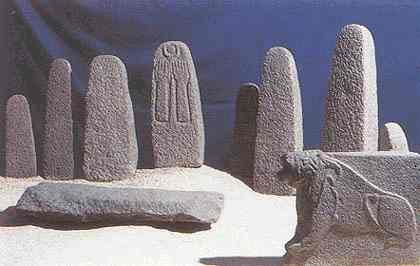
standing stones (
maṣṣeboth) to symbolize the divine (cf. Greek
xoanon and the Hindu
lingam), and
empty space aniconism, which makes use of an empty space as a symbol for the god’s presence. Genuine West Semitic (Canaanite) religion in general was aniconic: for most West Semitic religions, a sacred place meant an open-air
temenos with stelae. (There were exceptions to this, particularly in areas like cities, where we have evidence of iconic cults.) Now there are some cultures, like the Phoenicians who favored the ‘sacred emptiness’-type of aniconism: very often what was chosen was the image of an empty throne or animals like bulls, where the deity is envisioned to sit or ride upon.
West Semitic aniconism wasn’t of the “thou shalt not make any graven image” type, as the Israelite version was: while the norm amongst the majority was to use abstract symbols, there was nothing which prevented the use of actual effigies or figurines to represent gods. It was not a question of prohibition, but of preference and mentality.
We could see that the early Hebrews originally held the former, although they would also eventually adopt the latter. Within the Old Testament we often hear of
maṣṣeboth being set up in commemoration of some event (usually a divine revelation) or in memory of someone. On at least four occasions, Jacob sets up a standing stone in connection with certain events of his life: the most well-known is, of course, after he receives the vision of the stairway reaching to heaven in Luz/Bethel (Genesis 28:18). In Genesis 31 (v. 45-54), Jacob erects another stone, as well as a mound, as a witness of his decision to leave Laban. After his return to Bethel, God appears again to Jacob, and once more, Jacob erects yet another
maṣṣebah in memory of this (Genesis 35:14-15). Not too long after this event, Rachel dies and Jacob sets up one last stone in his wife’s grave (35:20). Also, God’s covenant with Israel through Moses was represented by twelve
maṣṣeboth erected at the foot of Mount Sinai, one stone for each tribe (Exodus 24:4). Finally, the book of Joshua also records a number of times that such monuments were erected pointing to the power of God: in Joshua 4:20-24 for example, Joshua sets up twelve stones taken from the Jordan in memory of Israel’s miraculous crossing of the river. Near the end of his life, after Joshua challenged the Israelites to serve God, he takes a large stone and sets it “under the oak that was in the sanctuary of Yhwh” as a witness against them should they deny the Lord (24:25-27).
It was not a huge step from the idea of the standing-stone as a sign of the presence of the divine or the manifestation of a god to accepting the stone itself as a representation of the deity, and there was not need for it to be hewn in the shape of a statue: even in its crude, natural shape, the
maṣṣebah is a symbol of the god. In latter days, the connection between
maṣṣeboth and worship of false gods seems to have strengthened to the point that even making one was eventually frowned upon altogether.
The cherubim in the Ark of the Covenant and in Solomon’s Temple, as well as the golden calf (and Jeroboam’s calves) all seem to be representatives of the latter category of empty space aniconism: the cherubim (we shouldn’t imagine here the cute babies of the Renaissance, but rather the
winged men or
human-animal hybrids of Ancient Near Eastern and Egyptian iconography) and the ‘calves’ are envisioned to be the steeds and/or the throne of the invisible Yhwh, the “Rider of the cherubim.”
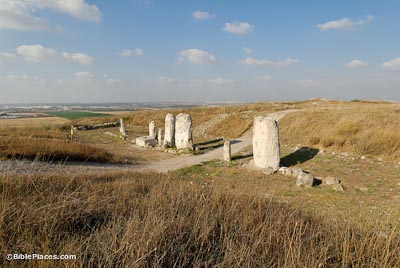
Standing stones (Gezer)

Standing stones (Hazor)

Standing stone (Shechem)
http://www.bu.edu/anep/BethShanthrone.gif
Empty throne (Beth-Shan)

Empty throne (Tyre)
We do not know exactly when the Israelites, which eventually rejected even standing stones in its cult, moved from West Semitic
de facto aniconism to a programmatic one (which is close to iconoclasm but developing out of the aniconic tendency of an earlier time). We can already see its signs however by the 7th century BC, when Judahite name seals show a clear tendency towards aniconicity, a tendency that is not exclusive but begins even further back and then becomes quite pronounced. (There are two other Semitic peoples which moved from
de facto standing-stone aniconism to iconoclasm: the Nabataeans and the Arabs.)
Some, however, think that the best way to interpret the evidence is thus: aniconism was the official, dominant position throughout Israelite history, but it was not totally uniform. (For example, Moses’ bronze serpent - which was later became a focus of worship - and Micah’s silver idol.) From earliest times, the main or official cult of the God of Israel was largely aniconic, as represented in its leaders and its sanctuaries. At earlier times, a number cultic paraphernalia that were later regarded as ‘idols’ seem to have been tolerated in some circles, but were eventually condemned outright by major elements of the official cult (for example, prophets and kings). At the same time, unofficial, domestic cults and extramural shrines were probably more open to iconography and maybe even outright housed images of the Deity - which is also eventually frowned upon.




 BTW I always wanted to ask… do you have a degree in History, or you are just very interested in the subject/read a lot? You seem to know a lot