What do we know about Yahweh's coins? Don't they violate the second commandment?

  • Thread starter Thread starter minichibi
  • Start date Start date
Status
Not open for further replies.
Didn’t these coins violate the Second Commandment? Why did the Hebrews use it?

First off, we know from the OT itself that the Israelites did not always follow the commandments. Secondly (this is the most important question), are you sure that this is an Israelite coin as opposed to some other contemporary Canaanite culture? If so, why?
 
The 2nd Commandment in Catholicism is “Thou shalt not take the name of the Lord thy God in vain.” In your denonination, what is the 2nd commandment?
Graven images
 
First off, we know from the OT itself that the Israelites did not always follow the commandments. Secondly (this is the most important question), are you sure that this is an Israelite coin as opposed to some other contemporary Canaanite culture? If so, why?
They have several pagan images on them such as the wheel with a centered cross in the middle, and Assyrian style wings on it. When I first saw it I immediately associated it with Assyria, not the Israelites.
 
Didn’t these coins violate the Second Commandment? Why did the Hebrews use it?
The Hebrews were a “CONQUERED” people and had to trade and buy stuff to survive. Therefore there where many different coins being used in circulation that belonged not to them but to the ruler in turn.

Those coins were not accepted for the temple alms giving where.
In fact in the NT we see Jesus kicking out the money exchangers from the temple that made huge profits from the practice that the Temple priests had instituded of only accepting “Temple coins” here there is an example from the page where you found the one you linked.

upload.wikimedia.org/wikipedia/commons/8/8e/Half_Shekel.jp

Basically the Temple coins could not have any man image.

We also see this in the passage where the pharisees wanted to have Jesus say not to pay taxes to Caesar, but Jesus asks Pilatus to show him a coin whereby He asked him “whose image is that in the coin” at the response from Pilatus Jesus gave us the famous phrase: “Render to Ceasar what is Caesar’s and to God what is to God’s”

Also the Israelites were not forbidden to make any images, they could and did make statues and big ones at that, of: Cherubims.
They were placed in the Holy of Holies of the Temple in Jerusalem and also could represent grain, flowers, trees, etc.
They could not make statues of humans or animals as those had been used to represent gods in the cultures they had interacted with.

This does not contradict in any way our current tradition in the Catholic Church as we do not make statues of God either. In fact our statues represent people that are in Heaven and certainly we do NOT worship them.
 
The Hebrews were a “CONQUERED” people and had to trade and buy stuff to survive. Therefore there where many different coins being used in circulation that belonged not to them but to the ruler in turn.

Those coins were not accepted for the temple alms giving where.
In fact in the NT we see Jesus kicking out the money exchangers from the temple that made huge profits from the practice that the Temple priests had instituded of only accepting “Temple coins” here there is an example from the page where you found the one you linked.

upload.wikimedia.org/wikipedia/commons/8/8e/Half_Shekel.jp

Basically the Temple coins could not have any man image.
Fun fact: the Tyrian shekel used in the Temple at the time of Jesus did have graven images on it, namely that of the eagle of Tyre and a profile of Melqart-Heracles.

http://www-scf.usc.edu/~ciccone/images/tyrian shekel 5 in.jpg
 
They have several pagan images on them such as the wheel with a centered cross in the middle, and Assyrian style wings on it. When I first saw it I immediately associated it with Assyria, not the Israelites.
And even then, that’s not a reliable indicator since artistic styles circulate widely (look at the Phoenicians’ adoption of facets of Egyptian art for example). The thing about Levantine Canaanite cultures is that they are so highly similar to each other that even archaeologists sometimes have a hard time guessing who occupied which particular site. I mean, most of them spoke what is ultimately the same language (with some peculiar local quirks of their own of course), used the same writing system, had pretty much the same material culture. (The Israelites, probably because of the ban against images, did not develop any unique art of their own or contributed in a big way to arts and crafts - they were content to adopt the art of their neighbors, which was already pretty much the same to begin with anyway.) Heck, there were also some similarities in religious practices and beliefs.
 
Coins were used for writing and drawing. Not that much different than using paper or computer gif today, I would think.
 
I did see the following from Wikipedia:

Unlike later Jewish coinage, Yehud coins depict living creatures, flowers and even human beings, in contravention of the Second Commandment “Thou shalt not make for thyself a sculptured image or any likeness” (Exodus 20:4). During the First Temple period figural art was frequently used, such as the cherubim over the Ark of the Covenant, the twelve oxen that supported the giant laver in front of Solomon’s Temple, etc. Thus, it is likely that the Yehud coins are continuing the use of figural art from the previous period. The prohibition against graven images in Exodus was probably seen as relating only to idolatrous images rather than the purely decorative. Depictions on the coinage include imagery borrowed from other cultures, such as the Athenian Owl, mythological creatures, and perhaps even images of Jewish rulers.** One coin depicts an enthroned deity, claimed by some experts to be Yahweh, while this is disputed by others. It has been suggested recently that this coin was actually minted in Samaria and depicts Samarian Yahweh.**

So yes, it could be possible that this 4th century BC coin is a depiction of Yhwh (or rather, Yhw - which is what the inscription says), but we are not totally sure. At least, the winged wheel seems to evoke for some people the vision of Ezekiel. We aren’t even sure who minted the coin in question: whether it was the Jews themselves or the Persian authorities of Yehud. I’ve seen a number of alternative ideas, one of which is to the effect that this is a syncretistic, general template of a god (perhaps a solar deity) easily comprehensible to many people in the western part of the Persian Empire with the name of the Jewish God tacked on it.

You have to remember that early in their history, the Israelites seem to have had a pretty lax interpretation of the commandment against graven images. It seems that what is really forbidden is more the depiction of the Deity Himself, although as mentioned this rule is not always followed. Aniconism (the use of an abstract symbol or an empty space to symbolically represent a given deity) wasn’t unique to the Israelites: it was a common feature of West Semitic religions in general. The active prohibition against idols however was unique to them. Quoting myself for a moment from another thread:

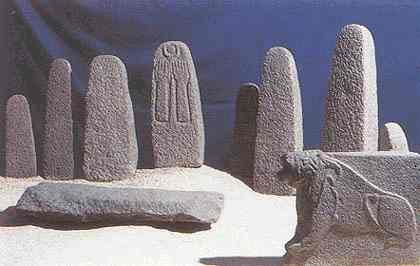
Scholars generally define two types of aniconism, both related to one another: material aniconism, which refrains from using effigies, but rather makes use of abstract images or symbols - like poles ('asherah) or standing stones (maṣṣeboth) to symbolize the divine (cf. Greek xoanon and the Hindu lingam), and empty space aniconism, which makes use of an empty space as a symbol for the god’s presence. Genuine West Semitic (Canaanite) religion in general was aniconic: for most West Semitic religions, a sacred place meant an open-air temenos with stelae. (There were exceptions to this, particularly in areas like cities, where we have evidence of iconic cults.) Now there are some cultures, like the Phoenicians who favored the ‘sacred emptiness’-type of aniconism: very often what was chosen was the image of an empty throne or animals like bulls, where the deity is envisioned to sit or ride upon.

West Semitic aniconism wasn’t of the “thou shalt not make any graven image” type, as the Israelite version was: while the norm amongst the majority was to use abstract symbols, there was nothing which prevented the use of actual effigies or figurines to represent gods. It was not a question of prohibition, but of preference and mentality.

We could see that the early Hebrews originally held the former, although they would also eventually adopt the latter. Within the Old Testament we often hear of maṣṣeboth being set up in commemoration of some event (usually a divine revelation) or in memory of someone. On at least four occasions, Jacob sets up a standing stone in connection with certain events of his life: the most well-known is, of course, after he receives the vision of the stairway reaching to heaven in Luz/Bethel (Genesis 28:18). In Genesis 31 (v. 45-54), Jacob erects another stone, as well as a mound, as a witness of his decision to leave Laban. After his return to Bethel, God appears again to Jacob, and once more, Jacob erects yet another maṣṣebah in memory of this (Genesis 35:14-15). Not too long after this event, Rachel dies and Jacob sets up one last stone in his wife’s grave (35:20). Also, God’s covenant with Israel through Moses was represented by twelve maṣṣeboth erected at the foot of Mount Sinai, one stone for each tribe (Exodus 24:4). Finally, the book of Joshua also records a number of times that such monuments were erected pointing to the power of God: in Joshua 4:20-24 for example, Joshua sets up twelve stones taken from the Jordan in memory of Israel’s miraculous crossing of the river. Near the end of his life, after Joshua challenged the Israelites to serve God, he takes a large stone and sets it “under the oak that was in the sanctuary of Yhwh” as a witness against them should they deny the Lord (24:25-27).
 
(Continued)

It was not a huge step from the idea of the standing-stone as a sign of the presence of the divine or the manifestation of a god to accepting the stone itself as a representation of the deity, and there was not need for it to be hewn in the shape of a statue: even in its crude, natural shape, the maṣṣebah is a symbol of the god. In latter days, the connection between maṣṣeboth and worship of false gods seems to have strengthened to the point that even making one was eventually frowned upon altogether.

The cherubim in the Ark of the Covenant and in Solomon’s Temple, as well as the golden calf (and Jeroboam’s calves) all seem to be representatives of the latter category of empty space aniconism: the cherubim (we shouldn’t imagine here the cute babies of the Renaissance, but rather the winged men or human-animal hybrids of Ancient Near Eastern and Egyptian iconography) and the ‘calves’ are envisioned to be the steeds and/or the throne of the invisible Yhwh, the “Rider of the cherubim.”


Standing stones (Gezer)


Standing stones (Hazor)


Standing stone (Shechem)

http://www.bu.edu/anep/BethShanthrone.gif
Empty throne (Beth-Shan)


Empty throne (Tyre)

We do not know exactly when the Israelites, which eventually rejected even standing stones in its cult, moved from West Semitic de facto aniconism to a programmatic one (which is close to iconoclasm but developing out of the aniconic tendency of an earlier time). We can already see its signs however by the 7th century BC, when Judahite name seals show a clear tendency towards aniconicity, a tendency that is not exclusive but begins even further back and then becomes quite pronounced. (There are two other Semitic peoples which moved from de facto standing-stone aniconism to iconoclasm: the Nabataeans and the Arabs.)

Some, however, think that the best way to interpret the evidence is thus: aniconism was the official, dominant position throughout Israelite history, but it was not totally uniform. (For example, Moses’ bronze serpent - which was later became a focus of worship - and Micah’s silver idol.) From earliest times, the main or official cult of the God of Israel was largely aniconic, as represented in its leaders and its sanctuaries. At earlier times, a number cultic paraphernalia that were later regarded as ‘idols’ seem to have been tolerated in some circles, but were eventually condemned outright by major elements of the official cult (for example, prophets and kings). At the same time, unofficial, domestic cults and extramural shrines were probably more open to iconography and maybe even outright housed images of the Deity - which is also eventually frowned upon.

The strict view (avoidance of any figural depictions whatsoever) only became the norm starting from the late Hellenistic to the Hasmonean period, although as you can see the trend was already slowly moving towards it for quite some time. The reason for this change of views is unclear; some suggestions include (1) as a reaction against the forced eradication of Jewish customs by the Seleucids and the desecration of the Temple by Antiochus Epiphanes; (2) a more stringent position reflecting the Sadducean position, who were generally in control of affairs in Jewish Palestine in the late Second Temple period (except for the era of Salome in 76-67 BC, when their rivals the Pharisees dominated); (3) as a part of the Hasmonean campaign to cultivate and assert a unique Jewish identity; and (4) a general reaction against Hellenization and the threat of foreign influences.

Of course, this trend soon shifted back after the Bar Kochba revolt in AD 132-135, when Jews began to embrace art once more (cf. the Dura Europos synagogue in Syria, as well as Byzantine-era synagogues in Palestine). Again, there are a number explanations for the reintroduction of figural representation (not necessarily mutually exclusive): increasing Hellenization, increasing minority status which made the need the accomodation to the outside world more pressing, the slow decline of paganism and the perception that images are not really a threat to Jews and Judaism after all.

http://cojs.org/cojswiki/images/thu...d_Man.jpg/300px-Yehud_Coin_of_Bearded_Man.jpg
 
Status
Not open for further replies.
Back
Top