What happened to the healing Angel at the pool near the Sheep Gate after the Crucifixion?

  • Thread starter Thread starter IwishIknew
  • Start date Start date
Status
Not open for further replies.
I

IwishIknew

Guest
Does anyone know of what happened to the healing waters that were troubled (by an Angel) at the Pool of Beth-zatha (Bethseda) after the Crucifixion and the tearing of the temple curtain? Wondering if the waters no longer offered healing prior to the fall of Jerusalem.
 
Thanks. I’m wondering if there is any account of what happened to the waters prior to the fall of Jerusalem (70 AD). Did the Angel quit coming? Did the waters quit healing after the Crucifixion? Does anyone know, is there any account?
 
Just to add a description of the pool itself.

There were two large basins: the northern pool, measuring 53 x 40 meters, which served as a reservoir (or otṣar) for collected rainwater, and the southern pool (47 x 52 meters) which served as the ritual pool (miqveh). The two pools would have been surrounded by galleries or porticoes on all four sides, with an additional portico extending across the massive 6-meter barrier wall separating the two basins (cf. John 5:2 “Now there is in Jerusalem by the sheep gate a pool, which is called in Hebrew Bethesda, having five porticoes”).

Within the massive barrier wall, there was a vertical shaft which led to a horizontal tunnel with a sluice gate at the bottom, which meant that the water of the otṣar to the north could easily have come into contact with with the water of the miqveh to the south by simply lifting the sluice gate. Further on, at the lower level of the tunnel, there was a covered trough in which more than 1 cubic meter of valid water could have ‘mingled’ with the added water, before then rising and replenishing the waters of the southern pool. A sluice gate was opened at the far end of this trough when necessary, which then, in turn, led to a covered channel that helped drain surplus water away to the south.

The north pool, a dam or reservoir for rain water, and the sluice gate is thought to have already existed by the 8th century BC, before the Exile; the channel at this time brought a steady stream of water from the reservoir into the city. By the early 2nd century BC, the bigger southern pool was constructed and the channel was enclosed.

A flight of steps facilitated access down to the very base of the pool, depending on the amount of water available there for bathing. These extended down along the entire western side of the southern pool (53 meters in length), with sets of steps in groups of one to six extending between landings. The landings at different intervals would have been used for the placing of the beds of disabled people.
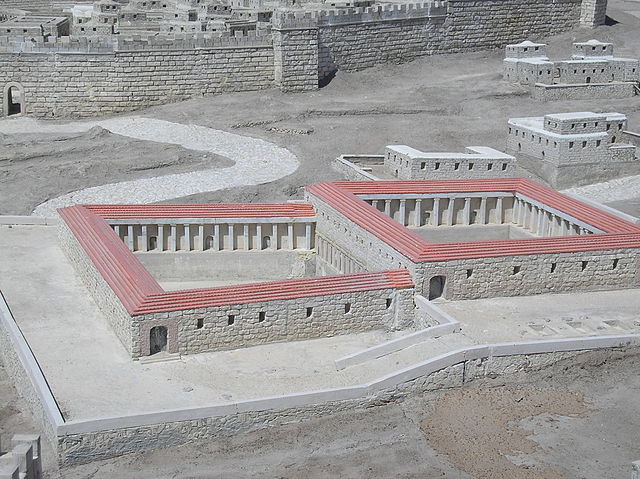


It is thought that the pool would have bubbled and frothed when the water was drained into the southern pool, which was what John was describing when the waters were “stirred up.”* In addition, layers of bright red soil trapped between geological layers, seen within the lower part of this area, may have contributed to the picture provided by early Christian writers such as Eusebius and Eucherius regarding the color of the stirred-up waters (Eusebius describes it as “of a ruddy color,” while Eucherius calls it “reddish”).
  • The thing is, many scholars think that the verse was not authentic, but could have been added by a scribe (who probably did not have any knowledge of the mechanics of the actual pool) who either tried to explain how the water was stirred or who recorded a popular belief about the water. There’s of course the fact that many early surviving manuscripts of John don’t have this portion, but also: (1) the verse has a vocabulary and syntax that is un-Johannine (i.e. it is not in keeping with the vocabulary and syntax of the rest of the Gospel); (2) several of the manuscripts that include the verses mark them with an asterisk or obelisk as if to mark it as spurious; and because there is a great amount of textual diversity among the witnesses that do include the verses. (In other words, the actual form of the verses differ across the manuscripts - you’d expect a little more consistency in the words if it was authentic.)

 
Thanks. I’m wondering if there is any account of what happened to the waters prior to the fall of Jerusalem (70 AD). Did the Angel quit coming? Did the waters quit healing after the Crucifixion? Does anyone know, is there any account?
Bethesda after the New Testament era continued to be used as an asclepion (a sort of healing sanctuary, a hospital-temple dedicated to the Greek god of health, Asclepius) before Christians built a church on it. There was actually a 2nd-century ex-voto of a marble foot (a common votive gift for healing shrines such as asclepions) donated by a Roman woman found in the site.

By the 4th century, a Christian pilgrim from what is now Bordeaux, France still testified to the water’s curative power:

And further in the city are twin pools, with five porticoes, which are called Bethsaida (John 5:2-18). There persons who have been sick for many years are cured; the pools contain water which is red when it is disturbed. There is also here a crypt, in which Solomon used to torture devils.

Note here that the pilgrim links the site with Solomon. Solomon in Jewish folklore was considered to be a healer and an exorcist; one who subdued demons and even made them do his bidding. Josephus already exhibits the ‘Solomon the healer’ tradition (Antiquities 8.45-49):

(45) God also enabled him to learn the technique against demons for the benefit and healing of humans. He composed incantations by which illnesses are relieved, and left behind exorcistic practices with which those binding demons expel them so that they return no more. (46) And this same form of healing remains quite strong among us until today. For I became acquainted with a certain Eleazar of my own people, who, in the presence of Vespasian and his sons, along with their tribunes and a crowd of soldiers, delivered those possessed by demons. The method of healing is as follows:

(47) Bringing up to the nose of the demonized person a ring that had under its seal a root from among those prescribed by Solomon, he [Eleazar] would then draw out the demonic [presence] through the nostrils, as the man sniffed. Upon the man’s immediately falling down, he adjured the demonic [presence] not to return to him again, making mention of Solomon and likewise reciting the incantations he had composed. (48) Eleazar, wishing to persuade and convince those present that he had this power, first placed a cup or foot-basin filled with water a short distance away and ordered the demonic [presence], which was now outside the person, to knock these over, and so cause the spectators to realize that he had left the person. (49) When this happened, the sagacity and wisdom of Solomon became evident through this. We felt bound to speak of these matters so that all might know the greatness of his nature and his closeness to God, and so that the king’s preeminence in every sort of virtue should not hidden from any of those beneath the sun.
 
Thanks for the info Patrick.

I live in the state of Georgia, USA, where the soil is red due to the high iron content. The same could account for the ruddy color of the water. Iron rich water has been used medicinally.

*Ferruginous: Waters rich in iron and its salts and oxides. Taken internally and externally, exerts a vitalizing, tonic effect in convalescence, and is therapeutic for various types of anemia. Contraindicated in gastroduodenitis with a tendency to hemorrhage or glomerulonephritis with a tendency to hemorrhage.

Read More…*

So do you think this was actually a mikveh used for ritual purification? I suppose any “living” water could have been used.
 
So do you think this was actually a mikveh used for ritual purification? I suppose any “living” water could have been used.
It certainly could be, since it counts as ‘living water’. (The Pool of Siloam is another miqveh.)

As an aside: while the common idea was that Bethesda only became an asclepion by the 2nd century (when the Emperor Hadrian kicked the Jews out of Jerusalem), there was this French scholar named Antoine Duprez who in the 1970s suggested - a bit controversially - that Bethesda was already a Greco-Roman asclepion during the time of Jesus. Anticipating any objection to his proposal, he pointed out that Bethesda at that time was still outside the walls of Jerusalem (it would not be included into the city until Herod Agrippa’s reign in 41-44), not to mention that it was close enough to Antonia Fortress. The Roman troops stationed there, he says, could have been behind the development of a Greco-Roman cult in the area.

Now Duprez’s theory was not accepted widely, since scholars found it hard to imagine that Jews before AD 70 could have put up with anything gentile within Jerusalem (we know from Josephus that they generally didn’t). But at the same time, it was pointed out that Duprez missed a possible analogy to his proposal: a tradition from the Mishnah implies that a pool dedicated to the Roman goddess Fortuna - Gad-YavanGad (Fortune = Fortuna) of the Greeks’ - was situated close to Siloam south of the city walls of Jerusalem before AD 70 (Mishnah Zavim 1.5). So even if there is a hesitancy to say that Bethesda pre-70 was already an asclepion, one can’t totally rule out the possibility of an influence of the Asclepius cult in the area.

Maureen W. Yeung (Faith in Jesus and Paul: A Comparison with Special Reference to “Faith that Can Remove Mountains” and “Your Faith Has Healed/Saved You”, p. 76) suggested that maybe what we have in Bethesda was a mixed situation: the pool attracted both Jews and non-Jews. The non-Jews, of course, attributed the healing properties of the water to gods of healing such as Asclepius or Serapis.
 
Thanks so much for all of your research into this. From a spiritual point of view, I wonder if the pool was miraculous (like Lourdes) or simply provided healing minerals - like many Roman Baths. Reading interpretations of Scripture, it seems like it was miraculous (for example the first person who entered the pool was healed of anything - which is why someone would wait decades if necessary to try to get into the pool at the moment it was disturbed). If miraculous, and if it continued to be so even 4 centuries after the Crucifixion of the Son of God and under pagan rule, it is insightful into the tremendous Mercy of God who although justly allowed the Temple to be destroyed, endures all evil continuing to express His Love through this miraculous gift - giving hope to all that are most in need.
 
I wonder–what is the date of the oldest manuscript that includes the angel? The attitude of too many scholars seems to be “if in doubt–throw it out”. Now many times it may be true that there are later additions which need to be removed–but not always. The bible seems to shrink more and more with each translation.

Is the angel mentioned in the Nova Vulgata? If it is then I would go with that.
 
Status
Not open for further replies.
Back
Top