T
ThomasToo
Guest
Could you please refer me to an article in a peer-reviewed journal of economics that supports this hypothesis?You could start with the link I posted previously.

Could you please refer me to an article in a peer-reviewed journal of economics that supports this hypothesis?You could start with the link I posted previously.
You’re asking for the equivalent of a peer reviewed journal article that shows that gravity causes apples to fall to earth, but here goes.Could you please refer me to an article in a peer-reviewed journal of economics that supports this hypothesis?
I’m doing no such thing. You’re making a gross assertion that may or may not be backed up by the facts. Interesting aside, the Congress is not peer reviewed, nor is it composed of economists nor is it an academic journal. But thank you for playing.You’re asking for the equivalent of a peer reviewed journal article that shows that gravity causes apples to fall to earth, but here goes.
house.gov/jec/cost-gov/regs/minimum/50years.htm
That is from the Congress of the United States of America.
If you pay him so little that he has to spend every waking hour at work just to keep body and soul together, he will never have time to seek out a better job, and improve his situation.
- I fail to see how this “inexorably leads to wage slavery.”
“What Causes Unemployment?”You’ve asserted twice that the minimum wage increases unemployment. Could you please refer me to an article in a peer-reviewed journal of economics that supports this hypothesis?
Not exactly peer-reviewed or for that matter it doesn’t really cite sources but it’s an interesting take on the question.“What Causes Unemployment?”
by Thomas Sowell
Capitalism Magazine
14 November 2005
“The net economic effect of minimum wage laws is to make less skilled, less experienced, or otherwise less desired workers more expensive – thereby pricing many of them out of jobs.” capitalismmagazine.com/economics/price-controls/4472-What-Causes-Unemployment.html
What is a peer review journal? knowledgecenter.unr.edu/instruction/help/peer.htmlNot exactly peer-reviewed or for that matter it doesn’t really cite sources but it’s an interesting take on the question.
What is a peer review journal? knowledgecenter.unr.edu/instruction/help/peer.html
The question is would you * pay an employee of yours* $10 and hour if he produced for you only $5 worth of wealth?
I don’t think Capitalism Magazine qualifies as peer reviewed (interesting aside, the same group of people that run CM also run abortionisprolife.com). I mean something like the Cambridge Journal of Economics or the Journal of Economics.
I’m not a business owner and most of the minimum wage jobs with which I am familiar are in the service industry and the question of producing wealth in that situation is a very sticky proposition. That said, are you actually defending the right of a business owner to pay a (much less than) living wage?
From my linkI don’t think Capitalism Magazine qualifies as peer reviewed (interesting aside, the same group of people that run CM also run abortionisprolife.com). I mean something like the Cambridge Journal of Economics or the Journal of Economics.
I tried to find one of his articles in a peer review journal, but found out you have to be a paid subscriber to view them. I think your requirement is asking too much, considering it is only your opinion that the one I provided was inadequate, and the limits of a forum like this.Articles in some scholarly and professional journals are not peer-reviewed, but are selected by an editor or board. Standards of scholarship in such journals are often equal or comparable to those of peer-reviewed publications, although this is not always the case.
I’m saying that asking someone to pay more is guaranteeing the worker will be unemployed, and I think Sowell explained why with his examples of 20th century America and France today.I’m not a business owner and most of the minimum wage jobs with which I am familiar are in the service industry and the question of producing wealth in that situation is a very sticky proposition. That said, are you actually defending the right of a business owner to pay a (much less than) living wage?
I’m sorry but this is not a convincing rebuttal. Note the fact that they are illegal, they are in the black market, they are not protected by the law and must work for employers who are willing to hire illegals. They can not effectively lower the cost for products and services over the entire market, they can only create specific cost reductions for the company they are working for.Ok. Assume that there are people willing to work 80 hours a week at $3.60/hour. They would be, after what most of us would consider a double work week, making less than what is now set is the minimum wage. If you would like to question this assumption there are numerous illegal immigrants working at this wage or less. (As we’ve shown above the income working full time at the minimum wage is not enough to support a family and is hardly enough to support an individual.)
As there are people willing to work for a pittance the market will favor them and there will be less opportunities available at what I think we are hard pressed to call anything other than ‘a fair day’s pay for a fair day’s work.’ As such, the market will drive wages downward beyond what people need to survive.
As I said above, the invisible hand has no compassion and we’re trying to set up a system that is just. A free market will not provide for the needs of the many when the few are willing to settle for less in the same way a free market will get away with any number of other offenses (e.g. sweat shop labor in the Third World, carcinogens in toys for children, incredibly unsafe working conditions, monopolies &c the list goes on, of course).
 ) , while they encouraged savings (debunking the “stimulating the economy” by spending lie), and third but not least they had a stable, sound dollar, convertible into gold.
Actually the idea of a ‘living wage’ originated in 1891 in the encyclical Rerum Novarum although that term, in the English translation, does not appear explicitly in the text.I think the idea of a “living wage” was concocted by politicians for the sole purpose of shifting more power to government. Just think of the regulations required to enforce a “living wage” law.
The notion of a living wage starts out with a huge flaw in its assumptions, which is that a family of four should be supportable on only one wage-earner making minimum wage. Middle class families invariably are two-wage-earner families.
I would tend to think that this amount is a bit too high for the minimum wage. On the other hand, it brings to mind the question of whether or not there should be a maximum wage?It should be over $250,000/year so that everyone can achieve social justice by paying taxes.
Yeah except it won’t reduce rents, or insurance premiums, or the cost of imported products, or goods not produced with minimum wage labour…With no minimum wage over an entire economy two things will happen; employment will reduce significantly(almost to zero) while products and services suddenly become more affordable(reducing the cost of living for those who are being paid less and privileged to be working)
I don;t see where businesses really want to eliminate illegal immigration. Many businesses will take advantage of the cheap labor.Ok. Assume that there are people willing to work 80 hours a week at $3.60/hour. They would be, after what most of us would consider a double work week, making less than what is now set is the minimum wage. If you would like to question this assumption there are numerous illegal immigrants working at this wage or less. (As we’ve shown above the income working full time at the minimum wage is not enough to support a family and is hardly enough to support an individual.)
As there are people willing to work for a pittance the market will favor them and there will be less opportunities available at what I think we are hard pressed to call anything other than ‘a fair day’s pay for a fair day’s work.’ As such, the market will drive wages downward beyond what people need to survive.
As I said above, the invisible hand has no compassion and we’re trying to set up a system that is just. A free market will not provide for the needs of the many when the few are willing to settle for less in the same way a free market will get away with any number of other offenses (e.g. sweat shop labor in the Third World, carcinogens in toys for children, incredibly unsafe working conditions, monopolies &c the list goes on, of course).
True, and when it comes to jobs that don’t involve contact with the general public, a Mexican is just as good as an American, at half or even a quarter of the price.I don;t see where businesses really want to eliminate illegal immigration. Many businesses will take advantage of the cheap labor.

This relies on the assumption that employers have nowhere to move, must raise prices with rising labour costs, and that employees have and will always get an optimum wage for their labour. It basically ignores the nineteenth-century labour movement, and the use third world labour.Wages are the price of labor. The price of labor–like the price of other goods–is determined by supply and demand. For every available good, there is a price at which the supply of the good matches perfectly with the demand for the good–the equilibrium price.
The law is sound, what is not sound is what the government chooses to interfere with.This relies on the assumption that employers have nowhere to move, must raise prices with rising labour costs, and that employees have and will always get an optimum wage for their labour. It basically ignores the nineteenth-century labour movement, and the use third world labour.
You are willfully turning a blind eye to the truth, refusing to look at any data that does not reinforce your presuppositions. You’ve conceded the point by your actions.I’m doing no such thing. You’re making a gross assertion that may or may not be backed up by the facts. Interesting aside, the Congress is not peer reviewed, nor is it composed of economists nor is it an academic journal. But thank you for playing.
In addition, a group of 650 economists who study and write on the subject (including 5 Nobel laureates and 6 past presidents of the American Economic Association) disagree with you (“Hundreds of Economists Say: Raise the Minimum Wage”).
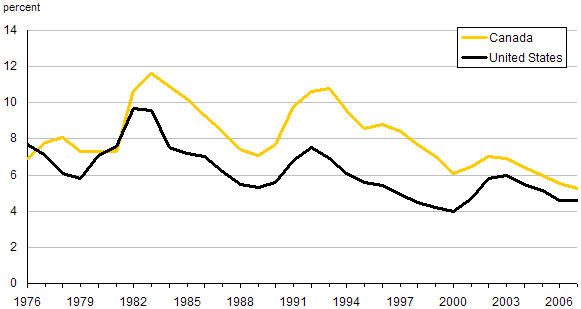
That is generally not true. Canadian unemployment, over the last 30 years had pretty much consistantly been 1-3 percentage points HIGHER than that of the USWell, I’m no economist, but the poor in Canada and Europe are much better off than in the States. **Canadian unemployment is lower than American unemployment. **.