What is a Monsignor?

  • Thread starter Thread starter TimothyH
  • Start date Start date
Status
Not open for further replies.
T

TimothyH

Guest
What is a Monsignor as compared to a priest, or as compared the the senior pastor of a parish? Is it a rank above ordinary priests? What rights and repsonsiblities comes with the title? Is a Monsignor in charge of a deanery?

-Tim-
 
The monsignors I have known were essentially retired from being pastors but still active in ministry. Since reverting to “vicar” could be seen as a kind of “demotion,” they were “promoted” instead.
 
What is a Monsignor as compared to a priest, or as compared the the senior pastor of a parish? Is it a rank above ordinary priests? What rights and repsonsiblities comes with the title? Is a Monsignor in charge of a deanery?

-Tim-
I think it’s really just an honorary title. I don’t think it confers any extra responsibilities.
 
My understanding that “monsignor” is just an honorary title, that carries with it no extra rank or privilige.

In my diocese, the title is no longer used, except for the couple of very elderly priests who were already “Monsignor” before our present Bishop took office.
 
A monsignor is essentially an honorary bishop. The title means My Lord, as in a courtly context. (In many countries, bishops are addressed as Monsignor.) There are actually three different levels of monsignor: Chaplain of Honor to His Holiness, a Prelate of Honor, and an Protonotary Apostolic. Most Monsignori in parishes and dioceses are in the second category, with a handful in the third. They typically have the letters P.A. after their names.

The title is honorary, and it allows the monsignor to wear a little purple trim around his cassock and biretta, though these are often not seen in everyday wear. A monsignor is still a priest, and the title does not give him any special responsibilities, as it is more a recognition of service to the Church. A bishop submits names to Rome for approval. and the Holy Father signs off on it. Some bishops do not submit names to become monsignori often or even at all, while other bishops do so more frequently. In my previous diocese, a former archbishop from the late seventies to mid nineties named no monsignors; his successor named about 25 in 16 years.

Until 1968 Monsignori could celebrate Pontifical Masses four times a year, essentially dressed as bishops. In many dioceses today several high-ranking chancery figures (chancellors and vicars general who are not bishops) tend to have this title, as do pastors of large, successful parishes, and others who have contributed to the life of the diocese in some special way. Again, it depends on the bishop’s style. The title is The Reverend Monsignor ________, and the priest is adressed as Monsignor. (Pre-1968 there were also Very Rev. Msgr. and Rt. Rev. Msgr., but these were done away with.)

A priest today who leads a deanery is a vicar forane and is titled The Very. Rev. Fr. ______ or The Very Rev. Msgr. _____, if he is also a Monsignor. He also may use the letters V.F. after his name, in lieu of the title.

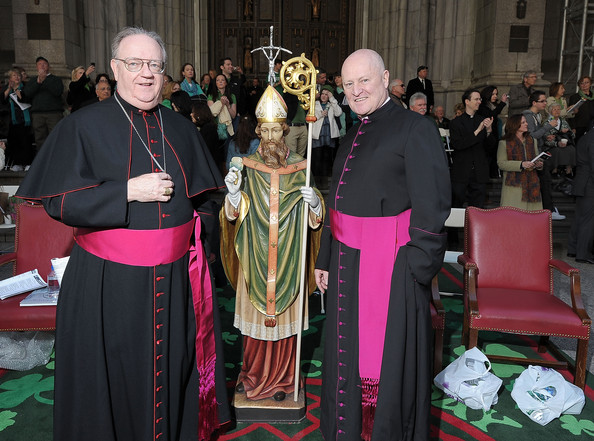
In the picture below, taken at St. Patrick’s Cathedral in New York, Auxiliary Bishop Dennis Sullivan is on the left, and Msgr. Robert Ritchie, rector of the cathedral, is on the right.
 
Our old Irish pastor claimed that a Monsignor was just a priest in a red cassock. However, he quickly got a red cassock when he was made a monsignor. 😃
 
My understanding that “monsignor” is just an honorary title, that carries with it no extra rank or privilige.

In my diocese, the title is no longer used, except for the couple of very elderly priests who were already “Monsignor” before our present Bishop took office.
Bishops still petition the Holy See to grant one of the monsignor titles (Supernumerary Protonotary Apostolic, Prelate of Honor, Chaplain of His Holiness) all the time. I bet your diocese’s vicar general is a monsignor.
 
My previous parish is a minor basilica, and the pastor there was named as monsignor. My understanding is that it was something that went along with the parish becoming a minor basilica in that case.
 
The only Monsignor I know of personally is the pastor of the parish in the next town. He has been pastor there since its establishment-1978. I think this is pretty unusual, at every other parish I’ve been to they tend to move priests around every 5-10 years.

Does anyone else have/know of a pastor that has been at a parish that long?
 
Bishops still petition the Holy See to grant one of the monsignor titles (Supernumerary Protonotary Apostolic, Prelate of Honor, Chaplain of His Holiness) all the time. I bet your diocese’s vicar general is a monsignor.
Vicars General are monsignors by virtue of their office. I remember reading that they are referred to as “black monsignors” as they are entitled to have black satin lining on their cassocks and a black velvet sash. When priest stops being a vicar general, he loses his monsignor title (unless he is a monsignor in his own right).

This is what Wikipedia says:
Under legislation of Pope Pius X, vicars general and vicars capitular (the latter are now called diocesan administrators) are titular (not actual) Protonotaries durante munere, i.e. as long as they held those offices, and so are entitled to be addressed as Monsignor.[9]
The only privileges of dress that Pope Pius X granted them were a black silk fringed sash, black piping on the biretta with a black tuft,[10] and a black mantelletta. As a result of this they were in some countries referred to as “black protonotaries.”[11] However, “Pontificalis domus” of Paul VI removed this position from the Pontifical Household, even though the title of “monsignor”, which is to be distinguished from a prelatial rank, has not been withdrawn from vicars general, as can be seen, for instance, from the placing of the abbreviated title “Mons.” before the name of every member of the secular (diocesan) clergy listed as a vicar general in the Annuario Pontificio. (Honorary titles such as that of “Monsignor” are not considered appropriate for religious.)
 
The monsignors I have known were essentially retired from being pastors but still active in ministry. Since reverting to “vicar” could be seen as a kind of “demotion,” they were “promoted” instead.
Uh… it really has nothing to do with that…
 
The only Monsignor I know of personally is the pastor of the parish in the next town. He has been pastor there since its establishment-1978. I think this is pretty unusual, at every other parish I’ve been to they tend to move priests around every 5-10 years.

Does anyone else have/know of a pastor that has been at a parish that long?
My former pastor is celebrating his 30th anniversary as pastor this year, at the same parish where I knew him. BTW, he was made a monsignor at a very young age (33); they kidded him and called him Mons-junior.

Ten years ago I attended the 40th anniversary of a pastor in another diocese, also a monsignor. The trend these days is to move pastors around (like public school principals), but there is nothing in canon law that requires this and it is ultimately up to the bishop. Some bishops still subscribe to the “If it ain’t broke, don’t fix it” rule.

Here is a nice picture of a pastor in the Diocese of Fargo, ND who is a monsignor:

http://images.acswebnetworks.com/1/1724/Monsignor_Wald_043_8x10_md.jpg
 
My former pastor is celebrating his 30th anniversary as pastor this year, as the same parish where I knew him.

Ten years ago I attended the 40th anniversary of a pastor in another diocese. The trend these days is to move pastors around (like public school principals), but there is nothing in canon law that requires this and it is ultimately up to the bishop. Some bishops still subscribe to the “If it ain’t broke, don’t fix it” rule.
Yes, I know it’s not a rule, I just don’t know of any other pastors that have been in that place for so long around here…I bet they are so attached to their parish and parishioners and likewise…
 
In my diocese, Orange CA, pastors are assigned for six years and may be extended for a second six years. On the other hand one of our former pastors told me that if the Bishop asked him to move before his six years were up he would feel compelled to go since he had sworn obedience to the Bishop. He later accepted a transfer mid-way into his second term.}
 
In my diocese, Orange CA, pastors are assigned for six years and may be extended for a second six years. On the other hand one of our former pastors told me that if the Bishop asked him to move before his six years were up he would feel compelled to go since he had sworn obedience to the Bishop. [He later accepted a transfer mid-way into his second term.}
This is how it works in my diocese also. We do, however, have one priest who has been pastor at his parish for over 25 years. He will reach mandatory retirement age in the next few years, so I am pretty sure he is staying put until then.
[/quote]
 
Bishops still petition the Holy See to grant one of the monsignor titles (Supernumerary Protonotary Apostolic, Prelate of Honor, Chaplain of His Holiness) all the time. I bet your diocese’s vicar general is a monsignor.
Vicars general are titular monsignori durante munere of the rank of protonotary apostolic supernumerary. In other words, they are protonotaries apostolic as long as they are vicars general.
 
The only Monsignor I know of personally is the pastor of the parish in the next town. He has been pastor there since its establishment-1978. I think this is pretty unusual, at every other parish I’ve been to they tend to move priests around every 5-10 years.

Does anyone else have/know of a pastor that has been at a parish that long?
One priest explained to me than when bishops started transferring priests regularly, they often “grandfathered” those who were already pastors into the old system. In his case, he could stay in the same parish so long as both he and the congregation agreed.
 
One priest explained to me than when bishops started transferring priests regularly, they often “grandfathered” those who were already pastors into the old system. In his case, he could stay in the same parish so long as both he and the congregation agreed.
Hmmmm, “both he and the bishop agreed” seems more likely.
 
In the early 40’s I lived a couple of years in Eastport, Maine. The pastor there told us that the bishop had tried to force him to take an assignment that he didn’t want. He told the bishop that the bishop couldn’t force him to go because he had paid for his own education. *.

The bishop told him fine, and he hoped he liked Eastport, because there was no rule which required the bishop to give him a new assignment. As far as I know he spent the rest of his life there.*
 
In the early 40’s I lived a couple of years in Eastport, Maine. The pastor there told us that the bishop had tried to force him to take an assignment that he didn’t want. He told the bishop that the bishop couldn’t force him to go because he had paid for his own education. *.

The bishop told him fine, and he hoped he liked Eastport, because there was no rule which required the bishop to give him a new assignment. As far as I know he spent the rest of his life there.*

I don’t know about paying for one’s own education, but I do know that things were a bit different in pre-conciliar times. When a pastor was installed, it wasn’t at all unusual for him to serve in that parish for life or at least until (voluntary) retirement. I know of one case (this was in the late '40s or early '50s) where the pastor became very (and terminally) ill, which caused the bishop to appoint an administrator. He ended-up serving in that capacity for nearly 10 years until the pastor passed away, at which point the administrator was named pastor and served the same parish for another 10 or so years until he retired.

Curates (aka “assistant pastors” which in post-conciliar parlance changed to “associate pastors” which seems to have morphed these days into “parochial vicars”) were a different story. They were transferred regularly. That, at least, doesn’t seem to have changed.
 
Status
Not open for further replies.
Back
Top
