E
EphelDuath
Guest
I vaguely understand what they are (a “wall” around the Sanctuary); what are they for, and why do traditionalist Catholics resist their removal? Why were they removed in the first place?

 Nuns (or the altar and rosary society) would scrub the floor around the altar on their hands and knees in total reverence. Nowadays, in many places almost anybody might walk up and around the altar, not having a sense that it is inappropriate.
~cymbal crash~Naturally, once the rails were gone the altar area began to take on aspects of a theatrical stage.

Michael is right.The communion rail helps to define the altar area as sacred space. In a very real sense, during the Mass this was thought of as where heaven and earth would meet.
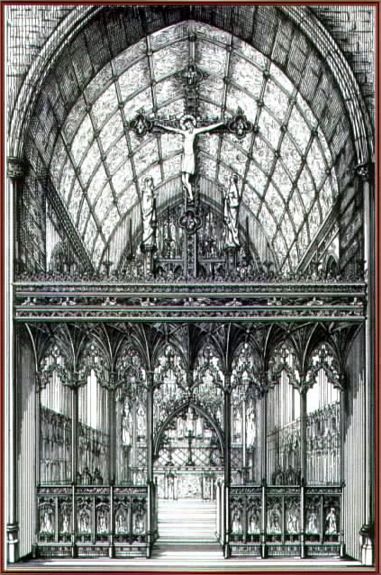
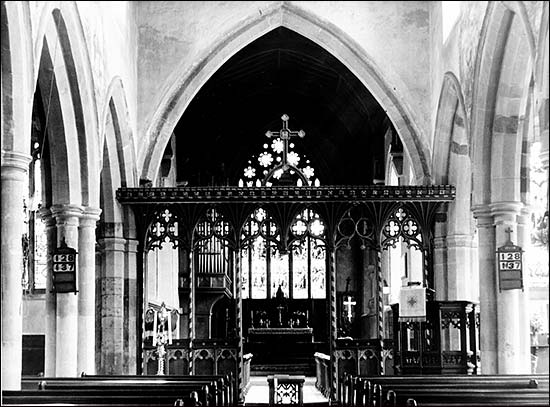
The rail is actually a remnant from a much larger structure known as the rood screen, which would reach up higher to form a type of fence. People would receive through the screen or from the door, I am not sure if they were customarily kneeling for communion at rood screens.
http://www.execulink.com/~dtribe/blog/roodscreen.jpg
http://burtonlatimer.info/images/Churches/Churchinterior.jpg
When I was young we would all line up along it in rows three deep, the foremost line kneeling at the rail, and the priest would come along and deposit the Host upon our tongues. I remember being terrified of even touching a part of the floor beyond the rail. When we did so (as wee ones) we thought we were being very naughty and might be in BIG trouble with God.
These “rails” were actually a fine quality piece of wooden furniture, or in many beautiful old parishes sculpted out of attractive durable stone like granite or marble. Highly decorative, there was a sense of increasing holiness beginning at the edge where this ribbon of art wrapped around the altar space, then on an elevated level the high altar with an impressive reredo rising above and beyond the altar to the Eastward.
Four decades ago the idea was current that the communion rail provided a barrier which made God and His priesthood seem less approachable. There was also a lot of discussion about how we had lost the sense that the Holy Eucharist was a common meal and some of the liturgical and architectural changes were meant to address that.
Naturally, once the rails were gone the altar area began to take on aspects of a theatrical stage.
I think that removing the rails was a bad idea, but that was not at all clear at the time. For some of the older folks, it is a part of the nostalgia for old familiar things. But for the church in general it was part of a decline in a sense of the sacred which admitted numerous other problems later.
Michael


As far as I know, Vatican II itself said nothing on the matter. They were largely removed after communion standing and in the hand became the default in practice. Apparently a lot of people argued - and still argue - that they create a “barrier” that limits the “active participation” called for by the council (a silly reason, IMO, I’ve yet to feel separated from God because of a two-food six-inch high decorative railing).I was born way after VII and have never been to a church with altar rails, but I really, really…want them to be brought back.
does anyone know… was it decided at VII to get rid of the rails, or was it one of the “modernizations” that were taken too far by people who misinterpreted the Council???
Do the rails still exist at parishes where they have Tridentine Mass?
I think they really add reverence…
i agree, they really do add reverence.I was born way after VII and have never been to a church with altar rails, but I really, really…want them to be brought back.
does anyone know… was it decided at VII to get rid of the rails, or was it one of the “modernizations” that were taken too far by people who misinterpreted the Council???
Do the rails still exist at parishes where they have Tridentine Mass?
I think they really add reverence…