What is the purpose of the Pope?

  • Thread starter Thread starter Masihi
  • Start date Start date
Status
Not open for further replies.
M

Masihi

Guest
I’ve been thinking to myself for a long time on what is the purpose of the Pope how can God need a representative on Earth. Christ said I will be with you till the end. Also not all popes were perfect some did commit terrible mistakes like massive atrocities and if they were capable of sinning then how can an imperfect human being claim the title of the representative of a God on Earth. Also it makes no sense for Jesus Christ to have a pope represent him since he is all powerful.
 
There has to be a final arbiter on disagreements, otherwise you end up with the fractured schizophrenic beliefs of the sola scriptura crowd or with never having anything decided like the Eastern Orthodox.
 
The Pope’s job is to serve the unity of the Church. That’s the whole point. As far as teaching, the poster above me correctly noted having one person with the final, definitive say, is important for the unity of faith.

The Church’s one-ness requires the jurisdiction of the papacy as well. The Eastern Orthodox Churches are a good example of this. They get into situations where EO Church A is in communion with B, B is in communion with C, but A and C are not in communion with each other (A=B=C≠A) (e.g. the Moscow Patriarchate breaking communion with Constantinople over who had jurisdiction over Estonia in 1996 while other Churches remained in communion with both; ROCOR’s situation until 2006; the Bulgarian schism of the 19th century when most patriarchates, but not Moscow, broke communion with the Bulgarian Church, etc.). How can one Church simultaneously have some parts in communion with other parts, while other parts are separated from each other? This doesn’t even make any sense unless there is only a plurality of Churches, rather than just one.

Also, look at the recent pan-Orthodox Synod (or whatever it ultimately was classified as). It barely even got off the ground because Churches were threatening to boycott (and many did) because they were fighting with other Churches over who had jurisdiction over what. And for all the EO polemics about all bishops being equal, if you look at how that synod was organized and carried out, the bishops who participated in that synod did not do so as equal bishops of one Church, but as representatives of multiple national Churches and patriarchates. What was sought was not a consensus of bishops of one Church, but of national Churches/patriarchates (which didn’t happen anyway). They lacked anyone to coordinate all the bishops as each true bishops of the one Church.

Some Popes have done a better job at this than others, but overall, looking at the history of the Church and its unrivaled ability to fulfill the Great Commission and give Jesus a voice among the nations, I think Jesus made the right decision in constituting His Church in this way.
 
Last edited:
Very interesting read! You seem very knowledgeable about this topic. 👏
 
I’ve been thinking to myself for a long time on what is the purpose of the Pope how can God need a representative on Earth. Christ said I will be with you till the end. Also not all popes were perfect some did commit terrible mistakes like massive atrocities and if they were capable of sinning then how can an imperfect human being claim the title of the representative of a God on Earth. Also it makes no sense for Jesus Christ to have a pope represent him since he is all powerful.
One can ask why does Christ need any representatives here on earth: popes, bishops, priests, laity. We are all Christ’s reps, even though some of the baptized have committed atrocities. Why does Christ “need” a bible, for instance? Some passages seem to condone (in our view) controversial actions, and certainly the bible has been misused to support evil actions.

Why does God “need” the sacrament of marriage, for instance? He can create babies directly, and he can provide social and psychological supports directly, not going through a “spouse”.

The answer to all these questions is God does not “need” anything, but His plan assigns different roles to different persons, all of them imperfect in their personal morality according to our standard. But where does that “standard” come from? It is partly true, to say “the Bible”. But the bible does not interpret itself, and the bible does not tell which books are in the bible.

It is partly right to say “Tradition”. But who interprets Tradition? How do things enter Tradition? In other words, who looks at all the Christian traditions, and says this 1% is Tradition, the rest is traditions. Thus, there is a tripod, the Bible, Tradition, and the Magisterium, each balancing the others.
 
I can understand the Pope serving as the head of the Church but he claims the title of representative of God on Earth that is where my main confusion lies.
 
what is the purpose of the Pope how can God need a representative on Earth
I think the answer to this is clear in the Gospels, and in the Great Commission, Matt. 28.
Christ said I will be with you till the end.
If the Catholic Church were of human origin, it would have disintegrated by now. All the Reformation communities have fragmented repeatedly and continue to drift further and further from the Apostolic faith.
Also not all popes were perfect some did commit terrible mistakes like massive atrocities and if they were capable of sinning then how can an imperfect human being claim the title of the representative of a God on Earth.
There is a common misconception that infallibility equals impeccability, but this is not true. Peter was not perfect even after Jesus chose him. God’s gifts also do not mean we are no longer “capable of sinning”.

No human being “claims the title” of Pope, or bishop. All of us are called to be representatives of God on earth,and none of us are perfect. Those who are called to the priesthood “claim” nothing but take hold of that which has taken hold of them. Their purpose is to serve the flock of God.

The Pope is the visible sign of unity in the Church founded by Christ. From the earliest days of the Church, authentic Christians were known by those who obey the Bishop.
I can understand the Pope serving as the head of the Church but he claims the title of representative of God on Earth that is where my main confusion lies.
The Pope is not “head of the Church”, that is Jesus. You will have to show me where the Pope “claims this title” and how it is that every Christian is not also a representative of Christ on earth.
 
He is a representative in the sense of a delegate. Christ has delegated to Him certain responsibilities and authority to serve His people. Bishops are delegates of Christ for their particular churches (dioceses), but the Pope for the whole Church.

Why did Jesus tell Peter to “Feed my sheep”? Why didn’t He just feed His sheep Himself? He does, but it is through the ministry of the Church in which Peter acts as chief shepherd by the commission of Christ, the true, ultimate Good Shepherd.

Men are social and physical creatures. While Christ is present in a spiritual and sacramental sense, He has left us a visible ministry to serve that visible society He established to carry on His ministry in the world.
 
Last edited:
I can understand the Pope serving as the head of the Church but he claims the title of representative of God on Earth that is where my main confusion lies.
Wouldn’t you consider Moses, in a sense, as “representative of God on Earth” when he passed on the 10 commandments (originating from God)? Didn’t the prophets in a sense represent God, in passing on the Word of the Lord? Most Jews and Christians would say yes. Don’t you represent God, if you are a Christian passing on the Good News to someone?

We do not all represent God in the same way. We have different roles; no one else but me is husband of my wife. No one but John Doe is father of Billy Doe…not even the pope.

The pope’s role, as Vicar of Christ, is different, but not totally different. Infallibility does not mean the pope will always teach the truth. He might not know the truth on a given topic; he might know it, but for various reasons not teach it at this time.

Infallibility only means if he does teach on a matter of faith and morals, and emphasizes it in a certain way as formal teaching, it will not be wrong.
 
The pope’s role comes from scripture and sacred tradition. The pope is chosen, in faith, by the Holy Spirit.
 
I can understand the Pope serving as the head of the Church but he claims the title of representative of God on Earth that is where my main confusion lies.
He doesn’t claim the title, it was given to him:
Isaiah 22:20-24
20 In that day I will call my servant Eliakim the son of Hilkiah,
21 and I will clothe him with your robe, and will bind your girdle on him, and will commit your authority to his hand; and he shall be a father to the inhabitants of Jerusalem and to the house of Judah.
22 And I will place on his shoulder the key of the house of David; he shall open, and none shall shut; and he shall shut, and none shall open.
23 And I will fasten him like a peg in a sure place, and he will become a throne of honor to his father’s house.
24 And they will hang on him the whole weight of his father’s house, the offspring and issue, every small vessel, from the cups to all the flagons.
Here we have Eliakim being made steward, and given all authority of the house of David. Now compare this to what Jesus says to Peter:
Matthew 16:16-19
16 Simon Peter replied, “You are the Christ, the Son of the living God.”
17 And Jesus answered him, “Blessed are you, Simon Bar-Jona! For flesh and blood has not revealed this to you, but my Father who is in heaven.
18 And I tell you, you are Peter, and on this rock I will build my church, and the powers of death shall not prevail against it.
19 I will give you the keys of the kingdom of heaven, and whatever you bind on earth shall be bound in heaven, and whatever you loose on earth shall be loosed in heaven.
So here we have Jesus (who is a Davidic king) making Peter His steward, giving him the keys of the kingdom, and the power to bind and loose things in heaven and on earth. The Jews in Caesarea Philippi would have been quite familiar with the scripturally referential words deliberately used by Jesus.

Jesus also promises in this establishment of the Church that “the powers of death shall not prevail against it” because of this foundational rock He is building it upon. Jesus promises that the fidelity of this Church He is establishing will not be conquered by Satan.

Now you can look at the history of the Church and see that the vast majority of the popes have been holy, courageous, spiritual men who have carried out their duties wonderfully. You can also see some popes who were quite sinful and an embarrassment. Does this mean the Church was corrupted?

To answer this question, we only have to look at our first pope. Who did Jesus choose to give this massive responsibility to?

Was it someone with unshakeable faith?
No… It was the one of “little faith” who got scared when he was called out to walk on the water and sank.

Was it the only apostle why actually had the courage to stand at the foot of the cross with His mother?
No… It was the one who He knew would deny Him three times and flee.

Was it the one who loved Him most?
No… It was the one who He asked multiple times if they loved (agape) Him, and the most they could offer back to Him was that they only “loved” (philios) Him.

 
Last edited:
Peter was a headstrong, sinful, and mistake making man, yet Jesus still saw fit to establish the Papacy with Him and to build His Church upon it.

The Holy Spirit protects the Church and it’s teachings. Papal infallibility does not mean that every word they utter or action they take will be perfect, but rather that when they make decisions or declarations on matters of faith and morals, they are protected from error by the Spirit.

The Church is not a hall of fame for winners, but rather is a hospital for sinners.
 
Last edited:
Churchill said democracy was the worst of all possible forms of government…except for all the others.

The same can be said about the papacy. Every kind of Christianity has a pope. For Protestants, it often is the pastor. He determines what scriptures are relevant to a given topic, and how they should be interpreted. In recent years the mass media has propelled a relatively few people to extreme prominence. They teach people directly, and set the general parameters for religion for their viewers. In some cases, people influenced by Joel Osteen may choose a congregation and pastor compatible with him.

Mainline denominations are heavily influenced by the persons who control the secular media. If the publisher of the NY Times reaches a certain discernment, along with the CEO of Time Warner, that will be come a Social Justice Theme followed by many denominations.

Even if an individual insists on following no pope, no pastor, no social justice media, no peer pressure - let’s say he lives alone in a shack, with no human contact, totally cut off from civilization - then he becomes his own pope. But even he won’t know how much his vision is skewed by his upbringing, narrowed by his surroundings, his genetic makeup.

All things considered, the Roman pontificate seems the least unreasonable, so I follow it.
 
…Every kind of Christianity has a pope…
Exactly. Any shared system of belief will be subject to disagreements of interpretation. When this happens, there must be some authority to clarify things. Most of these authorities are man made or self declared, but the authority of the Pope was established by Christ Himself.
 
Last edited:
I’m a Christian and I believe in his words and I spread his words but I am not his representative on Earth I am like his child and his creation nothing more. Christ was the only representative of God in a physical form and the Apostles were inspired through him so you could say they were inspired by God. I do not believe my Patriarch to be a representative of God on Earth inspired yes, but not his representative. Part of the popes infallibility is to believe he is the voice of God yet he is not a prophet. If you study Church history from an Orthodox point of view, you will see that the Popes were bishops of Rome who were respected for their correct faith and holding the Patriarchal See. What we see now with the Pope being the sole head of the Church is something that did not exist for the first thousand years of Church history and the infallibility of the Popes was, I think, added at Vatican I.
 
The Pope is the “Prime Minister.” During the time of King David, there was a “second in command” who literally wore the keys to the kingdom around his neck. This person was in charge when King David was away, and the King often delegated responsibilities to him.

Christ is now the new King and the Pope is the keeper of the keys of the kingdom, just like the person King David had working for him.

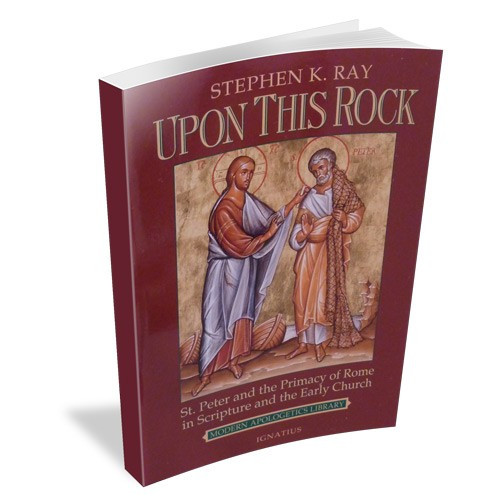
I highly recommend this book by Steve Ray - published by Ignatius Press. Steve used to be Protestant who was schooled in taking Catholics out of the Catholic Church, and he needed to do a TON of research in order to become Catholic.

If you buy it from Steve’s website, he will send you a signed copy 🙂


God Bless
 
The pope is chosen, in faith, by the Holy Spirit.
Mmm, I don’t think this is correct. Even Pope Emeritus Benedict XVI has said the Pope is not picked by the Holy Spirit.

From the National Catholic Register:
“I would not say so, in the sense that the Holy Spirit picks out the Pope. . . . I would say that the Spirit does not exactly take control of the affair, but rather like a good educator, as it were, leaves us much space, much freedom, without entirely abandoning us. Thus the Spirit’s role should be understood in a much more elastic sense, not that he dictates the candidate for whom one must vote. Probably the only assurance he offers is that the thing cannot be totally ruined…There are too many contrary instances of popes the Holy Spirit obviously would not have picked!”
Or did you mean something else by picked in faith?
 
The question is who gave the Pope these keys also Christ is no king of this world unlike David or Solomon or Saul. He is the king of kings and all men in the end even the rulers of the mightiest empire while confess he is lord.
 
If you study Church history from an Orthodox point of view, you will see that the Popes were bishops of Rome who were respected for their correct faith and holding the Patriarchal See. What we see now with the Pope being the sole head of the Church is something that did not exist for the first thousand years of Church history and the infallibility of the Popes was, I think, added at Vatican I.
🤣😂🤣

Not quite my friend…

Here are some quotes from early Church Fathers and Saints that beg to differ:


And some more reading for you:


And just because something wasn’t declared a dogma early on doesn’t mean it wasn’t an established doctrine and truth before that point. Dogmatic proclamations don’t create new teachings, but rather clarify things when challenges or confusions arise.
 
Last edited:
The question is who gave the Pope these keys also Christ is no king of this world unlike David or Solomon or Saul. He is the king of kings and all men in the end even the rulers of the mightiest empire while confess he is lord.
I beg to your pardon, but Jesus Christ is THE KING OF THIS WHOLE WORLD. Yes, He is the King of Kings, which means all other Kings kneel before him.

Jesus Christ gave the keys to Peter and those keys (just like in David’s time) were passed to the successor of the prime minister.

Here is the thing that our Eastern Orthodox and Oriental Orthodox brothers and sisters fail to understand when looking at the past.

The Bishop of Rome also served as the Patriarch of the West. The Eastern Churches also had a Patriarch. All 5 Patriarchs out ranked all other Bishops. Each Patriarch was (and still is) the head of their respective Church. And they were all in communion with one another, but all 5 were not on equal footing. There was a ranking in precedence and in power.

Only the Bishop of Rome held the keys to the Kingdom. However, the Bishop of Rome did not have to closely manage or be involved with the affairs of other patriarchs. The only thing the Bishop of Rome needed to do was make sure the other Patriarchs were doing their jobs, without heresy, and then focus on what was going on with the Bishops of the West and in Rome.

Why is there little documentation during the first 1000 years? Because, typically, the Patriarch of Constantinople was doing his job.

But there are a number of letters written by Bishops in the East that reference their need to defer to the Bishop of Rome for clarification, including the Ignatius of Antioch who was Bishop (Patriarch) of Antioch regarding the need to defer to Rome.

God Bless
 
Last edited:
Status
Not open for further replies.
Back
Top