J
Jewel34
Guest

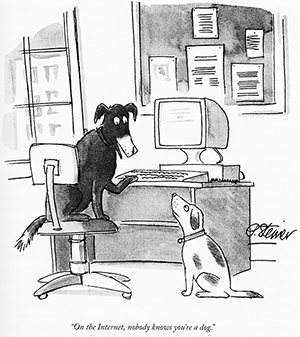
That is one way to look at it. But it is not the only way. Suppose that in the future we can build actual “machines” which look like and act like human beings, true humaniform “robots”. Asimov, who was the best to explore these questions presented a story in “I Robot”, the title is “Evidence”. Its plot revolves around the “unmasking” of a possibly robot, possibly human “entity”, who scrupulously protects his identity. And the reason is to spare the humans the embarrassment lest they would find out that the best leader is “only” a positronic robot, who embodies the best traits a human might have.Turing called it the Imitation Game rather than a test. The machine’s objective is to fool the interrogator, so yes deception is key to playing the game.
This brings up the question: “where does the emulation end and reality begin?”. If the “emulation” is so perfect, that is it cannot be detected, then it makes no sense to talk about emulation any more.The machine is isolated and communicates by texting, so it only needs to pretend to have human traits, it doesn’t actually need to possess them to win.
I would love it.We are learning that many of our traits are also displayed by other species of social mammals, so I wouldn’t have thought they’re anything to be ashamed about. Wouldn’t it be something to celebrate if and when human ingenuity builds a machine that can win the game?


Sorry, I presented my questions, and I am interested in your answers, not some links. What is “understanding”, what is “meaning”, and how do we know that our conversation partner understood what we say? I am genuinely interested in what you have to say, and totally uninterested in what other people might say.Here is another version of argument:
What meaning is “meaning” is a little tricky but you can find a clear explanation here.
- To lie you have to construct a subject (lie) which oppose the real subject (truth)
- This requires semantic (understand the meaning of subject)
- Computer work is based on syntax
- Syntax does not suffice semantic (following chines room thought experiment)
- Hence computer cannot lie
And the main Chinese room outcome is “Syntax does not suffice semantic”. You can read the details on the provided link.
The phrase “mental image” simply stands for the internal structure of the entity involved.
We deal with information exchange between two partners. The exchange of information takes place in a communication channel. The sender of the information has his own mental “image” of the information he is sending. The receiver of the information interprets the information, and if his mental “image” is sufficiently close to that of the sender’s then we speak of understanding.
The meaning of the information is simply the mental image that the information conjures up in the receiver. None of this presupposes a biological environment. The “syntactical rules” only make the understanding process easier, but the language is so redundant with extra information that even with somewhat distorted syntax one can (usually) decipher the “meaning” of the information. (An interesting example is this: “take a piece of white paper and cover up the bottom part of each line in the paper. You will be able to read it even with such distorted “syntax”.)
Finally, we know that the receiver “understood” the information, if the continued exchange will reveal this. A very simple analogy from the IBM mainframes: In a communication channel there are two instructions “RUOK” and “IMOK” which stand for “are you ok?” and “I am ok”. When both computers send and receive these simple messages, they both “know” that the communication channel is open and operational.
 No one was talking about emulation. Have you read Turing’s paper? He was attempting to answer the question of how could we tell if a machine can think, but without getting caught up in the meaning of words. He writes: