What's so bad about Monastery Icons?

  • Thread starter Thread starter LordNecro
  • Start date Start date
Status
Not open for further replies.
L

LordNecro

Guest
I don’t get it… I mean, is it just that the guy in charge incorporates Hindu elements into his spirituality, or that he is a heretic? Or is there something more?

And how does one tell if one has a Monastery icon? I bought a Pantocrator icon yesterday and it looks pretty similar to theirs… :S
 
Here’s the word on “Monastery Icons”

The following comments concern a business called Monastery Icons This company offers “icons” and other religious content that has a veneer of Orthodoxy, but which in fact is associated with Hinduism. Their products are spirituallly dangerous, and so Fr. Anthony Nelson, a Priest in the Russian Orthodox Church Outside of Russia, sent me these remarks.

orthodoxinfo.com/general/monasteryicons.aspx
 
But - but - but -

What does he mean? When I read it it sounds like the sort of thing people said about Dungeons and Dragons or rock music…

How do I know the icon I bought the other day isn’t one? It looks almost identical to their stuff…
 
I don’t get it… I mean, is it just that the guy in charge incorporates Hindu elements into his spirituality, or that he is a heretic? Or is there something more?

And how does one tell if one has a Monastery icon? I bought a Pantocrator icon yesterday and it looks pretty similar to theirs… :S
Fundamentally, Icons are texts for religious education. (They also serve ritual and worship purposes.)

Some of the icons by Monastery Icons have oddities. Many are excessively busy. They are not providing clear and orthodox renditions.

A few have gnostic implications.Gnosticism is anathematized since the early councils for being heresy.

so it’s both “Heretics” and “Other”
 
Fundamentally, Icons are texts for religious education. (They also serve ritual and worship purposes.)

Some of the icons by Monastery Icons have oddities. Many are excessively busy. They are not providing clear and orthodox renditions.

A few have gnostic implications.Gnosticism is anathematized since the early councils for being heresy.

so it’s both “Heretics” and “Other”
I always found their icons to be quite bland. Many seem hollow and empty. This is probably a very subjective observation, but it is how I see it.

Aramis, could you provide some specific examples of where some of their icons are excessively busy or have gnostic implications.
 
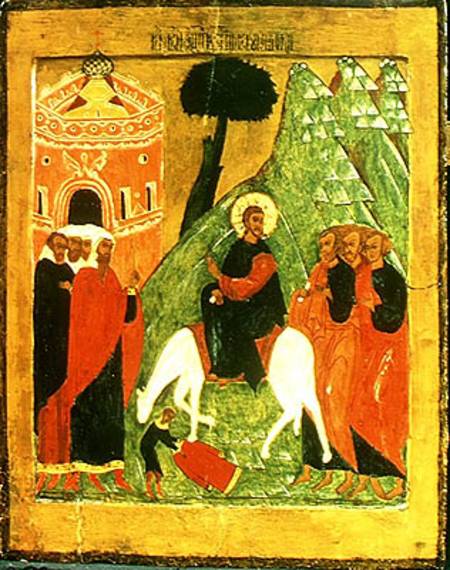
Looking at their “Entry into Jerusalem”:

guy in front left examining his foot. Dwarves in front right, the donkey eating the branches,chap in green with head turned 180° away from direction of his feet, AND away from Christ. 11 apostles following Christ. Tree does not look like a palm.

Signature block on lower left corner.
 
Looking at their “Entry into Jerusalem”:

guy in front left examining his foot. Dwarves in front right, the donkey eating the branches,chap in green with head turned 180° away from direction of his feet, AND away from Christ. 11 apostles following Christ. Tree does not look like a palm.

Signature block on lower left corner.
Is this an example of busy or gnosticism (sorry, I never cared to learn about gnostic symbolism, so I don’t know if this would be gnostic or not)?

Also, I can’t read the signature block, what does it say?
 
Is this an example of busy or gnosticism (sorry, I never cared to learn about gnostic symbolism, so I don’t know if this would be gnostic or not)?

Also, I can’t read the signature block, what does it say?
by the hand of
Simeon 1995

This one is busy, needlessly so, but not of need gnostic.

Oh, I forgot to mention that Christ is riding side-saddle.

It definitely shows a lack of focus.

Oh, and several of the individuals are making the “2-finger” hand of blessing.
 
Here’s the word on “Monastery Icons”

The following comments concern a business called Monastery Icons This company offers “icons” and other religious content that has a veneer of Orthodoxy, but which in fact is associated with Hinduism. Their products are spirituallly dangerous, and so Fr. Anthony Nelson, a Priest in the Russian Orthodox Church Outside of Russia, sent me these remarks.

orthodoxinfo.com/general/monasteryicons.aspx
That’s interesting! My friend used to work in a Catholic bookstore which sells some icons, and he said once an Orthodox monk or brother came in the store and when he saw the icons they were selling, told them they were “cursed.” I guess this is what he was referring to.
 
Dwarves in front right, the .
Guess this one doesn’t count either because of the “dwarves”…

(Please Note: This uploaded content is no longer available.)

Oh, BTW, they aren’t “dwarves”, this is the way children are depitcted in traditional iconographery:tsktsk:
 
The Monastery Icon ones don’t have body proprotions of children, unlike the ones you posted Patchunky.

As to the “Not a Palm”… modern iconographers have no reason to not know what a palm looks like. Ancient ones might never have seen one.

1st of the two you posoted sure looks like a well watered palm.

I do count 12 Apostles following Christ in the 2nd Icon you posted.
 
Gee, in this icon, the donkey is eating branches too… oh, there are only 3 disciples pictured and 3 other “heads”… guess this one doesn’t count as a real ikon either…

christthesaviourhbg.org/images/Church%20Icons/Entry_Into_Jerusalem.JPG

This ikon is done by Master Iconographer, Fr. Theodore Jurewicz, and is in Christ the Savior Orthodox Church, in Harrisburg, PA.

What do you think of ikons where Jesus is riding on a horse instead of a donkey, guess that doesn’t count as an ikon either then…
 
I’m not an expert on icons, but I did learn some things about icons from a very holy Passionist father, Fr. Lawrence Rywalt, C.P.

I remember that the first thing he taught us was that if you’re going to purchase an icon, you don’t purchase it because the color matches your decor. An icon is an item of prayer, not a decoration like a painting.

The second thing we learned is that one does not “paint” an icon. One “prays” an icon. A true iconographer prays and fasts for a set period of time before embarking on the praying of an icon.

Fr. Lawrence said that there are set rules for each icon as to what belongs in the icon and what does not, so one cannot paint an icon and decide to throw in extra images (or something connected to Hinduism etc.).

Also, everything in an icon has a meaning, even the colors. For example, the Lord wearing a red garment covered with a blue cloak conveys the meaning of Divinity (red) was covered with humanity (blue)…
http://www.uncutmountainsupply.com/prodimages/lg/11S08.jpg
CHRIST PANTOCRATOR

…while Our Lady wears blue because she is human and has a red cloak because she carried Divinity…
http://www.uncutmountainsupply.com/prodimages/lg/12H10.jpg
VIRGIN ENTHRONED

I don’t know too much more about icons, and so I bow to the wisdom of our Eastern brothers and sisters who are much more fluent in the language of icons than I am.
 
GemmaRose wrote: “I* remember that the first thing he taught us was that if you’re going to purchase an icon, you don’t purchase it because the color matches your decor. An icon is an item of prayer, not a decoration like a painting”*

This is very true. You do not choose an ikon, an ikon CHOOSES YOU!

GemmaRose wrote: “The* second thing we learned is that one does not “paint” an icon. One “prays” an icon. A true iconographer prays and fasts for a set period of time before embarking on the praying of an icon.”*
**

Well, you really pray “into” an ikon as you paint the ikon. You pray special intentions into the ikon and the intercession of the Saint you are painting.

Yes, I said painting and I mean painting. The idea of an ikon being “written” is a Western concept that started with the Anglican church and moved to Roman Catholics. All of the Russian ikonographers I’ve studied with say they paint ikons. You write books, letters, and songs; you paint ikons.😃

GemmaRose wrote: "Fr. Lawrence said that there are set rules for each icon as to what belongs in the icon and what does not, so one cannot paint an icon and decide to throw in extra images."

This is true to some extent but not always the case. Take this ikon for example:


It’s a portion of an ikon of St. NIcholas with scenes from his life. Depected here is St. Nicholas at his death. The figures in the background are the coal miners from Jacob’s Creek, PA and the ikonostas at their church.

The miners of Jacob’s Creek refused to work on the Feast of St. Nicholas, December 19, 1907 (on the Old Calendar). There were in church when the church was rocked by a massive explosion.

237 miners were killed in the worst coal mining disaster in US history. The miners who stayed home survived and credit St. Nicholas for saving their lives.

This ikon depicting St. Nicholas and scenes from his life was painted for the 100th anniversary of the disaster in 2007. The miners were painted into the ikon as was their church so this is a case of things being added to an ikon by the ikonographer.

Hope this helps…

 
You do not choose an ikon, an ikon CHOOSES YOU!
Sounds like blasphemy to me. I believe it would be better to say ‘you do not choose the icon, God chooses what icon you pray.’
Yes, I said painting and I mean painting. The idea of an ikon being “written” is a Western concept that started with the Anglican church and moved to Roman Catholics. All of the Russian ikonographers I’ve studied with say they paint ikons. You write books, letters, and songs; you paint ikons.😃
Do you have proof of this Catholic claim or is it just another Eastern Orthodox bashing Catholics?
 
Sounds like blasphemy to me. I believe it would be better to say ‘you do not choose the icon, God chooses what icon you pray.’

Do you have proof of this Catholic claim or is it just another Eastern Orthodox bashing Catholics?
That would be odd, since Patchunky is Byzantine Catholic. :rolleyes: I actually had heard something to the effect that the confusion regarding “writing” icons comes from the words for writing and painting being the same in some language, maybe it was Russian? 🤷
 
Status
Not open for further replies.
Back
Top