When does a baby receive it's soul?

  • Thread starter Thread starter RachelKH
  • Start date Start date
Status
Not open for further replies.
That doesn’t mean they didn’t have an eternal soul to begin with and will live on for all eternity. And nothing gives us the excuse to take the lives of unborn babies for any reason. God Bless, Memaw
Exactly, nothing gives us the excuse. Furthermore, we do not know God’s plans and what occurs to those humans who did not attach to the uterus. We may meet them all in the afterlife.🙂

Job 38:4-11

4 Were you there when I made the world? If you know so much, tell me about it. 5 Who decided how large it would be? Who stretched the measuring line over it? Do you know all the answers? 6 What holds up the pillars that support the earth? Who laid the cornerstone of the world? 7 In the dawn of that day the stars sang together, and the heavenly beings shouted for joy. 8 Who closed the gates to hold back the sea when it burst from the womb of the earth? 9 It was I who covered the sea with clouds and wrapped it in darkness. 10 I marked a boundary for the sea and kept it behind bolted gates. 11 I told it, “So far and no farther! Here your powerful waves must stop.”

Psalm 139:

For you created my inmost being;
you knit me together in my mother’s womb.
14 I praise you because I am fearfully and wonderfully made;
your works are wonderful,
I know that full well.
15 My frame was not hidden from you
when I was made in the secret place,
when I was woven together in the depths of the earth.
16 Your eyes saw my unformed body;
all the days ordained for me were written in your book
before one of them came to be.
17 How precious to me are your thoughts,[a] God!
How vast is the sum of them!
18 Were I to count them,
they would outnumber the grains of sand—
when I awake, I am still with you.
 
Just now was told this teaching comes from the book The Mystical City of God which has an imprimatur saying the Vatican approves the book – that really concerns me.
 
Just now was told this teaching comes from the book The Mystical City of God which has an imprimatur saying the Vatican approves the book – that really concerns me.
Mother Mary said to Bernadette at Lourdes to tell the priest, who had told Bernadette to ask her name: Tell him that I am the Immaculate Conception. Mary was conceived without sin, hence, at conception she had a soul.
 
Just now was told this teaching comes from the book The Mystical City of God which has an imprimatur saying the Vatican approves the book – that really concerns me.
I found the book online. sacredheart.com/MysticalCityOfGod.htm Can you find out what chapter they are quoting?

In the meanwhile, it appears as though the Church has always taught that abortion is a mortal sin, but has not declared that humans are ensouled at conception. I think this the reason why you can find the writings of Ven. Mary Greda and Saint Thomas Aquinas claiming a later time. Yet, if Saint Thomas came to know about DNA, I think he would go with that the fetus is ensouled from the moment of conception, I think Aristotle would as well. the DNA already defines it as a particular human and not a bunch of undetermined cells.

INSTRUCTION ON RESPECT FOR HUMAN LIFE IN ITS ORIGIN
AND ON THE DIGNITY OF PROCREATION
REPLIES TO CERTAIN QUESTIONS OF THE DAY

This Congregation is aware of the current debates concerning the beginning of human life, concerning the individuality of the human being and concerning the identity of the human person. The Congregation recalls the teachings found in the Declaration on Procured Abortion: “From the time that the ovum is fertilized, a new life is begun which is neither that of the father nor of the mother; it is rather the life of a new human being with his own growth. It would never be made human if it were not human already. To this perpetual evidence … modern genetic science brings valuable confirmation. It has demonstrated that, from the first instant, the programme is fixed as to what this living being will be: a man, this individual-man with his characteristic aspects already well determined. Right from fertilization is begun the adventure of a human life, and each of its great capacities requires time … to find its place and to be in a position to act”. (25) This teaching remains valid and is further confirmed, if confirmation were needed, by recent findings of human biological science which recognize that in the zygote* resulting from fertilization the biological identity of a new human individual is already constituted. Certainly no experimental datum can be in itself sufficient to bring us to the recognition of a spiritual soul; nevertheless, the conclusions of science regarding the human embryo provide a valuable indication for discerning by the use of reason a personal presence at the moment of this first appearance of a human life: how could a human individual not be a human person? The Magisterium has not expressly committed itself to an affirmation of a philosophical nature, but it constantly reaffirms the moral condemnation of any kind of procured abortion. This teaching has not been changed and is unchangeable.(26)
vatican.va/roman_curia/congregations/cfaith/documents/rc_con_cfaith_doc_19870222_respect-for-human-life_en.html
 
Just now was told this teaching comes from the book The Mystical City of God which has an imprimatur saying the Vatican approves the book – that really concerns me.
I would not let this concern you. This is nothing more than theoretical theology. It is not Dogma or Doctrine.

While I believe the we receive the Soul at Conception, the truth is that humans do not actually know for sure when the soul is received. This was not publicly revealed to us by Christ. As far as we know, little girls might receive it 40 days after birth and baby boys receive theirs at 9 months! (After all, baby girls do seem to be smarter than baby boys 😃 )

The point is, we don’t know and we will not know in this lifetime. Therefore, we must treat each life as if they have a soul at conception. The Church will not and cannot change this teaching.

God Bless.
 
While the church definitely teaches that human life begins at fertilization, I’m reasonably sure that it does not definitively teach as to exactly when humans receive their rational souls. See post #11 above.

If it’s true that 50% or more of human zygotes fail to implant, I can easily see how teaching that humans receive their rational souls at fertilization could lead to the conclusion that most eternally-existing human souls never even made it to the embryonic stage of development.
The OP begs the question about twinning…before the very early stage embryo splits…it is infused with two souls, or after the split.

Best to leave this one as a mystery…
 
ALWAYS, ALWAYS, ALWAYS at conception. I don’t believe for a minute that Aquinas taught otherwise.
Sorry to disappoint, but he most certainly did. You can read it in the Summa Contra Gentiles, Book 2, Chapter 89. The brief outline is in paragraph 11:
Thus, the vegetative soul, which is present first (when the embryo lives the life of a plant), perishes, and is succeeded by a more perfect soul, both nutritive and sensitive in character, and then the embryo lives an animal life; and when this passes away it is succeeded by the rational soul introduced from without …
Aquinas was forced to admit this because of the Aristotelean framework he worked in, which states (as a foundational principle, one that can’t be denied) that something cannot have a form (in this case a soul) if it is not able to actualize that powers of that form. So at conception, the embryo has nutritive powers like a plant, and later when it gains some sort of physically-abled mobility it can then have a sensitive (animal) soul, and when it is able to use understanding (brain stem I guess) then it can get the rational (intellectual), immortal soul (which is what characterizes human beings). You cannot give a human soul to an embryo because it is not able to actualize the powers of that soul, namely the intellectual parts.

Aquinas had to teach delayed ensoulment; the system he adopted from Aristotle left him no choice.
 
That doesn’t mean they didn’t have an eternal soul to begin with and will live on for all eternity. And nothing gives us the excuse to take the lives of unborn babies for any reason. God Bless, Memaw
👍

Wonderfully said.
 
Just now was told this teaching comes from the book The Mystical City of God which has an imprimatur saying the Vatican approves the book – that really concerns me.
Well, the New American Bible also has an imprimatur. 😛

Also, “Mystical City of God” is private revelation. Private revelations can never substitute for, or override, the teachings of the Church, and those who teach otherwise - and lead the unwary astray - are riding for a fall (cf. Matthew 18: 6).
 
26 In the sixth month of Elizabeth’s pregnancy, God sent the angel Gabriel to Nazareth, a town in Galilee, 27 to a virgin pledged to be married to a man named Joseph, a descendant of David. The virgin’s name was Mary. 28 The angel went to her and said, “Greetings, you who are highly favored! The Lord is with you.”

Mary and Joeph were Married at the time of the Annunciation. You have to understand the customs of those days. Otherwise why would Joseph have thought to divorce her, (put her away quietly,) when he found her to be with Child. They just hadn’t moved into their home together yet. Which was the custon then. God Bless, Memaw
 
Just now was told this teaching comes from the book The Mystical City of God which has an imprimatur saying the Vatican approves the book – that really concerns me./QUOTE

And imprimatur does NOT mean the Vatican approves a book…
 
Just now was told this teaching comes from the book The Mystical City of God which has an imprimatur saying the Vatican approves the book – that really concerns me.
An imprimatur does not mean the Vatican approves a book…
 
One can infer “ensoulment at conception” from the infallible Dogma of the Immaculate Conception in the 1800’s- that Mary (the person…) was preserved from Original Sin from the moment of her* conception*.

And then if one wishes to bring Private Revelation into things – one can then look to the Private Revelation of Mary at Lourdes which occurred not long after that dogma was defined–she said “I am the Immaculate Conception” (not I was conceived immaculately).

(As to our Good Angelic Doctor of the Church St. Thomas remember he was encumbered by the biological understandings or rather lack of understandings in his time so many centuries ago --as wonderful as his mind was.)
 
Jesus is like us in all things but sin. It is dogma that He had a human soul and body (united to His Divine Nature) from conception.

Mary is also like us in all things but sin. And as Bookcat pointed out, the dogma of the Immaculate Conception necessarily implies that she had a soul as well as a body at conception.

Sacred Congregation for the Doctrine of the Faith: “Thus the fruit of human generation, from the first moment of its existence, that is to say from the moment the zygote has formed, demands the unconditional respect that is morally due to the human being in his bodily and spiritual totality. The human being is to be respected and treated as a person from the moment of conception; and therefore from that same moment his rights as a person must be recognized, among which in the first place is the inviolable right of every innocent human being to life.” [Cardinal Ratzinger, Donum Vitae, I, 1. ]

Sacred Congregation for the Doctrine of the Faith: “The human being must be respected – as a person – from the very first instant of his existence.” [Ibid.]
Code:
Pope Pius XII: “The soul is not a person, but the soul, joined to the body, is a person.” [Munificentissimus Deus, n. 32.]


Therefore, every human being, beginning at the first instant of conception, is a human person, having both a body and a soul.
 
Jesus is like us in all things but sin. It is dogma that He had a human soul and body (united to His Divine Nature) from conception.

Mary is also like us in all things but sin. And as Bookcat pointed out, the dogma of the Immaculate Conception necessarily implies that she had a soul as well as a body at conception.

Sacred Congregation for the Doctrine of the Faith: “Thus the fruit of human generation, from the first moment of its existence, that is to say from the moment the zygote has formed, demands the unconditional respect that is morally due to the human being in his bodily and spiritual totality. The human being is to be respected and treated as a person from the moment of conception; and therefore from that same moment his rights as a person must be recognized, among which in the first place is the inviolable right of every innocent human being to life.” [Cardinal Ratzinger, Donum Vitae, I, 1. ]

Sacred Congregation for the Doctrine of the Faith: “The human being must be respected – as a person – from the very first instant of his existence.” [Ibid.]
Code:
Pope Pius XII: “The soul is not a person, but the soul, joined to the body, is a person.” [Munificentissimus Deus, n. 32.]


Therefore, every human being, beginning at the first instant of conception, is a human person, having both a body and a soul.
I don’t always agree with your opinions, but you make a great case here. Well done. 👍
 
One can infer “ensoulment at conception” from the infallible Dogma of the Immaculate Conception in the 1800’s- that Mary (the person…) was preserved from Original Sin from the moment of her* conception*.

And then if one wishes to bring Private Revelation into things – one can then look to the Private Revelation of Mary at Lourdes which occurred not long after that dogma was defined–she said “I am the Immaculate Conception” (not I was conceived immaculately).
And note her “I” there …
 
Jesus is like us in all things but sin. It is dogma that He had a human soul and body (united to His Divine Nature) from conception.

Mary is also like us in all things but sin. And as Bookcat pointed out, the dogma of the Immaculate Conception necessarily implies that she had a soul as well as a body at conception.

Sacred Congregation for the Doctrine of the Faith: “Thus the fruit of human generation, from the first moment of its existence, that is to say from the moment the zygote has formed, demands the unconditional respect that is morally due to the human being in his bodily and spiritual totality. The human being is to be respected and treated as a person from the moment of conception; and therefore from that same moment his rights as a person must be recognized, among which in the first place is the inviolable right of every innocent human being to life.” [Cardinal Ratzinger, Donum Vitae, I, 1. ]

Sacred Congregation for the Doctrine of the Faith: “The human being must be respected – as a person – from the very first instant of his existence.” [Ibid.]
Code:
Pope Pius XII: “The soul is not a person, but the soul, joined to the body, is a person.” [Munificentissimus Deus, n. 32.]


Therefore, every human being, beginning at the first instant of conception, is a human person, having both a body and a soul.
👍👍 Very well put!
 
First, note that the church has always considered abortion a grave sin (grave matter). The time of ensoulment debate does not affect that fact. Not one, single iota. At all.

Next, recall that until very recently in church history, theologians operated under a very crude scientific understanding of human reproduction. In short, they thought of the man’s semen as seed and the woman’s womb as the fertile soil. Since nobody thought that semen itself was a new human being, it was natural for them to speculate how long it took for the seed to undergo enough transformation to become human.

Fr. Tad (quoted above from NCBC) is correct and doing his job to note that the church hasn’t formally ruled on the matter or even any truly great theologians taken a stance on it since the science has firmed up. But from MY amateur’s seat (and knowing that science and theology always support one another if they are CORRECT science and theology), it appears to me that science has progressed to the point where a difference in very substance can be detected and accurately described. At conception, the sperm and egg cease to be separate cells and join to form an organism with unique DNA sequence.

To me, that’s a pretty clear indicator of a change in substance. Which is something we’d expect to happen at ensoulment. If man is a union of body and soul, wouldn’t you expect the soul to enter that body at the very moment it becomes a distinct living being?

As others mentioned, that still leaves the question of just how many newly conceived zygotes fail to implant, and the implications of just how many souls out there never got to be born at all. Maybe God knows which will naturally fail to implant and thus doesn’t ensoul them? I dunno, that’s speculation WAY beyond our ability to comprehend at this point. But conception sure is the best candidate, in spite of impressive Early Fathers and Doctors of the Church who opined based on now outdated scientific ideas.
 
Sorry to disappoint, but he most certainly did. You can read it in the Summa Contra Gentiles, Book 2, Chapter 89. The brief outline is in paragraph 11:

Aquinas was forced to admit this because of the Aristotelean framework he worked in, which states (as a foundational principle, one that can’t be denied) that something cannot have a form (in this case a soul) if it is not able to actualize that powers of that form. So at conception, the embryo has nutritive powers like a plant, and later when it gains some sort of physically-abled mobility it can then have a sensitive (animal) soul, and when it is able to use understanding (brain stem I guess) then it can get the rational (intellectual), immortal soul (which is what characterizes human beings). You cannot give a human soul to an embryo because it is not able to actualize the powers of that soul, namely the intellectual parts.

Aquinas had to teach delayed ensoulment; the system he adopted from Aristotle left him no choice.
It’s pure speculation of course, but I think Aquinas might have modified his position on this if he had known the facts of conception and embryogenesis. The fact is, a newly conceived human being, genetically distinct from mother and father, is from the first instant of existence busily going about the process of actualizing the human powers inherent in its human body. Differentiation proceeds with a purpose, and the soul–the form of the body–would seem to be necessarily that which makes this possible, as a human process.
 
Pardon me, 😊, I shouldn’t have thrown Sacred Scripture at Aquinas. He was more familiar with it than I am and most likely ever will be. So, Aquinas was well aware of Psalm 139, Luke, Psalm 51:5 etcetera. I can’t use the Bible to refute Aquinas. :D:blush:😛 The matter of when conception occurs is not firmly and clearly established in the Bible and that is exactly the matter at hand.

I further erred when I noted the Immaculate Conception. It does not apply in this matter as it does not establish the time/when conception occurs. It establishes that at conception the Virgin Mary was Immaculate - without original sin.

This is why in the document I quoted (see below) it is written that the Church has not made a philosophical determination and this document is dated 1987; long after 1854. However, it is also written in that same document that we can make a determination by the use of reason: how could a human individual not be a human person?"
INSTRUCTION ON RESPECT FOR HUMAN LIFE IN ITS ORIGIN
AND ON THE DIGNITY OF PROCREATION
REPLIES TO CERTAIN QUESTIONS OF THE DAY

Certainly no experimental datum can be in itself sufficient to bring us to the recognition of a spiritual soul; nevertheless, the conclusions of science regarding the human embryo provide a valuable indication for discerning by the use of reason a personal presence at the moment of this first appearance of a human life: how could a human individual not be a human person? The Magisterium has not expressly committed itself to an affirmation of a philosophical nature, but it constantly reaffirms the moral condemnation of any kind of procured abortion. This teaching has not been changed and is unchangeable.(26)
vatican.va/roman_curia/congregations/cfaith/documents/rc_con_cfaith_doc_19870222_respect-for-human-life_en.html
Given the guidance the Church has given us in the past 70 or so years especially, I don’t see how anyone can be justified in teaching that ensoulment does not occur at the moment of conception and that there are different time spans for the ensoulment of male and female. I have found myself in a group that I looked up to for teaching as the members either had teaching positions at the parish or were religious. However, when those same people started talking about how women priests should be allowed, priests should be permitted to marry, and expressed pro homosexuality views, I with a lot of courtesy and protocol just minimized my time until I disappeared. I objected and mentioned the teachings of the Church but the response was that the Church is behind the times. I would recommend that you try to iron the thoughts out with them but if they insist that ensoulment occurs at different times ( I don’t see how they will philosophical justify such an idea in our day and age) - I would just look for another group. Males and females have the same nature, we are not different species.

I am learning and so I try to learn from people who are members of the Church and are teaching the teachings of the Church - not those of a church within the Church.

Btw, I wasn’t even aware the Church has not made a declaration on the time of ensoulment happening at the instant of conception nor the whole story of Aquinas and Aristotle. I hae been reading On Generation of Aristotle and Aquinas on this matter. Hey, they work working with what they had and I think given their limitations they did very well. When Aquinas writing on this topic, he refutes the idea that the embryo had the soul of the mother until birth. People were not clear at all on what was really happening. I think Aquinas helped, although I am still trying to figure out how he could justify to himself the idea of three souls in one body (vegetative, animal and then rational) 🤷

It was a Muslim who made it possible for Aquina to read Aristotle; ʾAbū l-Walīd Muḥammad bin ʾAḥmad bin Rušd, commonly known as Ibn Rushd, latinized (Averroes)
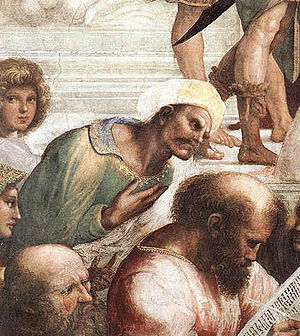


Now I know who the Muslim is in Raphael’s School of Athens.
philosophyonline.net/

 
Status
Not open for further replies.
Back
Top