A leper came to him (and kneeling down) begged him and said, “If you wish, you can make me clean.” Moved with pity, he stretched out his hand, touched him, and said to him, “I do will it. Be made clean.” The leprosy left him immediately, and he was made clean. Then, warning him sternly, he dismissed him at once. Then he said to him, “See that you tell no one anything, but go, show yourself to the priest and offer for your cleansing what Moses prescribed; that will be proof for them.” The man went away and began to publicize the whole matter. He spread the report abroad so that it was impossible for Jesus to enter a town openly. He remained outside in deserted places, and people kept coming to him from everywhere.
This story, while short, has many layers when examined closely. I think to too many people it is simply another one of Jesus’ numerous healings performed during his ministry on earth.
Leprosy is a vile disease that is even today not completely understood. It is believed to be caused by a bacterial infection spread through the air. The incubation period can be as long as several years. Many people are immune to infection, some are infected, but show no symptoms while the unfortunate few fall victim. While today treatment is possible, back in biblical times there was nothing. (
WARNING the balance of this paragraph has a somewhat explicit description of my understanding of what leprosy can do to a person, if you would rather not read this sort of thing go ahead and skip down to the next paragraph) Left untreated victims suffer lesions and there is permanent damage to the nervous tissue, to the point that sufferers can literally no longer
feel anything. This may seem innocuous in itself, but the secondary effects are the most substantial. If you or I were to, say step on a sharp rock that breaks the skin, we would yelp in pain initially, hop around a bit and then hobble along with the wound off the ground until we could properly clean and bandage the area. This is a natural reaction to this sort of injury. Someone with advanced leprosy, however, might never know that they had an injury at all. They would continue to walk on the open wound until it became infected. Eventually a leper might have several such wounds. Infected tissue would not receive the necessary nutrients from their body and would begin to rot. While I doubt it ever got to the point where whole limbs fell off, it none the less made lepers very unpleasant to be around. Their appearance, covered in lesions, with various other deformities and the odor from unhealed festering wounds and rotting flesh would be very noticeable even at a distance.
Based on the repugnant nature of these symptoms of leprosy, it is not surprising that your average person would want to avoid those infected, even without the general prejudice that the disease was a divine punishment for sinful behavior. In the Middle Ages many “leper colonies” were established for the treatment of the victims, but also to quarantine them from the general population. Some jurisdictions required lepers to wear a bell to warn others of their approach and give them time to move away. Victims of leprosy are no less human than anyone else and there is no reason why they would find the company of other lepers any more appealing than we would. The worst effect of this disease, at least in biblical times, was the complete separation from the community, totally cut off from everyone else. Even if there was the occasional “good Samaritan” who was willing to approach them and offer alms or food, I doubt many would go so far as to touch them, and even then the leper probably wouldn’t feel it. No human contact.
This is where this healing miracle stands out from all the others. We know that Jesus’ power to heal the body is unbounded. The evidence is overwhelming, the woman suffering from hemorrhages merely touched the tassel on his cloak (Lk 8:43-44), Lazarus was brought back from the dead from shouting distance(Jn 11:43), the centurion’s servant was cured at an even greater distance (Mt 8:5-13), even after Jesus’ Ascension it was believed that Peter’s
shadow was enough to heal the sick (Acts 5:15-16). In this case, however, Jesus, moved by pity,
touched him. While the Gospel doesn’t say so, I have always imagined Jesus touching his face.
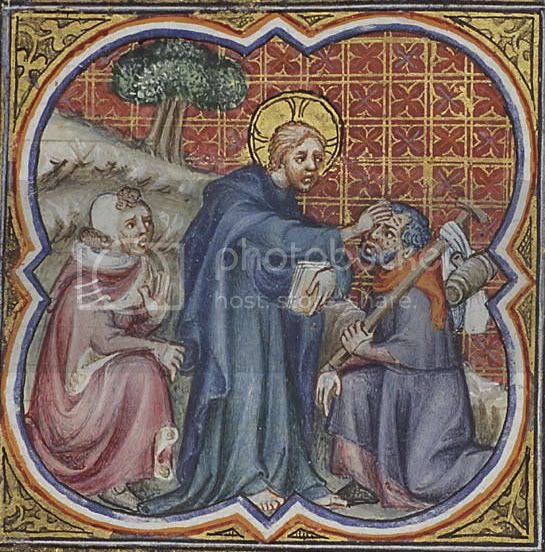
Jesus could have healed the man with a word. He could have held is nose and healed him with just a thought, but he
touched him first. This was not someone who had recently contracted the disease and “wasn’t that bad.” Luke’s Gospel describes the man as “full of leprosy” (Lk 5:12) It had probably been some time since the man had been within speaking distance of another human being, let alone close enough to be touched. Just this simple act of physical contact out of Jesus’ love for him, in and of itself, might have been the best thing that happened to the man in months if not years. And then to have his body instantly healed, not only restoring his health, but restoring him to the community where he could now be accepted and loved by others was almost too much. Mark’s version of this healing (cf Mt 8:2-4; Lk 5:12-16) is my favorite because it makes clear just how rapturous this miracle was for the man. He had originally approached Jesus because he knew, at least on some level, who Jesus really was and therefore had the faith that he could be healed. In all versions Jesus clearly instructs him not to tell anyone, Mark has him warned “sternly” (Mk 1:43) and Luke even says he was “ordered” (Lk 5:14). This man has just received a direct order from God himself not to tell anyone what happened and what does he do? He goes and tells EVERYBODY!



 I like that one too!