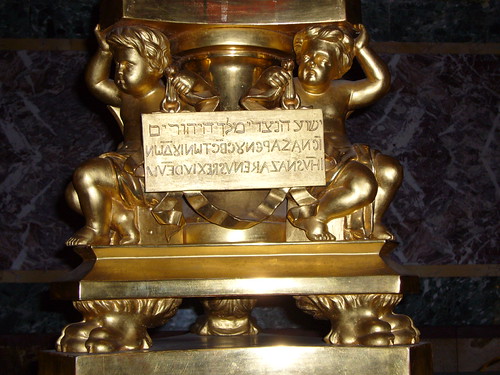
Why Are the Greek and Latin on the Titulus Relic Transcribed in Reverse?

  • Thread starter Thread starter Fidelis
  • Start date Start date
Status
Not open for further replies.
F

Fidelis

Guest
Regarding this traditional relic now being kept in a church in Rome: I don’t want to get into debate about the value or historicity of this or other relics, but does anyone know off the top of their head any given reason why the Greek and the Latin renderings of the line “Jesus the Nazarene King of the Jews” is transcribed in reverse?

Thanks for your help and for not turning this into a debate about relics. 🙂

(Please Note: This uploaded content is no longer available.)
 
Regarding this traditional relic now being kept in a church in Rome: I don’t want to get into debate about the value or historicity of this or other relics, but does anyone know off the top of their head any given reason why the Greek and the Latin renderings of the line “Jesus the Nazarene King of the Jews” is transcribed in reverse?
Can we have a link to the site of the image? Do you think the pic might just be reversed?
 
According to the Wikipedia article, the Greek and Latin scripts are indeed reversed. No reason for this is offered.
Maybe it has something to do with this:
It is generally either ignored by scholars or considered to be a medieval forgery.
So, lets say you are not able to write the languages but want to make a forgery. Perhaps you can talk someone who can into writing it out for you on some paper you supply.

No carbon paper, so how do you transfer it to the wood plank? Trace over the letters with charcoal, turn it over onto the wood and rub until the charcoal transfers. Then trace in some ink or paint over the charcoal. I believe I’ve read that the wealthy and royal were for the most part illiterate during the Dark Ages, so they wouldn’t know if the letters were reversed or not if one took the Holy Land pilgrimage looking for relics at the end of that time.
 
I don’t think so, since the ‘Hebrew’ part of the inscription reads normally (right to left).
No link to the image? Well, I’m no expert but what looks like Hebrew to you? I see Greek and Latin, mirrored. Maybe some sort of Aramaic and Latin.
 
So, lets say you are not able to write the languages but want to make a forgery. Perhaps you can talk someone who can into writing it out for you on some paper you supply.

No carbon paper, so how do you transfer it to the wood plank? Trace over the letters with charcoal, turn it over onto the wood and rub until the charcoal transfers. Then trace in some ink or paint over the charcoal. I believe I’ve read that the wealthy and royal were for the most part illiterate during the Dark Ages, so they wouldn’t know if the letters were reversed or not if one took the Holy Land pilgrimage looking for relics at the end of that time.
That’s possible, of course, but as someone pointed out the Hebrew is not reversed. If said illiterate did indeed trace these letters, it would have ALL been reversed.
 
Maybe it has something to do with this:
It is generally either ignored by scholars or considered to be a medieval forgery.
The Wikipedia article that is cited here has been tagged as containing possible biases. Other sources I’ve seen state that the evidence for authenticity (including the radiocarbon testing) is inconclusive. For the sake of the topic at hand, let’s lay aside the question of authenticity aside for now. 🙂
 
Not all Greek scripts read left to right. Some were right to left, and others alternated: in Greek it was described “as the ox plows.”
A much more telling matter is that there are divisions between the words. I don’t know when it began in Latin, but neither Greek nor Hebrew divided words. On that alone, I would say the authenticity would be suspect.
 
Boustrophedon meant that alternating lines of text were left-right and then right-left. Here we have three consecutive lines all written right-to-left. That’s not boustrophedon.
 
Boustrophedon meant that alternating lines of text were left-right and then right-left. Here we have three consecutive lines all written right-to-left. That’s not boustrophedon.
Right, but the three lines are in different languages AND it was written with an attitude of “whatever, these are the last crucifixions on the schedule for today, and I just want to go home”. People back then were apparently used to mirror-writing since the direction even then seems not to have been standardized.

I really don’t think the guy who wrote it was thinking he was making history.
 
No link to the image? Well, I’m no expert but what looks like Hebrew to you? I see Greek and Latin, mirrored. Maybe some sort of Aramaic and Latin.
Let me correct myself.

(Please Note: This uploaded content is no longer available.)

(Please Note: This uploaded content is no longer available.)

As we can see, the surviving portion only shows (part of) the Greek and Latin and the lower half of the ‘Hebrew’ text. All the reconstructions of the titulus I can find on the Internet have the portion written normally: ישוע הנצרי מלך היהודים (Hebrew: Yēšūă’ ha-Noṣrî Meleḵə ha-Yĕhûdîm).


http://bchristiancenter.com/boards 004.jpg

(Please Note: This uploaded content is no longer available.)

(Please Note: This uploaded content is no longer available.)

 
Not all Greek scripts read left to right. Some were right to left, and others alternated: in Greek it was described “as the ox plows.”
Boustrophedon. I might point out that boustrophedonic writing was only common in the case of Greek among prehistoric and archaic inscriptions (originally the predominant way of writing was from right to left, just like its parent script Phoenician): throughout the Hellenistic period this style of writing became increasinly less popular, when the left-to-right writing direction familiar with us today became the standard. Same goes for Latin.
 
The Wikipedia article that is cited here has been tagged as containing possible biases.
I saw that, but I’m not the one who originally referenced it, I was just responding to the poster who did.

In general, it looks like from these replies and a few things I’ve read (not an expert at all) it can just be attributed to the style of whoever wrote it. It’s not like they had the kind of culture-wide writing conventions we have.
 
There are two questions here.
  1. Did St. Helena recover the real titulus as part of her True Cross dig, which she did where the Christians of Jerusalem told her to look?
  2. Is the titulus on display today, the one found in 1492 tucked away in the walls, the same titulus that St. Helena brought back to Rome from Jerusalem? Or is it some kind of copy or alternate version that was hanging around the parish for forgotten reasons?
Most Christians down the ages would have said Yes to #1. We don’t know about #2. It’s also possible that if #2 isn’t #1, it incorporates fragments of #1.
  1. The final question is why the backward carved writing? Because obviously nobody is going to either write or forge backward writing for no good reason. If you wanted to forge something by some backward method, you’d write the letters backward and forge the thing forward. Obviously.
Now, if you were making medieval souvenir woodblock prints for people to take home as a souvenir of the pilgrimage, a reverse-writing block of wood replicating the titulus words in a mirrored format would be exactly what you’d want. But I don’t think anybody has said there’s fragments of ink or paint in the current titulus, or that Santa Croce in Gerusalemme ever offered souvenir woodblock prints from a blessed titulus replica.

Re: Hebrew, the Hebrew part of St. Helena’s titulus was split off and left in Jerusalem. A lot of the stuff St. Helena left in Jerusalem, or which Emperor Constantine sent back there, was eventually moved to Constantinople for safekeeping and lost. I’m not real up on the fate of the Hebrew titulus, though.
 
Now, if you were making medieval souvenir woodblock prints for people to take home as a souvenir of the pilgrimage, a reverse-writing block of wood replicating the titulus words in a mirrored format would be exactly what you’d want. .
But in that case, the letters would not be inset, but the material around the letters carved out. However, it would have worked as a form to make a cast.
 
There are two questions here.
  1. Did St. Helena recover the real titulus as part of her True Cross dig, which she did where the Christians of Jerusalem told her to look?
This is where things are a little unclear. The earliest account we have - Eusebius’ Life of Constantine - does not mention the True Cross at all. Rather, the focus was on Constantine ordering that the site of Jesus’ tomb be uncovered and instructing Macarius, bishop of Jerusalem to build a church on the site. (While it is still far from certain whether the traditional site is the real location, it does have some pretty strong claims for its authenticity.)

After these things, the pious emperor addressed himself to another work truly worthy of record, in the province of Palestine. What then was this work? He judged it incumbent on him to render the blessed locality of our Saviour’s resurrection an object of attraction and veneration to all. He issued immediate injunctions, therefore, for the erection in that spot of a house of prayer: and this he did, not on the mere natural impulse of his own mind, but being moved in spirit by the Saviour himself. …]

[A]s soon as the original surface of the ground, beneath the covering of earth, appeared, immediately, and contrary to all expectation, the venerable and hollowed monument of our Saviour’s resurrection was discovered. Then indeed did this most holy cave present a faithful similitude of his return to life, in that, after lying buried in darkness, it again emerged to light, and afforded to all who came to witness the sight, a clear and visible proof of the wonders of which that spot had once been the scene, a testimony to the resurrection of the Saviour clearer than any voice could give.

Immediately after the transactions I have recorded, the emperor sent forth injunctions which breathed a truly pious spirit, at the same time granting ample supplies of money, and commanding that a house of prayer worthy of the worship of God should be erected near the Saviour’s tomb on a scale of rich and royal greatness …

It was Socrates Scholasticus, writing around the early 5th century, who first gives the account of the finding of the True Cross. The task of the discovery of both sepulchre and cross is now attributed to Constantine’s mother Helena. In Socrates, Macarius has the three crosses placed in turn on a deathly ill woman. This woman recovered at the touch of the third one, which was taken as a sign that this was the true Cross. Socrates also reports that, having also found the nails with which Jesus had been fastened to the cross, Helena sent these to Constantinople, where they were incorporated into the emperor’s helmet and the bridle of his horse.

Contemporary and later writers parrot Socrates’ account: Sozomen (died c. 450) only adds the detail that it was said (by whom he does not say) that the location of the tomb was “disclosed by a Hebrew who dwelt in the East, and who derived his information from some documents which had come to him by paternal inheritance” (although Sozomen himself disputes this account) and that a dead person was also revived by the touch of the True Cross. It is with Theodoret’s account that we get the standard version of the story. Interestingly, a Syriac legend (later also passed down in Armenian) has it that the True Cross was discovered, not by Helena, but by an empress named Protonike, who is alleged to be the wife of the emperor Claudius (AD 41-54): most versions, however, attempt to harmonize the various conflicting stories by making it appear that after Protonike discovered the True Cross, it was eventually hidden again until Helena (or the Jew Judas, aka Kyriakos) found it again.

All in all, we have three versions of the story of the finding of the True Cross: the Helena version (in which Helena herself discovers the artifacts in question), and its two deritatives the Kyriakos version (where the actual discovery is made by Judas the Jew, who eventually converts and changes his name to Kyriakos), and the Protonike version. We don’t know for certain which part of the story is factual and which parts are apocryphal, but it is certain that the Basilica of the Holy Sepulchre was completed by 335 and that alleged relics of the Cross were being venerated there at least a decade later.

 
Status
Not open for further replies.
Back
Top