
Why did the Jews have pigs?

Status
Not open for further replies.

Nelka

New member
I know they weren’t allowed to eat them but could they touch them? What did they do with them?

Luke 8:32-34 Now there was a large herd of pigs feeding there on the mountain, and the devils begged him to let them go into these. So he gave them leave. The devils came out of the man and went into the pigs, and the herd charged down the cliff into the lake and was drowned. When the swineherds saw what had happened they ran off and told their story in the city and in the country round about.

Swineherds and pigs o what was their use?

Thanks.
 
I know they weren’t allowed to eat them but could they touch them? What did they do with them?

Luke 8:32-34 Now there was a large herd of pigs feeding there on the mountain, and the devils begged him to let them go into these. So he gave them leave. The devils came out of the man and went into the pigs, and the herd charged down the cliff into the lake and was drowned. When the swineherds saw what had happened they ran off and told their story in the city and in the country round about.

Swineherds and pigs o what was their use?

Thanks.
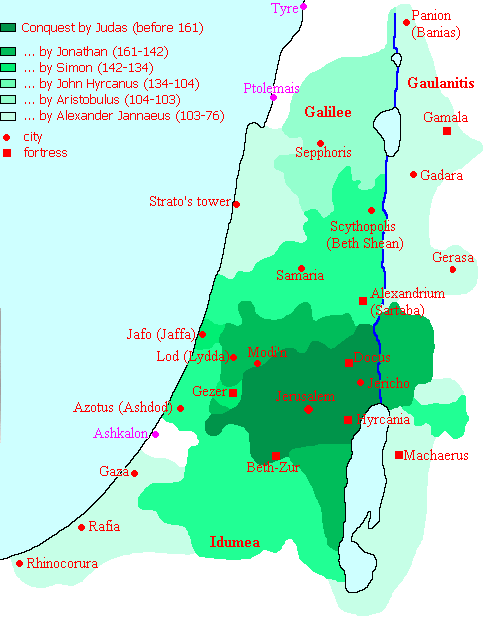
You’re talking about the Gerasene/Gadarene/Gergesene (whichever it was) demoniac, right? Both Gerasa and Gadara (and Gergesa) were not in Jewish territory; they were part of the Decapolis. That’s why pigs appear in the narrative.

(Please Note: This uploaded content is no longer available.)

Do you know one of the tell-tale signs archaeologists look for when they’re trying to ascertain whether a site is Jewish or not? It’s the presence or absence of pig bones. When absolutely no (or negligible amounts of) pig bones - or any other non-kosher animal - are found in the area, then it’s highly likely that those who lived there were Jews. Because obviously, pork is not kosher.
 
Why did Jesus permit the destruction of these animals? It was symbolic of the grave sins of secular society, which lead to the destruction of the soul.
 
There must have been pigs knocking about originally, did the Jews sell them or did non Jews bring pigs to the wider area?
 
As someone remarked, the area of the Gerasenes, although within Biblical Israel, was not Jewish, but a Greek colony. Hence they could raise and eat pigs.

However, I’ve heard one Protestant preacher say that “our LORD wanted to teach the farmer a lesson about not raising pigs”. :)🙂

ICXC NIKA.
 
There must have been pigs knocking about originally, did the Jews sell them or did non Jews bring pigs to the wider area?
The Decapolis was founded by Greek settlers during the Hellenistic period (between the death of Alexander the Great in 323 BC and the Roman conquest of 63 BC). The descendants of Alexander’s generals, the Ptolemies and the Seleucids, founded many city-states (polis), including in what was in the OT (pre-Exilic) period Israelite territory, and other cities simply became Hellenized due to their influence. (Gerasa - modern Jerash - was originally part of the region of Gilead; Scythopolis was originally Beth-She’an.) We know this because some of these cities included “Antiochia” - cf. Antiochus - or “Seleucia” in their official names (Hippos, for example, is officially known as Antiochia Hippos).

Essentially, what became the Decapolis was originally Israelite (Gerasa, Beth-She’an/Scythopolis), Ammonite (Philadelphia - modern Amman, Jordan - was originally the Ammonite capital Rabbath Ammon), and Aramean (Damascus) territory in the OT period.

(Please Note: This uploaded content is no longer available.)

When Pompey conquered Judea in 63 BC and made an end to the Seleucid Empire, he also awarded some kind of independence to a group of Hellenized city-states east of the Sea of Galilee, which was called the Decapolis. Up to that point, some of these cities were locked in conflict with the Jewish Hasmonean dynasty (the dynasty the Maccabees founded) that had ruled much of the area, because the Hasmoneans were forcing the non-Jewish peoples in their kingdom to convert to Judaism. The people of the Decapolis cities welcomed Pompey as a liberator from the Jewish ‘fanatics’, and as a result, the cities based their calendar era on Pompey’s conquest in his honor.


Hasmonaean Judaea
 
As someone remarked, the area of the Gerasenes, although within Biblical Israel, was not Jewish, but a Greek colony. Hence they could raise and eat pigs.
Textually you have three candidates: Gerasa, Gadara, and Gergesa. Gerasa and Gadara are the more famous cities, but they’re quite far from the sea - or from any other body of water (Gerasa in particular). Gergesa (likely modern Kursi) has the advantage of being closer to the Sea of Galilee and so probably fits the narrative better. (Some people even propose that the actual location of the story could have been yet another city in the Decapolis: Hippos, which is located a hill overlooking the Sea of Galilee.)
 
I know they weren’t allowed to eat them but could they touch them? What did they do with them?

Luke 8:32-34 Now there was a large herd of pigs feeding there on the mountain, and the devils begged him to let them go into these. So he gave them leave. The devils came out of the man and went into the pigs, and the herd charged down the cliff into the lake and was drowned. When the swineherds saw what had happened they ran off and told their story in the city and in the country round about.

Swineherds and pigs o what was their use?

Thanks.
The inhabitants of the city were not Jews. The whole pig incident might actually be a joke referring to the Tenth Legion, who’s animal, incidentally, was a pig.
 
The inhabitants of the city were not Jews. The whole pig incident might actually be a joke referring to the Tenth Legion, who’s animal, incidentally, was a pig.
I.e., there were never any pigs?

Presumably, had HE drowned a Roman legion’s food source, the Gospel would have ended much earlier…

ICXC NIKA
 
I.e., there were never any pigs?
No, it means that there were pigs. 😉
Presumably, had HE drowned a Roman legion’s food source, the Gospel would have ended much earlier…
ICXC NIKA
It’s not so much that Jesus drowned a potential meal for the Roman legions, it’s that the incident could also symbolize Jesus showing His superiority to the power of Rome. I mean, at His command ‘Legion’ throws itself (themselves?) into the water.
 
I.e., there were never any pigs?

Presumably, had HE drowned a Roman legion’s food source, the Gospel would have ended much earlier…

ICXC NIKA
I never said that the town was a supply for the Tenth Legion, just that its animal symbol was a pig.
 
No, it means that there were pigs. 😉

It’s not so much that Jesus drowned a potential meal for the Roman legions, it’s that the incident could also symbolize Jesus showing His superiority to the power of Rome. I mean, at His command ‘Legion’ throws itself (themselves?) into the water.
wow that’s interesting!
 
I never said that the town was a supply for the Tenth Legion, just that its animal symbol was a pig.
And it’s all the more interesting, because the tenth legion was the one who crushed both the Jewish revolt of AD 66-73 and the Bar Kochba revolt of 132-135.
 
Status
Not open for further replies.
Back
Top