Why sola Scriptura?

  • Thread starter Thread starter Charlemagne_II
  • Start date Start date
Status
Not open for further replies.
It’s a rounding, not intended to be literal, but do a Google search, type
30,000 denominations, it’s quite a common number, other numbers in-
clude 33,000 and 20,000, the point is: THERE ARE THOUSANDS!

Also check out Wikipedia:en.wikipedia.org/wiki/List_of_Christian_denominations
Also see:philvaz.com/apologetics/a120.htm
SAMPLE:
The 2001 edition (World Christian Encyclopedia), successor to his 1982 first
edition , which took a decade to compile, identifies 10,000 distinct religions,
of which 150 have 1 million or more followers. ** Within Christianity, he counts
33,820 denominations.**​
Yes the number comes from a study, maybe a book that studies "Christianity . The 20-30 thousand uses certain criteria which if applied to Catholicism would put Her having thousands of “divisions” also.It is a number that is used as propaganda. There are divisions in all Christianity including "Catholicism’. No one is immune. The most you could say is protestantism has more,depending on what criteria you use.The ratio may be closer to 7 to one. If you like I can dig up site that talks of study /book (which is non-catholic-non protestant) that has been used or misused by some Catholics. lazyboysreststop.org/apol44.htm
 
Barnabus, early church father said, " Let all those learned in the Lord’s commandments keep them, as many as are written.". St Augustine who felt blessed by the tradition of church still said, “Therefore since we are too weak to find truth by pure reason and for that cause we needed the authority of Holy Writ, I now began to believe that in no wise would you have given such surpassing authority throughout the whole world to that Scripture, unless you wished that both through it you be believed and through it you be sought”…it is"easy for everyone to read’…and “accessible to all men”. " Confessions, book 5 The Authority of the Scriptures.
St. Augustine also wrote:

CHAPTER 4.—PROOFS OF THE CATHOLIC FAITH
  1. For in the Catholic Church, not to speak of the purest wisdom, to the knowledge of which a few spiritual, men attain in this life, so as to know it, in the scantiest measure, indeed, because they are but men, still without any uncertainty (since the rest of the multitude derive their entire security not from acuteness of intellect, but from simplicity of faith,)—not to speak of this wisdom, which you do not believe to be in the Catholic Church, there are many other things which most justly keep me in her bosom. The consent of peoples and nations keeps me in the Church; so does her authority, inaugurated by miracles, nourished by hope, enlarged by love, established by age. The succession of priests keeps me, beginning from the very seat of the Apostle Peter, to whom the Lord, after His resurrection, gave it in charge to feed His sheep, down to the present episcopate. And so, lastly, does the name itself of Catholic, which, not without reason, amid so many heresies, the Church has thus retained; so that, though all heretics wish to be called Catholics, yet when a stranger asks where the Catholic Church meets, no heretic will venture to point to his own chapel or house. Such then in number and importance are the precious ties belonging to the Christian name which keep a believer in the Catholic Church, as it is right they should, though from the slowness of our understanding, or the small attainment of our life, the truth may not yet fully disclose itself. But with you, where there is none of these things to attract or keep me, the promise of truth is the only thing that comes into play. Now if the truth is so clearly proved as to leave no possibility of doubt, it must be set before all the things that keep me in the Catholic Church; but if there is only a promise without any fulfillment, no one shall move me from the faith which binds my mind with ties so many and so strong to the Christian religion.
Augustine of Hippo. (1887). Against the Epistle of Manichæus Called Fundamental. (R. Stothert, Tran.)A Select Library of the Nicene and Post-Nicene Fathers of the Christian Church, First Series, Volume IV: St. Augustin: The Writings against the Manichaeans and against the Donatists (p. 130). Buffalo, NY: Christian Literature Company.

And

For my part, I should not believe the gospel except as moved by the authority of the Catholic Church. So when those on whose authority I have consented to believe in the gospel tell me not to believe in Manichæus, how can I but consent? Take your choice. If you say, Believe the Catholics: their advice to me is to put no faith in you; so that, believing them, I am precluded from believing you;—If you say, Do not believe the Catholics: you cannot fairly use the gospel in bringing me to faith in Manichæus; for it was at the command of the Catholics that I believed the gospel;—Again, if you say, You were right in believing the Catholics when they praised the gospel, but wrong in believing their vituperation of Manichæus: do you think me such a fool as to believe or not to believe as you like or dislike, without any reason? It is therefore fairer and safer by far for me, having in one instance put faith in the Catholics, not to go over to you, till, instead of bidding me believe, you make me understand something in the clearest and most open manner. To convince me, then, you must put aside the gospel. If you keep to the gospel, I will keep to those who commanded me to believe the gospel; and, in obedience to them, I will not believe you at all.

Augustine of Hippo. (1887). Against the Epistle of Manichæus Called Fundamental. (R. Stothert, Tran.)A Select Library of the Nicene and Post-Nicene Fathers of the Christian Church, First Series, Volume IV: St. Augustin: The Writings against the Manichaeans and against the Donatists (p. 131). Buffalo, NY: Christian Literature Company.
 
****steido

Well there’s a loaded question. To which local councils of the 4th century are you referring? **

newadvent.org/cathen/03274a.htm

You can read all about it here. The Catholic Church fixed the canon of the New Testament. If you believe the canon is incorrect, and that the holy Spirit erred in guiding the Church, you have to explain yourself. It’s the same basic Bible all Christians use today. Where did you get your Bible if not from the Holy Spirit through the Catholic Church of the 4th Century?**
 
Yes the number comes from a study, maybe a book that studies "Christianity . The 20-30 thousand uses certain criteria which if applied to Catholicism would put Her having thousands of “divisions” also.It is a number that is used as propaganda. There are divisions in all Christianity including "Catholicism’. No one is immune. The most you could say is protestantism has more,depending on what criteria you use.The ratio may be closer to 7 to one. If you like I can dig up site that talks of study /book (which is non-catholic-non protestant) that has been used or misused by some Catholics. lazyboysreststop.org/apol44.htm
Have you ever actually looked at the World Christian Encyclopedia? It says there are 242 CatholIc denominations. Would you agree with that? It includes Gnostics (present during the early church) and all manner of nonsensical inclusions. JW’s, Mormons, etc. These faiths didn’t come from sola scriptura.

I understand that not everyone checks every source especially when they cost over $700.00., but this myth gets old. In fact there are Catholics apologists that beg Catholics to stop spreading this falsehood. I sincerely appreciate your candor. It’s refreshing. The reason I asked, was I knew this was not true, and I saw it posted once again, but of course, I don’t check every source either. When we post things to public websites we become part of a system of bearing false witness. I don’t think that many people do this intentionally. People just hear things and then repeat them. You are very wise. God Bless.
 
Contarini
**
But all the books were there and recognized by Christians. So yes, the NT as we know it did exist.**

The books were there but they were not assembled as the New Testament and given their authority as true Testaments until the 4th Century. Until the 4th Century the New Testament did not exist as we know it. Why is this so difficult for you to grasp? :confused:
First of all, because you poorly define what you mean as “assembled as the New Testament”–do you mean “assembled in one physical volume” or what? Second, because insofar as I can make sense of your claim, it’s clearly false. Irenaeus, for instance, speaks of the four-Gospel canon as authoritative. Much earlier even than that, 2 Peter speaks of Paul’s letters as Scripture. The “Muratorian Canon,” usually dated to around 170, is the first formal list of canonical NT books, and it includes the four Gospels, the Pauline Epistles, 1-2 John, Jude, and Revelation.

Now if your claim still makes sense in light of this evidence, you need to define it better. You may be giving the phrase “assembled as the New Testament” some meaning that escapes me.

Edwin
 
Yes, but along other books like: The Didache, the Shepperd of Hermas, Clement I, and others.

It wasn’t until much later that the 27 books we have now we singled out.
From the date of 2 Peter at least (I suspect that most here will put it in the first century, rather than the more common date among scholars of the early second century–but it was certainly written long before the fourth century) there was a concept of New Testament Scripture. There was some debate about the margins of the canon until the late fourth century, and perhaps to some degree even until the Council of Trent. But it is nonsensical to claim that for that reason there was no such thing as the New Testament.
Which begs the question:
How do you know that those other books are not Scriptures?
That’s a reasonable question. (My answer is “by the authority of the Church,” in case you are wondering.)

Edwin
 
Have you ever actually looked at the World Christian Encyclopedia? It says there are 242 CatholIc denominations. Would you agree with that? It includes Gnostics (present during the early church) and all manner of nonsensical inclusions. JW’s, Mormons, etc. These faiths didn’t come from sola scriptura.

I understand that not everyone checks every source especially when they cost over $700.00., but this myth gets old. In fact there are Catholics apologists that beg Catholics to stop spreading this falsehood. I sincerely appreciate your candor. It’s refreshing. The reason I asked, was I knew this was not true, and I saw it posted once again, but of course, I don’t check every source either. When we post things to public websites we become part of a system of bearing false witness. I don’t think that many people do this intentionally. People just hear things and then repeat them. You are very wise. God Bless.
The editors explained how the number of denominations is calculated:

"The definition for denominations used in WCT, and also in our publication World Christian Encyclopedia (Oxford, 2001) is as follows:

“Any agency consisting of a number of congregations or churches voluntarily aligning themselves with it. As a statistical unit in this survey, a ‘denomination’ always refers to one single country. Thus the Roman Catholic Church, although a single organization, is described here as consisting of 236 denominations in the world’s 238 countries.”

Whatever the reason, it is how they arrive at their total.

GKC
 
Hi,

Would you be so kind as to provide a reference for your 30,000 denomination claim? Thanks so much.
The Number of Protestant Denominations

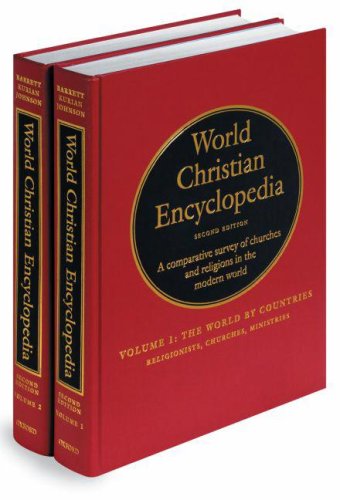
The source for this is the World Christian Encylopedia published by Oxford Press and edited by David Barrett.


The publisher has a major facility located in Cary, NC near my home, and I have held this book (two volumes, actually) in my own hands and confirmed the numbers printed there. You can view more information about this book here:

amazon.com/World-Christian-Encyclopedia-Comparative-Religions/dp/0195079639

For a more conservative number, try The World Christian Database produced by the Center for the Study of Global Christianity at the Gordon-Conwell Theological Seminary (Presbyterian) available here:

worldchristiandatabase.org/wcd/

A researcher from the Protestant Gordon-Conwell Theological Seminary confirmed that the numbers are accurate in the following email:

Email from Gordon-Conwell Theological Seminary “Global Christianity” to Ms. Shenandoah Brown, SFO (Secular Franciscan Order)
author of Lamp Unto My Feet to be published by PublishAmerica
Received 9/28/2007 11:17 a.m. MST

Hello Ms. Brown,

Thank you for your inquiry. I can assure you that the figure of 39,000 is in no way inflated. This number represents our most current, up-to-date data. As we are constantly updating this figure, it is not published in print form. The figure of 33,800 from the year 2000 was printed in our book World Christian Trends, (Pasadena, CA: William Carey Library, 2001). Part 12 of World Christian Trends (WCT), Table 12-1 gives figures of denominational totals for all 238 countries of the world. These figures are also represented graphically in WCT on page 917, Global Map 14. The definition for denominations used in WCT, and also in our publication World Christian Encyclopedia (Oxford, 2001) is as follows:

“Any agency consisting of a number of congregations or churches voluntarily aligning themselves with it. As a statistical unit in this survey, a ‘denomination’ always refers to one single country. Thus the Roman Catholic Church, although a single organization, is described here as consisting of 236 denominations in the world’s 238 countries.”​

More precise listings of denominations can be found in the World Christian Encyclopedia, under the article for each country. These lists are not exhaustive, as there are too many small denominations to list separately, but they should help give a clearer picture.

Furthermore, the Southern Baptist Convention has over 40,000 congregations in the US alone; not to mention the Baptist General Conference, Baptist Bible Fellowship International, etc. So we are definitely not counting each congregation as its own denomination. We are also not lumping all Baptists into a single denomination, but counting each organization separately. I hope this information helps.

Justin J. Evans
Research Assistant
Center for the Study of Global Christianity

Gordon-Conwell Theological Seminary
130 Essex Street #228
South Hamilton, MA 01982 USA
E-mail: csgc@gcts.edu
 
Have you ever actually looked at the World Christian Encyclopedia? It says there are 242 CatholIc denominations. Would you agree with that? It includes Gnostics (present during the early church) and all manner of nonsensical inclusions. JW’s, Mormons, etc. These faiths didn’t come from sola scriptura.

I understand that not everyone checks every source especially when they cost over $700.00., but this myth gets old. In fact there are Catholics apologists that beg Catholics to stop spreading this falsehood. I sincerely appreciate your candor. It’s refreshing. The reason I asked, was I knew this was not true, and I saw it posted once again, but of course, I don’t check every source either. When we post things to public websites we become part of a system of bearing false witness. I don’t think that many people do this intentionally. People just hear things and then repeat them. You are very wise. God Bless.
I live a few miles from the offices of the publisher which are located in Cary, NC. I have held the volumes in my own hands and reviewed the data.

Since we can agree that there are NOT 242 Catholic denominations (one per country), let’s divide the number of non-Catholic denominations by 242.

40,000/242 = 165.29 Protestant denominations
30,000/242 = 123,97 Protestant denominations

However, there is a flaw here: is it reasonable to expect that every little denomination in the world is represented in all 242 countries?

No.

Therefore, dividing whatever total you wish to begin with by 242 produces an inaccurate result. Because some tiny, independent groups will be present in only one country, we can say with confidence that the number of Protestant denominations numbers in the thousands.

And that is far more than the ONE that Jesus established, isn’t it?

Hope this helps.

:tiphat:
 
I live a few miles from the offices of the publisher which are located in Cary, NC. I have held the volumes in my own hands and reviewed the data.

Since we can agree that there are NOT 242 Catholic denominations (one per country), let’s divide the number of non-Catholic denominations by 242.

40,000/242 = 165.29 Protestant denominations
30,000/242 = 123,97 Protestant denominations

However, there is a flaw here: is it reasonable to expect that every little denomination in the world is represented in all 242 countries?

No.

Therefore, dividing whatever total you wish to begin with by 242 produces an inaccurate result. Because some tiny, independent groups will be present in only one country, we can say with confidence that the number of Protestant denominations numbers in the thousands.

And that is far more than the ONE that Jesus established, isn’t it?

Hope this helps.

:tiphat:
But the bigger point is that the methodology is hopelessly flawed. You know that there aren’t 242 Catholic denominations, right? You know that any definition of “denomination” that leads to that result is irrelevant for ecclesiological purposes.

For instance, many Protestant denominations agree doctrinally with each other and cooperate completely with each other. It’s a complicated picture–there isn’t a clear-cut criterion that distinguishes which denominations are functionally the same “church” with each other and which aren’t. (Transitivity doesn’t necessarily apply: for instance, the Episcopal Church is in full communion with the ELCA, and the ELCA is in full communion with several denominations of Reformed origin, but these denominations are not in full communion with the Episcopal Church. The relationships among evangelical denominations and independent congregations are much more complex and hard to define.)

Institutional decentralization is one thing; ecclesial disunity is another. Both exist within Protestantism, and Catholics have a very strong argument from Protestant disunity. But the argument is obscured when Catholics show total ignorance about what a Protestant denomination is, and/or a lack of interest in speaking precisely on the subject.

Edwin
 
**Contarini

Now if your claim still makes sense in light of this evidence, you need to define it better. You may be giving the phrase “assembled as the New Testament” some meaning that escapes me.**

Your homework is one easy question. Tell me the first date that all the present books of the New Testament were published in one volume.

That is what I mean by the New Testament as we know it.

It’s disingenuous of you to suggest that all the early Christians had access to all the present book of the New Testament as soon as they were written.

For one thing, most of them couldn’t even read. For another, those books were not assembled in one volume and given canonical validity until the 4th Century. For yet another, they were not translated into all the many languages of Christendom (that was not even considered possible in the earliest days).

So how did the early Christians get the Gospel truths under their belt? By the preaching of the Church and the tradition of Church authority. Paul preached the Gospel in all the communities he visited long before he later wrote the epistles to those same communities. None of the 4 Gospels was available in written form until after the deaths of Peter and Paul, when Mark wrote the first Gospel. So what Scriptures are you talking about when you insist the Scriptures were all written and available to all in the earliest days? You talk about Peter letter referencing Paul. But you can’t find anyone (including Peter) referencing the Gospel of Mark, or any of the later Gospels, can you? 😉 How can you say the Scriptures were all presents to the early Christians when all four Gospels were not written until after the deaths of Peter and Paul, and all four Gospels were not available to be read by all Christians in one book with any kind of canonical authenticity until the 4th Century?

Please stop asking the same question over and over, and start answering some of the questions I have posed. It’s only fair that you do so, or this is going to be a long and useless discussion from my point of view.

Bottom line question:

When was the New Testament first published with all its present books in one volume and given the imprimatur of Church tradition? Who gave the New Testament that imprimatur in the 4th Century … Protestants or the Catholic Church?

Until you answer directly, I will not be answering any more of your questions.

Thank you. 😉
 
**Contarini

Institutional decentralization is one thing; ecclesial disunity is another. Both exist within Protestantism, and Catholics have a very strong argument from Protestant disunity. But the argument is obscured when Catholics show total ignorance about what a Protestant denomination is, and/or a lack of interest in speaking precisely on the subject.**

Protestant are mainly united under one flag: their “protest” against Catholicism. Why do you think they are called Protestants (people who protest)? Otherwise, you find a wilderness of diversity both in doctrine and traditions among them all. This is not what Christ wanted.

I guess you could say, in a strange way, that Jesus was a Protestant. After all, he protested the lack of unity among those who would follow him.

“Neither pray I for these alone, but for them also which shall believe on me through their word, that they all may be one; as thou, Father, art in me, and I in thee, that they also may be one in us; that the world may believe that thou has sent me.” - John 17:20-21

“Other sheep I have, which are not of this fold: them also I must bring, and they shall hear my voice; and there shall be one flock, one shepherd.” (John 10:16)

Show me how Protestantism fulfills the wish of Jesus that there “be one flock and one shepherd.”
 
Have you ever actually looked at the World Christian Encyclopedia? It says there are 242 CatholIc denominations. Would you agree with that? It includes Gnostics (present during the early church) and all manner of nonsensical inclusions. JW’s, Mormons, etc. These faiths didn’t come from sola scriptura.

I understand that not everyone checks every source especially when they cost over $700.00., but this myth gets old. In fact there are Catholics apologists that beg Catholics to stop spreading this falsehood. I sincerely appreciate your candor. It’s refreshing. The reason I asked, was I knew this was not true, and I saw it posted once again, but of course, I don’t check every source either. When we post things to public websites we become part of a system of bearing false witness. I don’t think that many people do this intentionally. People just hear things and then repeat them. You are very wise. God Bless.
Thanks,very encouraging and blessings also
 
=Charlemagne II;11246891]
Protestant are mainly united under one flag: their “protest” against Catholicism.
This is simplistic, and in the current era, inaccurate. The vast number of protestants don’t even think about or care about the Catholic Church. They were raised in their current communion. They’re not protesting anyone else.
Why do you think they are called Protestants (people who protest)?
They are called that because, 1) in 1529 at the Second Diet of Speyer, attempts were made to restrict religious activity of the Evangelical churches (Lutheran), and others, not by the Catholic Church, but essentially by government. The Lutherans and other mounted a protest against this, hence the term protestant, 2) today it is a convenient term to describe western non-Catholic Christians.
Otherwise, you find a wilderness of diversity both in doctrine and traditions among them all. This is not what Christ wanted.
It should not be surprising that there are differing doctrines and practices, as there are a variety of groups with different roots. You are correct, however, that this is not what Christ wants for His Church.
I guess you could say, in a strange way, that Jesus was a Protestant. After all, he protested the lack of unity among those who would follow him.
An odd assertion, coming from a Catholic, that Jesus was a protestant. But in fact, looking at the original meaning, the Catholic Church is now protestant, because it is protesting the government’s attempts to force abortion into Catholic insurance policies - the HHS Mandate.
“Neither pray I for these alone, but for them also which shall believe on me through their word, that they all may be one; as thou, Father, art in me, and I in thee, that they also may be one in us; that the world may believe that thou has sent me.” - John 17:20-21
“Other sheep I have, which are not of this fold: them also I must bring, and they shall hear my voice; and there shall be one flock, one shepherd.” (John 10:16)
Amen
Show me how Protestantism fulfills the wish of Jesus that there “be one flock and one shepherd.”
Consider that the Roman See has been in Schism with the East for twice as long as the events of the Reformation, one could ask the same question of it. 🤷

Jon
 
The Number of Protestant Denominations

The source for this is the World Christian Encylopedia published by Oxford Press and edited by David Barrett.

http://ecx.images-amazon.com/images/I/51ENMYCD92L.jpg

The publisher has a major facility located in Cary, NC near my home, and I have held this book (two volumes, actually) in my own hands and confirmed the numbers printed there. You can view more information about this book here:

amazon.com/World-Christian-Encyclopedia-Comparative-Religions/dp/0195079639

For a more conservative number, try The World Christian Database produced by the Center for the Study of Global Christianity at the Gordon-Conwell Theological Seminary (Presbyterian) available here:

worldchristiandatabase.org/wcd/

A researcher from the Protestant Gordon-Conwell Theological Seminary confirmed that the numbers are accurate in the following email:

Email from Gordon-Conwell Theological Seminary “Global Christianity” to Ms. Shenandoah Brown, SFO (Secular Franciscan Order)
author of Lamp Unto My Feet to be published by PublishAmerica
Received 9/28/2007 11:17 a.m. MST

Hello Ms. Brown,

Thank you for your inquiry. I can assure you that the figure of 39,000 is in no way inflated. This number represents our most current, up-to-date data. As we are constantly updating this figure, it is not published in print form. The figure of 33,800 from the year 2000 was printed in our book World Christian Trends, (Pasadena, CA: William Carey Library, 2001). Part 12 of World Christian Trends (WCT), Table 12-1 gives figures of denominational totals for all 238 countries of the world. These figures are also represented graphically in WCT on page 917, Global Map 14. The definition for denominations used in WCT, and also in our publication World Christian Encyclopedia (Oxford, 2001) is as follows:

“Any agency consisting of a number of congregations or churches voluntarily aligning themselves with it. As a statistical unit in this survey, a ‘denomination’ always refers to one single country. Thus the Roman Catholic Church, although a single organization, is described here as consisting of 236 denominations in the world’s 238 countries.”​

More precise listings of denominations can be found in the World Christian Encyclopedia, under the article for each country. These lists are not exhaustive, as there are too many small denominations to list separately, but they should help give a clearer picture.

Furthermore, the Southern Baptist Convention has over 40,000 congregations in the US alone; not to mention the Baptist General Conference, Baptist Bible Fellowship International, etc. So we are definitely not counting each congregation as its own denomination. We are also not lumping all Baptists into a single denomination, but counting each organization separately. I hope this information helps.

Justin J. Evans
Research Assistant
Center for the Study of Global Christianity

Gordon-Conwell Theological Seminary
130 Essex Street #228
South Hamilton, MA 01982 USA
E-mail: csgc@gcts.edu
Yep. That’s what I took my excerpt from, above.

GKC
 
**Contarini

Now if your claim still makes sense in light of this evidence, you need to define it better. You may be giving the phrase “assembled as the New Testament” some meaning that escapes me.**

Your homework
You don’t get to give “homework.” That’s arrogant and rude.
is one easy question. Tell me the first date that all the present books of the New Testament were published in one volume.
That is what I mean by the New Testament as we know it.
So it really is about whether they’re all in the same codex? Why is this important?

The oldest extant codex containing all 27 books is the Codex Sinaiticus, from the fourth century. However, Sinaiticus also contains the Epistle of Barnabas and part of the Shepherd of Hermas. So I’m not sure how that really helps your argument. Furthermore, there may very well have been older codices that were lost.

I don’t think most people, hearing the phrase “the New Testament as we know it didn’t exist until the fourth century,” would understand you to mean nothing more than “the oldest extant codex containing all 27 books dates from the fourth century, and this codex also includes non-canonical books.” So perhaps you should express yourself more clearly in future.
It’s disingenuous of you to suggest that all the early Christians had access to all the present book of the New Testament as soon as they were written.
Well, that explains why I suggested no such thing, doesn’t it:p That would be why I rested my argument not on the probable dates of composition, but on the dates when we have evidence of early Christians speaking of particular books as canonical.

Your language, however, does suggest that early Christians did not have access to all of what we now call the NT until the late fourth century. And that really is disingenuous.
For one thing, most of them couldn’t even read.
There’s a debate on how widespread literacy was in the ancient world. For all the issues we’ve been discussing, I recommend Harry Gamble, Books and Readers in the Early Church. However, I’ll concede the point for the sake of argument. I don’t see how it’s relevant. They had access through the liturgy and catechesis. You’re trying to have all kinds of side arguments with me that I’m not interested in having.
For another, those books were not assembled in one volume
You don’t know that. The earliest codex we have, which includes non-canonical books, is from the fourth century. And why is that even important?
and given canonical validity until the 4th Century.
And that’s where you’re just wrong, as I have shown. The vast majority of the NT was given canonical validity by the end of the second century. Now if what you mean by “the New Testament as we know it” is that “there were still debates about some books,” why not say so? Your language is misleading. It gives the impression to people that the NT books were not functioning as Scripture during the second and third centuries, when there’s abundant evidence that they were.
 
For yet another, they were not translated into all the many languages of Christendom (that was not even considered possible in the earliest days).
What evidence do you have for this belief that translation was impossible? That’s a new one to me. Greek, Latin, and Syriac pretty much covered it for most early Christians.
So how did the early Christians get the Gospel truths under their belt?
If you’re talking about the laity, including uneducated laity (as your remark about illiteracy implies), then that’s irrelevant to what we are talking about. Even if it were true–which it obviously wasn’t–that laypeople never read Scripture at all and only clergy did–that would be irrelevant to the question of whether the NT existed in canonical form before the fourth century. Please stick to this point.
By the preaching of the Church and the tradition of Church authority. Paul preached the Gospel in all the communities he visited long before he later wrote the epistles to those same communities. None of the 4 Gospels was available in written form until after the deaths of Peter and Paul, when Mark wrote the first Gospel. So what Scriptures are you talking about when you insist the Scriptures were all written and available to all in the earliest days?
Again, I didn’t say that. I said “by the second century.”

The NT books were written to be read. Obivously they were available to some people as soon as they were written, and they seem to have been spread quite widely quite fast. But I rested my case on evidence pertaining to canonical acceptance. You have not responded to that point.
You talk about Peter letter referencing Paul.
As Scripture–in a manner that implies that this is a foregone conclusion (“as they do the other Scriptures”). That is one reason why many scholars think the letter can’t be by Peter. If the letter really is by Peter, then Paul’s letters were accepted as Scripture by the first, not the second century. But I’m simply making an argument for the second century.
But you can’t find anyone (including Peter) referencing the Gospel of Mark, or any of the later Gospels, can you? 😉
Of course I can, and I did–Irenaeus. There’s also the evidence of Papias from the early second century, though we only have him in fragments quoted by later writers (including Irenaeus). And there’s the Muratorian canon.

Note again that I did not claim that the NT existed as canonical Scripture in the first century (though if II Peter is by Peter, then a very large and important part of it did). My argument rests on the second century not the first. The second century is not the fourth. If you want to say, in future, that the NT didn’t exist as we know it until the second century, I won’t disagree with you.
How can you say the Scriptures were all presents to the early Christians when all four Gospels were not written until after the deaths of Peter and Paul
Because, again, I am talking about the second century.
and all four Gospels were not available to be read by all Christians in one book
Apart from the fact that I can’t see why “availability in one book” is so important to you, this isn’t true. While the first extant codex with all 27 books dates from the fourth century, we have fragments of a papyrus codex from the third century (probably the first half) with all four Gospels. And as with Sinaiticus, this is just the first extant manuscript. It’s probable that there were earlier codices that have been lost.
with any kind of canonical authenticity until the 4th Century?
And that’s where you’re just wrong, as I showed above. Irenaeus refers to all four Gospels as canonical, in the late second century.
Please stop asking the same question over and over,
Only when I get a satisfactory response. I don’t want to pick on you personally, but this particular argument is false and destructive, and Catholics need to stop using it. Substitute the second century for the fourth century and we’re fine.
and start answering some of the questions I have posed.
As far as I can see, I’ve answered all your questions, even the irrelevant ones. You, on the other hand, have ignored the evidence of Irenaeus and the Muratorian Canon. You are giving a vastly exaggerated importance to the local councils of the late fourth century, as if the Church had not given its “imprimatur” to the New Testament books before that, which is just wrong. And when you try to argue with Protestants based on flatly inaccurate historical claims and highly dubious definitions, you are getting in the way of the holy truth you are trying to defend. I know you mean well, but you are causing scandal in the Biblical sense of the term, and you need to stop.
Who gave the New Testament that imprimatur in the 4th Century … Protestants or the Catholic Church?
Local councils of the Catholic Church, although the “imprimatur” had been given by what would now be called the “ordinary magisterium” long before, through the common consent of the churches, with the possible exception of a few controversial books.

Why is this relevant?

Don’t take me to be defending Protestantism. I’m defending Catholicism. The argument against conservative Protestantism from the Biblical canon is, in my opinion, irrefutable, when rightly put. But you are putting it wrongly, and thus giving Protestants an excuse to persist in error. That’s what this argument is about.

Edwin

 
**Contarini

And that’s where you’re just wrong, as I have shown. The vast majority of the NT was given canonical validity by the end of the second century. Now if what you mean by “the New Testament as we know it” is that “there were still debates about some books,” why not say so? Your language is misleading. It gives the impression to people that the NT books were not functioning as Scripture during the second and third centuries, when there’s abundant evidence that they were. **

You are confusing me. Are you saying that a volume of New Testament writings (as we know the New Testament) was available to ALL Christians in the 2nd Century?

Of course, all the books of the New Testament were available to various Christians at various times in the 2nd and 3rd centuries. Why should I have to point that out in order to make it clear to you? Don’t you think I would have assumed you knew that?

What I am alleging, and no Protestant I know denies it, is that the full canon of the Bible as we know it was not collected and authorized and published and made available to all Christians until the 4th Century. Honestly, do you have a problem with that? Was it not the Catholic Church that did this in the 4th Century? Was it not therefore the Catholic Church that by its authority presented the New Testament and authorized it for all future generations, including the later generations of modern Protestants? That’s all I am alleging. What part of this paragraph do you dispute, because at this point I cannot figure out what your problem is with anything I’ve said.

Was the Catholic Church of the 4th Century blessed by the Holy Spirit to infallibly present the final version of the New Testament to the world or was it not?

Please answer yes or no, and then follow with commentary as you like. Thank you.

I assume you are at home when you post. So that is your next homework assignment. 😃

Is a college professor rude when he gives a homework assignment?

Then call me a rude college professor! 😉

I’m certain many of my students felt the same way.
 
I would contend that the Holy Spirit is not telling something different to each of the groups you mentioned. It does seem, however, that each group is hearing

things differently.

JonNC, Don’t you hear yourself you “contend” to grabbing at straws. The Holy Spirt does not cause chaos, the reason why there is only One Church that the Holy Spirit speaks to and guides. When the Holy Spirit speaks to any man made church and He without a doubt does, He is saying to that “GROUPsss” come HOME.
It truly is remarkable, though the last sentence is considerably overstated, IMO. That said, and speaking honestly and without malice, the claim of supremacy over the Church Militant seems to be the biggest issue that divides.
JonNC, from the beginning God always had a leader for His people, now tell me why not His Church?

Ufam Tobie
 
Since the Protestants pride themselves on repudiating infallibility in the Catholic Church, it would seem they also have to repudiate it among themselves. No wonder there are so many differing sects. They all accept that they might be in error, and they are all resigned to swimming against the turbulent waters of uncertainty.
 
Status
Not open for further replies.
Back
Top