And WHEN was communion on the tongue first instated?
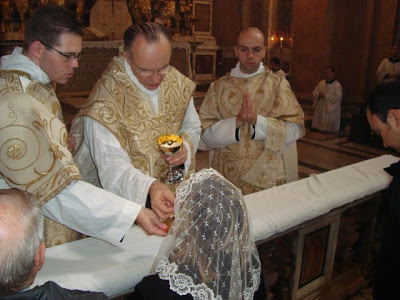
As a loyal, obedient Catholic, I first received communion on the tongue, per the instructions given at the time. Kneeling. At an altar rail. From the hand of a priest only. With an attendant altar boy holding a paten beneath my chin to show reverence for each bit of the Eucharist and prevent dropping accidents. There was much reverence in this and each physical element underscored the importance of the moment and what was happening.
But at the Last Supper (the first mass) it was likely not that way (to say the least).
Considering each apostle a Bishop/priest … that first Eucharist was likely passed from the hands of Christ to apostles down the table and … “communion in the hand” was almost certainly the case for the apostles that night.
But the Church, with power of the keys, wisely decided for a number of reasons to institute rules per this in worship services involving more and more people – and to convey to those people the sublime mystery of the moment.
I personally opt for communion on the tongue each time. When I’ve distributed communion at a service as a CSL (like an extraordinary minister of the Eucharist), once the communicant has affirmed their “Amen” to the proclamation “Body of Christ”, I give them communion according to their option … tongue or in the hand(s).
Certain cautions are better observed with communion on the tongue … i.e., in ANY case the Eucharist is to be immediately consumed by the communicant (and not taken away from the Church to be used in any other way). The worst case scenarios would be people who deliberately want to procure a host for profaning (as in a Satanist ritual). And that sacrilege is more easily accomplished by taking communion in hand and pretending to consume it.
Looking at the above question in a “no-fault” way — one might guess that it was a more “practical” move than an “improvement to the devotion” to the Eucharist.
In my lifetime, most changes have been increasingly “liberal” (not in a political sense), but in what some might “positively” term as a “greater accessibility” to the Eucharist – per lessening things like how long a pre-communion fast from food and liquids must be.
In my parents’ adolescence in Chicago the fasting rule was that one must fast from food and drink from the stroke of midnight Sunday morning - to be able to receive that day. As a result communion was to be the first thing taken each Sunday (excluding water).
When I was in first grade the rule was changed to fasting for 3 hours from food and 1 hour for liquids other than water (at least in our Diocese). This was not necessarily a decrease in fasting (and a “liberalization” in all cases). In the city especially, many parishes had midnight masses on Saturday Night/Sunday Morning … where one hardly fasted at all!
Socially this had the salutory effect of interrupting a Saturday night of drinking in bars
with an “I’ve got to get to mass …” element – and chances were that folks were not going to speed directly from midnight mass to the local bar for “last call” at 2 am.
My Father shook his head when recalling that time (which, with the new fasting rules, tended to reduce the midnight mass numbers) enough that that practice became rarer.
Communion in the hand began (in my time) after I had graduated from a Catholic High School. Once it was allowed many people gave it a try out of novelty I think. And it was not noticed that much since bigger changes were being made. Mass in the vernacular. The eventual reduction of Latin Masses. Mass with the priests facing the congregation. The laity beginning to do more things at or near the altar or at the pulpit that were formerly done by just the priests. etc.
Gone soon were altar rails. Kneeling at communion. The altar boy with the paten. Communion from the blessed hands of a priest only.
The way the altar rail was organized for efficiency was altered into the standing and advancing communion line. Which was “quicker and more practical” in one sense, but like a “communion express line” and less reverent in the sense of many.
Per the mass itself, the culture change seemed to emphasize a bit more of the “WE worship together as community at mass now …” than a more vertical sense of "this is an hour that we dedicate completely to Christ as our King as individuals … as a “community” but with “community” not being an equal focus (during the mass).
In the “old way” community things like a choir were there … but each individual did their own task as part of the vertical worship. In the “new way” (perhaps most evident in the new at the time - “Sign of Peace” in the middle of the service) the “body of Christ” next to you and all around you was acknowledged and a more horizontal focus than before per the mass gained ascendency.
I thank the person who posted this question. It causes me to think more about what is the most important moment of my week (or day, or life!). We serve the Lord with our tongues and our hands. And sin with them too, sadly.
The answer to WHY communion in the hand was “instated” or “re-instated” as an option is probably best answered by those who brought it (back) into practice at the time. Options can mean a lack of unity in form somewhat (vs. one uniform code of how to receive) … but perhaps having to choose which way to receive the Eucharist is another way of calling a communicant’s attention more deeply to the importance of WHAT they are doing. In a best case scenario.


 . Please don’t thank me
  I thank you!