"Will Pope Francis Stop the aggression of Malankara Catholic Rite against the Indian Malankara Orthodox Church"

  • Thread starter Thread starter Sophronius
  • Start date Start date
Status
Not open for further replies.
S

Sophronius

Guest
How are relations between the two churches. I’ve been under the impression the Oriental Catholics and Oriental Orthodox have been far more cordial and fraternal with each other than the Byzantines. I hope they don’t petition Pope Francis. I think it’s great that Mar Baselios has been acclaimed Catholicos. What are people’s thoughts?

*The election of Pope Francis have brought much hope for the advancing improvement of Orthodox- Roman Catholic ties and cooperation. In a recent message to the Executive Council of Orthodoxy Cognate PAGE Society, Mr George Alexander expressed his high concerns over the attitude of Malankara Catholic Rite towards the Indian Orthodox Church which has been continuing since 1930 when the Malankara rite broke away from the Indian Orthodox Church under the leadership of Archbishop Ivanios.

Since 2005 the aggression has changed to a newer level when the Primate of Malankara Catholic Rite declared himself to be Catholicos along with the title Major Archbishop of Trivandrum of the Syr0-Malankaras.

“In the year 2005 this Church was elevated to the status of a Major Archiepiscopal Church and suddenly the Church began to address its Primate as Major Archbishop Catholicos. Catholicos title has not been granted by Vatican and that has been clearly mentioned in the letter (Port.N. 2581/2005/h) sent on 18th June 2005 by His Excellency Cardinal Walter Kasper, the then President of the Pontifical Council for the Promotion of Christian Unity to the late Metropolitan Philipose Mar Eusebius , the President of the Ecumenical Relations Department of Indian Malankara Orthodox Church.

But the Syro-Malankara Catholic Rite continue to use the title Catholicos along with tile of Major Archbishop. Apart from that the Primate of the Syro-Malankara Catholic Rite claims the following titles such as “The Successor of the Apostolic See of St Thomas In India and Malankara Metropolitan”

Both titles are exclusive privilege of the primate of the Indian Malankara Orthodox Church. So presently Major Archbishop Baslius Cleemis being a Cardinal confuse the situation further as he holds three tiles Major Archbishop, Cardinal and “self proclaimed Catholicos”. The original title is nothing more than His Excellency/His Beatitude Baselius Cleemis – Major Archbishop of Trivandrum of the Syro-Malanakras (now a Cardinal).”

The OCP Executive Council hope that the hierarchy of Indian Malanakra Orthodox Church will take adequate and official steps to ask the Roman Catholic Church to rectify the error made by Vatican and Malankara Catholic Rite. The Council hopes newly elected Pope Francis will genuinely ask Malankara Catholic Rite to immediately withdrew all false claims and refrain from further aggression so as to foster better ecumenical relations.*
 
That article sounds to me to be nothing but bitter polemic from some highly disgruntled “Orthodox” Malayali person. We’ve had a few such post on this forum in the past. For my part, I really don’t care what some hot-head has to say. From what I know, Mor Basilous Cleemis should be officially recognized as “Catholicos” (and of course that means that the formal separation from the SCC that was made in the 1980s would have to be undone, but that’s another matter) of the Syro-Malankara Church.
 
What is a Malayali?
I know it’s from wikipedia, but this isn’t bad. 🙂
Malayali … another equivalent is Keralite) is the term used to refer to the native speakers of Malayalam, originating from the Indian state of Kerala. The Malayali identity is primarily linguistic, although in recent times the definition has been broadened to include emigrants of Malayali descent who partly maintain Malayali cultural traditions, even if they do not regularly speak the language, and also not living in Kerala. While the origins of the Malayali people are in the state of Kerala, significant populations also exist in other parts of India, the Middle East, Europe and North America. According to the Indian census of 2001, there were 30,803,747 speakers of Malayalam in Kerala,[6] making up 96.7% of the total population of that state. Hence the word Keralite is often used in the same context, though a proper definition is ambiguous.
 
Fights over titles, especially in ANOTHER communion, doesn’t strike me as the best example of Christian charity.
 
I am a malayali (keralite) (indian). I know what is going on in india. What is done by this so called indian orthodox church. These indian orthodox people are creating problems all over kerala. What these indian orthodox people are doing to syriac orthodox church are beyond words.
There are billionaires present in the indian orthodox faction of the syriac orthodox church. They are ruling the state of kerala. The largest printed newspaper in kerala state of india belongs to indian orthodox faction. They file a large number of cases against the syriac orthodox faction in courts.
What these indian orthodox faction is spreading is that the church in kerala was started by st thomas and patriarch of antioch has no authority over india. They invented something called throne of st thomas. But scholars say that there is only one throne, that is, throne of st peter.
There is no reason to blame malankara catholic church and its major archbishop cardinal cleemis. He is a very good, humble man. Now indian orthodox are fearing that they may get forced to join the malankara catholic church because all the church heads in kerala and govt of india has realised the real value of syriac orthodox patriarchate of antioch. Now indian orthodox faction has no other way.
 
What these indian orthodox faction is spreading is that the church in kerala was started by st thomas and patriarch of antioch has no authority over india. They invented something called throne of st thomas.
It is historically well known that the Apostle Thomas traveled to India and established the Church there. The Orthodox Bishops in India can trace themselves back to the Holy Apostle St. Thomas. This is well documented in both Catholic & Orthodox sources.

There is zero historical evidence either in Sacred Scripture or Sacred Tradition that St. Peter ever stepped foot in India although St. Peter is historically known to have been in Antioch & was the one who established the Church in Antioch before heading to Rome at the end of his life where he was crucified upside down not dying until after 3 days.
 
There are billionaires present in the indian orthodox faction of the syriac orthodox church. They are ruling the state of kerala. The largest printed newspaper in kerala state of india belongs to indian orthodox faction. They file a large number of cases against the syriac orthodox faction in courts.
I won’t comment on the division in the Indian Orthodox Church other than to say it’s sad, but this doesn’t strike me as a particularly good reason to be upset at Indian Orthodox people. There are rich and vindictive people in every communion.
What these indian orthodox faction is spreading is that the church in kerala was started by st thomas
That’s the history accepted by all sides, I thought…? :confused:
and patriarch of antioch has no authority over india.
That is the contention, yes. Whether Antioch does or should have such powers based on its historically important role in Indian Orthodox Christianity is a matter of some debate. I believe that the period of the first major problems regarding this arrangement (including the creation of Syriac churches in union with Rome) is covered to some degree in HH Mor Aphrem I. Barsoum’s “History of the Syriac Dioceses”, covering the period 1687-1774, but I don’t remember exactly which entries talk about it. It’s all biographies of various patriarchs and the historical circumstances of their dioceses at that time, including in India.
They invented something called throne of st thomas. But scholars say that there is only one throne, that is, throne of st peter.
This is silly. We in the Coptic Church also talk about the throne or chair or seat (all of these things are equivalent, of course) of St. Mark, and those of other apostles can be and are discussed similarly. There is no “one throne” in Christianity, no matter what apostle is ascribed to it.
There is no reason to blame malankara catholic church and its major archbishop cardinal cleemis. He is a very good, humble man. Now indian orthodox are fearing that they may get forced to join the malankara catholic church because all the church heads in kerala and govt of india has realised the real value of syriac orthodox patriarchate of antioch. Now indian orthodox faction has no other way.
This seems like baseless rumor and hearsay. I don’t know what value (whatever that term means in this context) of any patriarchate, Catholic or Orthodox, would force anyone to do anything.
 
If memory serves correctly, only The Church of the East first spread Christianity to India, due to links with Saint Thomas. Therefore only the Assyrian Church Of The East and the Chaldean Catholic patriarchs are able to claim to be the direct successors of St. Thomas, just as the Ecumenical Patriarch is the successor of St Andrew.

I’m not completely sure when the Syriac Orthodox church began to exist in India, but I’m sure it was far after the Assyrian Church of the East. With that foundation and Catholic unions, both Malabar and Malankara, led to the many sects of Christianity within Kerala. The Indian Orthodox Church also decided to become independent of Antioch, while remaining in communion, I think. I hope someone can confirm my statements.

God bless.
 
Fights over titles, especially in ANOTHER communion, doesn’t strike me as the best example of Christian charity.
It doesn’t strike me as aggression, charity or important. I think the Orthodox has no point. It has zero authority and interest in affairs outside its own faith community. We have a lot of pastors of independent Churches that take a title of “bishop”. I never causes a stir.
 
It is hard to say which ritual church first laid “claim” to India but from my understanding this would be a good timelime. The dates may be a little off. Also I dont see a problem in claiming a title if your patriarchs are of two differant ritual churches.

1.Church of the East/Chaldeans (52-1500s)
2.Roman Catholics (1500-)
3.Syriac Orthodox (1700-)
 
If memory serves correctly, only The Church of the East first spread Christianity to India, due to links with Saint Thomas. Therefore only the Assyrian Church Of The East and the Chaldean Catholic patriarchs are able to claim to be the direct successors of St. Thomas, just as the Ecumenical Patriarch is the successor of St Andrew.

I’m not completely sure when the Syriac Orthodox church began to exist in India, but I’m sure it was far after the Assyrian Church of the East. With that foundation and Catholic unions, both Malabar and Malankara, led to the many sects of Christianity within Kerala. The Indian Orthodox Church also decided to become independent of Antioch, while remaining in communion, I think. I hope someone can confirm my statements.

God bless.
It is hard to say which ritual church first laid “claim” to India but from my understanding this would be a good timelime. The dates may be a little off. Also I dont see a problem in claiming a title if your patriarchs are of two differant ritual churches.

1.Church of the East/Chaldeans (52-1500s)
2.Roman Catholics (1500-)
3.Syriac Orthodox (1700-)
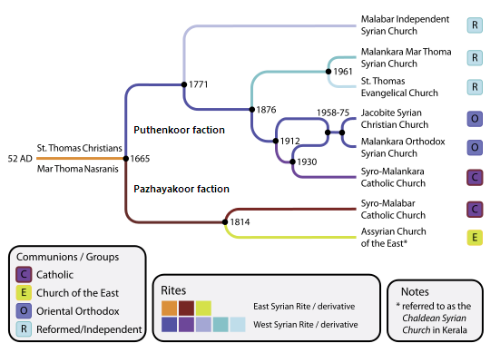
I kind of like the “timeline” as presented below (and yes, I know it’s from wikipedia, but the "timeline itself seems to be accurate):


IIRC, the Synod of Diamper in 1599 gave rise to a certain amount of dissatisfaction which led to the Coonan Cross Oath in 1653, and the 1665 date in the “timeline” represents the actual arrival of a Syriac Orthodox bishop.

In any case, it seems to me that both the original East Syriac (Syro-Malabar plus the more recently restored Chaldean Syrian) and the later-established West Syriac (Syro-Malankara, Jacobite Syrian Orthodox, Malankara Jacobite Orthodox – and I apologize if I messed-up the last two: that’s kind of a complicated thing by an measure) Churches can all legitimately lay claim to St Thomas. (I’m not so sure about the “Independents” and the Marthomites because they are Protestant.)
 
Part of the reason why this might be confusing is that apparently from the Syriac Orthodox perspective, the churches in India were considered to constitute a constituent diocese of the larger Syriac Orthodox Church (the entry in HH Mor Aphram Barsoum’s history on Iyawannis Yuhanna, Ecumenical Metropolitan from 1740-1755, speaks of him being sent to the “diocese of Malabar”, for instance). As we know, this tension is still playing itself out, but it is important to remember this in light of claims as to which church lays claim to what (not that I particularly care, myself). It seems to me an incontrovertible fact that the Nestorians were probably the earliest to establish a presence in India, but whether their Orthodox West Syrian cousins came a little later or a lot later shouldn’t be a point of contention particularly in favor of Catholics, of all people, given the existence of “Syriac Catholic”, “Coptic Catholic” and other sui juris churches within your communion which date from around the same time as the first documented arrival of a Syriac Orthodox bishop, or even much later (like the section that came out of the Orthodox Church in India, the Malankara Syriac Catholic Church, est. 1930 or thereabouts).

And I can’t help but wonder, having read what I have about the presence of the Orthodox in India via HH Aphram I Barsoum and others, if there isn’t more to this story. In the account of Basilius Shukrallah, Maphryono of Malabar (1748-64), it is written that he traveled from his native Aleppo at some point early in his tenure to ordain Metropolitan Tuma V of Malabar the lawful metropolitan. Only a little while before him, the aforementioned Iyawannis Yuhanna was (in)famously smashing Latin statuary to bits in defiance of the Portuguese who had gotten there only in the 16th century. It seems to me from reading these accounts that the most likely scenario was as Malphono put it: People were ticked off about the Portuguese messing with their native East Syrian church, and via the Coonan Cross Oath and other events, eventually split into the utterly bewildering array of competing factions you now see today.

And yet somehow the Orthodox get the blame…! 🤷 Why not blame the Church of the East patriarchs for going into schism in 1552, and one of them for joining the Roman Catholic Church, thereby creating the conditions in which the Portuguese and the CoE sent competing bishops, accelerating the extremely poor treatment of the native Syriac Nasranis at the hands of the Portuguese who eventually cut them off from their previous clergy.

This way you can leave us the heck out of it, since we’re neither Portuguese Jesuits nor Nestorians. 😛

Besides, who can hate this? (With apologies to Malphono for the pronunciation which I’m sure is grating on his ears…)
 
And yet somehow the Orthodox get the blame…! 🤷 Why not blame the Church of the East patriarchs for going into schism in 1552, and one of them for joining the Roman Catholic Church, thereby creating the conditions in which the Portuguese and the CoE sent competing bishops, accelerating the extremely poor treatment of the native Syriac Nasranis at the hands of the Portuguese who eventually cut them off from their previous clergy.

This way you can leave us the heck out of it, since we’re neither Portuguese Jesuits nor Nestorians. 😛
I’ll blame Nestorius and all that occurred do to his spreading of poisonous heresy. 👍
 
Besides, who can hate this? (With apologies to Malphono for the pronunciation which I’m sure is grating on his ears…)
Actually … no, it’s not grating at all. :eek: In fact, it’s one of the best examples of Syriac chant/pronunciation from a Malankara source that I’ve ever heard. 😛 Pretty faithful to its origins. I was even able to follow it! 😃 😉
 
Zekariya;10517300:
And yet somehow the Orthodox get the blame…! 🤷 Why not blame the Church of the East patriarchs for going into schism in 1552, and one of them for joining the Roman Catholic Church, thereby creating the conditions in which the Portuguese and the CoE sent competing bishops, accelerating the extremely poor treatment of the native Syriac Nasranis at the hands of the Portuguese who eventually cut them off from their previous clergy.
I’ll blame Nestorius and all that occurred do to his spreading of poisonous heresy. 👍
Of course the question remains as to whether or not Nestorious was actually a heretic. 🤷 That question has come up before in this forum, and I’m not going there now.
This way you can leave us the heck out of it, since we’re neither Portuguese Jesuits nor Nestorians. 😛
Indeed the Portuguese, through the ubiquitous Jesuits, did a “job” there, but it would seem that the ACoE itself was at least partially to blame. In its decline, it more-or-less neglected the Malabar branch of the Church and it was just that, I think, which set the stage for what the Portuguese/Jesuits ultimately wrought. And, of course, its aftermath, including the CoE Protestants.
 
Actually … no, it’s not grating at all. :eek: In fact, it’s one of the best examples of Syriac chant/pronunciation from a Malankara source that I’ve ever heard. 😛 Pretty faithful to its origins. I was even able to follow it! 😃 😉
Hahaha. It’s too echoey for me to tell either way, but I liked it…I guess I just assumed you wouldn’t, given our past discussions on this topic. There are certainly far too few of these kind of examples from the Indian church…really I was just happy to find something without fake drums and keyboard. 😊
 
Forgive me if I’m being ignorant, being Knanaya I only learned the basic history of the St.Thomas Christians and never went in depth. From what I learned under the Syro Malabar Church (and I’m sure all Syrian Orthodox will counter this) is that the revolting Malabar Christians were foolish and believed that this bishop who arrived from the Syriac Orthodox Church was actually one from the the Church of the East and that is why they followed him. Can anyone clarify this?

This is also a beautiful Jacobite Melody called “Nadha Savidhe” : ). The priest mixes Malayalam,Syriac, and English into the liturgy.

youtube.com/watch?v=dgLWE_9r3J4
 
Your post would be a lot less funny if you didn’t end it with a video of a Malankara Orthodox priest… 😛 I love Fr. Aju Philip Matthews too, it’s just funny.

Anyway, I’ve never heard that regarding the Malabarese following the Syriac Orthodox in the mistaken belief that they were CoE, and it doesn’t really make sense to me, though some details of Iyawannis Yuhanna’s story might lend themselves to being confused that way, assuming that the Indian Syriacs would not be able to tell the difference between West Syrians and their own previous East Syrian bishops (kind of difficult to imagine, since they use different liturgies, different dialects, etc.), such as Iyawannis Yuhanna being referred to as “Iyawannis the Iconoclast” for his habit of destroying statues placed in churches by the Jesuits. Granted, that’s a misunderstanding of why he was doing that, but the de facto prohibition on iconography in the CoE is commonly known (though I don’t know if it would’ve been similarly known in India, as I have read that it was only firmly established in the time period of the Mongols, who did not penetrate very far into India thanks to the presence of the Delhi Sultanate).
 
Perhaps yes because of the liturgy they would know. I wouln’t be so sure you could say by the dialect though. Truth be told and im not sure this could be said about the Syriac Orthodox Nasranis but most St.Thomas Christians did not know Syriac. If you ask elderly Syro Malabar Catholics who were around during the time of the of the Syriac Liturgy usage most say they had no idea what the preist was saying.

I asked my own grandmother who was Knanaya Jacobite but later converted Catholic how her experience was with Syraic or as they called it Suriyani Qurbana. She told me they would all stand at the church while the preist repeated “Khandisha Khandisha Khandisha”. She said they would recite Syriac prayers along with the priests by memory only, she said they had no idea what they were actually saying. Now perhaps by a good chance it was differant in ancient times? I know Syriac liturgies were of coarse a deep fundamental of the St.Thomas Christian community but from hearing accounts from the elderly im guessing, Syriac was mainly passed down by the kathanars (priests) of the community and not really the community members themselves.
 
Status
Not open for further replies.
Back
Top