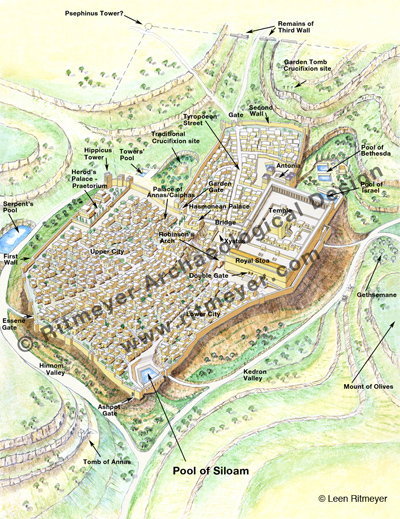
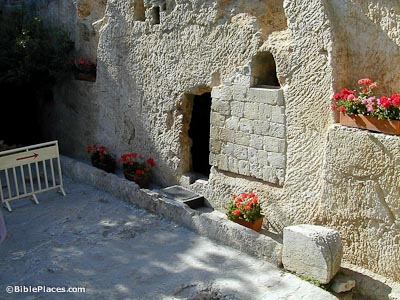
Since Trevor brought this up: Golgotha.
1.) What do we know about Golgotha from the gospels?
Well, first, all four gospels agree about the name:
Kraniou-topos ‘Skull-place’ or ‘Skull’ (Matt. 27:33; Mk. 15:22; Lk. 23:33; Jn. 19:17-18). John (19:41) gives the impression that the name didn’t just refer to a small, specific locality, associated only with the death of Jesus (as we assume when we refer to, say, ‘Mount Calvary’), but to a much larger region: “in the place where he was crucified there was a garden, and in the garden there was a new tomb in which no one had been laid.”
So ‘Golgotha’ for John doesn’t just refer to the site of the crucifixion, but encompasses
both the spot where Jesus was crucified
and the garden where His tomb was located. (We can see the same thing in early Christian literature: early Christians also tended to imagine that Golgotha was a region rather than a specific, small place. It wasn’t until the 6th century that ‘Golgotha’ came to specifically refer to the rocky outcrop encased within the Church of the Holy Sepulchre now known as the Rock of Calvary.)
Now that doesn’t necessarily mean that the two locations were side-by-side; the maximum distance between these two locations will depend on how large an area Golgotha was in the first place. No source tells us that the tomb and the place of the crucifixion were very close to one another. For all we know, Golgotha could have been this large area.

You know those movies and paintings where Golgotha is depicted as this secluded area (often shown as a hillock or mountain) some distance away from Jerusalem? That’s not really what the gospels depict.
John (19:20) expressly mentions that “the place where Jesus was crucified was near the city.” Matthew (27:39-40) and Mark (15:29-30), both mention “those passing by” taunting Jesus; this might suggest that Jesus was crucified near or by the roadside. In the Letter to the Hebrews (13:12), Jesus is also described as being crucified “outside the gate.”
An anonymous author writing in the name of the 1st century rhetorician Quintilian said this (Declamationes Minores 274):
When we crucify criminals the most frequented roads are chosen, where the greatest number of people can look and be seized by this fear. For every punishment has less to do with the offence than with the example.
We know from this and other texts that Romans usually executed criminals either in public places or in the place where they did their crime, to set an example. This would fit in with the inference from the gospels that Golgotha was a public area close to the streets and the city.
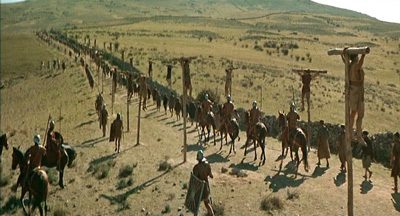
Kind of like Spartacus.
And here’s is the important thing:
none of the gospels ever speak of Golgotha as being a hill. In fact, there is no explicit mention of Golgotha being a raised place until the 4th century, when it is spoken of as a
monticulus (‘little hill’) by the anonymous pilgrim of Burdigala (modern Bordeaux). The expression does not occur again until once in the 6th century, after which we do not come across it until Bernard the Pilgrim visited Palestine in the 9th century and spoke of a
Mons Calvariae (by which he probably meant the Rock of Calvary).
The early Greek Christian writers, with the exception of Sts. Gregory of Nazianzus (c. 329-389/390) and Cyril of Jerusalem (ca. 313-386), also never speak of it as being connected with a hill or a height, and it must be remembered that both lived a bit after the traditional area, where the Church of the Holy Sepulchre now stands, was officially discovered by Constantine. In fact, St. Epiphanius of Salamis (d. 403), himself a native of Palestine, expressly says of the area: “There is nothing to be seen on the place resembling this name; for it is not situated upon a height that it should be called (the place) of a skull, answering to the place of the head in the human body.”
Now some of you might be familiar with that tradition that Golgotha was actually the mountain where Abraham nearly sacrificed Isaac (‘Mount Moriah’). That tradition should be taken with a grain of salt: Jewish tradition - guided by the reference in 2 Chronicles 3:1 - identifies that mountain with the Temple Mount.
In fact, the thing is, that the early Christians have appropriated a number of Jewish traditions about the Temple Mount and applied it to their own holy places. That explains why Golgotha came to be seen as Mount Moriah
and as Adam’s burial place (there is also a Jewish tradition that places Adam’s burial place underneath the Temple Mount instead of Hebron, the majority idea): Christians took those ideas about the Temple and applied them to Golgotha. (This is somewhat encouraged by the fact that Isaac’s sacrifice was seen as prefiguring the crucifixion of Jesus, and that Jesus was seen as the new Adam.)

I actually personally think that Jesus of Nazareth was one Jesus film that depicted Golgotha ‘accurately’: not this secluded, improbably high mountain some distance away from Jerusalem - as in
The Passion of the Christ - but an area just by the city walls.

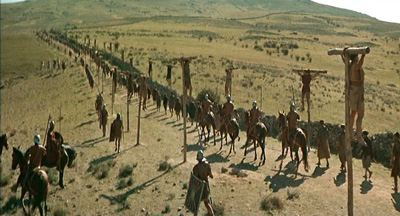

 Just adding that I don’t think what I wrote disagrees with this bit right here. The maps I’m looking at (which may or may not be accurate) show the location of the CotHS as being right outside what was part of Herod’s Wall (though of course it is now within the walls of the old city).
 ) is: “Josephus says that during the Jewish revolt (66-70 CE) as many as 500 Jewish victims per day were crucified “before the wall of the city,” in order to terrorize the population (War 5:289; 5:449-450). This description fits perfectly with the Mt. of Olives, before the main city gate, with the Romans camped just to the north on Mt Scopus. This was the only location that could be seen by anyone in the city of Jerusalem, and the week Jesus died it would be visible to passersby arriving from all directions for the Passover feast, thus providing a visible warning to those who might be tempted to sympathize with rebels.”