
P
patrick457
Guest
David’s Tomb
Related to the issue of Mount Zion is the location of David’s tomb.
We know from the Old Testament that David was buried in Ir David: “Then David slept with his fathers and was buried in the city of David.” (1 Kings 2:1) In 1913, French archaeologist Raymond Weill found around nine man-made burial caves on the southern tip of Ir David (labelled T1 to T9), among them three horizontal gallery graves. Weill believed that he had found what was the royal cemetery of Jerusalem, an identification many modern archaeologists today still share (though this has recently come under question); he also identified T1, the most monumental of the tombs, as that of David. But even if David wasn’t actually buried in one of these tombs, his tomb would nevertheless have still been somewhere on the Eastern Hill.
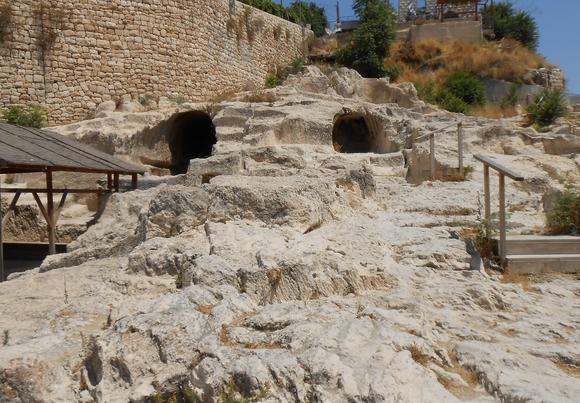
Two of the caves Weill discovered (T1 and T2).
It seemed that the location of David’s tomb was once well known, but it is difficult to learn from these ancient references just where it was located. Nehemiah refers to “the tombs of David” in his description of the rebuilding of the walls of Jerusalem when the exiles returned from Babylon in the late 6th century BC (Nehemiah 3:16). From this description it appears he located the tomb on the Eastern Hill.
We might infer that the location of the tomb - or a site that was claimed to be the location of the tomb - was still known just before and during the time of Jesus. The Jewish historian Josephus (Antiquities 7.393; 16.179-183) claimed that David “had great and immense wealth buried with him;” part of that treasure - three thousand talents of silver - was suposedly later used by the high priest John Hyrcanus (reigned 134-104 BC) to pay Seleucid king Antiochus VII Sidetes in exchange for lifting his siege on Jerusalem. Later, he claims that Herod the Great once clandestinely tried to loot the tomb as well; however, when two of Herod’s guards met a mysterious death, fear overcame him and he ordered a tomb-memorial (mnena) of white stone erected at the site.
As for Herod, he had spent vast sums about the cities, both without and within his own kingdom; and as he had before heard that Hyrcanus, who had been king before him, had opened David’s sepulcher, and taken out of it three thousand talents of silver, and that there was a much greater number left behind, and indeed enough to suffice all his wants, he had a great while an intention to make the attempt; and at this time he opened that sepulcher by night, and went into it, and endeavored that it should not be at all known in the city, but took only his most faithful friends with him. As for any money, he found none, as Hyrcanus had done, but that furniture of gold, and those precious goods that were laid up there; all which he took away. However, he had a great desire to make a more diligent search, and to go farther in, even as far as the very bodies of David and Solomon; where two of his guards were slain, by a flame that burst out upon those that went in, as the report was. So he was terribly affrighted, and went out, and built a propitiatory monument (mnena) of that fright he had been in; and this of white stone, at the mouth of the sepulcher, and that at great expense also.
This monument was probably what Peter was referring to in Acts 2:29 when he says that “David’s tomb (mnena) is with us to this day.”
The Roman historian Dio Cassius (AD 150-235) tells us that this monument - which apparently withstood the Roman destruction of Jerusalem in AD 70 - collapsed shortly before the Bar Kokhba revolt of AD 132-135, which was taken as a bad omen:
Thus nearly the whole of Judaea was made desolate, a result of which the people had had forewarning before the war. For the tomb of Solomon, which the Jews regard as an object of veneration, fell to pieces of itself and collapsed, and many wolves and hyenas rushed howling into their cities.
The last person we know of who knew the location of David’s tomb was the 1st-2nd century Jewish rabbi Akiva. Akiva was once asked why the graves of the Davidic dynasty were allowed within the city (remember, as I noted earlier, it became customary for Jews to build tombs outside the city walls). He responded that impurity of David’s grave was diverted out of the city to the Kidron Valley via a rock channel. This information is important because the Kidron lies on the east side of Ir David. It clearly indicates that Akiva placed the royal tombs on the Eastern Hill close to the Kidron.
After the emperor Hadrian suppressed the revolt and transformed Jerusalem into Aelia Capitolina, the caves found by Weill were used as a quarry, thereby severely disfiguring these caves. Because of this, it is very difficult to guess what these caves may have originally looked like, or whether these caves are tombs at all.
Related to the issue of Mount Zion is the location of David’s tomb.
We know from the Old Testament that David was buried in Ir David: “Then David slept with his fathers and was buried in the city of David.” (1 Kings 2:1) In 1913, French archaeologist Raymond Weill found around nine man-made burial caves on the southern tip of Ir David (labelled T1 to T9), among them three horizontal gallery graves. Weill believed that he had found what was the royal cemetery of Jerusalem, an identification many modern archaeologists today still share (though this has recently come under question); he also identified T1, the most monumental of the tombs, as that of David. But even if David wasn’t actually buried in one of these tombs, his tomb would nevertheless have still been somewhere on the Eastern Hill.

Two of the caves Weill discovered (T1 and T2).
It seemed that the location of David’s tomb was once well known, but it is difficult to learn from these ancient references just where it was located. Nehemiah refers to “the tombs of David” in his description of the rebuilding of the walls of Jerusalem when the exiles returned from Babylon in the late 6th century BC (Nehemiah 3:16). From this description it appears he located the tomb on the Eastern Hill.
We might infer that the location of the tomb - or a site that was claimed to be the location of the tomb - was still known just before and during the time of Jesus. The Jewish historian Josephus (Antiquities 7.393; 16.179-183) claimed that David “had great and immense wealth buried with him;” part of that treasure - three thousand talents of silver - was suposedly later used by the high priest John Hyrcanus (reigned 134-104 BC) to pay Seleucid king Antiochus VII Sidetes in exchange for lifting his siege on Jerusalem. Later, he claims that Herod the Great once clandestinely tried to loot the tomb as well; however, when two of Herod’s guards met a mysterious death, fear overcame him and he ordered a tomb-memorial (mnena) of white stone erected at the site.
As for Herod, he had spent vast sums about the cities, both without and within his own kingdom; and as he had before heard that Hyrcanus, who had been king before him, had opened David’s sepulcher, and taken out of it three thousand talents of silver, and that there was a much greater number left behind, and indeed enough to suffice all his wants, he had a great while an intention to make the attempt; and at this time he opened that sepulcher by night, and went into it, and endeavored that it should not be at all known in the city, but took only his most faithful friends with him. As for any money, he found none, as Hyrcanus had done, but that furniture of gold, and those precious goods that were laid up there; all which he took away. However, he had a great desire to make a more diligent search, and to go farther in, even as far as the very bodies of David and Solomon; where two of his guards were slain, by a flame that burst out upon those that went in, as the report was. So he was terribly affrighted, and went out, and built a propitiatory monument (mnena) of that fright he had been in; and this of white stone, at the mouth of the sepulcher, and that at great expense also.
This monument was probably what Peter was referring to in Acts 2:29 when he says that “David’s tomb (mnena) is with us to this day.”
The Roman historian Dio Cassius (AD 150-235) tells us that this monument - which apparently withstood the Roman destruction of Jerusalem in AD 70 - collapsed shortly before the Bar Kokhba revolt of AD 132-135, which was taken as a bad omen:
Thus nearly the whole of Judaea was made desolate, a result of which the people had had forewarning before the war. For the tomb of Solomon, which the Jews regard as an object of veneration, fell to pieces of itself and collapsed, and many wolves and hyenas rushed howling into their cities.
The last person we know of who knew the location of David’s tomb was the 1st-2nd century Jewish rabbi Akiva. Akiva was once asked why the graves of the Davidic dynasty were allowed within the city (remember, as I noted earlier, it became customary for Jews to build tombs outside the city walls). He responded that impurity of David’s grave was diverted out of the city to the Kidron Valley via a rock channel. This information is important because the Kidron lies on the east side of Ir David. It clearly indicates that Akiva placed the royal tombs on the Eastern Hill close to the Kidron.
After the emperor Hadrian suppressed the revolt and transformed Jerusalem into Aelia Capitolina, the caves found by Weill were used as a quarry, thereby severely disfiguring these caves. Because of this, it is very difficult to guess what these caves may have originally looked like, or whether these caves are tombs at all.