A stranger asks for the Catholic Church

  • Thread starter Thread starter Novocastrian
  • Start date Start date
Status
Not open for further replies.
The term “Catholic Church” wasn’t around** from the beginning** (nor was the term “Christians”) but it did appear quite early in the life of Christianity.
Peter, am I misreading you here? :confused:

[Acts 11:26 (http://www.biblegateway.com/passage/?search=Acts+11:26&version=RSVCE)
and when he had found him, he brought him to Antioch. For a whole year they met with the church, and taught a large company of people; and in Antioch the disciples were for the first time called Christians

[Acts 9:31 (http://www.biblegateway.com/passage/?search=Acts+9:31&version=RSVCE)
So the church throughout all Judea and Galilee and Samar′ia had peace and was built up; and walking in the fear of the Lord and in the comfort of the Holy Spirit it was multiplied.

That phrase (the church throughout all) in Greek [ἐκκλησία (http://bibleapps.com/greek/1577.htm),[καθ’ (http://bibleapps.com/greek/2596.htm),[ὅλης (http://bibleapps.com/greek/3650.htm)** ,[τῆς (http://bibleapps.com/greek/3588.htm) became the Greek compound word Katholikos, from kata (according to) holos (the whole). **So the ecclesia kata holos = the katholikos Church = the Catholic Church. btw the link is operational for each of the words in that phrase. It’s from the Greek translation

For historical clarity, one can / should ask

Why would Ignatius Bp of Antioch from ~69 a.d. to ~107 a.d. disciple of St John the apostle, (John died ~100 a.d.) use the name Catholic Church in his writings [Epistle to the Smyrnæans (http://www.newadvent.org/fathers/0109.htm) ch 8, unless the name is already being used by the apostles and it is already understood as the name of the Church throughout the whole Church?

Not only were there no objections to the name “Catholic Church”, the name was used by all the other ECF’s too. To name a few
P:
Even many of your fellow protestants profess it in the creed, and smaller-but-still-substantial portion of them will call themselves “Catholic” or “catholic”.
The name was never a general name but a specific name. People knew exactly what the Catholic Church is and where it is. When the unauthorized tried to call themselves Catholic when they weren’t,

Augustine wrote (emphasis mine)
  • Augustine ~395 There are many other things that most justly keep me in her * bosom. . . . The succession of priests keeps me, beginning from the very seat of the Apostle Peter, to whom the Lord, after His resurrection, gave it in charge to feed His sheep, down to the present episcopate. And so, lastly, does the name itself of Catholic, which, not without reason, amid so many heresies, the Church has thus retained; so that, though all heretics wish to be called Catholics, yet when a stranger asks where the Catholic Church meets, no heretic will venture to point to his own chapel or house.[Against the Epistle of Manichaeus Called Fundamental (http://www.newadvent.org/fathers/1405.htm)
 
I can’t stop reading more into your words than is there, anymore than I can stop beating my wife. I read exactly what is there. Here it is again:
Originally Posted by SteveVH
Since there is no such thing as the “Orthodox Church” any more than there is such a thing as the “Protestant Church”, I would ask them which Orthodox Church they are looking for; Greek, Russian, Byzantine, Independent, American…
I don’t see this as an issue at all.
And how is this a disparaging remark against the Eastern Orthodox? 🤷
 
Well what is God’s love ? Is it not the gift of Himself to us somehow,thru Christ ? How can you be fully in His love thru Christ and yet be separated from Him? That is oxymoron. Of course we have free will and can separate ourselves and Paul presupposes this but insists it won’t happen.
When I quoted

Rom 8:38-39
38 For I am sure that neither death, nor life, nor angels, nor principalities, nor things present, nor things to come, nor powers, 39 nor height, nor depth, nor anything else in all creation, will be able to separate us from the love of God in Christ Jesus our Lord.

While that speaks of His love for us His love is not on trial. It’s our love for Him and neighbor that is on trial

Jesus defines what love for him entails. .

John 14:15
If you love me, you will keep my commandments.

An example of a commandment of His

Romans 16:17-20 , Galatians 5:19-21 That was from Jesus John 16:12-15 through the Holy Spirit through Paul 😉

Therefore, Jesus the judge is telling all of us in advance, in those passages, DO NOT divide from My Church or there are serious consequences for that soul.
p:
For He foreknew us, conformed us, predestined us, called us, justified us, glorified us.
He knows who fits that bill in advance. We don’t.
p:
I can see God calling us separated brethren due to his foreknowledge that we will finally turn to Him, but for us to apply the term to one another who will not turn to Him is wrong.
I don’t think anyone here is judging a person’s final disposition. Current actions are what is being judged. That’s fair. We can judge actions.
p:
What good is your brotherhood if Christ says to you , “depart from me, I don’t know you”
If Jesus says that to a person, that person hasn’t fulfilled their role as brother in this life and they died in that state.
p:
Nor does it excuse the church from causing divisions or “not pacifying”.
Did Paul pacify those bent on and remaining in schism / division / dissension from the Church? No.

“I warn you, as I warned you before, that those who do such things shall not inherit the kingdom of God”. [Gal 5:21]
p:
Nothing to do with judging. Just that you seem to be saying "brethren "can be one who is in hell by definition,as well as a saint in heaven.
Paul is saying deliberate separation from the Church in this life, is to deliberately ignore the warnings. God eternalizes that seperation after this life is over for those who ignore the warnings and refuse obedience to God that comes by faith in this life.

Remember, faith and hope aren’t needed in the next life.
 
And how is this a disparaging remark against the Eastern Orthodox? 🤷
Well it’s not really fair to their ecclesiology, for one thing. To say that there is no Orthodox Church because there are Russian Orthodox, Greek Orthodox, American Orthodox, etc. is essentially the same as saying there is no Catholic Church because there are Greek Catholic, Roman Catholic, Syriac Catholic, etc. So long as they are in communion, they form a cohesive thing that can be labeled “The Orthodox Church”, insofar as you are asking about Eastern Orthodox specifically. There is not really any less unity among EO just because they are a communion of autocephalous churches whereas the Roman communion is a communion of sui juris churches…unless of course you want to argue that the non-Roman Catholic churches do not have all the inherent rights and dignities in practice that the Roman Church at least says they have on paper, and thus make a polemical argument in favor of the collegial model favored by the Eastern Orthodox themselves…which I don’t think you do. 🙂
 
Well it’s not really fair to their ecclesiology, for one thing. To say that there is no Orthodox Church because there are Russian Orthodox, Greek Orthodox, American Orthodox, etc. is essentially the same as saying there is no Catholic Church because there are Greek Catholic, Roman Catholic, Syriac Catholic, etc. So long as they are in communion, they form a cohesive thing that can be labeled “The Orthodox Church”, insofar as you are asking about Eastern Orthodox specifically.
I think what’s meant, when the Catholic Church dialogues with the Orthodox, there is no ONE person to dialogue with. No ONE has primacy over all because 1st among equals in Orthodox usage, is just a title with no authority behind it.

Re: Ecumenically speaking, Cardinal Kasper said the following. I would ask, what has changed since he said this ?

“We are increasingly conscious of the fact that an Orthodox Church does not really exist,” he contends. “At the present stage, it does not seem that Constantinople is yet capable of integrating the different autocephalous Orthodox Churches; there are doubts about its primacy of honor, especially in Moscow.”

He continues: “With Moscow, dialogue at the universal level at present is very difficult; the situation is improving with Greece; in the Middle East, in the territory of the ancient See of Antioch, the situation is completely different and there already is almost full communion.”

zenit.org/en/articles/the-crisis-of-ecumenism-according-to-cardinal-kasper

The Catholic Church otoh, is ONE because all in the Church no matter the rite, are in complete union with the pope of Rome, successor to Peter. The pope really does speak for the entire Church accross rites. He also has universal authority
d:
There is not really any less unity among EO just because they are a communion of autocephalous churches whereas the Roman communion is a communion of sui juris churches…unless of course you want to argue that the non-Roman Catholic churches do not have all the inherent rights and dignities in practice that the Roman Church at least says they have on paper, and thus make a polemical argument in favor of the collegial model favored by the Eastern Orthodox themselves…which I don’t think you do. 🙂
Again, I think what is meant, when the Catholic Church wants to dialogue with the Orthodox, the Church talks with each Orthodox Church individually since each Orthodox Church is a separate Church, and speaks for themself. Therefore if there are 15 Orthodox churches, there are 15 separate conversations with 15 seperate churches, with potentially 15 separate agreements. That is what I believe Card Kasper is saying.
 
I think what’s meant, when the Catholic Church dialogues with the Orthodox, there is no ONE person to dialogue with.
Hi steve. Question: do you think we *should *have a dialogue with one person?
 
Well it’s not really fair to their ecclesiology, for one thing. To say that there is no Orthodox Church because there are Russian Orthodox, Greek Orthodox, American Orthodox, etc. is essentially the same as saying there is no Catholic Church because there are Greek Catholic, Roman Catholic, Syriac Catholic, etc. So long as they are in communion, they form a cohesive thing that can be labeled “The Orthodox Church”, insofar as you are asking about Eastern Orthodox specifically. There is not really any less unity among EO just because they are a communion of autocephalous churches whereas the Roman communion is a communion of sui juris churches…unless of course you want to argue that the non-Roman Catholic churches do not have all the inherent rights and dignities in practice that the Roman Church at least says they have on paper, and thus make a polemical argument in favor of the collegial model favored by the Eastern Orthodox themselves…which I don’t think you do. 🙂
The thread topic is “A stranger asks for the Catholic Church…”. Now if I lived in a community that supported both Catholic and Orthodox Churches and one came to me and asked “where is the Orthodox Church” (which they would not) I would have to ask to which Orthodox Church he is referring, would I not? I would have to ask are you looking for the Greek or the Russian Orthodox Church? Not so when one asks where the Catholic Church is. It is just a matter of reality, I am certainly not trying to make any sort of disingenuous statement concerning our Orthodox brothers and sisters.
 
The thread topic is “A stranger asks for the Catholic Church…”. Now if I lived in a community that supported both Catholic and Orthodox Churches and one came to me and asked “where is the Orthodox Church” (which they would not) I would have to ask to which Orthodox Church he is referring, would I not?
No, you wouldn’t. You assume you would because you assume that they are divided (rather than organized) along ethnic/national lines, but they’re not. That’s the entire point of my post. If someone asked me to direct them to the Catholic church without any further qualifiers, I could point them to a Roman Catholic church or a Maronite church and either way they would be headed to the local Catholic church that is at this location, no? The same with the Orthodox. You could mention “there’s a Greek Orthodox church 2 miles away and a Russian Orthodox church 4 miles away”, but no matter which they ended up going to, they’d be going to the Orthodox church in that location. It’s the same thing.
I would have to ask are you looking for the Greek or the Russian Orthodox Church? Not so when one asks where the Catholic Church is. It is just a matter of reality,
It’s absolutely not a matter of reality. It’s a matter of you assuming that the Orthodox Church is terribly ethnic and divided while the Catholic Church, which is also organized (not divided) along ethnic lines in the exact same fashion, is much more united. That’s false. I live in a very Catholic state (New Mexico), and if I wanted to go to a Catholic Church I would have to choose between the local Byzantine Catholic church (which also holds Maronite and Chaldean services within it sometimes) and the Roman Catholic churches, but no matter which one I chose, I would still be going to the Catholic Church as it exists at this location.
I am certainly not trying to make any sort of disingenuous statement concerning our Orthodox brothers and sisters.
Like fun you aren’t. You’re repeating the same tired and false characterization of the Orthodox as somehow being much worse off than your own communion, even though the particular aspect that you’ve chosen to focus on is even “worse” in your own communion than it is among the Orthodox (since the Roman communion has within it several ethnic/national churches that have no Orthodox counterparts, so you’re really more “ethnic” than we are thanks to the Chaldeans, Maronites, Syro-Malabar, and Italo-Albanians, not to mention the whole mess with self-described “Knanaya Catholics”…look that up sometime…they’re an endogamous ethno-religious sect; can’t get any more divided than that, an yet the Catholic Church apparently sees no problem with allowing them their own special diocese or something within India.).

At least the Eastern Orthodox for their part have officially condemned phyletism as a heresy (and the Oriental Orthodox have never had that problem, so we didn’t have to). That doesn’t seem like the sort of thing that a terribly ethnically-divided communion would do.
 
No, you wouldn’t. You assume you would because you assume that they are divided (rather than organized) along ethnic/national lines, but they’re not. That’s the entire point of my post. If someone asked me to direct them to the Catholic church without any further qualifiers, I could point them to a Roman Catholic church or a Maronite church and either way they would be headed to the local Catholic church that is at this location, no? The same with the Orthodox. You could mention “there’s a Greek Orthodox church 2 miles away and a Russian Orthodox church 4 miles away”, but no matter which they ended up going to, they’d be going to the Orthodox church in that location. It’s the same thing.

It’s absolutely not a matter of reality. It’s a matter of you assuming that the Orthodox Church is terribly ethnic and divided while the Catholic Church, which is also organized (not divided) along ethnic lines in the exact same fashion, is much more united. That’s false. I live in a very Catholic state (New Mexico), and if I wanted to go to a Catholic Church I would have to choose between the local Byzantine Catholic church (which also holds Maronite and Chaldean services within it sometimes) and the Roman Catholic churches, but no matter which one I chose, I would still be going to the Catholic Church as it exists at this location.

Like fun you aren’t. You’re repeating the same tired and false characterization of the Orthodox as somehow being much worse off than your own communion, even though the particular aspect that you’ve chosen to focus on is even “worse” in your own communion than it is among the Orthodox (since the Roman communion has within it several ethnic/national churches that have no Orthodox counterparts, so you’re really more “ethnic” than we are thanks to the Chaldeans, Maronites, Syro-Malabar, and Italo-Albanians, not to mention the whole mess with self-described “Knanaya Catholics”…look that up sometime…they’re an endogamous ethno-religious sect; can’t get any more divided than that, an yet the Catholic Church apparently sees no problem with allowing them their own special diocese or something within India.).

At least the Eastern Orthodox for their part have officially condemned phyletism as a heresy (and the Oriental Orthodox have never had that problem, so we didn’t have to). That doesn’t seem like the sort of thing that a terribly ethnically-divided communion would do.
In the first place, I cannot imagine anyone in the Orthodox faith even asking me where the “Orthodox Church” is unless there is only one in the community. They would ask where their particular Orthodox Church is. That is my point. Why you are making which an issue over this is beyond me. If I have been in any way uncharitable toward the Orthodox then I would advise you to report it to the moderators. I would ask you, however, to stop assuming that you can read my heart.
 
I’m not reading your heart, I’m reading your argument. Your argument is faulty. The Catholic Church is no better or different than the Orthodox Church with regard to the aspect you are focusing on. In fact, the Roman communion is worse in this regard, for the reason I mentioned before (there are more “ethnic” churches in your communion than there are in ours, including self-consciously endogamous ethno-religious groups).
 
If one wishes to attend the Coptic or Maronite or Chaldean Catholic Church that is what they are going to ask for, specifically. If one asks simply for the Catholic Church they will be directed to the Latin rite Church for the simple reason that it is the most prevalent, not because it is better or worse

If one asks simply “where is the Orthodox Church” and it happens to be a large metropolitan area then one will have to be more specific for the simple reason that there is no Church with a sign outside that says “Orthodox Church”. There are many signs outside that say “Catholic Church”, however.

Holy Moley! You are making a huge deal out of nothing.
 
Hi steve. Question: do you think we *should *have a dialogue with one person?
All I was commenting on was that Card Kasper in ecumenical dialogue with the Orthodox, is representing the Catholic Church worldwide. In reverse, no voice in Orthodoxy does that for Orthodoxy. That oneness of Church doesn’t exist in Orthodoxy. Each Orthodox Church is a separate Church to itself, and can only speak for itself.

Actually that’s how individual Orthodox Churches reunited to the see of Peter at Florence for example. 🙂 Individual decisions by individual Churches to be in full communion with the pope were made, becoming Eastern rite Catholics.

What’s interesting, the other Orthodox Churches not making that decision didn’t like the decision of those who did make the decision.
 
All I was commenting on was that Card Kasper in ecumenical dialogue with the Orthodox, is representing the Catholic Church worldwide. In reverse, no voice in Orthodoxy does that for Orthodoxy. That oneness of Church doesn’t exist in Orthodoxy. Each Orthodox Church is a separate Church to itself, and can only speak for itself.

Actually that’s how individual Orthodox Churches reunited to the see of Peter at Florence for example. 🙂 Individual decisions by individual Churches to be in full communion with the pope were made, becoming Eastern rite Catholics.

What’s interesting, the other Orthodox Churches not making that decision didn’t like the decision of those who did make the decision.
Presumably the Orthodox answer would be to say that it is precisely because the Orthodox are one church that they have no single representative. If the Russians and the Greeks share the same faith, then you can talk to the Greeks or the Russians and either way you’re talking to the Orthodox.

The second point would be that while nobody denies that the Roman Catholic Church is one, some might think that it is rather monolithic; the Orthodox know that they can get on as well as they like with the Eastern Catholic bishops in, say, the Middle East, but that nothing will come of it without the say-so of the Bishop of Rome. While that’s all good and proper in your ecclesiology, it’s not very good in theirs. Different perspectives.
 
If one wishes to attend the Coptic or Maronite or Chaldean Catholic Church that is what they are going to ask for, specifically. If one asks simply for the Catholic Church they will be directed to the Latin rite Church for the simple reason that it is the most prevalent, not because it is better or worse
Yes. This has to do with your ecclesiology which makes a big division between Eastern and Latin Catholics. As this is not the case in the Orthodox communion (with the exception of the tiny fraction of Western rite parishes within the Antiochian EO church, which would need to be asked for), my point is that you are projecting your ecclesiology on to Orthodoxy.
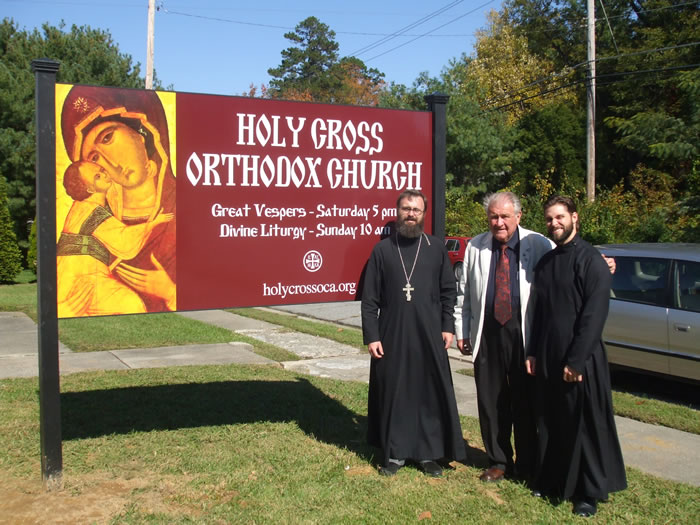
If one asks simply “where is the Orthodox Church” and it happens to be a large metropolitan area then one will have to be more specific for the simple reason that there is no Church with a sign outside that says “Orthodox Church”. There are many signs outside that say “Catholic Church”, however.
http://signs.stewartsigns.com/church_sign_saint_jonah_orthodox_2849.jpg

http://stmichaelcotuit.org/assets/images/welcome_sign.jpg
http://www.allmercifulsavior.com/images/Mission1.jpg

I have also seen Coptic Orthodox churches that are indicated as “(St. Name) Orthodox Church”, which are identifiable as Coptic by the form of the cross on their sign (though admittedly these are the extreme minority).
Holy Moley! You are making a huge deal out of nothing.
The reason why I am responding the way I am is that you are taking your presumptions from the Roman communion and using the fact that they do not fit Orthodoxy to try to claim things about Orthodoxy that are not true. For instance, you are right that many Catholic churches in America do say “Catholic Church” outside with no other qualifiers, and that this can be assumed to be Roman since the Roman/Latin church is the largest within your communion. So you are safe to direct any person who asks where the Catholic Church is to a Roman church, unless they specify otherwise. However, this wouldn’t work for Orthodoxy, since no one church predominates over the entire country since the overall demographics of the communion are different, e.g., something like 2% of all Catholics are non-Latins, whereas the different particular churches are more variable within Orthodoxy. In the OO communion, the Ethiopians make up the bulk of the communion (~45 million out of approximately ~75 million), but there are probably more Armenian or Coptic churches in the USA than Ethiopian (Ethiopians are mainly concentrated in the DC metro area, California, and NY). Where you go wrong is in saying that you would therefore have to wait for the person to specify that they mean a particular jurisdiction before you could tell them where the Church is. That may be what an Eastern Catholic would have to do to make sure that they don’t get sent to a Roman church, but that’s not a problem in Orthodoxy. In my home area of northern California, there are OCA and Bulgarian churches, and all receive whoever is around who is willing to profess the Orthodox faith (i.e., the local Habesha go to both, even though presumably they’d go to neither if there were any OO church around). It’s a matter of convenience or size in a given place, not jurisdiction, because again Orthodoxy does not have this division of Eastern on one hand and Western on the other (save for the tiny number of “Western Rite” churches under the Antiochians). The EO will tell you that they’re working hard to end the jurisdictional mess that plagues their communion in America, and I applaud them for it (the OO, for our part, are comparatively very few, so I’m not sure how high jurisdictional issues are on anyone’s list; usually we’re just happy that there’s any church we can go to, rather than having to go to the EO as often happens).

As an Oriental Orthodox person, I could be pointed to any OO church and there would be the Orthodox Church, just as any Catholic could go to a Roman or any other kind of Catholic Church and be going to the Catholic church. The fact that your communion’s statistical lack of diversity or balance gives you an illusion of being more unified/less ethnic is just that: it’s an illusion.
 
It’s absolutely not a matter of reality.
I have to agree with Steve VH. Most Orthodox Churches are highly ethnic. I’m not saying that they are racist but they are highly ethnic nonetheless. This is my personal real life experience in a highly populated metropolitan area (North Texas). You cannot tell me what reality when I have seen it and experienced it. In fact, even most Protestant Churches are highly ethnic as well. That is also my experience. I’m not a globetrotter but I have certainly been around in more Churches than I care to admit.

When I go to the Catholic Church I see peoples of all nations, in my Parish we have several (And mean many dozens),* not some *but several, families from all over the world - to name a few: China, Korea, Philippines (May God have mercy and help them through these times), several African countries and provinces, and a great mix of Caucasians (And I am using this term broadly to include Irish, German, Swiss and other European countries and non-Hispanic people) and Hispanics (From all over: Mexico, the Caribbean, Central America, South America, Brazil, Portugal, and Spain), and these are just from people that I know personally.

And I absolutely love this about the Catholic Church - it is truly universal, in not only that it is all over the world but that I can go to a local Parish and actually see the world together worshiping God as one.
 
Presumably the Orthodox answer would be to say that it is precisely because the Orthodox are one church that they have no single representative. If the Russians and the Greeks share the same faith, then you can talk to the Greeks or the Russians and either way you’re talking to the Orthodox.
Praise God, someone who understands! Thank you. 🙂
The second point would be that while nobody denies that the Roman Catholic Church is one, some might think that it is rather monolithic; the Orthodox know that they can get on as well as they like with the Eastern Catholic bishops in, say, the Middle East, but that nothing will come of it without the say-so of the Bishop of Rome. While that’s all good and proper in your ecclesiology, it’s not very good in theirs. Different perspectives.
How’dya like that – two for two! It really is a matter of different perspectives (and not just Eastern/Byzantine and Roman, but also Byzantine and Oriental, and Roman and Oriental…there are lots of different perspectives out there).
 
The thread topic is “A stranger asks for the Catholic Church…”. Now if I lived in a community that supported both Catholic and Orthodox Churches and one came to me and asked “where is the Orthodox Church” (which they would not) I would have to ask to which Orthodox Church he is referring, would I not? I would have to ask are you looking for the Greek or the Russian Orthodox Church? Not so when one asks where the Catholic Church is. It is just a matter of reality, I am certainly not trying to make any sort of disingenuous statement concerning our Orthodox brothers and sisters.
So what are we Eastern Catholics, chopped liver?

Edit: After writing the above, I read the long back-and-forth between you and dzeremi. So possibly this post is pointless, since you two may have already beaten this to death.
 
I have to agree with Steve VH. Most Orthodox Churches are highly ethnic. I’m not saying that they are racist but they are highly ethnic nonetheless. This is my personal real life experience in a highly populated metropolitan area (North Texas). You cannot tell me what reality when I have seen it and experienced it. In fact, even most Protestant Churches are highly ethnic as well. That is also my experience. I’m not a globetrotter but I have certainly been around in more Churches than I care to admit.

When I go to the Catholic Church I see peoples of all nations, in my Parish we have several (And mean many dozens),* not some *but several, families from all over the world - to name a few: China, Korea, Philippines (May God have mercy and help them through these times), several African countries and provinces, and a great mix of Caucasians (And I am using this term broadly to include Irish, German, Swiss and other European countries and non-Hispanic people) and Hispanics (From all over: Mexico, the Caribbean, Central America, South America, Brazil, Portugal, and Spain), and these are just from people that I know personally.

And I absolutely love this about the Catholic Church - it is truly universal, in not only that it is all over the world but that I can go to a local Parish and actually see the world together worshiping God as one.
Again, it is your communion’s statistical lack of diversity (2% Eastern/Oriental, 98% Roman/Latin) that provides you with the illusion that your church is “universal” while others are “ethnic”. Go tell a Syriac Maronite or a Chaldean that he is being “ethnic”. In fact, nevermind that, go tell the average Latin parish that. At the Latin church in my hometown, the church reflected the demographics of the town itself: roughly split 50/50 between Anglos and Latinos, who had separate masses since the Anglo priest knew no Spanish. There was hardly any crossover between the two communities, except for people like me who are of mixed cultural background (my grandmother on my father’s side was Mexican; my mother’s side of the family are all Anglo). What was bad, though, was that the two communities had different sermons preached to them on a regular basis, with the Hispanic priest often telling the congregation “the Anglos gave $(big number) this week, but we only gave $(smaller number)…why is that? Are they more committed to the Church than we are?” This was my experience in that particular parish, and it certainly didn’t seem very united to me.

At the Coptic church into which I was received, the situation seemed different: There were Anglos (whole families, apparently without Egyptian roots or spouses), Ethiopians, Eritreans, Syriacs, Hispanic people, etc. The deacon who drove me to the airport at the end of the day was an Iraqi Assyrian with a Coptic name worshiping in a Coptic Orthodox Church. :eek: Just this last week in Las Cruces, there were maybe 10 people in attendance at the liturgy outside of the deacons and the priest, and that included three different cultural backgrounds (Egyptians, Mexicans, and Anglos). We regularly have Ethiopians visit us in ABQ despite the fact that for them it’s a 6 hour drive, and before them we had Sudanese, Jordanians, Armenians, and several Anglos. We are a tiny community of maybe 40 people and still we drive 6 hours round trip to serve liturgy for the local non-Copts in Las Cruces, or somehow manage to attract locals of all stripes here in Albuquerque. Personal experience, indeed.
 
I have to agree with Steve VH. Most Orthodox Churches are highly ethnic. I’m not saying that they are racist but they are highly ethnic nonetheless. This is my personal real life experience in a highly populated metropolitan area (North Texas). You cannot tell me what reality when I have seen it and experienced it. In fact, even most Protestant Churches are highly ethnic as well. That is also my experience. I’m not a globetrotter but I have certainly been around in more Churches than I care to admit.

When I go to the Catholic Church I see peoples of all nations, in my Parish we have several (And mean many dozens),* not some *but several, families from all over the world - to name a few: China, Korea, Philippines (May God have mercy and help them through these times), several African countries and provinces, and a great mix of Caucasians (And I am using this term broadly to include Irish, German, Swiss and other European countries and non-Hispanic people) and Hispanics (From all over: Mexico, the Caribbean, Central America, South America, Brazil, Portugal, and Spain), and these are just from people that I know personally.

And I absolutely love this about the Catholic Church - it is truly universal, in not only that it is all over the world but that I can go to a local Parish and actually see the world together worshiping God as one.
I really wish you would learn a bit about us Eastern Catholics 😦
 
Status
Not open for further replies.
Back
Top