
Are the rich more virtuous than the poor?

  • Thread starter Thread starter Bubba_Switzler
  • Start date Start date
Status
Not open for further replies.
I am genuinely curious why you would say, “It’s not our concern HOW a person gets or stays poor.”

Please try again to explain your meaning here as understanding how and why people live in poverty is, of course, a central purpose of Charles Murray’s lifelong work. It would seem that you are directly challenging the value and morality of his research.
In the Gospels, Jesus tells us the importance of the poor in our lives, and that we are to treat them as well, or better than we treat ourselves. He further tells us that they will be with us always. I admit ignorance of the work of Charles Murray. Until this thread, I must say that I can’t challenge him directly, because I’m unfamiliar with his work. I think I’m probably just being simplistic in your eyes, and that the causes to me, aren’t addressed as that much of an element of concern, from what I’ve been able to find, to Jesus, or his apostles.

I have no problem whatsoever with any group of persons working to improve the lives of the poor, but I don’t put a lot of stock in the ability of man to solve mans problems. Particularly one as strong, pervasive and eternally imbedded as poverty, which, if blended with faith and hope, is in fact a virtue. If what Mr. Murray is saying is that we should not help the poor in the short run, as an adjunct to whatever other thing he and his friends or followers are proposing to do for the long run, then I’m afraid I won’t even be interested at all. I do wish that all of us, (myself included), would spend more of our time with the poor. Too often, I think, I’ll give someone some food, or money, or something, and not actually sit down with them for a few minutes, and perhaps share a meal together. I haven’t offered my home for lodging, etc., and there are actually living examples of folks who do these very things, even in Las Vegas. I only pray that at the end of my life, that I’ve given enough of myself, and given often enough, and without complaint, or even second thought, and with enough love, that Jesus will agree that I cared, and that I at least made an attempt to be Him for somebody else.

Working on a wider view and trying to help work at the root level of the myriad causes of individual poverty is probably a noble thing to do. If this is the way in which God is calling Mr. Murray and others to use their time, talent and treasure, who am I to say they are wrong in their approach? I’m dust. As long as the people doing this are doing it out of love and sincerity, God bless them. But in the mean time, I’m not called to use the limited resources I have been entrusted with in such a manner. I am more likely to give someone a sandwich or a dollar than find out why they need a sandwich or a dollar. I am not going to take on guilt for that.

God bless Mr. Murray. While he’s working out a grand plan, I’ll be giving my brother a dollar when he has his hand out, and I can sleep with that.

Peace to all, for however you approach this,

Steven
 
To anyone reading this thread. I wrote my comments to this thread on the fly, and while I am not ashamed of what I had to say here or anything like that, I do feel I that the fact that I haven’t read this book, combined with the fact that I am even unfamiliar with it’s author, his works, his philosophies, etc., disqualifies me from the debate on this thread. The thoughts I’ve expressed about the poor are apolitical, and are not the product of social studies and anthropology, but simple expressions of one Christian’s view and understanding of agape love from the Gospels. In short, I didn’t read the thread carefully enough, I didn’t adequately check out the link upon which it is based, and I don’t have political opinion to add to this discussion. I think this makes my third post on this thread. Please disregard them all. They don’t really fit with the discourse proposed for this thread. I felt I needed to make this statement, because after a few minutes, we are apparently unable to delete our own comments from a thread, or else I would have simply pulled them. Thank you,

May God bless,

Steven
 
I don’t know, I think there could be some truth to this. In lieu of all the bashing that has been done here towards Charles What’shisface and whoever the poster is that sympathesizes with him, I think a great deal of poverty, illness, etc can indeed be attributed to sin and immorality in multiple ways. It is entirely possible that the misfortune of many, at least in a free society, is the result of poor choices at the hands of both others and those who are suffering. In no way would this suggest anything of the likes of turning down beggars or not sympathizing with them or not caring for them, etc. But it could absolutely be a step in figuring out how to actually eliminate the problem. If poverty and poor conditions indeed result from immorality and poor decision making (and I think many of us could agree that it is at least partially true), and we have an even remotely sincere intention to care for the poor and eliminate/mitigate poverty, then we are obligated to admit this fact and do what we can to treat it.
 
Though this question is not addressed to me,it has become obvious that having read this book is a requirement to participate in this thread.Since as I have said I have not read the book whose author has additionaly restricted his research to US white sampling selection for reasons I am not questioning,I just do not qualify.Cause giving an opinion will come down to challenging Murray´s work,and it may not necessarily be the case.I appreciate though the intention of the OP.I believe it is the title of this thread what has not perhaps been the best choice and has caused some confusion.Thanks again and God bless.
Thank you for your thoughtful reply, of course I know that just because we don’t know all things does not mean we don’t know anything. Goodness that would mean I literally know nothing! (some close to me might agree with that hahahahaha)

Forgive me I was distracted, and while I did read your post I did focus on the word “virtue” in your title and made the mistake of thinking we were discussing virtue, not exclusively “Murray’s American Virtues.” Even after reading what you wrote I do not beleive I know enough about his writings to discuss this further. God bless.
To anyone reading this thread. I wrote my comments to this thread on the fly, and while I am not ashamed of what I had to say here or anything like that, I do feel I that the fact that I haven’t read this book, combined with the fact that I am even unfamiliar with it’s author, his works, his philosophies, etc., disqualifies me from the debate on this thread. The thoughts I’ve expressed about the poor are apolitical, and are not the product of social studies and anthropology, but simple expressions of one Christian’s view and understanding of agape love from the Gospels. In short, I didn’t read the thread carefully enough, I didn’t adequately check out the link upon which it is based, and I don’t have political opinion to add to this discussion. I think this makes my third post on this thread. Please disregard them all. They don’t really fit with the discourse proposed for this thread. I felt I needed to make this statement, because after a few minutes, we are apparently unable to delete our own comments from a thread, or else I would have simply pulled them. Thank you,
Although I would value each of you and your contributions to this discussion, I will honor your preference and refrain from further comments on your various points.

To those who may be considering joining this thread, I do think it is sufficient, and highly recommended, to read the book review I linked in the opening post of the thread. I think that will give you a good flavor for Charles Murray’s research and position though, obvoiusly, through the eyes of the reviewer.
 
I don’t know, I think there could be some truth to this. In lieu of all the bashing that has been done here towards Charles What’shisface and whoever the poster is that sympathesizes with him, I think a great deal of poverty, illness, etc can indeed be attributed to sin and immorality in multiple ways. It is entirely possible that the misfortune of many, at least in a free society, is the result of poor choices at the hands of both others and those who are suffering. In no way would this suggest anything of the likes of turning down beggars or not sympathizing with them or not caring for them, etc. But it could absolutely be a step in figuring out how to actually eliminate the problem. If poverty and poor conditions indeed result from immorality and poor decision making (and I think many of us could agree that it is at least partially true), and we have an even remotely sincere intention to care for the poor and eliminate/mitigate poverty, then we are obligated to admit this fact and do what we can to treat it.
I suspect that at least some of the attacks on Charles Murray have been in the mistaken belief that noting any sort of virtue among the rich would be tantamount to sanctioning snobery. Nothing could be further from the truth. The pope is a virtuous man, in the Catholic sense, but saying so does not in any way sanction him to look down on the rest of us.

A few seemed to object to the very direction of the research itself as if addressing “root causes” was unChristian. I had hoped to follow that line of discussion further but those who offered it have since taken leave.

I did raise my own voice of skepticism earlier. It is one thing to notice a correlation between poverty and lack of virtue (again, in the “American”, wordly sense, though there is good reason to believe it may extend to saintly virtues as well), and another thing entirely to claim any ability to mitigate, much less to eliminate poverty. But, at a minimum, it is a worthwhile line of research.

Let me just note in passing that I do recall seeing, and it may have been from Charles Murray, I don’t recall, evidence that church attendance was a) simlarly correlated with escape from poverty, and b) declining among the poor and increasing among the rich.
 
The rich have always blamed the immorality of the poor for their poverty. Take a look at the Irish Potato Famine-the deeply religious, deeply Catholic Irish peasantry was starving to death. Sir Charles Edward Trevelyan secured his place amongst the villains of history with this particularly vile sentiment:

“The judgement of God sent the calamity to teach the Irish a lesson, that calamity must not be too much mitigated… The real evil with which we have to contend is not the physical evil of the Famine, but the moral evil of the selfish, perverse and turbulent character of the people.”

Now, Murray is different from Trevelyan because Trevelyan was actually in a position to make sure that the Irish peasantry did, in fact, starve to death. But I see no difference in the sentiments.
 
The rich have always blamed the immorality of the poor for their poverty. Take a look at the Irish Potato Famine-the deeply religious, deeply Catholic Irish peasantry was starving to death. Sir Charles Edward Trevelyan secured his place amongst the villains of history with this particularly vile sentiment:

“The judgement of God sent the calamity to teach the Irish a lesson, that calamity must not be too much mitigated… The real evil with which we have to contend is not the physical evil of the Famine, but the moral evil of the selfish, perverse and turbulent character of the people.”

Now, Murray is different from Trevelyan because Trevelyan was actually in a position to make sure that the Irish peasantry did, in fact, starve to death. But I see no difference in the sentiments.
And, of course, it is not the least bit difficult to find similar examples fo the poor blaming their poverty on the immorality of the rich. Should we run through some historical examples and compare body counts?

Or perhaps our time would be better spent examining Murray’s research not in terms of “sentiment” but in terms of factuality.
 
And, of course, it is not the least bit difficult to find similar examples fo the poor blaming their poverty on the immorality of the rich.
The rich are usually in the positions of power, so they determine how resources are (re)distributed in a society. Blaming one’s powerty on the rich is not completely off base.
Or perhaps our time would be better spent examining Murray’s research not in terms of “sentiment” but in terms of factuality.
This research conveniently overlooks a straightforward observation made by one Karl Marx back in the 19th century (quoted in #13).
 
And, of course, it is not the least bit difficult to find similar examples fo the poor blaming their poverty on the immorality of the rich. Should we run through some historical examples and compare body counts?

Or perhaps our time would be better spent examining Murray’s research not in terms of “sentiment” but in terms of factuality.
My point is that people will always say what Charles Murray said, because it is convenient. People like Trevelyan and contemporaries of Jonathan Swift could very easily find things they didn’t like about the Irish peasantry-they drank more alcohol, they had a higher birth rate, they were dirty, they had a higher murder rate…all of these things are true. But what Murray ignores is that being rich, or at least middle class, gives you a margin for error-you can make some mistakes financially and maintain a good position. When my mother’s car breaks down and we have to get a new transmission, that’s a headache and an inconvenience and it maybe means we don’t go out to eat for a little while, but we still have enough to pay all the bills. When you don’t have much money, its a catastrophe.

When my brother failed to get his financial aid paperwork to his college in on time, my father was able to take the day off and drive to three hours to turn it in person. Other than a momentary 15 minute period of panic, it was no harm, no foul; had my dad not had a good, white-collar job that he could take the day off from work on short notice, he wouldn’t have been going away to that college.

Or how’s this-when you’re rich/middle-class, you generally can get a good night’s sleep. You won’t be woken up by loud noises all night long, meaning you can face the next day rested. You’ll also be more likely to eat the right kinds of foods, especially in the morning-going through the day hungry or filled up on garbage like pop-tarts affects you a lot more than having a banana and orange juice in the morning, and you can see that difference.

Or how’s this-the single greatest predictor of academic success is, and has been for generations…economic background! The single greatest predictor of economic success is, and has been for generations…academic success! There are, of course, exceptions as there are whenever we talk in such large numbers, but I think you can see the vicious cycle here.
 
My point is that people will always say what Charles Murray said, because it is convenient…People like Trevelyan and contemporaries of Jonathan Swift could very easily find things they didn’t like about the Irish peasantry-they drank more alcohol, they had a higher birth rate, they were dirty, they had a higher murder rate…all of these things are true.
If people “always say what Charles Murray said” then perhaps it is because there is some truth to it. This is a possibility that you ought to consider.

Accusing someone of speaking truth because it is “convenient” is patently absurd.

Now if you want to accuse Murray (or Trevelyan) of slander, that’s a different matter.
But what Murray ignores is that being rich, or at least middle class, gives you a margin for error-you can make some mistakes financially and maintain a good position. When my mother’s car breaks down and we have to get a new transmission, that’s a headache and an inconvenience and it maybe means we don’t go out to eat for a little while, but we still have enough to pay all the bills. When you don’t have much money, its a catastrophe. When my brother failed to get his financial aid paperwork to his college in on time, my father was able to take the day off and drive to three hours to turn it in person. Other than a momentary 15 minute period of panic, it was no harm, no foul; had my dad not had a good, white-collar job that he could take the day off from work on short notice, he wouldn’t have been going away to that college.
Nobody, including Murray, is suggesting that being rich is without benefits. This is a red herring.
The single greatest predictor of economic success is, and has been for generations…academic success! There are, of course, exceptions as there are whenever we talk in such large numbers, but I think you can see the vicious cycle here.
I suspect you are playing loosely with the definition of economic success here in the usual effort to discourage virtuous behavior. If by economic success you mean level of income, that is undoubtedly true. But if by economic success you mean improvement in income then this is false. The goal of those who live in poverty is not to be rich but to escape poverty. Achieving middle class status often takes generations. That’s how it was with the Irish, for example. And the single best predictor of economic improvement is virtuous behavior.

As I noted previously, in the US, there are really three simple behaviors that almost guarantee escape from poverty:
  1. Stay in school
  2. Get and hold a job
  3. Get married before having children
 
If people “always say what Charles Murray said” then perhaps it is because there is some truth to it. This is a possibility that you ought to consider.
Well, if the poor have always blamed the rich, perhaps there is some truth to that, too, right? Especially because the rich have the power to do something about it.

I’d also like to note that the people who “always say what Charles Murray said” usually end up among the most reviled figures in history. In the grand scheme of things, I’d much rather cast my lot with a dirt poor peasant from Ireland or a coal miner in West Virginia than someone who is almost universally reviled like Charles Trevalyan.
Accusing someone of speaking truth because it is “convenient” is patently absurd.
Now if you want to accuse Murray (or Trevelyan) of slander, that’s a different matter.
I’m not accusing him of speaking the truth because its convenient, I’m accusing him of speaking something other than truth because it is convenient. I won’t necessarily call it lying because there is such a thing as cognitive dissonance.
Nobody, including Murray, is suggesting that being rich is without benefits. This is a red herring.
But those benefits make it easier to follow your three perfect steps to economic success! We’ll get to that later.
I suspect you are playing loosely with the definition of economic success here in the usual effort to discourage virtuous behavior.
If there’s one thing that gets me annoyed quicker than anything else, its vicious insults couched in polite phrasing. You are, in this sentence, accusing me of lying because I want to discourage people from doing the right thing. I’m not sure why you think I would want that.
If by economic success you mean level of income, that is undoubtedly true. But if by economic success you mean improvement in income then this is false. The goal of those who live in poverty is not to be rich but to escape poverty. Achieving middle class status often takes generations. That’s how it was with the Irish, for example. And the single best predictor of economic improvement is virtuous behavior.
Well, that depends on why they got here. They weren’t stuck in poverty because they needed to learn to be virtuous, they were stuck in poverty because they were victims of vicious anti-Catholic prejudice. “No Irish Need Apply” was a real thing. Once that prejudice had been overcome, the path became a lot quicker-my great grandmother came over here in the 1920’s and cleaned movie theaters for a living; her son (my grandfather) became a police officer and lived a comfortable middle class life that included being able to rent a house for two weeks at the Shore each summer. He had to work hard all his life to get there, but it wasn’t as slow a process as you make it sound. He certainly didn’t do worse than his children (although that has something to do with the erosion in real wages, which is something else entirely).

I also like how you can just declare that “virtuous behavior” is the answer and act like that makes it so. Who was the richest Irish-American in the 1930’s? Joseph P. Kennedy. How did he get his power and influence? Rum-running and graft. He was doing a lot better than the average Irish beat cop, I’ll tell you that much. How did Jay Gould make his fortune? Financial fraud.

The reward of virtuous behavior is not economic success but virtue.
As I noted previously, in the US, there are really three simple behaviors that almost guarantee escape from poverty:
  1. Stay in school
The richer your parents are, the more likely you are to go to a good school, to eat good meals in the morning before going to school, to have your parents involved in your education, to get a good night’s sleep the night before school, and to have the opportunity to participate in extracurricular activities.

It is easier to stay in school if you are born rich/middle-class than if you are born poor.
  1. Get and hold a job
Boy, when you put it that way it all sounds so simple. I mean, through sheer force of will, you can get yourself a job when there are more applicants than there are jobs, you can prevent yourself from being laid off, and you can prevent yourself from suffering any kind of a crippling injury or getting any kind of a disease.

Virtue doesn’t help you avoid ill-luck or catastrophe.
  1. Get married before having children
The rich/middle-class are more likely to have access to contraception and abortions and other forms of family planning. And if they do have children early, they usually have a better support system-a girl I went to high school with had a kid her freshman year in college; her mother took care of the baby for its early years while she and her father were finishing its education. The girl’s mother had a job, but didn’t need to work and so could do things like that. Had they been in a more desperate financial situation, either the mother of the father would have had to leave school.
 
Well, if the poor have always blamed the rich, perhaps there is some truth to that, too, right? Especially because the rich have the power to do something about it.
I look forward to your presentation of the evidence.
I’d also like to note that the people who “always say what Charles Murray said” usually end up among the most reviled figures in history. In the grand scheme of things, I’d much rather cast my lot with a dirt poor peasant from Ireland or a coal miner in West Virginia than someone who is almost universally reviled like Charles Trevalyan.
Hmmm. More reviled than Hitler and Stalin? I doubt it. No, I think you are engaging in a bit of hyperbole here in addition to crude guild by association. Let’s try to stick to the facts, shall we?
I’m not accusing him of speaking the truth because its convenient, I’m accusing him of speaking something other than truth because it is convenient. I won’t necessarily call it lying because there is such a thing as cognitive dissonance.
Well, then why don’t you address yourself to where he is mistaken instead of engaging in all this convoluted rhetoric?
But those benefits make it easier to follow your three perfect steps to economic success!
It doesn’t matter. The results of the poor following these three steps do not depend on how many rich also follow them.
Well, that depends on why they got here. They weren’t stuck in poverty because they needed to learn to be virtuous, they were stuck in poverty because they were victims of vicious anti-Catholic prejudice.
No, this is quite ahistorical. The Irish started poor. Various theories have been offered as to why they had such bad work habits, some blame the nature of potato farming. But by all accounts the Irish were not reliable workers when they first came over, quite the contrary.
I also like how you can just declare that “virtuous behavior” is the answer and act like that makes it so. Who was the richest Irish-American in the 1930’s? Joseph P. Kennedy. How did he get his power and influence? Rum-running and graft. He was doing a lot better than the average Irish beat cop, I’ll tell you that much. How did Jay Gould make his fortune? Financial fraud. The reward of virtuous behavior is not economic success but virtue.
Charles Murray, and others who have done the research, have drawn their conclusions from observation of general behavior and results, not upon a few exceptions here and there.
The richer your parents are, the more likely you are to go to a good school, to eat good meals in the morning before going to school, to have your parents involved in your education, to get a good night’s sleep the night before school, and to have the opportunity to participate in extracurricular activities. It is easier to stay in school if you are born rich/middle-class than if you are born poor.
None of this is relevant to the issue at hand: whether or not the poor can escape poverty by their own virtuous behavior. You keep wanting to make this a comparison of rich and poor. Charles Murray is simply concerned with determining why the poor remain trapped in poverty (and why materialistic efforts to help them have had the effect of trapping then in dependency and further decline).
Boy, when you put it that way it all sounds so simple. I mean, through sheer force of will, you can get yourself a job when there are more applicants than there are jobs, you can prevent yourself from being laid off, and you can prevent yourself from suffering any kind of a crippling injury or getting any kind of a disease. Virtue doesn’t help you avoid ill-luck or catastrophe.
No, it doesn’t, but it does dent it. Getting and keeping a job is not, for the most part, a matter of luck.
The rich/middle-class are more likely to have access to contraception and abortions and other forms of family planning. And if they do have children early, they usually have a better support system-a girl I went to high school with had a kid her freshman year in college; her mother took care of the baby for its early years while she and her father were finishing its education. The girl’s mother had a job, but didn’t need to work and so could do things like that. Had they been in a more desperate financial situation, either the mother of the father would have had to leave school.
You keep wanting to make this a comprison of rich and poor but see above.
 
I look forward to your presentation of the evidence.
Of what? That Sir Charles Trevelyan, the Baronet of Wallington and Assistant Secretary of the Treasury for Great Britain, responsible for the handling of the Irish Potato Famine, had more power than Sean McRandomPotatoFarmerfromSkibereen? That JP Morgan has more power than a random worker in a steel mill? That the owner of a large company has more power than the janitorial staff?

I need to present evidence of that?
One of the most reviled figures in history. One of… One of… Meaning amongst. I didn’t say he was the most reviled figure in history. That would be an insane thing to say. But Trevelyan is among the most reviled figures in history, especially in Ireland.
Well, then why don’t you address yourself to where he is mistaken instead of engaging in all this convoluted rhetoric?
He is mistaken because he assumes there is a direct correlation between virtue and economic success. You make more money teaching at a public school than at a Catholic school; you make more money in corporate law than doing inner-city legal aid; stock brokers have more possessions than Franciscans; crime lords make more money than janitors; Bernie Madoff was vastly richer than his secretary.
It doesn’t matter. The results of the poor following these three steps do not depend on how many rich also follow them.
My point is that more rich/middle-class people follow these steps because it is easier for them to do it, not because they are more virtuous.
No, this is quite ahistorical. The Irish started
poor. Various theories have been offered as to why they had such bad work habits, some blame the nature of potato farming. But by all accounts the Irish were not reliable workers when they first came over, quite the contrary.

By whose accounts? The accounts of the Know-Nothing Party and other nativist/anti-Catholic groups? Because they tell a very different than say, what Thomas Francis Meagher, Michael Corcoran, or Archbishop John Hughes might say.
Charles Murray, and others who have done the research, have drawn their conclusions from observation of general behavior and results, not upon a few exceptions here and there.
So he’s right because he’s right because he’s right…there’s something very circular about your logic.
None of this is relevant to the issue at hand: whether or not the poor can escape poverty by their own virtuous behavior. You keep wanting to make this a comparison of rich and poor. Charles Murray is simply concerned with determining why the poor remain trapped in poverty (and why materialistic efforts to help them have had the effect of trapping then in dependency and further decline).
“Further decline”? Life is better for the poor today than it was in 1950. The poverty rate is significantly lower; the number of people who live in structurally unsound housing and who die in fires is much lower; the inner cities are no longer vastly overcrowded; poverty among the elderly has been drastically reduced. Life is much better for the poor today than it was in 1900; life is much better than it was in Ireland in the 1800’s, when being born a potato farmer was virtually a guarantee that you would die a potato farmer.

And it again ignores the issue of margin of error-I would like to think I’ve been generally virtuous throughout my life, but I’ve made some errors; my sophomore year in high school I was lazy and didn’t get my application for a summer job in on time. No big deal for me…but would I poor, that could well be the lapse in virtue that you point to as my fault for remaining in poverty.
No, it doesn’t, but it does dent it. Getting and keeping a job is not, for the most part, a matter of luck.
You keep wanting to make this a comprison of rich and poor but see above.
I keep wanting to make this a comparison of rich and poor. Your thread title asks “Are the rich more virtuous than the poor [emphasis mine]?” You started the thread with a comparison!

I also wouldn’t call it luck, but there are factors beyond your control. Your entire occupation can be made obsolete-the company you work for can be the victim of financial mismanagement and go under-you could be in a car accident and suffer a head injury-you could just get laid off for seniority reasons.

There are more applicants than there are jobs!
 
Of what? That Sir Charles Trevelyan, the Baronet of Wallington and Assistant Secretary of the Treasury for Great Britain, responsible for the handling of the Irish Potato Famine, had more power than Sean McRandomPotatoFarmerfromSkibereen? That JP Morgan has more power than a random worker in a steel mill? That the owner of a large company has more power than the janitorial staff? I need to present evidence of that?
Charles Murray didn’t just rely on what “everybody knows” about the lack of virtue among the poor. He went to the trouble of collecting and analyzing the data, of forming and testing a hypothesis. Give it a try.
One of the most reviled figures in history. One of… One of… Meaning amongst. I didn’t say he was the most reviled figure in history. That would be an insane thing to say. But Trevelyan is among the most reviled figures in history, especially in Ireland.
I’d date say that the vast majority of people have never heard of the man.
He is mistaken because he assumes there is a direct correlation between virtue and economic success. You make more money teaching at a public school than at a Catholic school; you make more money in corporate law than doing inner-city legal aid; stock brokers have more possessions than Franciscans; crime lords make more money than janitors; Bernie Madoff was vastly richer than his secretary.
He is not making claims about how people across the economic income spectrum can improve their standard of living. He is solely concerned with the plight of the poor, those living in poverty. And, yes, here is where he has found the correlation.
My point is that more rich/middle-class people follow these steps because it is easier for them to do it, not because they are more virtuous.
It doesn’t matter whether it is easier for the rich to be industrious. It matters only whether or not the poor can escape poverty by doing a few simple things.
By whose accounts? The accounts of the Know-Nothing Party and other nativist/anti-Catholic groups? Because they tell a very different than say, what Thomas Francis Meagher, Michael Corcoran, or Archbishop John Hughes might say.
So your claim is that the Irish came to America as industious good citizens who were simply misunderstood by anti-Catholic zealots?
So he’s right because he’s right because he’s right…there’s something very circular about your logic.
He went to the trouble of collecting the evidence for his conclusions.
“Further decline”? Life is better for the poor today than it was in 1950. The poverty rate is significantly lower; the number of people who live in structurally unsound housing and who die in fires is much lower; the inner cities are no longer vastly overcrowded; poverty among the elderly has been drastically reduced. Life is much better for the poor today than it was in 1900; life is much better than it was in Ireland in the 1800’s, when being born a potato farmer was virtually a guarantee that you would die a potato farmer.
And it again ignores the issue of margin of error-I would like to think I’ve been generally virtuous throughout my life, but I’ve made some errors; my sophomore year in high school I was lazy and didn’t get my application for a summer job in on time. No big deal for me…but would I poor, that could well be the lapse in virtue that you point to as my fault for remaining in poverty.
Povety rates are notoriously problematic because they are usually defined relatively so no matter how much the poor improve their condition they always remain in poverty. But, yes, oveall everyone is living better now than they did in 1C AD.
I also wouldn’t call it luck, but there are factors beyond your control. Your entire occupation can be made obsolete-the company you work for can be the victim of financial mismanagement and go under-you could be in a car accident and suffer a head injury-you could just get laid off for seniority reasons. There are more applicants than there are jobs!
It is indeed sad that so many encourage the belief in the primacy of luck and the futility of virtuous behavior.
 
Charles Murray didn’t just rely on what “everybody knows” about the lack of virtue among the poor. He went to the trouble of collecting and analyzing the data, of forming and testing a hypothesis. Give it a try.
Do you really want to me justify to you that powerful people are powerful?
I’d date say that the vast majority of people have never heard of the man.
If they’re Irish or Irish-American, they likely have.
He is not making claims about how people across the economic income spectrum can improve their standard of living. He is solely concerned with the plight of the poor, those living in poverty. And, yes, here is where he has found the correlation.
No, he is not concerned with the plight of the poor. He is concerned with justifying his own lack of caring for the poor. Yes, I am attacking his motives.
It doesn’t matter whether it is easier for the rich to be industrious. It matters only whether or not the poor can escape poverty by doing a few simple things.
Those “few simple things” are not easy. And I think industrious is the wrong word-a bank manager makes more money than a coal miner or a roofer, but the physical toll on the coal miner or the roofer is significantly higher.

I’m about to become a professional teacher after my semester of student-teaching, and as hard as I worked, I’m very easily going to concede that a coal miner in West Virginia or Chile is working much harder than I am, and will likely die much poorer than I do.
So your claim is that the Irish came to America as industious good citizens who were simply misunderstood by anti-Catholic zealots?
Yes, yes it is. Is your claim that the Irish came to America as inferior and lazy and needed to be educated in how to work by their betters?
He went to the trouble of collecting the evidence for his conclusions.
Exactly. He started with his conclusions
Povety rates are notoriously problematic because they are usually defined relatively so no matter how much the poor improve their condition they always remain in poverty. But, yes, oveall everyone is living better now than they did in 1C AD.
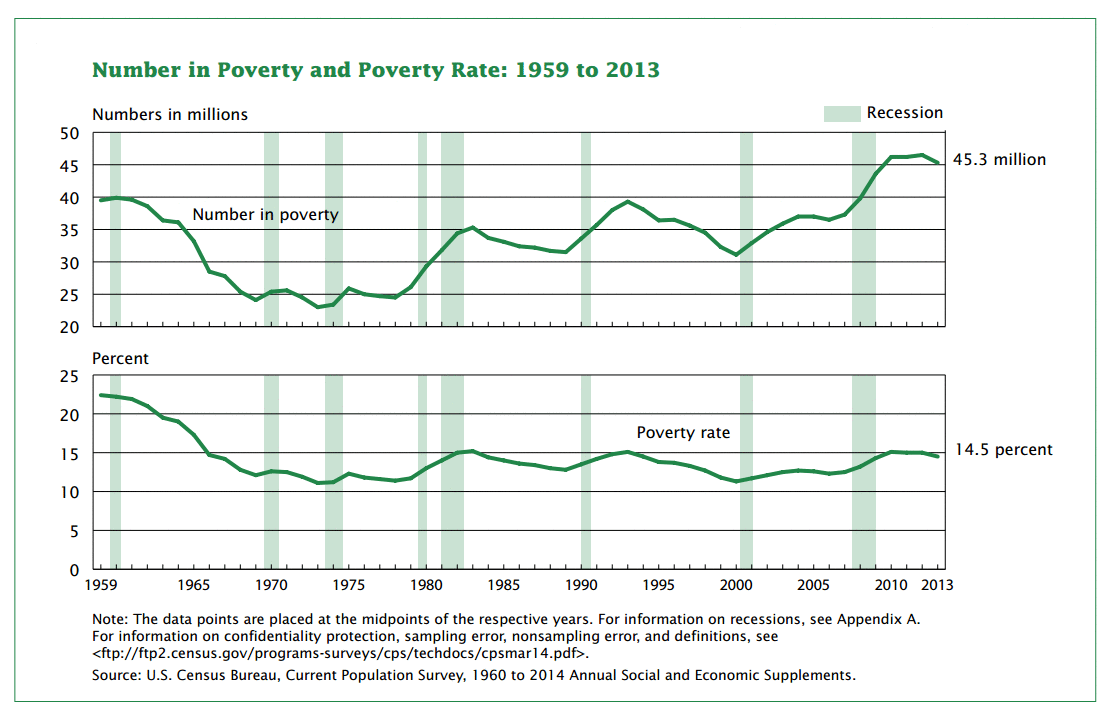
The poverty rate today is slightly over half what it once was. African-American poverty in particular went from 55% in 1960 to about 27% today. The overall poverty rate went from 22% to 12% over the same period.

That means that following the greatest period of government activism on behalf of the poor in American history, the poverty rate declined more sharply than it had at any time in American history.
It is indeed sad that so many encourage the belief in the primacy of luck and the futility of virtuous behavior.
Virtuous behavior is its own reward; at the end of the day, the honest coal miner who dies poor is better than Richard Nixon, and the honest janitor who dies poor is better than JP Morgan. This is one of the basic pillars of Catholicism.

There’s more to it than luck-the actions of others matter tremendously. I’m soon going to graduate a very good school with some very good accomplishments, but I often wonder-what if I didn’t have the parents I have to teach me the values I follow? Would I have grown to hate school if my second grade teacher hadn’t recognized the writing disability I have and made the effort to have me type everything? If my football coaches hadn’t been such an inspiration, would I have learned to work hard?

I don’t know where I heard “Show me a self-made man and I’ll show you an ungrateful SOB,” but its one hundred percent accurate.
 
He is solely concerned with the plight of the poor, those living in poverty. And, yes, here is where he has found the correlation.
  1. Repeat after me: Correlation does not equal causation.
  2. Marx said (paraphrasing) that it’s the poverty which drives the immorality, not immorality which drives the poverty. What evidence does Murray present that Marx got it backwards?
  3. John Nash’s theory presents economic behavior in terms of game theory. Here is a textbook exercise known as the prisonner’s dilemma:
Two men are arrested, but the police do not possess enough information for a conviction. Following the separation of the two men, the police offer both a similar deal—if one testifies against his partner (defects/betrays), and the other remains silent (cooperates/assists), the betrayer goes free and the cooperator receives the full one-year sentence. If both remain silent, both are sentenced to only one month in jail for a minor charge. If each ‘rats out’ the other, each receives a three-month sentence. Each prisoner must choose either to betray or remain silent; the decision of each is kept quiet. What should they do?
In this game, the optimal course of action is to betray your partner: if he doesn’t betray, you walk out free; if he betrays as well, you will both get three months. However, this course of action is also amoral. The moral course of action is to cooperate, yet, cooperation means that you will get a month in prison in the best case, and a year in prison in the worst case. It thus follows, that virtuous behavior does not lead to profits. Quite the contrary.

Recall, that economy can be expressed in terms of games theory. It follows, that moral behavior in economy is not rewarded, but punished. That’s the reason why economic activity is regulated by very complex legal codes. In econonic activity, actors have no inherent incentive to play nice, and external forcings are needed to level the playing field.

How does Murray explain the paradox that moral behavior lifts people out of poverty, yet, in general, moral behavior in economy does not lead to profits?
 
  1. Repeat after me: Correlation does not equal causation.
Please show where I have suggested otherwise? In fact, I made exactly this point earlier.
  1. Marx said (paraphrasing) that it’s the poverty which drives the immorality, not immorality which drives the poverty. What evidence does Murray present that Marx got it backwards?
Uh, if you are relying on Karl Marx as your expert on poverty and morality then I think we’re already too far apart to have any sort of useful discussion.
  1. John Nash’s theory presents economic behavior in terms of game theory. Here is a textbook exercise known as the prisonner’s dilemma: In this game, the optimal course of action is to betray your partner: if he doesn’t betray, you walk out free; if he betrays as well, you will both get three months. However, this course of action is also amoral. The moral course of action is to cooperate, yet, cooperation means that you will get a month in prison in the best case, and a year in prison in the worst case. It thus follows, that virtuous behavior does not lead to profits. Quite the contrary.
If you are familiar with game theory then you know that when the game is played in repeatedly and not in a one-off then behavrior changes radically towards cooperation.
Recall, that economy can be expressed in terms of games theory. It follows, that moral behavior in economy is not rewarded, but punished. That’s the reason why economic activity is regulated by very complex legal codes. In econonic activity, actors have no inherent incentive to play nice, and external forcings are needed to level the playing field.
How does Murray explain the paradox that moral behavior lifts people out of poverty, yet, in general, moral behavior in economy does not lead to profits?
Unfortunately, you have represented game theory, in general by a single game. Go back and study the subject a little more broadly.
 
Do you really want to me justify to you that powerful people are powerful?
Nice try, but the question is not whether “powerful people are powerful” but whether the immorality of the rich is the cause of poverty. Give that one a try.
No, he is not concerned with the plight of the poor. He is concerned with justifying his own lack of caring for the poor. Yes, I am attacking his motives.
I guess I should not be surprised that you would feel the need to slander Charles Murray. His research is certainly threatening to your worldview.
Those “few simple things” are not easy.
Apparently not. But then who promised that life is easy?
Yes, yes it is. Is your claim that the Irish came to America as inferior and lazy and needed to be educated in how to work by their betters?
It is my claim that the experience of the Irish was typical of the experience throughout the era of industrialization in which farmers moved to cities and worked in factories. You can see the exact same thing going on today in countries like China and India.
The poverty rate today is slightly over half what it once was. African-American poverty in particular went from 55% in 1960 to about 27% today. The overall poverty rate went from 22% to 12% over the same period.
 
The condescension and vicious insults hidden by false politeness are too much for me. It was clear from the start of this thread that you never had any intention of an honest discussion; I should never have been foolish enough to start debating this.

I’m out.
 
If by economic success you mean level of income, that is undoubtedly true.
What else would one mean by “economic success”? :confused:

The difference between the poor and the rich is that the rich have money, and the poor do not.

Money allows you to do things like go to college, get married, and buy a house. These things are not given away for free - if you have no money, you will not go to college, you will not get married (have you seen the price of wedding dresses lately?), and you will not purchase a house.
 
Status
Not open for further replies.
Back
Top