BTW, I note with some interest that the Jatakas contain rather interesting versions of the Rama and Krishna legends.

The legend of Rāma, prince of Ayodhya, is a highly famous one in the Indian subcontinent and in southeast Asia.
Rāma is a highly popular figure, revered for his unending compassion, courage and devotion to religious values and duty (
dharma). To top it all off, Rāma is also worshipped as a deity and a
maryāda puruṣottama the ‘perfect man’, often considered as an
avatar of the preserver god Vishnu, to the point that some Indian funerals feature the chanting of the phrase
Rām nām satya hai “Rāma’s name is truth” while the body is carried to the cremation ground.
The primary source for the Rāma legendarium is often considered to be the Sanskrit epic
Rāmāyaṇa, traditionally considered to be composed by the sage
Valmiki. which is one of, if not the, oldest of the
Rama-katha (‘stories of Rāma’). However, throughout the ages there are so many versions of the basic story (sometimes even substantially contradicting one another), as the tale is constantly told and retold over and over again, with each narrator adapting the tale as he sees fit. So while lip service is often paid to the
Rāmāyaṇa, many people nowadays have never even read the work - which is written in a dead language anyway - but are familiar with the story through one of its many retellings (such as
Tulsidas’
Rāmcharitmānas written in the Awadhi dialect or
Kamban’s Tamil
Ramavatharam, the Thai
Ramakien, the Malaysian
Hikayat Seri Rama, etc.) and dramatizations (one notable example being the famous 1980s TV drama
Ramayan - so famous, in fact, that virtually most of India literally
stood still just to watch it!) And even if they do, their prior knowledge often tends to color their reading of the epic.
Let’s give here a general summary based on Valmiki’s
Rāmāyaṇa, since many of the authors of the later
Rama-kathas themselves look upon Valmiki as an authoritative source or a story to which they disagree, and which is the one that has caught the attention of most Western scholars.
After being childless for a long time, Daśaratha, king of Kosala, the capital of which was the city of Ayodhya, at the advice of his ministers decides to hold a special sacrifice, which causes his three wives to conceive sons. Firstborn among them was Rāma, son of Kausalyā. His other two queens, Kaikeyī and Sumitrā, meanwhile, were the mothers of Rama’s half-brothers Bharata and the twins Lakṣmaṇa and Śatrughna. The boys are then reared as the princes of the realm, receiving education from the scriptures and in warfare.
Rāma begins his career as a warrior, as a youth, when he successfully defends the sacrifice of the sage Viśvāmitra from demons that threaten its success. He and his brother Lakṣmaṇa receive further instructions from Vishvamitra in the meantime, as well as possession of supernatural weapons. Subsequently, Rama wins his bride Sītā (the daughter of Janaka, king of Mithila) in
a contest by lifting and stringing - and in the process breaking - an enormous bow that once belonged to the god Rudra (Śiva), something which only Rāma was able to do.
Upon retirement, Daśaratha expresses his desire to crown Rāma, so beloved by the citizens of Ayodhya, as his successor. On the eve of the coronation, Kaikeyī — her jealousy aroused by a hunchbacked maidservant called Manthara — claims two boons that Daśaratha had long ago granted her. Kaikeyī demands Rāma be exiled for fourteen years, while the succession passes to her son Bharata. The king has no choice but to accept, and Rāma himself calmly submits to his fate and heads off for the forest, with Sītā and Lakṣmaṇa tagging along with him. Daśaratha eventually dies out of grief.
Meanwhile, Bharata, who was on a visit to his maternal uncle, learns what has happened and would have nothing to do with it. He visits Rāma in the forest and requests him to return, but the latter, determined to carry out his father’s orders to the letter, refuses to return before the period of exile. Bharata then goes back to Ayodhya with Rāma’s
sandals, and keeps them on the throne, while he rules as Rāma’s regent.
The threesome journeys deep into the forest southward along the banks of river Godavari, where they settle down and live an ascetic lifestyle. One day they are visited by a demoness (
rākṣasi) named Surpanakha who falls in love with Rāma and boldly offers herself to him in marriage. When Rāma refuses she deems Sītā to be the obstacle and tries to eat her. Lakṣmaṇa cuts off her nose and ears and she flees to her brother Rāvaṇa, king of the faraway island kingdom of Lankā. Rāvaṇa had gained a boon from the gods that rendered him invincible from any being except for humans (considered too weak and insignificant to be worthy of any attention) and had used this same power to defeat and harass the gods themselves.
When Surpanakha complains of the cruelty of the two princes and tells of the extraordinary beauty of Sītā, her words arouse in Rāvaṇa a passionate desire for Sītā. By enlisting the aid of another
rākṣasa (whom Rāma once defeated during Viśvāmitra’s sacrifice), who takes the form of a golden deer, Rāvaṇa manages to lure Rāma and Lakṣmaṇa away from their hermitage. Rāvaṇa then successfully abducts Sītā under the guise of a wandering ascetic and carries her off to Lankā.
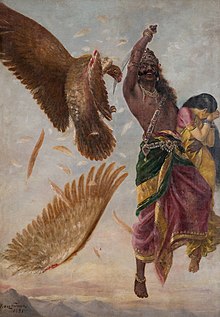
Rāvaṇa kidnapping Sītā
In the course of their quest for the place where Sītā has been taken and for allies to help him fight against Rāvaṇa, the two brothers find themselves in Kiṣkindhā, the citadel of ape-like humanoids known as
vanaras. There Rāma meets Hanuman, minister to the exiled prince Sugrīva, who, like Rāma, had lost both wife and kingdom. Hanuman becomes a faithful devotee of Rāma, and Sugrīva and Rāma make a pact that if Rāma will help Sugrīva ‘regain’ the throne and wife from his brother Vali, Sugrīva will in return help Rāma in his quest. During a duel between Sugrīva and Vali, Rāma conceals himsef behind a tree and shoots Vali from his position of hiding with an arrow, an act in violation of the warrior’s code.
Sugrīva, who now has regained what he lost, soon forgets his promise and spends his time in debauchery. It was up to his clever wife Tārā to pacify the enraged Lakṣmaṇa, and Sugrīva sends off search parties in every direction. Finally they receive information that Sītā has been imprisoned in Lankā.
After learning about Sītā, Hanuman assumes a gargantuan form and makes a colossal leap across the vast ocean to Lanka and locates her in Rāvaṇa’s palace. After seeing Sītā being alternately wooed and threatened by Rāvaṇa and his servants, he gives Rāma’s signet ring to her as a sign of good faith. He offers to carry Sītā back to Rāma, however she refuses, preferring that Rāma himself come and avenge the insult of her abduction.

 ): rather those two terms denoted whether one accepts the Vedas as authoritative (astika ‘it is so’) or not (nastika ‘it is not so’).
 Because even if the happiness was caused by the sight guess who created the sight? You got it! The Lord Almighty creator of heaven and EARTH!


