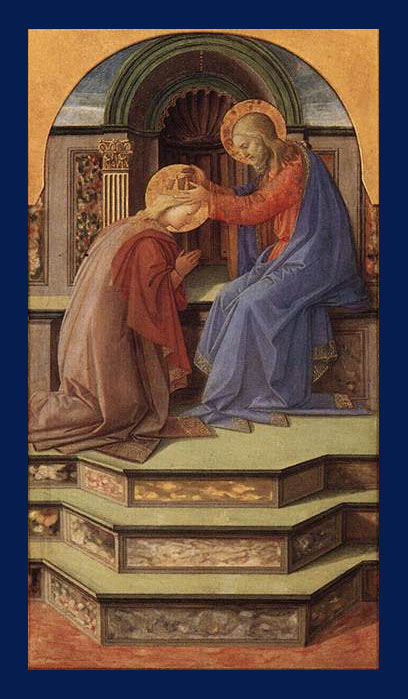
Assumption and Coronation of Mary

  • Thread starter Thread starter aball1035
  • Start date Start date
Status
Not open for further replies.
Oh, ok. I’m not familiar with the book of Revelations. All I know is End of the World 🤷
 
I see no reason why Our Blessed Mom would not have the same kind of birth pains as Eve was designed to have before the Fall.

Gen. 3 (Duay Reims)
16
To the woman also he said: I will multiply thy sorrows, and thy conceptions: in sorrow shalt thou bring forth children, and thou shalt be under thy husband’s power, and he shall have dominion over thee.

Gen. 3 (RSV)
16 To the woman he said: “I will greatly multipy your pain in childbearing; in pain you shall bring forth children, yet your dessire shall be for your husband, and he shall rule over you.”

Eve must have been designed to have some level of birth pain before the Fall, because it is impossible to “greatly multiply” something unless it first exists. Mary is the New Eve. She shares the same sinlessness as the pre-fallen Eve. To what degree the childbearing pain would be (for pre-Fallen Eve of for the New Eve) is anybody’s guess, but I am certain it would be of “greatly reduced” significance.

Therefore it is my personal opinion that Our Blessed Mom had birth pains. They were what God intended for Eve and her offspring before the Fall. So the real question is if there would be even a little pain in Paradise.

If my personal opinion is contrary to the Magisterium,
shoot me. :cool:

 
So…I’m confused here, if someone wants to help me out. If Mary had no labor pains, yet the woman of Revelations did, how are they the same? 😊
The woman of Revelation may be interpreted to refer to Mary or not. The Catholic Church does not teach they are the same, simply.
 
The woman of Revelation may be interpreted to refer to Mary or not. The Catholic Church does not teach they are the same, simply.
The woman is the Church, the woman is Mary, the woman can be Israel… In the bible one passage can be validly and correctly interpreted many ways, fulfilled in many ways…

The birth pains were not literal, no one ever interpreted these pains as being literal birth pains, especially since the Greek does not suggest they are.
 
Douay-Rheims Bible
And the temple of God was opened in heaven: and the ark of his testament was seen in his temple, and there were lightnings, and voices, and an earthquake, and great hail And a great sign appeared in heaven: A woman clothed with the sun, and the moon under her feet, and on her head a crown of twelve stars:

κὶ ἠνοίαγη ὁ ναὸς τοῦ θεοῦ ὁ ἐν τῷ οὐρανῷ, καὶ ὤφθη ἡ κιβωτὸς τῆς διαθήκης αὐτοῦ ἐν τῷ ναῷ αὐτοῦ: καὶ ἐγένοντο ἀστραπαὶ καὶ φωναὶ καὶ βρονταὶ καὶ σεισμὸς καὶ χάλαζα μεγάλη Καὶ σημεῖον μέγα ὤφθη ἐν τῷ οὐρανῷ, γυνὴ περιβεβλημένη τὸν ἥλιον, καὶ ἡ σελήνη ὑποκάτω τῶν ποδῶν αὐτῆς, καὶ ἐπὶ τῆς κεφαλῆς αὐτῆς στέφανος ἀστέρων δώδεκα,

I think it is important to keep Rev. 12:1 connected to the previous verse. Remember there were no chapter and verse numbers before the 13th century. I left them out on purpose. If I am not mistaken commas were added later. Capital letters were introduced in the uncial alphabet in the 9th century.

I think the “woman” is a personification of the “ark of his testament”. The seeing of the ark, and the appearance of the great sign describing the woman are one and the same action. We know that the ark of the Old Covenant (Exodus 25:11-21, 2 Sam. 6:7, 1 Chron. 13:9-10, 1 Chron.15 and 16.), foreshadows the Ark of the New Covenant: “Mary”:
Luke 1:39 / 2 Sam. 6:2
Luke 1:41 / 2 Sam. 6:16
Luke 1:43 / 2 Sam. 6:9
Luke 1:56 / 2 Sam. 6:11 and 1 Chron. 13:14

Any thoughts?
 
Are these in the Bible? If they aren’t Biblical, then are they from sacred tradition?
The Assumption is a forerunner of what will happen to each one of us on the Last Day.

Gen. 5:24, Heb. 11:5 - Enoch was bodily assumed into heaven without dying. Would God do any less for Mary the Ark of the New Covenant?

2 Kings 2:11-12; 1 Mac 2:58 - Elijah was assumed into heaven in fiery chariot. Jesus would not do any less for His Blessed Mother.

Psalm 132:8 - Arise, O Lord, and go to thy resting place, thou and the Ark (Mary) of thy might. Both Jesus and Mary were taken up to their eternal resting place in heaven.

2 Cor. 12:2 - Paul speaks of a man in Christ who was caught up to the third heaven. Mary was also brought up into heaven by God.

Matt. 27:52-53 - when Jesus died and rose, the bodies of the saints were raised. Nothing in Scripture precludes Mary’s assumption into heaven.

1 Thess. 4:17 - we shall be caught up in the clouds to meet the Lord in the air and so we shall always be with the Lord.

Rev. 12:1 - we see Mary, the “woman,” clothed with the sun. While in Rev. 6:9 we only see the souls of the martyrs in heaven, in Rev. 12:1 we see Mary, both body and soul.

2 Thess. 2:15 - Paul instructs us to hold fast to oral (not just written) tradition. Apostolic tradition says Mary was assumed into heaven. While claiming the bones of the saints was a common practice during these times (and would have been especially important to obtain Mary’s bones as she was the Mother of God), Mary’s bones were never claimed. This is because they were not available. Mary was taken up body and soul into heaven.

As for the coronation, Mary is the Queen because Jesus is the King of the Davidic Kingdom. The Church is structured on the Davidic Kingdom of the Old Testament.

2 Tim 4:8 - Paul says that there is laid up for him the crown of righteousness. The saints are crowned in heaven, and Mary is the greatest saint of all.

James 1:12 - those who endure will receive the crown of life which God has promised. Mary has received the crown of life by bringing eternal life to the world.

1 Peter 5:4 - when the chief Shepherd is manifested we will receive the unfading crown of glory.

Rev. 2:10 - Jesus will give the faithful unto death the crown of life. Jesus gave Mary His Mother the crown of life.

Rev. 12:1 - Mary, the “woman,” is crowned with twelve stars. She is Queen of heaven and earth and the Mother of the Church.

Wis. 5:16 - we will receive a glorious crown and a beautiful diadem from the hand of the Lord. Mary is with Jesus forever crowned in His glory.
 
A miraculous child-birth would not necessarily preclude the pangs of childbirth, and nowhere in Scripture or in Sacred Tradition (to my knowledge) is there a consistent belief that the Virgin Mary did not suffer the pangs of childbirth.

[BIBLEDRB]Rev 12:1-6[/BIBLEDRB]

Verse 5 is certainly referring to the Glorious Virgin Mary. And as I stated before, the Catholic Church in her Liturgy always reads Rev. 12 on all of the Marian feasts and High Holy Days. We have many statues and images of the Blessed Virgin Mary shown with a crown of 12 stars with the moon under her feet (as in the miraculous image of Our Lady of Guadalupe.) So it would not be Catholic to say that the Theotokos is not the woman of Rev. 12, on some level. But it has ever been Catholic belief that the Virgin Mary is being referred to in Rev. 12. (notice I use Catholic with a capital C) 😉
It would seem, at least in my own reflection that since Christ was like us in all things except sin, that the deliverance from Mary in birth would have been subjected to any other child birth, i.e. pangs of birth.
 
So…I’m confused here, if someone wants to help me out. If Mary had no labor pains, yet the woman of Revelations did, how are they the same? 😊
Revelation 12:13 -17
“And when the dragon saw that he had been thrown down to the earth, he pursued the woman who had borne the male child. … . 17 Then the dragon was angry with the woman, and went off to make war on the rest of her offspring, on those who keep the commandments of God and bear testimony to Jesus.”

Since Mary had no original sin, its curse did not apply to her.
The pain at birth could be a reference to the pain she bore through the adoption of us sinners as her spiritual children.

It is not good to grieve your mother. But, Unfortunately, sometimes we do.


.
 
Since the Theotokos did NOT suffer pangs of childbirth, the woman of Rev. 12 is not her.

However, the Assumption of the Thetokos is a tradition shared by all the pre-reformation Apostolic Churches, including those of the East, even non-Chalcedonian and Assyrian.
Haydock Commentary, Revelations 12:2
2 And being with child, she cried travailing in birth, and was in pain to be delivered.

Ver. 2. With child, &c., to signify that the Church, even in the time of persecutions, brought forth children to Christ. (Witham) — It likewise signifies the difficulties which obstructed the first propagation of Christianity. (Pastorini)
 
Biblical theology asserts for us the possibilities to mend our future.
 
Since the Theotokos did NOT suffer pangs of childbirth, the woman of Rev. 12 is not her.
I agree that the Blessed Virgin Mary did not suffer birth pangs giving birth to Jesus, but she suffered at the cross helping to give birth to the Church. I think Rev 12 alludes to both events.
Grace and Peace,
Bruce
 
I agree that the Blessed Virgin Mary did not suffer birth pangs giving birth to Jesus, but she suffered at the cross helping to give birth to the Church. I think Rev 12 alludes to both events.
Grace and Peace,
Bruce
Indeed. In the chaplet of Seven Sorrows, the meditations are:

The First Sorrow – The Prophecy of Simeon
Reading: Luke 2:25-35.
When Mary and Joseph present the infant Jesus in the temple, Simeon predicts that a “sword” (of sorrow) will pierce Mary’s soul.
The Second Sorrow – The flight into Egypt
Reading: Matthew 2:13-15.
When King Herod orders the death of all male children age two or younger, Mary and Joseph flee to Egypt with the infant Jesus.
The Third Sorrow – The Child Jesus Lost in the Temple
Reading: Luke 2: 41-50.
Mary and Joseph search for the child Jesus for three days, finding Him at last — after agonizing sorrow — in the temple.
The Fourth Sorrow – Mary meets Jesus carrying the cross
Reading: Luke 23: 27-29.
As Jesus makes His way to Calvary, condemned to crucifixion, He meets His mother, Mary. He is bruised, derided, cursed and defiled and her sorrow is absolute as Jesus drags His own cross up the hill of His crucifixion.
The Fifth Sorrow – Mary at the foot of the cross
Reading: John 19: 25-30.
Mary stands near her dying Son unable to minister to him as He cries “I thirst.” She hears Him promise heaven to a thief and forgive His enemies. His last words, “Behold your mother,” charge us to look on Mary as our mother.
The Sixth Sorrow – Mary receives the body of Jesus
Reading: Psalm 130.
Jesus is taken down from the cross and His body is placed in Mary’s arms. The passion and death are over, but for His mother, grief continues. She holds His body in her arms.
The Seventh Sorrow – Mary witnesses the burial of Jesus
Reading: Luke 23: 50-56.
The body of Jesus is laid in the tomb. The most tragic day in history ends, Mary alone in sorrow, awaiting the Resurrection.​
 
If Mary did not have labour pains, does that mean a newly baptised woman won’t have labour pains as well, since she won’t have original sin anymore? It’s incredibly weird to think that she wasn’t in pain while giving birth. A baby coming out of her…ouch. :eek:
 
A woman of course will feel the birth pains, the temporal punishment/effects of original sin still remain, for instance, despite original sin being the source of physical death, humans will still undergo it. The Virgin, on the other hand, this was never an issue since she was not conceived with it. From what I understand, she died because of her desire to die, since her Son also died, not as a result of Adam where men will die naturally of old age, sickness etc. but by being executed, and even then only because He allowed them to execute Him and because He made it so His body could die by execution.
 
Are these in the Bible? If they aren’t Biblical, then are they from sacred tradition?
First, the Assumption

Is there a way to prove the Assumption of Mary other than saying “the Church says so” to a Protestant?

I think so, keeping in mind that, “For some, no proof is necessary. For others, no proof is ever enough.”

So, remember that 99% of the time, your explanation will seem to fall upon deaf ears. But, we only plant seeds. God makes the growth. Therefore, always be prepared to give a reason for your faith. But don’t fall into the trap of thinking that you need to convince anyone right then and there. That will happen in God’s time.

So, having said that, lets try this:
  1. We know that people can be translated into heaven, (i.e. assumed) because Enoch, Elijah and Moses were assumed into heaven according to the Bible:
Genesis 5:24 And Enoch walked with God: and he was not; for God took him.

2 Kings 2:11 And it came to pass, as they still went on, and talked, that, behold, there appeared a chariot of fire, and horses of fire, and parted them both asunder; and Elijah went up by a whirlwind into heaven.

Jude 1:9 Yet Michael the archangel, when contending with the devil he disputed about the body of Moses, durst not bring against him a railing accusation, but said, The Lord rebuke thee.
  1. And we also know that assumption into heaven is possible because we are awaiting what Protestants call the Rapture.
1 Thessalonians 4:17 Then we which are alive and remain shall be caught up together with them in the clouds, to meet the Lord in the air: and so shall we ever be with the Lord.
  1. And we also know that assumption into heaven is possible because St. Paul went to heaven and came back again:
2 Corinthians 12:2I knew a man in Christ above fourteen years ago, (whether in the body, I cannot tell; or whether out of the body, I cannot tell: God knoweth such an one caught up to the third heaven.
  1. And presumably, the dead who rose when Jesus died on the Cross were also caught into heaven since there is no record they were returned to their graves:
Matthew 27:52And the graves were opened; and many bodies of the saints which slept arose,
  1. And Jesus said that some would not taste death:
Matthew 16:28Verily I say unto you, There be some standing here, which shall not taste of death, till they see the Son of man coming in his kingdom.
  1. The Bible does not say that Mary was not assumed into heaven.
  2. But the Bible does say that the mother of Jesus Christ, is in Heaven, bodily:
Revelation 12:1And there appeared a great wonder in heaven; a woman clothed with the sun, and the moon under her feet, and upon her head a crown of twelve stars:

We know this woman is the mother of Jesus Christ because her Son is caught up to the Throne of God. And we also know that the mother of Jesus Christ, is Mary. Therefore, this woman is Mary.

So, our belief squares with Scripture perfectly. We have plenty of Biblical reasons to believe that the Mother of Jesus Christ, the Son of God, was assumed into heaven:

CCC #966 “Finally the Immaculate Virgin, preserved free from all stain of original sin, when the course of her earthly life was finished, was taken up body and soul into heavenly glory, and exalted by the Lord as Queen over all things, so that she might be the more fully conformed to her Son, the Lord of lords and conqueror of sin and death.” The Assumption of the Blessed Virgin is a singular participation in her Son’s Resurrection and an anticipation of the resurrection of other Christians: In giving birth you kept your virginity; in your Dormition you did not leave the world, O Mother of God, but were joined to the source of Life. You conceived the living God and, by your prayers, will deliver our souls from death.

What do you think?

Cont’d
 
2. The Coronation

That sounds blasphemous to our Protestant brethren. They look at Scripture and see this verse:

Jeremiah 7:18
The children gather wood, and the fathers kindle the fire, and the women knead their dough, to make cakes to the queen of heaven, and to pour out drink offerings unto other gods, that they may provoke me to anger.

So, they become indignant when we call the Virgin Mary, the Queen of Heaven.

So, then, why do we call the Virgin Mary the Queen of Heaven, if God, according to Scripture, is angered by that title?

Because, its not that God is angered by the title. Its that God is angered by men usurping His right to assign who sits at His right or at His left. Remember what Jesus said to the Apostles?

Mark 10:39 And they said unto him, We can. And Jesus said unto them, Ye shall indeed drink of the cup that I drink of; and with the baptism that I am baptized withal shall ye be baptized: 40 But to sit on my right hand and on my left hand is not mine to give; but it shall be given to them for whom it is prepared.

God had already reserved the title, Queen of Heaven, for the Virgin Mary from the beginning of time.

So, then, why do we call the Virgin Mary the Queen of Heaven?

Because it is God’s will as revealed in the Sacred Scriptures.

Revelation 12:1 And there appeared a great wonder in heaven; a woman clothed with the sun, and the moon under her feet, and upon her head a crown of twelve stars:
That Woman is obviously, the Virgin Mary. If we go through the entire chapter, it is clear that the Woman is the Mother of the Messiah. The Messiah is Jesus Christ and His Mother is Mary. This is absolutely clear. But, Protestants will deny it. They claim it can only be a reference to Israel?

Israel is our Patriarch, not our Matriarch. Israel is a man.

John doesn’t say that he saw a man, crowned with twelve stars. So, at best, this can only be a very indirect reference to the fact that Jesus Christ is a very distant relative of the man, Israel. Because men do not get pregnant and have children. And that is how the Woman of Rev 12 is described:

Rev 12:2 And she being with child cried, travailing in birth, and pained to be delivered.

What about the dream?

What dream? Joseph’s? Notice that it is a dream of a man, Joseph, not Israel, not crowned with twelve stars but with 13 heavenly bodies bowing to him. 11 of those were stars, one was the sun and one was the moon.

Genesis 37:9 And he dreamed yet another dream, and told it his brethren, and said, Behold, I have dreamed a dream more; and, behold, the sun and the moon and the eleven stars made obeisance to me.

So, if this is a reference to Joseph’s dream, it is very indirect and barely fits without a great deal of stretching.

Israel is a nation

This has some merit. But only secondarily, because, again, St. John described a woman, not a nation. Although, Israel is frequently described as a woman, in the OT. Still the vision fits Mary, the Woman, the Mother of Jesus Christ, perfectly.

The Woman is Mary?
  1. The Woman of Rev 12 gave birth to the Messiah. Who can deny that?
Revelation 12
1 And there appeared a great wonder in heaven; a woman clothed with the sun, and the moon under her feet, and upon her head a crown of twelve stars:…5 And she brought forth a man child, who was to rule all nations with a rod of iron: and her child was caught up unto God, and to his throne.
  1. This man child is the Messiah. Jesus Christ is the Messiah. Who can deny that?
  2. Mary is the mother of Christ. Who can deny that?
Therefore, the Woman of Rev 12 is Mary the mother of Christ.

It seems really simple, don’t you agree?

Therefore, it is God who has revealed, in Scripture, that Mary is the Queen of Heaven.

Does that help?
 
There are two theological arguments that show us the Assumption is at least implicitly contained in the Bible. I’m just going to give you the basics of those two theological arguments, because there are theologians who could explain them much better, like Garrigou-Lagrange (cf. The Mother of the Saviour and Our Interior Life).

First argument.

1 - Mary received fulness of grace (Luke 1,28) and was exceptionally blessed by God (Luke 1,42) ----> revealed truth.

2 - This exceptional blessing negatives the divine curse to bring forth children in pain and to return to dust (Genesis 3,16-19) ----> revealed truth.

3 - Therefore, Mary was preserved from corruption in her body. It wouldn’t return to dust, but rather be resuscitated in an anticipated resurrection and assumed into heaven ----> conclusion capable of being defined.

Second argument.

1 - Jesus Christ’s complete victory over satan included victory over sin (Hebrews 9,26) and death (1Corinthians 15,54-57) ----> revealed truth.

2 - Mary was voluntarily (Luke 1,38) and most intimately associated with Jesus Christ on Calvary (John 19,25) in His complete victory over satan (Genesis 3,15). She participated in His sufferings as Simeon predicted (Luke 2,35).

3 - Therefore, Mary was associated with Him in His victory over death by her anticipated resurrection and her Assumption into heaven ----> conclusion capable of being defined.
 
There are two theological arguments that show us the Assumption is at least implicitly contained in the Bible. I’m just going to give you the basics of those two theological arguments, because there are theologians who could explain them much better, like Garrigou-Lagrange (cf. The Mother of the Saviour and Our Interior Life).

First argument.

1 - Mary received fulness of grace (Luke 1,28) and was exceptionally blessed by God (Luke 1,42) ----> revealed truth.

2 - This exceptional blessing negatives the divine curse to bring forth children in pain and to return to dust (Genesis 3,16-19) ----> revealed truth.

3 - Therefore, Mary was preserved from corruption in her body. It wouldn’t return to dust, but rather be resuscitated in an anticipated resurrection and assumed into heaven ----> conclusion capable of being defined.

Second argument.

1 - Jesus Christ’s complete victory over satan included victory over sin (Hebrews 9,26) and death (1Corinthians 15,54-57) ----> revealed truth.

2 - Mary was voluntarily (Luke 1,38) and most intimately associated with Jesus Christ on Calvary (John 19,25) in His complete victory over satan (Genesis 3,15). She participated in His sufferings as Simeon predicted (Luke 2,35).

3 - Therefore, Mary was associated with Him in His victory over death by her anticipated resurrection and her Assumption into heaven ----> conclusion capable of being defined.
Very nice, well documented and succinct.
 
Status
Not open for further replies.
Back
Top
