Baptism... And the True Church

  • Thread starter Thread starter bibleapologist
  • Start date Start date
Status
Not open for further replies.
By the way, where does it say that Baptism should only be by full immersion?

And if it’s only a symbol of our “Baptism of Faith”, then why is immersion so important?
 
Where in that verse does it say “baptize infants”…
“Suffer the little children to come unto me” sounds pretty clear.
Because nowhere does the bible explicitly state that we are to baptize our children before they are sophisticated enough to be taught to obey all thing whatsoever Christ has commanded them.
Nowhere does the Bible explicitly state that we are not to baptize our children before they are sophisticated enough to be taught to obey all things whatsoever Christ has commanded them.
Many early "anabaptist’ sects referred to Infant Baptism as “the badge of the Antichrist”… and I concur. That is a chance I am willing to take.
The sixteenth century is early? Since when?
The ark, and deliverance by it, as it was a type of Christ,
Adam was a type of Christ. 1 Peter 3 says that the ark was a type of baptism.
When Noah and his family were shut up in it by God, it represented a burial, and they seemed as it were to be buried in it, it was an emblem of baptism, which is expressed by a burial and resurrection.
You’ve at least got that right.
Verse 21 states that like that same figure of baptism (Noah’s baptism,
Noah wasn’t baptized. Noah was in an ark. You’re misusing the term “baptism” here.
which illustrated the resurrection), baptism doth also now save us…
Let’s repeat that for good measure. Baptism doth also now save us.
Not that water baptism is the act that brings about salvation,
That’s exactly what that passage says, and it’s exactly what that passage has always been interpreted as saying.
but Peter was still using that water baptism illustratively.
Peter used Noah’s ark illustratively, to illustrate the fact that Baptism doth also now save us.
Hence Peter’s clarification…
Peter’s clarification was of how baptism saves. It saves, not as a cleansing of the flesh, but as an appeal for a good conscience before God.
not that it was like the Baptism that John the Baptist administered,
Who said anything about John’s baptism here?
but that it was an answer of a good conscience toward God
I’ve already shown you that this is a mistranslation, and you’ve provided no evidence whatsoever to counter this claim.
(a spiritual baptism).
Peter uses Noah’s ark as a type of baptism precisely because he wanted to emphasize that water baptism now saves us. He clarifies that baptism doesn’t save us by cleansing away filth from the flesh becuase he’s talking about water baptism, and people might be prone to misunderstand why water baptism saves us. This is the way the passage has always been interpreted.
The statement made by Peter “the answer of a good conscience toward God”
Peter didn’t say that. Your KJV says that. Peter said, “the appeal to God for a good conscience.”
was still intended as referencing the illustrative act of water baptism…
The illustrative act was Noah’s ark. The illustrated act was baptism.
as I stated earlier by the “inquiry”.
An entirely unsubstantiated claim, as most or all of yours seem to be.
That whole clarification in verse 21 was intended as a clarification and should not be taken as to qualify the opening statement… “baptism doth also now save us”.
The grammar very clearly indicates that it does modify “Baptism doth also now save us.” You don’t have another option provided by the Greek grammar.
The final statement of that sentence explains how baptism saves us…
You don’t believe that baptism saves us, remember?
“by the resurrection of Jesus Christ”.
All of our grace is received through the resurrection of Jesus Christ, so this makes sense.
Everything in parenthasis in verse 21 is speaking directly of water baptism… what is not in the parenthasis is speaking directly of spiritual baptism in Christ.
So now even the parentheses of the KJV are inspired?
The clarifications in parenthasis were meant to distinguish the illustration from the literal.
The clarification in parentheses clarifies the manner by which baptism saves us.

Jeremy
 
My answer to that, is that they would find a way.
And we’re back to the conspiracy theories. “I have no idea how they would do this, but they would find a way.”
Your argument that they didn’t have baths doesn’t negate how a true baptism should be administered.
His argument that they didn’t have baths is strong evidence that they didn’t always do baptism by immersion. In conjunction with the fact that baptism by immersion is never commanded in the Bible, it’s a pretty darn strong indication that baptism by immersion is not the only biblical method of water baptism.

What do you care anyway? You think water baptism is just a symbol, and yet you seem to think that this symbol, this mere “public proclamation” of our faith in Christ must be performed a certain way?
Why would they have baptized the prison guard in Acts 16 outside, then after the baptism come inside…
The Greek doesn’t say that. Heck, your KJV doesn’t even say that.
wouldn’t it had been safer to stay out of sight and be baptized indoors?
Nice try, but you have no proof the baptism was outside.

I may as well note here why it’s so frustrating arguing with you, John. I’ll make a list:
  1. You don’t answer all the points made by your opponents. You answer points selectively, presenting the appearance that you’re engaged in fruitful debate, but lacking the substance necessary to qualify as such.
  2. You don’t offer any substantiation for claims you make. When you offer an interpretation of the Bible, you offer it only as your own teaching, with accompanying historical support to show that your belief is what was really taught by the Apostles.
  3. You continue to make the same, tired arguments repeatedly, without ever providing new support for your theses.
  4. You eagerly believe in what I like to call “conspiracy theories”: theological innovations that you can’t support with Scripture or history, but that you hold to simply because you must in order to prop up your un-biblical and un-historical theology.
  5. You always fail to answer the most direct and applicable questions of your opponents.
  6. You set up strawmen and argue against them, rather than interacting with the actual arguments your opponent presents you.
  7. You ignore the plain meaning of Scripture and the historical interpretation of the same in support of a theology you received from men who were not Apostles nor the valid recipients of authority thereof.
I could go on and on, but I doubt you’ll rectify any of these complaints, so there’s not much point.

Jeremy
 
BA

Are you telling us that God cant bestow his grace on someone who dosnt have faith? Catholic believe that grace is given to the baby threw baptism. What are yoiur coments on this?

If ive missed a post on this politly show me. Otherwise im interested in what you have to say.
 
I Googled “badge of the Anti-Christ” and the only result I got was one Baptist website.

The Ten Affirmations Concerning our Baptist Heritage

By James Beller

1. Baptists are Ancient, and our Ancestry can be traced through the vital principles established and set forth by our Lord Jesus Christ and His disciples in the New Testament Churches

2. Baptists are not “Protestants,” as our testimony extends much further in History than that of Martin Luther or John Calvin.

3. Baptists are not “Reformed” in Theology or practice, for our view of the church could never allow the marriage of church and state.

4. Baptists are not “Calvinists,” for the doctrines of grace were believed and preached long before John Calvin Preached in Geneva. Calvinism

5. Baptists are not “Arminian” in theology, for our forefathers preached the Gospel with fervor long before the time of Jacob Arminius, and believed they were enabled by God to Persevere.

6. Immersion was in common use among Baptists before 1641. We reject the 1641 theory of William Whitsitt and oppose the Conclusion of Henry Veddar About Baptism. We View as Suspect the modern histories of Robert Baker, Leon McBeth, Walter Shurden, Robert G. Torbet, and James Edward McGoldrick as they submit to the thoroughly disproved theory of William Whitsitt.

7. Baptists heritage is far older than “Fundamentalism,” or the era of the city-wide revival campaigns, or the time of the old Evangelical Alliance.

8. Because Baptists have suffered at the hands of Papists and Pedobaptistic Protestants alike, we ought to venerate and remember our historic testimony far above the testimony of our persecuting enemies. That is, we ought to revere the testimony of the Paulicians, Peter de Bruys, Henry of Clugny, Balthasar Hubmaier, Henry D’anvers, John Clarke, Obadiah Holmes, Valentine Wightman, Isaac Backus, Shubal Stearns, Samuel Harris, John Leland, John Taylor, Isaac McCoy, et. al. These names should be more commonly known among Baptists than those of D. L. Moody, Ira Sankey, R. A. Torrey, Sam Jones, Gipsy Smith, John Wilbur Chapman or Billy Sunday.

**9. Infant Baptism is the badge of the antichrist, and flirtation with that badge is akin to treason against God’s word. **

10. Ignorance of Baptist heritage, which is so infectious in our pulpits and pews today, is dangerous and must be overcome with a renewed teaching of our Baptist heritage and heroes of past generations.

baptistbanner.net/baptist_history/baptist_history.htm

Since I can’t find it, can we get a list of the “early anabaptists” who said infant baptism is “the badge of the Anti-Christ”?

 
  1. Immersion was in common use among Baptists before 1641. We reject the 1641 theory of William Whitsitt and oppose the Conclusion of Henry Veddar About Baptism. We View as Suspect the modern histories of Robert Baker, Leon McBeth, Walter Shurden, Robert G. Torbet, and James Edward McGoldrick as they submit to the thoroughly disproved theory of William Whitsitt.
Bibleapologist,

What evidence is there that this “theory” that baptism was by immersion only began in 1641 is wrong? If it didn’t begin in 1641 (or 1644), when did it begin?

According to the Handbook of Christian Denominations (1995), the Immersion Baptists split from the General Baptists (born 1609) and the Particular Baptists (born 1638) in 1644 and “wrote a confession that established these people popularly for the first time as Baptists.”

Please provide the evidence that early Christians practiced baptism by immersion only.

The Baptist practice of rebaptizing “backsliders” who “rededicate” their lives to Christ is not biblical either. I was dunked twice. I have friends who went under the waters three times. Babtists tell me there is no limit to the number of times one may be baptized. “One faith, one baptism” ???

I find it astounding that Baptists argue ad infinitum over HOW to baptize, when they don’t believe it’s necessary at all or that it accomplishes anything. But immersion, they say, is the only way to do it, even though it is merely symbolic. Say what?

Peace be with you, Katholikos
A thoroughly baptized ex-Southern Baptist
 
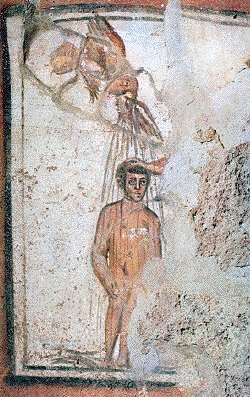
The following caption illustrates a photo on page 339 of Understanding the New Testament by Howard Clark Kee, a Methodist biblical scholar. The book was used in my NT history class at Arizona State University.

QUOTE: The oldest baptistry ever found was in a tiny chapel in Dura Europos on the Euphrates River in northeastern Syria. The walls of the chapel, which was destroyed in A.D. 258, were covered with paintings of biblical scenes, traces of which are still visible. The person to be baptized stood in the shallow pool and had water poured over his head (Yale University Art Gallery, Duro Europos collection). END QUOTE

Baptist claims that immersion is the only way to validly baptize are unfounded. The evidence is overwhelming that it was NOT the method commonly used until the 17th century, when it began with the Immersion Baptists. The practice of immersion only is not supported by any artistic, archaelogical, literary, biblical, or historical evidence. Many mainline Protestant churches sprinkle or infuse (pour). Even the first Baptists followed the Mennonites (from whence they sprang) in the practice of infusion.

Peace to all, Katholikos
 
After reading that the same Baptists who view infant baptism as a badge of the Anti-Christ, reject the “theory” of the Baptist William Whitsitt, I decided to find some of his writings.

The Baptist William Whitsitt wrote “Did They Dip?” in 1880. Here are some excerpts:

As we understand it, Roger Williams never was a Baptist in the modern sense—that is, never was immersed, and the ceremony referred to was anabaptism, rebaptism by sprinkling, and not “catabaptism,” or baptism by immersion. The baptism of Roger Williams is affirmed by Governor Winthrop to have taken place in March, 1639. This, however, was at least two years prior to the introduction of the practice of immersion among the Baptists. Up to the year 1641 all Baptists employed sprinkling and pouring as the mode of baptism

We admit that there are no positive historical statements as yet discovered concerning the mode of Mr. Williams’ baptism; but as it took place in the year 1639, we assume, as a matter of course, that sprinkling or pouring was the method, since no other was at that time in use among the Baptists. The burden of proof rests entirely upon those who assert that Williams was immersed… Has *The Congregationalist *any positive testimony to that effect ? If so, we shall be glad to receive it. We are inclined to believe that no case of immersion took place among the American Baptists before the year 1644

The proofs which are demanded by Zion’s Advocate of our recent assertion that** immersion was not practiced in England before a period as late as 1641** are so abundant that one is embarrassed to know where to begin. We shall mention, in the first instance, the silence of history. This is absolute and unbroken. Tho’ a number of works were written by Smyth, Helwys, Merton and other Baptists prior to 1641, and tho’ these were replied to by opponents such as Clifton, Robinson, Ainsworth and Johnson, it is nowhere intimated that the Baptists were then in the practice of immersion. Nay, more, the earliest Baptist Confessions of Faith all contemplate sprinkling or pouring as the act of baptism. We, refer, in proof of this, to the Confession of Faith, in twenty articles, which is subscribed by John Smyth, and may be found in the Appendix to Volume I of Evan’s “Early English Baptists.” We refer also to the Helwys Confession, entitled “A Declaration of Faith of English People Remaining at Amsterdam Holland,” printed 1611. We also refer to the “Propositions and Conclusions Concerning the Christian Religion,” which were published after his death, by “the remainders of Mr. Smyth’s company.” It was not until the year 1644, three years after the invention of immersion that any Baptist confession prescribes “dipping or plunging the body in water as the way and manner of dispensing this ordinance” (“London Confession of 1644,” Article 40).

More here:

reformedreader.org/history/christian/chapter01.htm
 
The Garg,

I am not making the subject complicated, I am reasoning with you by rightly dividing the scripture.

The confusion comes by your fidiestic approach to Catholic Doctrine… “I believe it, therefore it is true”. Your approach to the subject matter is self-defeating because it eliminates God as the originator of truth, and gives yourself the status of infallibility.

You are ignoring my reason, and dismissing it as irrelevent because it doesn’t fit with your preconceived ideas… that is Neo-Platonism, and Neo-platonism has no place in theology. Neo-platonism dismisses truth as it proceeds from God, and embraces a notion of existential truth.

If you wish to continue the debate, and reason through the scripture, I am more than willing to engage in discussion on Covenant theology and how it relates to baptism. But the discussion will be fruitless unless you admit you are not God, and therefore not the originator of truth.

John
www.gideonsword.net
:rolleyes: ahem, ahem; :cool: cough, cough…]
Might I (respectfully as all 😉 heck, I assure you) suggest that, before asking this of others, that you consent to take the same advice?
It just seems to me, you see, that it is a :whistle: little unfair when, in open debate, the Baptist side demands of the Catholic side adherence to a rule that said Baptist is seemingly:tsktsk: unwilling and/or unable to apply to himself…
OK??
 
Odell,

My answer to that, is that they would find a way. Your argument that they didn’t have baths doesn’t negate how a true baptism should be administered.

John
www.gideonsword.net
Might we hear a :hmmm:speculation, please, as to what that way might be:confused: ???
(I am ;)assuming that, being ;)Baptists, that a raindance was :rolleyes: right out…).
 
40.png
BIBLEAPOLOGIST:
If you wish to continue the debate, and reason through the scripture…
Does that include All Scripture - does it include the stuff the Apostle said he could not write down because there was too much of it - …the stuff the Apostle must have taught the Churches Personally By spoken word - because there was No written new testament Scriptures. I can see the Apostle teaching Everything to the Church that Christ had taught him - as Christ had commanded him to obey Eveything He taught the Apostle. I can also see some Apostles writing letters to the Church encouraging them to continue to hold fast to the Doctrines the Apostles had taught them. And I see someone sending a request to an Apostle for more information on the Story of Christ. And I see an Apostle responding with the written Gospel account telling him that its contents were for Those Who Wished To Learn More. The Written Gospel Scripture being a step by step account of Christs life which would enhance All the Doctrines and teachings the Apostles had already handed on to the Church from Christ - the same which the Church has always perserved and taught.
It seems that Church History is important.
 
Notworthy,
But the problem is the quote specifically says, "eight in all, were saved through water. This prefigured baptism, which saves you now.
  • How were they saved? Through water.
  • What is the “this” that prefigured Baptism? This has to point to the previous clause, or else it would have to specify an earlier relationship to “this”. Since it doesn’t, “This” is the saving through water.
  • What saves you now? Baptism.
  • Which Baptism? The Baptism that Jesus describes to Nicodemus. Being born of Water and Spirit, the same Baptism that Peter describes in Acts, chapter 2. “Repent and be baptized… and receive the Holy Spirit” (be born of water and Spirit).
Why do you have to go through such literary gymnastics when Peter states his case quite plainly?
You’re exactly right… Baptism does save us, just not water baptism. Like I said earlier in this thread, there is more than just one baptism mentioned in the New Testament, I have shown that.

You said it right… the baptism that Jesus described to Nicodemus was the same baptism that Peter descibes in Acts 2… being born of Spirit. Where you are wrong, is that we are all already born of water… when our mother’s gave birth to us. That is why Jesus corrected Nicodemus when he asked “can a man enter again into his mother’s womb?”.

John
www.gideonsword.net
 
Notworthy,
By the way, where does it say that Baptism should only be by full immersion?
And if it’s only a symbol of our “Baptism of Faith”, then why is immersion so important?
It symbolizes the death, burial, and resurrection… and identifies ourselves with Christ and His death burial, and resurrection to the observers.

John
www.gideonsword.net
 
Jeremy,

First, you said…
Adam was a type of Christ. 1 Peter 3 says that the ark was a type of baptism.
So the ark was not a type of Christ… even though the eight were saved by water… Isn’t it Jesus that saves? Or is it a work that saves us? If it is a work, such as baptism, why would we need Jesus?

You then went on to say…
Noah wasn’t baptized. Noah was in an ark. You’re misusing the term “baptism” here.
If the ark was a type of baptism, how can you say that Noah wasn’t baptized? The truth is, my explanation still stands… Noah was baptized in a figurative sense, and he was saved from judgement through that baptism… which is the same way Peter uses the term baptism in verse 21 (figuratively)… a spiritual baptism.

Then you made correct observation which contradicted the previous statements…
Peter used Noah’s ark illustratively, to illustrate the fact that Baptism doth also now save us.
Exactly, and that is why in verse 21 Peter says: “The like figure whereunto baptism doth also now save us”. Peter was still using the term baptism in an illustrative sense to describe a spiritual event hence the opening statement “the like figure”.

I think you are starting to understand jemfinch.

John
www.gideonsword.net
 
jemfinch,
  1. You don’t answer all the points made by your opponents. You answer points selectively, presenting the appearance that you’re engaged in fruitful debate, but lacking the substance necessary to qualify as such.
  2. You don’t offer any substantiation for claims you make. When you offer an interpretation of the Bible, you offer it only as your own teaching, with accompanying historical support to show that your belief is what was really taught by the Apostles.
  3. You continue to make the same, tired arguments repeatedly, without ever providing new support for your theses.
  4. You eagerly believe in what I like to call “conspiracy theories”: theological innovations that you can’t support with Scripture or history, but that you hold to simply because you must in order to prop up your un-biblical and un-historical theology.
  5. You always fail to answer the most direct and applicable questions of your opponents.
  6. You set up strawmen and argue against them, rather than interacting with the actual arguments your opponent presents you.
  7. You ignore the plain meaning of Scripture and the historical interpretation of the same in support of a theology you received from men who were not Apostles nor the valid recipients of authority thereof.
I could go on and on, but I doubt you’ll rectify any of these complaints, so there’s not much point.
I’ll take that last statement as a challenge. 🙂
  1. That is an unfair accusation, since this is an unfair debate. There are many people here arguing against me… and many different points to argue. I have though answered every one of your posts, notworthy’s posts, and Odell’s one post (who is the one who this thread was started for).
  2. I have also offered reason, and comparitive scripure… again that is an unfair accusation. I am trying to be fair and argue the point on the foundation of God’s word which I was under the impression that Catholics understood as an authority (not the only authority). The bible is common ground, I haven’t posted links to baptist sermons… that is not common ground, and wouldn’t be fruitful, would it?
  3. I am making the same tired arguments because my arguments are misrepresented in the rebuttals.
  4. You are accusing me of fideism, and that is not at all what I proposing, my theological approach to these doctrines is viewed as fideism because you chose to ignore the substantiation that I have provided… you are assuming that you have won the argument before it is over.
  5. Since the volume of Catholic posts far outweigh my ability as a human to respond, that is another unfair accusation… I answer the most applicable arguments that my limited time will allow for the express purpose of avoiding an accusation like the one you made.
  6. Show me where I have done that. That is a lie.
  7. I don’t ignore the plain meaning of scripture… I offer an explanation based on a deeper study than anyone here is willing to accept, I don’t take “proof verses” out of text to prove my preconceived notions… that is a naive approach to biblical study, and it’s an irresponsible approach to theology.
Now that I have rectified these points, can we get on with the debate?

John
www.gideonsword.net
 
Notworthy,
You said it right… the baptism that Jesus described to Nicodemus was the same baptism that Peter descibes in Acts 2… being born of Spirit. Where you are wrong, is that we are all already born of water… when our mother’s gave birth to us. That is why Jesus corrected Nicodemus when he asked “can a man enter again into his mother’s womb?”.

John
www.gideonsword.net
What are you talking about we are already born of water? I came from my mothers womb not water. also please respond to my post 82
 
Odell,
Are you telling us that God cant bestow his grace on someone who dosnt have faith? Catholic believe that grace is given to the baby threw baptism. What are yoiur coments on this?
Of course not, but the scripture is clear that faith is required for justification…
Gal 2:16 Knowing that a man is not justified by the works of the law, but by the faith of Jesus Christ, even we have believed in Jesus Christ, that we might be justified by the faith of Christ, and not by the works of the law: for by the works of the law shall no flesh be justified.
John
www.gideonsword.net
 
Katholikos,
What evidence is there that this “theory” that baptism was by immersion only began in 1641 is wrong? If it didn’t begin in 1641 (or 1644), when did it begin?
What I am trying to prove, is that the early churches in the New Testament practices baptism by immersion, which that argument would supercede any historical reference I would give you concerning the anabaptists.

My arguments are that the early churches practices baptism by immersion, and the doctrine of baptism expained biblically only allows for immersion baptisms.
According to the Handbook of Christian Denominations (1995), the Immersion Baptists split from the General Baptists (born 1609) and the Particular Baptists (born 1638) in 1644 and “wrote a confession that established these people popularly for the first time as Baptists.”
Actually the General Baptists, and the Particular Baptists were identified at the same time. General meaning “general atonement”, and Particular meaning “particular atonement”, or only a few were chosen for atonement. As far as the split occuring in 1609, they were both immersion baptists… one was John Smythe, and the other was led by Thomas Hellewys. That split occured in Amsterdam.
The Baptist practice of rebaptizing “backsliders” who “rededicate” their lives to Christ is not biblical either. I was dunked twice. I have friends who went under the waters three times. Babtists tell me there is no limit to the number of times one may be baptized. “One faith, one baptism” ???
That is not a baptist practice. The illustrative work of baptism is the first act of obedience to Christ… most Baptists believe in eternal security so there is no need for a re-baptizing if that person was truly saved to begin with… there may be so-called baptists who believe you can lose your salvation, so you need to re-establish your baptism. The only problem with that is, we all sin every day, that would mean that we lose our salvation every day… and would therefore need to be baptized every day. That’s kind of silly.

John
www.gideonsword.net
 
Katholikos,
Baptist claims that immersion is the only way to validly baptize are unfounded. The evidence is overwhelming that it was NOT the method commonly used until the 17th century, when it began with the Immersion Baptists. The practice of immersion only is not supported by any artistic, archaelogical, literary, biblical, or historical evidence. Many mainline Protestant churches sprinkle or infuse (pour). Even the first Baptists followed the Mennonites (from whence they sprang) in the practice of infusion.
THIS STATMENT IS FOR EVERYONE TO READ

Rather than using historical claims such as the one quoted above, which can be easily invalidated by simply stating that it is possible they had misunderstood the correct mode of baptism… Let’s establish the biblical basis for baptism.

If we can establish the biblical basis for baptism, and the correct mode of it… we can then determine which sects and institutions have been in error since the 1st century.

To say that anyone throughout history practiced aspersion or effusion as opposed to immersion does not prove anything more than me saying that I practice immersion.

What needs to be established is the foundational truth behind baptism… and that being proven by an explication of scripture, and logical reasoning.

John
www.gideonsword.net
 
Status
Not open for further replies.
Back
Top