Black Jesus...?

  • Thread starter Thread starter Riseof_Rome
  • Start date Start date
Status
Not open for further replies.
R

Riseof_Rome

Guest
Many times I hear the Catholic Church called “racist” because Jesus is portrayed as white almost all the time, even though we don’t really have any physical evidence that he was.

It got me wondering though, does it matter? Would it make a difference if He was White, Black, Asian, German, etc? Even though it is most likely he was white based off of where Israel is, we still don’t know for certain. But would it really make a big difference if tomorrow we found out Jesus was definitely black? Would people have a different outlook on the Church? What are your thoughts?
 
If I recall correctly, the Jews were pretty selective about who became Jews. They were pretty intent on being a “pure” race; I am not sure what color their skin was. If we go by the Semites who are in the Middle East today, I think we can get a pretty accurate idea of what Christ looked like, which was neither Anglo-Caucasoid nor Afric-Negro.
 
Don’t forget people who blare out the word “racist” constantly at little or no provocation are usually racist themselves. If they weren’t they wouldn’t have racism constantly on their minds.

I was told because I didn’t vote for Obama for the sole reason of his abortion views, that I was a racist. I got so angry at the person but I didn’t show it at all. I just ignored the comment and stayed the course of my point.

But here is another point of view: perhaps they are annoyed with the fact many paintings have Jesus portrayed with golden hair and blue eyes. That is most likely not historically correct either. Maybe they see this as wrong too and wonder why he can’t be portrayed black? :confused:
 
The problem is that there are too many incorrect portrayals of Jesus with blonde hair and blue eyes. Jesus was a Jew and, technically, from the Middle East. However, it is natural that many Churches–especially those with European traces–portray Jesus with blonde hair, white skin, and blue eyes; white has always been the color of purity, so I suppose it’s more of an artistic symbol.

Christians from African or Mexican or other descent may get offend because he is not “racially correct”.

My personal take: (Granted that Jesus existed) I believe he was neither black nor white, but Jewish. :yup:

Ironically Yours, Blade and Blood
 
The only reason Jesus is popularly portrayed with white skin and blue eyes in the U.S. is because the Western Europeans are the ones who brought Christianity here.

Different cultures have always depicted God in their image, but I think the more physicially accurate depictions are from the early icons.

Here is the Hodegetria icon attributed to St. Luke:

http://www.monasterygreetings.com/productimages/item1664_virgin_icon.jpg

Our Lady of Częstochowa is a variation of the Hodegetria icon.

http://www.ilianrachov.com/ikons/im...tochova.privat collection.hamburg.germany.jpg

Jesus and Mary are clearly pictured with Middle Eastern features and olive skin.

Of course, in various Church-approved apparitions, Jesus and Mary have always appeared resembling the physicial features of the person they are appearing to, so any depiction of God in any race is accurate. Humans are only physicially different because of regional adaptations over time, so God is not bound to any race.
 
I saw that program and it turned me off. I don’t know why. I don’t like the way they portray anyone when they do reconstructions like that. None of them look quite real to me. Especially the ones they reproduce from skull remains. Perhaps they do resemble the original person, but they just dont look right in some way. Kind of like a wax figure that is very tastefully done but just doesn’t look quite right…
 
The only reason Jesus is popularly portrayed with white skin and blue eyes in the U.S. is because the Western Europeans are the ones who brought Christianity here.

Different cultures have always depicted God in their image, [snip]

Of course, in various Church-approved apparitions, Jesus and Mary have always appeared resembling the physicial features of the person they are appearing to, so any depiction of God in any race is accurate. Humans are only physicially different because of regional adaptations over time, so God is not bound to any race.
This was the point I was going to make - Jesus and Mary undoubtably looked “Jewish” - but Our Lady of Guadaloupe is clearly Azteca. The whole point of the Incarnation is that God became One of Us (John 1).

I do think it’s unfortunate that most of the common depictions of Jesus we see are very Northern-European looking, because they reinforce the least-realistic image! Although I must admit that Rembrandt’s painting of Mary Magdelene meeting Jesus after the Resurrection is one of my very favorite representations-
 
Here is the Hodegetria icon attributed to St. Luke:

http://www.monasterygreetings.com/productimages/item1664_virgin_icon.jpg

Our Lady of Częstochowa is a variation of the Hodegetria icon.

http://www.ilianrachov.com/ikons/im...tochova.privat collection.hamburg.germany.jpg

Jesus and Mary are clearly pictured with Middle Eastern features and olive skin.
If I could add, while St. Luke is attributed to have painted an icon of Mary and Jesus, I think that both of these are not exactly the ones he had painted (if he did make such a portrait) - it was common for many icons and images to be attributed as such in honor of that tradition during the medieval period. The Vladimirskaya above most likely dates from the Komnenos dynasty (c.1081 to c.1185).

The icon of Our Lady of Czestochowa, meanwhile, while also attributed to St. Luke, is more difficult to date properly - the original image was painted over after being badly damaged by Hussites in 1430. Medieval restorers unfamiliar with the encaustic method found that the paints they applied to the damaged areas “simply sloughed off the image” according to the medieval chronicler Risinius, which prompted them to scrape off the original image and to repaint it on the original panel - said to be a portion of a table top used by the Holy Family.
 
But here is another point of view: perhaps they are annoyed with the fact many paintings have Jesus portrayed with golden hair and blue eyes. That is most likely not historically correct either. Maybe they see this as wrong too and wonder why he can’t be portrayed black? :confused:
That is one reason I dislike ultra-Nordic Jesuses…

But as consolation, why not let these people see this image of Jesus from the basilica of Santi Cosma e Damiano (Sts. Cosmas & Damian), dating 350 AD. One could notice that He has a brown to dark-ish hue in this mosaic :D:

http://wwwdelivery.superstock.com/WI/223/457/PreviewComp/SuperStock_457-2416.jpg

http://new.rejesus.co.uk/images/area_uploads/faces/faces_black_jesus2.jpg
 
I just forgot to add the following. Sorry:
Of course, in various Church-approved apparitions, Jesus and Mary have always appeared resembling the physicial features of the person they are appearing to, so any depiction of God in any race is accurate. Humans are only physicially different because of regional adaptations over time, so God is not bound to any race.
It reminds me of a quote from James Hal Cone (one proponent of the Black liberation theology):

God is whatever color God needs to be in order to let people know they’re not nobodies, they’re somebodies.
 
If I could add, while St. Luke is attributed to have painted an icon of Mary and Jesus, I think that both of these are not exactly the ones he had painted (if he did make such a portrait)
Yes, I don’t think these are the exact ones either. I was trying to find the original painted on a table top from a quick google search, but couldn’t locate it. Oh well, close enough. 😃
 
Yes, I don’t think these are the exact ones either. I was trying to find the original painted on a table top from a quick google search, but couldn’t locate it. Oh well, close enough. 😃
I think that these would be it:


(Please Note: This uploaded content is no longer available.)

We could not be entirely sure that it was actually painted by St. Luke (did he actually paint such a huge number of portraits?) but nevertheless I think it was old enough to have been originally painted using the encaustic method (a lot of early icons from before or around the 7th century were made in this way, before tempera gradually became the new medium of choice).
 
We could not be entirely sure that it was actually painted by St. Luke (did he actually paint such a huge number of portraits?) but nevertheless I think it was old enough to have been originally painted using the encaustic method (a lot of early icons from before or around the 7th century were made in this way, before tempera gradually became the new medium of choice).
I think Our Lady of Częstochowa is only a copy of the original. The one painted by St. Luke is said to be at the Monastery of the Panaghia Hodegetria, built in the 5th century. Can’t find any pictures.
 
What about that androgynous, Native American, transsexual Jesus of the New Millennium that the heretics at the National Catholic Reporter commissioned a few years back.
 
I think Our Lady of Częstochowa is only a copy of the original. The one painted by St. Luke is said to be at the Monastery of the Panaghia Hodegetria, built in the 5th century. Can’t find any pictures.
Apparently the icon is lost during the Sack of 1453. There is a contemporary report of a Turkish commander who had one of his soldiers flogged because he tore a certain painting sacred to Christians into four pieces and dragged it to the mud. Some believe that this refers to the Hodegetria icon.

There are various accounts as to the whereabouts of this icon aside from the above:

1.) A French knight named Robert de Clari relates Alexius V Doukas took the icon with him.
2.) An old Venetian tradition relates that the icon was brought with other spoils in Italy and installed in St. Mark’s in Venice. De Clari once more reports thus:

When the Doge of Venice (Enrico Dandolo) and the Venetians saw that they wanted to make my lord Henry of Flanders emperor (of Constantinople), they were against it, nor would they suffer it, unless they should have a certain image of Our Lady which was painted on a panel. This image was rich beyond measure, and was all covered with rich and precious stones. And the Greeks said that it was the first image of Our Lady ever made or painted. The Greeks had such faith in this image that they treasured it above everything, and they bore it in procession every Sunday and they worshiped it and gave gifts to it. Now the Venetians were not willing to allow my lord Henry to be emperor, unless they should have this image, so … it was given to them and … Henry was crowned.

3.) Another tradition holds that the original icon is somewhere else. Chroniclers claim that the icon was hidden during the period of Iconoclasm in a chapel deep in a forest far outside Constantinople for safekeeping. Official records then state that it was returned in 840 AD. One story relates that the inhabitants of that particular forest never parted with it. A variant claims that it was indeed returned to Constantinople, but once more left it when Anna Porphyrogeneta, sister of Emperor Basil II, was married to Vladimir, Grand Duke of Rus in 988. Yet another version links it with the Częstochowa image through Władysław Opolczyk, who is said to have brought the icon from that forest - here identified as somewhere in Hungary to Częstochowa. This is how the Częstochowa icon became attributed to St. Luke - this version relates that it was the true Hodegetria icon.
4.) Russians believe that the original icon resurfaced in Russia after the fall of Constantinople, where it was placed in the Assumption Cathedral in Smolensk and venerated as the “Hodegetria of Smolensk”. This icon - which despite the story is dated to the 11th century - is officially believed to have been destroyed by fire during the German occupation of Smolensk in 1941.
5.) Still another tradition tells that the original icon of Mary attributed to Luke, sent by Eudocia to Pulcheria from Palestine, was a large circular icon only of her head. When the icon arrived in Constantinople it was fitted in as the head into a very large rectangular icon of Mary holding the Christ child and it is this composite icon that became the one historically known as the Hodegetria. Another story continues that when the last Latin Emperor of Constantinople, Baldwin II, was escaping Constantinople in 1261 after it was captured by Michael VIII Palaelogus he took this original circular portion of the icon with him. This remained in the possession of the Angevin dynasty who had it likewise inserted into a much larger image of Mary and the Christ child (usually dated to the 13th century), which is presently enshrined above the high altar of the Territorial Abbey of Montevergine. Even so, if this story was true and the original was enshrined here it would be very difficult to determine the truth, as this icon has been over the subsequent centuries subjected to repeated repainting.
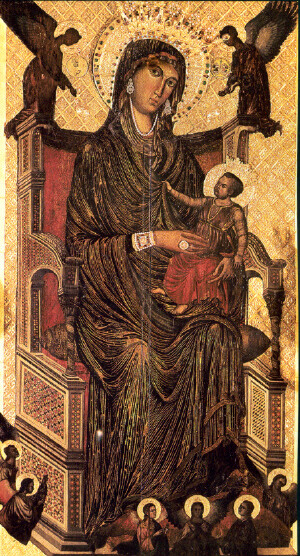

Our Lady of Montevergine.

There is a 5th-century painting presently located at the sacristy in Santa Francesca Romana (aka Santa Maria Nova al Foro Romano) known as the “Madonna Glycophilusa” discovered during restoration works in 1949. Some determine it to depict a very early copy of the supposedly circular icon, but in reverse.


I guess some things are just meant to be mysteries… 😛
 
What about that androgynous, Native American, transsexual Jesus of the New Millennium that the heretics at the National Catholic Reporter commissioned a few years back.
Oh, this one (known as “Jesus of the People”):

http://www.quickbrightsharp.com/radworld/images/Jesus.jpg

I don’t think the image is that bad (androgynous features aside), though I did wonder why in the world is Jesus wearing a Dominican habit when I first saw it. 😛 It reminded me of that well-known (?) joke:

A Domincan and Jesuit were debating which order was the greatest. So, they decided to ask for a sign from God. This is what they received falling down from heaven:

My sons,
Please stop bickering about such trivial matters,

Sincerely,
God, O.P.​
 
It’s not androgynous. Looks like a man to me.
Well, I guess the artist (Janet McKenzie) failed in this regard…then again she stated that Jesus was intended to be a “masculine presence” with a subtle female dimension (she even used a woman as the model).

As I’ve said before, the painting is not that bad (though there are other better examples of modern-day style portraits of Jesus out there), the only problem being that the concept of this picture reeks of the now-rampant political correctness and “diversity”. A case of man trying to form God in his own image.
 
What do we love - His skin color?
He could be green with purple polka dots and I would still love Him
 
Status
Not open for further replies.
Back
Top