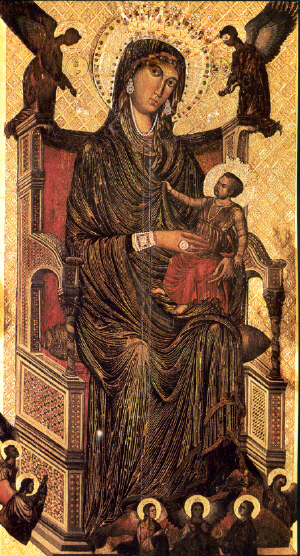
I think Our Lady of Częstochowa is only a copy of the original. The one painted by St. Luke is said to be at the Monastery of the Panaghia Hodegetria, built in the 5th century. Can’t find any pictures.
Apparently the icon is lost during the Sack of 1453. There is a contemporary report of a Turkish commander who had one of his soldiers flogged because he tore a certain painting sacred to Christians into four pieces and dragged it to the mud. Some believe that this refers to the Hodegetria icon.
There are various accounts as to the whereabouts of this icon aside from the above:
1.) A French knight named
Robert de Clari relates
Alexius V Doukas took the icon with him.
2.) An old Venetian tradition relates that the icon was brought with other spoils in Italy and installed in St. Mark’s in Venice. De Clari once more reports thus:
When the Doge of Venice (
Enrico Dandolo) and the Venetians saw that they wanted to make my lord
Henry of Flanders emperor (of Constantinople), they were against it, nor would they suffer it, unless they should have a certain image of Our Lady which was painted on a panel. This image was rich beyond measure, and was all covered with rich and precious stones. And the Greeks said that it was the first image of Our Lady ever made or painted. The Greeks had such faith in this image that they treasured it above everything, and they bore it in procession every Sunday and they worshiped it and gave gifts to it. Now the Venetians were not willing to allow my lord Henry to be emperor, unless they should have this image, so … it was given to them and … Henry was crowned.
3.) Another tradition holds that the original icon is somewhere else. Chroniclers claim that the icon was hidden during the period of Iconoclasm in a chapel deep in a forest far outside Constantinople for safekeeping. Official records then state that it was returned in 840 AD. One story relates that the inhabitants of that particular forest never parted with it. A variant claims that it was indeed returned to Constantinople, but once more left it when
Anna Porphyrogeneta, sister of Emperor Basil II, was married to
Vladimir, Grand Duke of Rus in 988. Yet another version links it with the Częstochowa image through
Władysław Opolczyk, who is said to have brought the icon from that forest - here identified as somewhere in Hungary to Częstochowa. This is how the Częstochowa icon became attributed to St. Luke - this version relates that it was the true Hodegetria icon.
4.) Russians believe that the original icon resurfaced in Russia after the fall of Constantinople, where it was placed in the Assumption Cathedral in Smolensk and venerated as the “Hodegetria of Smolensk”. This icon - which despite the story is dated to the 11th century - is officially believed to have been destroyed by fire during the German occupation of Smolensk in 1941.
5.) Still another tradition tells that the original icon of Mary attributed to Luke, sent by Eudocia to Pulcheria from Palestine, was a large circular icon only of her head. When the icon arrived in Constantinople it was fitted in as the head into a very large rectangular icon of Mary holding the Christ child and it is this composite icon that became the one historically known as the Hodegetria. Another story continues that when the last Latin Emperor of Constantinople,
Baldwin II, was escaping Constantinople in 1261 after it was captured by
Michael VIII Palaelogus he took this original circular portion of the icon with him. This remained in the possession of the
Angevin dynasty who had it likewise inserted into a much larger image of Mary and the Christ child (usually dated to the 13th century), which is presently enshrined above the high altar of the Territorial Abbey of Montevergine. Even so, if this story was true and the original was enshrined here it would be very difficult to determine the truth, as this icon has been over the subsequent centuries subjected to repeated repainting.
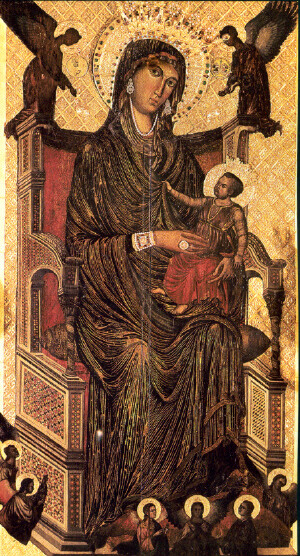
Our Lady of Montevergine.
There is a 5th-century painting presently located at the sacristy in Santa Francesca Romana (aka Santa Maria Nova al Foro Romano) known as the “
Madonna Glycophilusa” discovered during restoration works in 1949. Some determine it to depict a very early copy of the supposedly circular icon, but in reverse.

I guess some things are just meant to be mysteries…




 :
: