
BREAKING: Pope Francis gives local bishops more responsibility for Mass translations

  • Thread starter Thread starter JimR-OCDS
  • Start date Start date
Status
Not open for further replies.
J

JimR-OCDS

Guest
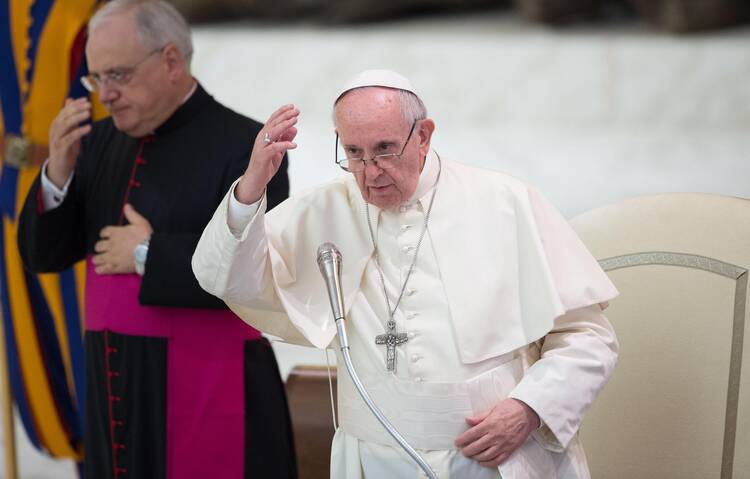
Pope Francis today issued new instructions for the approval of liturgical texts, rebalancing the relationship between the Vatican and local bishops’ conferences in favor of greater local control. The pope’s order, issued in a motu propio titled “Magnum Principium,” reverses the trend in recent years toward greater Vatican control over the texts used in the Mass. “In order that the renewal of the whole liturgical life might continue,” Francis wrote, “it seemed opportune that some principles handed on since the time of the [Second Vatican] Council should be more clearly reaffirmed and put into practice.”
Wonderful news!

Jim
 
Now the US Bishops can finally get their own Spanish Language Roman Missal they’ve been wanting for years. Thus far, they’ve been using the 2nd Edition Mexican Spanish Roman Missal, since the 3rd Edition isn’t approved for use in the US.
 
One imagines of course that those who might prefer the loose, indeed inaccurate, and generally all-around insipid translations that were composed in the 1960s and 1970s will view this as their chance to restore the glories of those bygone days. My prediction is that this particular motu proprio will lead to greater confusion and Babel-like disunity. From a political point of view of course, it does serve to further the apparent papal agenda of disempowering the Roman Curia.
 
Last edited:
Actually the recent English translation caused more confusion than anything before.

I would like to see the response returned to the previous translation, but the costs for parishes will be too high, so I don’t expect to see it happen.

Jim
 
Well sure, after you have an inaccurate, insipid translation for some four decades…there’s going to be some degree of “confusion” when you change it. Sort of like the “confusion” when the liturgy was simply changed almost overnight in some places in the 1960s.

Catholics have a right not to be deprived of their patrimony. The 1974 Sacramentary was an embarrassment. Unfortunately, it was an embarrassment the US Church was stuck with for more than a generation.
 
Finally, we can get rid of all those consubstantial gibbets, and other words that are tooooooo difficult for poor, dumb, catholics to understand. :roll_eyes:
 
Dumb Catholics ?

How about just using language that is common to the current time for English speaking Catholics, which doesn’t require much explanation, per Sacrosanctum Concilium ?
  1. The rites should be distinguished by a noble simplicity; they should be short, clear, and unencumbered by useless repetitions; they should be within the people’s powers of comprehension, and normally should not require much explanation.
Jim
 
Actually, that oft-quoted SC bit refers to the “ritus” or rites, not to the language of the liturgy.
 
Well that’s your interpretation, isn’t it? The proper language of the Roman Rite is Latin, which, of course, the progressive have worked overtime for many decades now to eradicate from the rite.
 
Dumb Catholics ?

How about just using language that is common to the current time for English speaking Catholics, which doesn’t require much explanation, per Sacrosanctum Concilium ?

Jim
That’s fine with me. I find “consubstantial” and “gibbet”* to be just as “common to the current time” and require no more explanation than, say, “begotten”, which has long been a part of the English liturgy translation.

(* Which, as attentive as I have tried to be at the Good Friday Liturgy, I still have never heard in church? 🤷‍♂️ )

(eta
PS.
I’m not the one who called Catholics dumb the last time the English speaking world went through translation palpitations)
 
Last edited:
This is a very good point. If were going to call the switch from from a rushed, and at some points, an inaccurate English translation to an accurate English translation, then what are we to call the switch from the Latin texts to the vernacular the world over in the 1960’s?

In any case, I do hope this doesn’t mean anything will be changed from the 2011 ICEL revisions. Do we really want to see a return to the text of the previous translation? How can one possibly say that when it’s clear these translations in the 1973 ICEL were rushed? Let’s compare the Collect for the 27th Sunday in Ordnary Time, which is also still used as the Collect for the 11th Sunday after Pentecost in the Extraordinary Form of the Mass:

Original Latin from the Sacramentary of Pope St. Gelasius I (+496):

Omnipotens sempiterne Deus, qui abundantia pietatis tuae et merita supplicum excedis et vota: effunde super nos misericordiam tuam; ut dimittas quae conscientia metuit, et adicias quod oratio non praesumit.

1973 ICEL Translation (now obsolete):

Father,
your love for us
surpasses all our hopes and desires.
Forgive our failings,
keep us in your peace
and lead us in the way of salvation.


Current 2011 ICEL Translation:

Almighty ever-living God,
who in the abundance of your kindness
surpass the merits and the desires of those who entreat you,
pour out your mercy upon us
to pardon what conscience dreads
and to give what prayer does not dare to ask.


Why would we ever go back to such a lacking, and paltry translation of a prayer that was beautifully composed in the age of the Church Fathers? Indeed, the 1973 translation is “an embarrassment” as Vadne pointed out. Hopefully, all this will do is allow some bishops to get a Spanish Language Korean Language, etc. Roman Missal for ethnic communities in places like the U.S. and Canada, as Janeway pointed out. But a wholesale return to the old translations, or even a partial return to the old translations? Please, no. From one priestly commentator on the above Collect:
Try reading these versions, bit by bit, alternately: “Almighty and everliving God” becomes “Father”; “abundance of Your kindness” is reduced to the nebulous catch-all “love”; “the merits and the desires of those who entreat you” is banalized into “our hopes and desires”; “pour out Your mercy upon us” becomes “Forgive our failings” (not sins!); “[those things which] conscience dreads” (our sins, the everlasting punishment of hell and having offended God) is rendered down to the amorphous “keep us in your peace”; and “what our prayer does not dare ask” veers away from the misery of our true state into “lead us in the way of salvation…
Our Latin Collect gives us a model for an attitude of prayer. We see the figure of one who is bowed down, folded, knees bent (supplex, – plico). This suppliant is frightened by what the just Judge will apply to him because of the sins which bother his conscience. This lowly beggar prays and prays, entwining (– plecto) his arms about the knees of his Lord. He petitions the Almighty Father, merciful and good, to allay his fears by totally removing his damning sins and then supply him with whatever he dares not ask or does not even know he ought to beg for (non praesumit). He simultaneously has the humility of the kneeling suppliant but also the boldness of sonship. He can dare what is beyond his own ability because God the Father Himself made him His son through a mysterious adoption. He is emboldened to ask many things of the Father with faith and confidence (cf. Mark 11:24 and 9:23).
The 1973 translation, on the other hand, does not give us a very good model for an attitude of prayer
 
No Latin isn’t the proper language of the Roman Rite.

Latin has a special place and to be preserved in the Latin Rite, but it’s not preferred.

Also, it’s not my interpretation alone, but that of the USCCB’s and of course Pope Francis.

Jim
 
Last edited:
Latin is indeed the proper language of the ROMAN Rite. That’s what we call obvious. Vernaculars are allowed within the latitude of liturgical law, but they are not the proper language of the rite.
 
Last edited:
More on the subject
A liturgical expert explains Pope Francis’ change to Mass translation rules

The question of who has appropriate responsibility for the translation of liturgical texts has been a kind of political football since the Second Vatican Council. On the one hand, the council clearly wanted that responsibility to rest mainly with episcopal conferences (i.e. national assemblies of bishops). On the other hand, even before the council ended, a Vatican instruction on implementing the liturgical reform put the weight of responsibility not on the national bishops conferences but on the recognition and confirmation of translated texts by the Holy See (i.e. the Congregation for Divine Worship and the Discipline of the Sacraments—as it is now known).

A liturgical expert explains Pope Francis' change to Mass translation rules | America Magazine
 
No where in SACROSANCTUM CONCILIUM, does it state that Latin is the proper language, but that it is to be preserved.

As the Bishops were given authority to experiment, the vernacular became the preferred language in the majority of parishes and dioceses.

It’s what we have today and thank God for Pope Francis, it’s not going back.

Jim
 
There are a lot of things that aren’t in SC. SC is not the be-all, end-all document on the liturgy. And the fact that Latin is the proper language of the Roman–indeed, LATIN Rite–is, as I said, “obvious.”
 
So by saying Latin is the proper language, non-Latin is improper ?

Jim
 
But you’re the one using the term, “proper.”

The opposite of proper is improper.

So, Mass in the vernacular is also proper, or it would have to be improper.

Jim
 
Last edited:
Status
Not open for further replies.
Back
Top