
California bishops decry lengthy solitary confinement

  • Thread starter Thread starter markomalley
  • Start date Start date
Status
Not open for further replies.
M

markomalley

Guest
From CWN:Before California prisoners suspended a hunger strike in protest of lengthy solitary confinement, the bishops of California issued a statement noting that “international human rights standards consider more than 15 days in isolation to be torture.”
See the California Catholic Conference statement. Also see this LA Times article.

The CCC states:Capital Punishment

2266 The State’s effort to contain the spread of behaviors injurious to human rights and the fundamental rules of civil coexistence corresponds to the requirement of watching over the common good. Legitimate public authority has the right and duty to inflict penalties commensurate with the gravity of the crime. the primary scope of the penalty is to redress the disorder caused by the offense. When his punishment is voluntarily accepted by the offender, it takes on the value of expiation. Moreover, punishment, in addition to preserving public order and the safety of persons, has a medicinal scope: as far as possible it should contribute to the correction of the offender.67

2267 The traditional teaching of the Church does not exclude, presupposing full ascertainment of the identity and responsibility of the offender, recourse to the death penalty, when this is the only practicable way to defend the lives of human beings effectively against the aggressor.
"If, instead, bloodless means are sufficient to defend against the aggressor and to protect the safety of persons, public authority should limit itself to such means, because they better correspond to the concrete conditions of the common good and are more in conformity to the dignity of the human person.
"Today, in fact, given the means at the State’s disposal to effectively repress crime by rendering inoffensive the one who has committed it, without depriving him definitively of the possibility of redeeming himself, cases of absolute necessity for suppression of the offender ‘today … are very rare, if not practically non-existent.’[John Paul II, Evangelium vitae 56.]
As shown in the CCC, punishment should first be appropriate for redress of the disorder caused by the crime. Then it should be concerned with preserving public order and the safety of persons. Then, if possible, it should contribute to the correction of the offender.

Interestingly, the CCC states that the State may have recourse to the death penalty (para 2267) if this is the only way to defend the lives of human beings effectively against the aggressor.

The California Catholic Conference has come out in opposition to the death penalty in all cases. So they believe that society can be protected without recourse to blood in any case. OK, that’s just fine.

But with their statement here, they are against isolating prisoners who are unable/unwilling to act appropriately in the general population and are confined to the SHU for their protection and the protection of other prisoners and prison staff. They state that rehabilitation cannot happen within the SHU. All well and good. But, according to the CCC, preservation of public order and safety of persons is a higher priority than rehabilitation (which is something to be done if possible).

There are some prisoners who are not going to be willing to sit around a fire, hold hands, and sing kumbaya. There are some who, through their own choice, are purely evil. Not to say that they are beyond redemption, but there are some who have simply rejected redemption. Are they to be kept in general population, where they can add to the danger of prison life…particularly for those prisoners who do want to be rehabilitated?

Your thoughts?

And, please, don’t just say “I stand with the California Bishops” or the like. (Leaving aside Apostolos Suos), they have stated that they oppose keeping a prisoner in SHU more than 15 days. OK, fine. But then what? What, in a practical sense, is to be done to protect the rest of the prison population and the prison staff from these people if you can’t just keep them in SHU?

You have a stabbing…and put a person in SHU for 15 days…then the prisoner goes back into general population?
 
People are not in jail or prison because they sang too loud in church. They broke the law of the land and should be punished by same.

Surprise, people kill people while behind bars ! Prisoners who act out should be put into solitary confinement for as long as the authorities deem necessary.

It is a different ball game behind prison walls and those in the know should make these decisions not outsiders.
 
People are not in jail or prison because they sang too loud in church. They broke the law of the land and should be punished by same.

Surprise, people kill people while behind bars ! Prisoners who act out should be put into solitary confinement for as long as the authorities deem necessary.

It is a different ball game behind prison walls and those in the know should make these decisions not outsiders.
What is meant by solitary confinement in CA?

If it is just being kept from others, that is an appropriate punishment for some actions.

If it involves a “dark hole” without sight or sound, that would be a form of torture if used on someone sustainedly. There is a difference.
 
What is meant by solitary confinement in CA?

If it is just being kept from others, that is an appropriate punishment for some actions.

If it involves a “dark hole” without sight or sound, that would be a form of torture if used on someone sustainedly. There is a difference.
No dark holes in California ! They are just confined separately . Rightfully so, in my opinion.
 
What is meant by solitary confinement in CA?

If it is just being kept from others, that is an appropriate punishment for some actions.

If it involves a “dark hole” without sight or sound, that would be a form of torture if used on someone sustainedly. There is a difference.


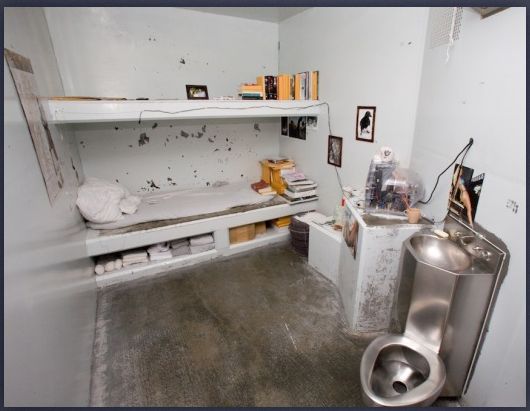
A SHU cell at Pelican Bay, CA. Prisoners are required to spend 23 hours a day in that cell (and the other hour, they have outside recreation…in individual cages, like this one from Corcoran)

 
Having read a little about the full Catholic idea on punishment, I think that we have several problem in our judicial system.

There is so much I think we should to do to improve it that I can’t begin to list them all, but wrt solitary confinement… this is one of those things that can go either way. One person will be happy to get out of the mess and chaos, another person could be fine with a week, and yet another would go a little batty after a couple of days.

I know that with children, time-outs work in different ways. For one, the solitude allows her to consider what went wrong. For another, it’s a time to brood on the numerous injustices he heaped upon him and he emerges more angry.

I think that our focus on protecting society has caused us to lose sight of contrition, restitution, and rehabilitation.

Someone told me something interesting. Suicides often come in copy-cat clusters, so the media started backing off on publicizing them; however, one case was (i forget why) publicized bit in a different way. Family and friends told about the pain they were experiencing rather than their anger against whatever the cause was perceived to be. This suicide, altho publicized, did not have any following suicides.

We have really lost sight of love in our society. Our media portrays love as sex, and there is little about *sacrificial *love and suffering. Everything is about being happy, usually by acquiring stuff. As a result, I think people don’t really think about the effects of their actions on others; they only think about how it affects themselves.

So, solitary confinement… Like any other form of punishment, it should be used only insofar as it is effective. We should stop having *only *a Pavlovian you do something bad, you get something bad attitude towards prisons, and certainly not abuse prisoners in the name of efficiency.
 
Before California prisoners suspended a hunger strike in protest of lengthy solitary confinement, the bishops of California issued a statement noting that “international human rights standards consider more than 15 days in isolation to be torture.”
It seems we need a more comprehensive understanding of international human rights standards. It stands to reason that this conclusion was not determined arbitrarily, and it also stands to reason that other countries have dealt with the same concerns about prison safety and purpose.
 
The reality is that the Church has never specified what means or methods render recourse to the death penalty obsolete.

Some say, “life without parole” is what the Church means. Yet the Church can’t possibly mean life without parole, because that demonstrably does NOT render offenders harmless, as they escape custody, can be pardoned, and can harm fellow prisoners and jail personnel.

Now the California bishops tell us that significant solitary confinement is torture; therefore there is even*** less ***reason to conclude that society has means to render certain offenders harmless short of execution.

Thank you, California bishops, for clarifying that mere imprisonment, and even isolation, is impermissible and therefore cannot be relied upon to render offenders harmless.

We’re back to where we started; execution in many cases is the only way adequately to protect society (including other inmates and staff) from some offenders.
 
The reality is that the Church has never specified what means or methods render recourse to the death penalty obsolete.

Some say, “life without parole” is what the Church means. Yet the Church can’t possibly mean life without parole, because that demonstrably does NOT render offenders harmless, as they escape custody, can be pardoned, and can harm fellow prisoners and jail personnel.

Now the California bishops tell us that significant solitary confinement is torture; therefore there is even*** less ***reason to conclude that society has means to render certain offenders harmless short of execution.

Thank you, California bishops, for clarifying that mere imprisonment, and even isolation, is impermissible and therefore cannot be relied upon to render offenders harmless.

We’re back to where we started; execution in many cases is the only way adequately to protect society (including other inmates and staff) from some offenders.
👍
 
The reality is that the Church has never specified what means or methods render recourse to the death penalty obsolete.

Some say, “life without parole” is what the Church means. Yet the Church can’t possibly mean life without parole, because that demonstrably does NOT render offenders harmless, as they escape custody, can be pardoned, and can harm fellow prisoners and jail personnel.

Now the California bishops tell us that significant solitary confinement is torture; therefore there is even*** less ***reason to conclude that society has means to render certain offenders harmless short of execution.

Thank you, California bishops, for clarifying that mere imprisonment, and even isolation, is impermissible and therefore cannot be relied upon to render offenders harmless.

We’re back to where we started; execution in many cases is the only way adequately to protect society (including other inmates and staff) from some offenders.
I read the CCC and don’t experience confusion about its teaching regarding capital punishment:
2267 Assuming that the guilty party’s identity and responsibility have been fully determined, the traditional teaching of the Church does not exclude recourse to the death penalty, if this is the only possible way of effectively defending human lives against the unjust aggressor.
If, however, non-lethal means are sufficient to defend and protect people’s safety from the aggressor, authority will limit itself to such means, as these are more in keeping with the concrete conditions of the common good and more in conformity to the dignity of the human person.
Today, in fact, as a consequence of the possibilities which the state has for effectively preventing crime, by rendering one who has committed an offense incapable of doing harm - without definitely taking away from him the possibility of redeeming himself - the cases in which the execution of the offender is an absolute necessity “are very rare, if not practically nonexistent.”
“Practically nonexistent” seems pretty clear for me.

But is this thread really about the death penalty? Solitary confinement is a separate issue.
 
Having read a little about the full Catholic idea on punishment, I think that we have several problem in our judicial system.

There is so much I think we should to do to improve it that I can’t begin to list them all, but wrt solitary confinement… this is one of those things that can go either way. One person will be happy to get out of the mess and chaos, another person could be fine with a week, and yet another would go a little batty after a couple of days.

I know that with children, time-outs work in different ways. For one, the solitude allows her to consider what went wrong. For another, it’s a time to brood on the numerous injustices he heaped upon him and he emerges more angry.

I think that our focus on protecting society has caused us to lose sight of contrition, restitution, and rehabilitation.

Someone told me something interesting. Suicides often come in copy-cat clusters, so the media started backing off on publicizing them; however, one case was (i forget why) publicized bit in a different way. Family and friends told about the pain they were experiencing rather than their anger against whatever the cause was perceived to be. This suicide, altho publicized, did not have any following suicides.

We have really lost sight of love in our society. Our media portrays love as sex, and there is little about *sacrificial *love and suffering. Everything is about being happy, usually by acquiring stuff. As a result, I think people don’t really think about the effects of their actions on others; they only think about how it affects themselves.

So, solitary confinement… Like any other form of punishment, it should be used only insofar as it is effective. We should stop having *only *a Pavlovian you do something bad, you get something bad attitude towards prisons, and certainly not abuse prisoners in the name of efficiency.
But, again, if the death penalty is not to be applied (as per the statement from the California Bishop’s Conference (linked above), what about the person who just wants to be plain-old bad. They have no desire for rehabilitation and want to take it out on any and everybody they can. Those type of folk exist in prison (I’m not saying everybody, but enough).

If long-term segregation is morally objectionable, as the bishop’s conference indicates, and the death penalty is morally objectionable, as the bishop’s conference indicates, then how do you protect the prison staff and the rest of the prison population from those people?

Note: I’m not saying that locking somebody in the SHU for 10-15 years…or for life…is the way to go. I, personally, would think that to be a more cruel punishment than the death penalty, but there has to be a stick (as in “carrot and stick”). Again, let me emphasize…I am talking about the really bad cases…not even about the typical prisoner.
 
But, again, if the death penalty is not to be applied (as per the statement from the California Bishop’s Conference (linked above), what about the person who just wants to be plain-old bad. They have no desire for rehabilitation and want to take it out on any and everybody they can. Those type of folk exist in prison (I’m not saying everybody, but enough).

If long-term segregation is morally objectionable, as the bishop’s conference indicates, and the death penalty is morally objectionable, as the bishop’s conference indicates, then how do you protect the prison staff and the rest of the prison population from those people?

Note: I’m not saying that locking somebody in the SHU for 10-15 years…or for life…is the way to go. I, personally, would think that to be a more cruel punishment than the death penalty, but there has to be a stick (as in “carrot and stick”). Again, let me emphasize…I am talking about the really bad cases…not even about the typical prisoner.
I think that mentally torturing prisoners is possibly more morally wrong than simply killing them.

I do not have a problem with the death penalty, which was always accepted by the Church as a form of just retribution rather than simply self-defense. If the only purpose for locking people up is self-defense, how can we justify applying prison time for drug possession? So we must sense that there is more to the criminal system than mere self-defense.

What purpose does keeping someone who lacks the resources to handle it (which I imagine more criminals would lack!) in solitary confinement? Yes, it is a bad consequence for bad behavior, but does the criminal learn anything from it? All to often, no. Something more or something else is needed.

After all, what is the purpose of not killing criminals? Is it to treat them like animals? If so, then we might as well save ourselves the money and kill them.

If the point is to help them attain a state of contrition, of redemption, then we must handle the situation much better than we do.
 
If the point is to help them attain a state of contrition, of redemption, then we must handle the situation much better than we do.
Sounds good.

But how does one help prisoners attain a state of contrition? Particularly if they have no desire for rehabilitation…or redemption

(Remember, the bishops also support “Religious Freedom”, so it’s not like we can force them to sit and listen…that would violate their religious freedom)
 
Sounds good.

But how does one help prisoners attain a state of contrition? Particularly if they have no desire for rehabilitation…or redemption

(Remember, the bishops also support “Religious Freedom”, so it’s not like we can force them to sit and listen…that would violate their religious freedom)
True, but let’s not make it worse.

I’m not saying that solitary should never be used but that especially in our current system it is over-used, and that it should be used more like a scalpel than a hammer.
 
True, but let’s not make it worse.

I’m not saying that solitary should never be used but that especially in our current system it is over-used, and that it should be used more like a scalpel than a hammer.
No argument.

The biggest thing I’m trying to get at is that this is not an easy thing. There are a whole lot of consequences involved when specific positions are taken on specific political issues. I am gratified that the bishops’ conference acknowledges all parties concerned in this case…but I’d hope that they provide some moral guidance on the issue rather than an over-simplistic non-solution that leaves the situation worse off.
 
Maybe the bishops hope the prisoners will go to Mass on Sundays? 😉

IMNSHO solitary confinement is overused, but I don’t know if it’s prudent to completely get rid of it. We can’t forget the value of retribution. How would this proposal work without resorting to the death penalty as an alternative (which is IMO a problematic proposition)? There are some prisoners where there is no other way to protect society, the prisoners, and the idea of divine justice other than solitary confinement.

Perhaps there would be some option for those isolated from everyone to speak to a priest if they desired? In some way where the priest would be completely free from any possible harm. But the odds of that are slim in our society. What we really need is the Church. Any political solution, however great it seems on paper, is nothing without a society that values Jesus Christ and His Church.
 
No argument.

The biggest thing I’m trying to get at is that this is not an easy thing. There are a whole lot of consequences involved when specific positions are taken on specific political issues. I am gratified that the bishops’ conference acknowledges all parties concerned in this case…but I’d hope that they provide some moral guidance on the issue rather than an over-simplistic non-solution that leaves the situation worse off.
I see this tendency so often among people in general. They decry X, then they decry X-1, then X-2, and so on. Like in Mexico, first the death penalty was ruled against, and then life imprisonment w/o parole!

I don’t think the bishops were arguing against any use of solitary confinement, but yes, I guess I was thinking that people needing long-term separation were kept in separate cells that they could still see and talk to people through. But it looks like those people are also kept in these very isolating cells, and of course they need to be kept there all the time.
 
If I’m not mistaken, what caused the prisoners to start a hunger strike in the first place is that the prison guards were abusing their power and arbitrarily putting inmates into solitary confinement, sometimes indefinitely (some have been in solitary confinement for decades). As noted in this article, an imprisoned physician was sent to a SHU for administering CPR to a fellow inmate having a heart attack. The prisoners were demanding that a five-year limit be given to solitary confinement.
 
Not to give the impression that I condone it as punishment, but I live most of my life in solitary confinement! If I was in prison, I would greatly prefer it to being locked up with criminals.
 
Status
Not open for further replies.
Back
Top