(Continued)
The anonymous author of the
Libri Carolini (who is probably
Theodulf of Orléans) expresses a viewpoint midway between the Iconoclast and Iconodule positions: he thinks that images are useful for their ability to recall, remind and instruct (in keeping with the Western view of images), but he rejects the opinion originally voiced by St. Basil of Caesarea that the images partook in some degree of the nature of the subject portrayed (the prototype) and thus is against their veneration.
For the author, all images - whether sacred or profane - are technically ‘false’ since they are the products of artists’ imaginations and thus not the truth. As examples of images that are untrue and manifestly ridiculous, the work describes nature personifications (i.e. the earth as a woman, rivers as men pouring water out of urns, seasons as human figures). The author argues that painters cannot truthfully represent sacred subjects either, but at best are only capable of “a certain ability to remind one of things that have happened.”
The
Libri Carolini condemned the Iconodules for what the author perceived to be an almost-idolatrous treatment of images on their part: he disapproved of various pious practices before images, such as burning incense and lamps before them or touching and kissing them, and even claimed that the stories of miracles wrought by images are sheer fiction, or worse, deceptions of the devil. However, the author does not share the Iconoclast idea that Christians are to actively get rid of images altogether. He acknowledges that the Iconoclasts destroyed images as though they were idols, and thinks that that is their greatest fault:
They do not know that the image is a general
genus], whereas the idol is a special
species], so that one cannot be related to the other. Although almost every idol is an image, not every image is an idol. An idol is defined quite differently than is an image
imago]. Images are there to ornament [churches] and to demonstrate the story of salvation, whereas idols serve only to mislead wretched people into sacrilegious rites and hollow superstition. The image refers to something else; the idol, as it is called, only to itself.
The author shares a similarity with the Iconoclasts in that he makes an exception for the Cross, both due to its direct association with Jesus and due to its symbolism as a token of the majesty of Christ and the triumph of the faith. He deems the Cross to be of a different caliber than other images, which do not have the right to be venerated even if a name of a saint is tagged on them. (Case in point, he proposes that a supporter of images should be shown two identical portraits, differing only on the title: one should be claimed to be a portrait of Mary and the other of Venus! “Holiness is conferred on people endowed with reason on account of merit and good works; on inanimate things it is conferred, not by an inscription, but by consecration by a priest and the invocation of the name of God.”)
For our author, images are generally okay in that they could serve an educational purpose (teaching tools for the illiterate, a
biblia pauperum “Bible of the poor” - the same idea Gregory the Great once expressed), as well as commemorative (as reminders of sacred persons and events) and aesthetic (images could be used to decorate a church) purposes, but they are ultimately just that, images: ‘useful’, but not inherently ‘holy’. The artist making such images wasn’t even considered to be doing a sacred task as the Eastern iconographer is: he is viewed as a mere craftsman doing something no different from any other human activity. If images are to be shown respect, it should be for the sake of the subjects portrayed, not of themselves (which would be - for the author - tantamount to idolatry).
But even then, the author did not think that images are necessary in the long run. A Christian should be able, the
Libri Carolini claims, to contemplate God and the virtues of the saints with
oculus mentis, the “mind’s eye,” without the need for sensual means. Carolingian theologians generally distinguished between the faculties of the “interior” and the “exterior” person. For Charlemagne’s scholars, it is the “interior man” who is made in the image of the triune God. This is why for the writer, the Iconodules’ veneration of images was of a kind inappropriate for God, since it confuses the spiritual quality with the gross, bodily “exterior person.” To give too much attention to the outward image is then to confuse the first, corrupt Adam with the second, new Adam.
The mind’s eye cannot discern how much distances the sacrament of the Lord’s body and blood from the images depicted by the iconographer’s art: while the one is effected invisibly through the work of the Spirit of God, the other is visibly produced by the hand of the artisan; the former is consecrated by the priest invoking the Divine Name, the other is painted by the artistry of a human agent.
Images aren’t viewed by the Franks as ‘windows to heaven’ as they are in the East, but are things of the corporeal world, distinct from the intellectual and spiritual encounter with God. Christians then should thus use their “mind’s eye” as opposed to the fleshly eye of carnal materiality to keep the two worlds distinct and separate.



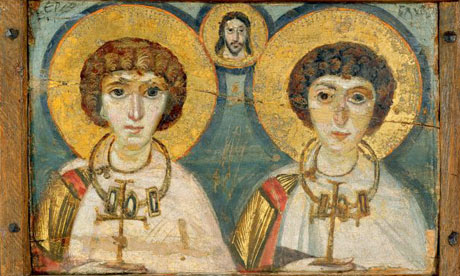

 We’re not advocating “praying to idols”; that’s exactly the wrong interpretation of what’s going on here.