Can praying before statues be supported biblically?

  • Thread starter Thread starter dronald
  • Start date Start date
Status
Not open for further replies.
I can’t believe that you come up with this one! How was that praying to idols?! The people admitted that they had sinned, and Gd taught them a lesson using a serpant they should look at and be healed. Had they trust enough in Gd they would do so. So they always knew that the serpant trancended Gds power. And they did look at it and were healed.
Later, when the danger came up that some knuckleheads could indeed start to worship the snake, the snake was destroyed immediately,.
I think that you make some good points here: when people actually worshipped the snake on the pole, as such, it became necessary to destroy it. However, the issue we’re talking about isn’t “praying to idols”; the OP was asking not about the validity of “praying to idols”, but about the validity of praying to God in the presence of some physical thing.

Now, the very example you gave leads to an interesting question: the ‘serpent on a pole’ episode seems to have three distinct phases: first, God’s instruction to create the image and have people look upon it, and last, when people took that too far and worshipped the serpent itself. However, the length of time between these two implies that there was a middle phase, that itself wasn’t abhorrent to God: a time in which the pole was kept in a revered place, and kept visible to the people, so that they might look upon it and remember the example of God’s love and healing for His people.

In this ‘middle phase’, then, the serpent on a pole was an image; the people of God prayed to Him; the serpent was a visible reminder of the work of God’s love among us; and the serpent itself was not seen as a God or as having power to act wonders. All of these things are good. And therefore, all of these things have some relevance to the question at hand – without stretching the point to extremes… 😉
 
Thanks for that. But any early statements from leaders of the Church? As it is common practice now, I would like to know the earliest that Priests or Popes or whatever were saying that it’s members may kneel before statues and pray. Also, how it somehow enhances or is beneficial to the person.
Why would they have to make any statements? If Moses bowed in front of the Ark 5000 years ago and the Tradition has been brought forward what would be the purpose???
I don’t get it.

Do you wash your mouth every morning? has your pastor priest told you that you have to do it?
Nope it was your peers (in this case mom and dad) that showed you and you carry on with your children.
The Pope and the Magisterium ONLY speak when there is an issue that needs to be addressed. Therefore unless someone with great authority had let’s say condemned the practice of praying in “front of” (NOT AT) Statues representing the Saints, Icons and Crucifixes the Magisterium would not speak about this.

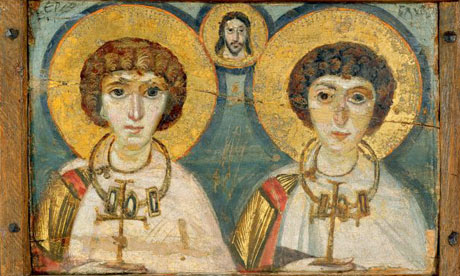
The statue’s only purpose is to bring to mind, to make present the Saint it represent, Mary or Jesus to whom we direct our petition/prayer of intersession. I guess that if the Church had available the techonology to make photos we would have that. The East seems more inclined to use Icons (which are pictures but painted) though they also have statues but to a less degree. It seems that this is the result of problems that arose with a movement called “Iconoclasts”

See this quote
Bishop Jerome, Bishop of Manhattan of the Russian Orthodox Church Outside Russia and this seems to summarise the situation nicely. He says:
Code:
The reason that statues are avoided in the Orthodox Church (and in some of the Eastern Catholic Churches) is not that they were seen as "heretical", but as part of the struggle to overcome the iconoclasts. Prior to the iconoclastic controversy, there were bas-relief representations of holy figures in the East, and in Russia the iconoclasts seem not to have been as virulent as they were in Constantinople. 3-dimensional figures were used to some extent again in Russia in certain places, such as the cathedral of the Ss. Peter & Paul Fortress in St. Petersburg, where the Royal Gates were topped by a small statue, or in the dome of St.Isaac's cathedral where there are statues of Angels.
The west did not suffer this problem therefore the Church in the west did not have to address it.

Hope this helps a little.

Peace 👍
 
Continuing where I left off:

Crucial to the development of Eastern icon theology is an anonymous 5th-6th theologian who wrote under the name of Dionysius the Areopagite (Pseudo-Dionysius). Pseudo-Dionysus’ writings aimed at a synthesis between traditional Christian dogma and Neoplatonist thought. The intimate union between God and the soul and the progressive deification (theosis) of man is, he felt, to be obtained in a process of unknowing in which sense perception and intellectual reasoning are abandoned.

Pseudo-Dionysius’ theory contributed to the veneration of images, since he regarded the sensuous world as an emanation (idea courtesy of Plotinus) of the divine. According to him, God created the visible universe to act as His own, immense icon. A vast “code” of visible symbols, deliberately placed by God in the world, linked humanity to an invisible God. The physical, visual aspects of human worship were part of that great code - hence, he great emphasis on the liturgy and the sacraments. God was far above human imagination, but God drew the human race toward Him through a proliferation of visible symbols.

We can contrast bishop Hypatius (whom I referred to in the last post) with pseudo-Dionysius. Both of them seem to use the same language and ideas (suggesting that Hypatius was himself influenced by Neoplatonism), but their outlook is actually fundamentally different. Pseudo-Dionysius envisions ascent for all believers through the earthly and heavenly ‘hierarchies’; his ‘sacramental’ view of the cosmos sees material helps as lower but still indispensible stages in the ascent. Hypatius, meanwhile, believed that material adornment are provisionally granted for the “imperfect”; the strong, the spiritually-perfect - among whom Hypatius naturally counts himself - do not need these, and there is no indication that he thought that the “perfect” ever passed through a stage where they needed such helps.

Hypatius’ idea of God granting concessions for “the weak” - for example, the command to make cherubim on the Ark, animal sacrifice, the use of pagan names for constellations within Scripture, or the leading the wise men through a star as temporary accomodation for their astrological errors - is rooted apparently in an ancient patristic exegesis of Deuteronomy 4:19 (“And beware lest you raise your eyes to heaven, and when you see the sun and the moon and the stars, all the host of heaven, you be drawn away and bow down to them and serve them, things that the LORD your God has allotted to all the peoples under the whole heaven”). In St. Justin Martyr’s Dialogue with Trypho (chapter 121), Justin’s Jewish character Trypho claims that God allotted the sun, moon and stars to the heathen; Justin does not comment on this, but himself later claims that God gave the sun for the heathen to worship (chapter 121).

The two Alexandrians, Clement of Alexandria and Origen, both elaborated on this idea, arguing that God “apportioned” in some way the heavenly bodies to pagans as revealing a divine pedagogic method. They both declared that God assigned them the heavenly bodies so that they may not fall away to atheism and gross idolatry of material objects, but rather to provide them to rise up to true religion. Origen in particular declares that the worship of heavenly bodies, while of course being inferior to the worship of the true God and the Logos, is much better than devotion to material idols. St. Athanasius in the 4th century also emphasizes the pedagogical role of the heavenly lights in leading men to knowledge of their Creator. They all agree in one thing: the imperfect were apportioned the “material light” in order to rise eventually to the immaterial light of the divinity. The true Israel of course needed no such preparation.
 
(Continued)

A handful of other works from the pre-Iconoclastic period mention the symbolic defense of Christian images. They mostly come from the adversus Iudaeos (“against the Jews”) literature of the 7th century, and two of them are preserved in the acts of the second council of Nicaea in 787. The writings of John of Thessaloniki and Leontius of Neapolis belong to the first half of the 7th century, but may well have been written after the Arab conquests of the same century.

The two fragments of John of Thessaloniki concern a discussion between a pagan and a Christian, and a Jew and a Christian. In the first fragment the pagan says that like the Christians and their images, the pagans do not worship their idols, but through them they honor the incorporeal powers. Here it is taken for granted that the symbolic argument is part of the Christian tradition. In the second fragment the symbolic argument is used to contradict the Jew who objects to images because of the prohibitions of the Old Testament. This time the Christian says that the purpose of images is to act as a reminder (hypomnēsis).


In his Apology against the Jews, Leontius of Neapolis repeats the defence of Christian images as reminders. He argues that Christians do not really worship the wood of the Cross; on the contrary, so long as two pieces of wood are so placed as to form a cross, a Christian honors it as a “type”, and a reminder of what was done for us on the Cross, but if they are separated they are burned - which of course would be absurd if Christians considered the wood itself as God. So when we kiss the royal seal it is not the clay or parchment that we reverence, but the symbol of the king. If in the absence of a father his children will kiss with tears his staff or his cloak, shouldn’t we also kiss the Cross as Christ’s staff, revere the manger at Bethlehem as His home, and pay homage to Nazareth as His hometown and the Jordan River as His bath? He makes the point that the Jews reverence the Book of the Law, and yet they do not worship its leather and ink, but the words of God written in it. A similar argument was made in The Trophies of Damascus, another anti-Jewish treatise written in the second half of the 7th century.

Of the third writer, Stephen of Bostra, we know nothing except that he wrote yet another anti-Jewish work simply titled Against the Jews around the beginning of the 8th century, which was quoted by St. John of Damascus as a prooftext for the veneration of images. The core of Stephen’s argument is that God ordered the tabernacle to be decorated with cherubim “fashioned by human hands;” Stephen then asks his hypothetical Jewish audience: “Will you call them idols? What will you say to Moses and to Israel, who venerated (proskynēsanti) them? Veneration (proskynēsis) is the outward sign (symbolon) by which honor (timē) is given.”

The abbot of St. Catherine’s Monastery at Mount Sinai, St. Anastasius, wrote a work in defense of the Chalcedonian definition called the Hodegos (aka the Viae Dux). He had apparently used an image of the crucifixion to solidify his argument (contra Monophysites) that Jesus suffered and died only in His human nature, and argued that images were more reliable witnesses to the past than texts are and conveyed the reality of the past better.

http://previews.agefotostock.com/pr...bd1cfd43a3fb3bf84e66d2b2dff5/DAE-97025820.jpg
 
Now I’m sure people will be pretty familiar (even if only slightly) with the Iconoclast controversy in the East - because it is often referred to in discussions like the one we’re having now. Really, St. John of Damascus’ defense of image veneration was more or less the standard textbook for iconodule Christians. What is often forgotten, however, is the controversy’s impact in the West.

To put things in perspective: the Byzantine empress Irene had summoned a council to meet at Nicaea in 787, and at this council, which was attended by representatives of pope Hadrian, the heresy of Iconoclasm was oficially condemned. The council had decreed that images of Christ, Mary or the saints might be represented since these stimulated the spectator to think of the original, and while these images were not deserving of latreia (the type of worship proper only to God), they were deserving of proskynesis, an expression of abject humility often involving prostration, usually accorded in the East to the emperors.

We, therefore, following the royal pathway and the divinely inspired authority of our Holy Fathers and the traditions of the Catholic Church (for, as we all know, the Holy Spirit indwells her), define with all certitude and accuracy that just as the figure of the precious and life-giving Cross, so also the venerable and holy images, as well in painting and mosaic as of other fit materials, should be set forth in the holy churches of God, and on the sacred vessels and on the vestments and on hangings and in pictures both in houses and by the wayside, to wit, the figure of our Lord God and Saviour Jesus Christ, of our spotless Lady, the Mother of God, of the honourable Angels, of all Saints and of all pious people. For by so much more frequently as they are seen in artistic representation, by so much more readily are men lifted up to the memory of their prototypes, and to a longing after them; and to these should be given due salutation and honourable reverence (aspasmon ke timitikin proskynisin), not indeed that true worship of faith (latreian) which pertains alone to the divine nature; but to these, as to the figure of the precious and life-giving Cross and to the Book of the Gospels and to the other holy objects, incense and lights may be offered according to ancient pious custom. For the honour which is paid to the image passes on to that which the image represents, and he who reveres the image reveres in it the subject represented. For thus the teaching of our holy Fathers, that is the tradition of the Catholic Church, which from one end of the earth to the other has received the Gospel, is strengthened. Thus we follow Paul, who spoke in Christ, and the whole divine Apostolic company and the holy Fathers, holding fast the traditions which we have received. So we sing prophetically the triumphal hymns of the Church, Rejoice greatly, O daughter of Sion; Shout, O daughter of Jerusalem. Rejoice and be glad with all your heart. The Lord has taken away from you the oppression of your adversaries; you are redeemed from the hand of your enemies. The Lord is a King in the midst of you; you shall not see evil any more, and peace be unto you forever.

Those, therefore who dare to think or teach otherwise, or as wicked heretics to spurn the traditions of the Church and to invent some novelty, or else to reject some of those things which the Church has received (e.g., the Book of the Gospels, or the image of the cross, or the pictorial icons, or the holy relics of a martyr), or evilly and sharply to devise anything subversive of the lawful traditions of the Catholic Church or to turn to common uses the sacred vessels or the venerable monasteries, if they be Bishops or Clerics, we command that they be deposed; if religious or laics, that they be cut off from communion.

A Latin translation of the acts of the council was made in Rome and forwarded to Charlemagne. His scholars were horrified to find in it what they considered to be a sanction of idolatry; possibly contributing to the misunderstanding were both the western ignorance of Byzantine forms and formulas and the difference in emphases between East and West. In answer to this, the Franks had earlier (around 791-2) sent Pope Hadrian a now-lost document detailing their objections to Nicaea II known as Capitulare contra synodum; Hadrian’s point-by-point refutation of Frankish criticism is known as the Hadrianum. Far from simply accepting the pope’s answer, however, Charlemagne ordered a more detailed examination of the Roman and Byzantine arguments. The result of this task is the so-called Libri Carolini (“the Caroline books”), aka Opus Caroli regis contra synodum (“The work of king Charles against the synod”).
 
(Continued)

The anonymous author of the Libri Carolini (who is probably Theodulf of Orléans) expresses a viewpoint midway between the Iconoclast and Iconodule positions: he thinks that images are useful for their ability to recall, remind and instruct (in keeping with the Western view of images), but he rejects the opinion originally voiced by St. Basil of Caesarea that the images partook in some degree of the nature of the subject portrayed (the prototype) and thus is against their veneration.

For the author, all images - whether sacred or profane - are technically ‘false’ since they are the products of artists’ imaginations and thus not the truth. As examples of images that are untrue and manifestly ridiculous, the work describes nature personifications (i.e. the earth as a woman, rivers as men pouring water out of urns, seasons as human figures). The author argues that painters cannot truthfully represent sacred subjects either, but at best are only capable of “a certain ability to remind one of things that have happened.”

The Libri Carolini condemned the Iconodules for what the author perceived to be an almost-idolatrous treatment of images on their part: he disapproved of various pious practices before images, such as burning incense and lamps before them or touching and kissing them, and even claimed that the stories of miracles wrought by images are sheer fiction, or worse, deceptions of the devil. However, the author does not share the Iconoclast idea that Christians are to actively get rid of images altogether. He acknowledges that the Iconoclasts destroyed images as though they were idols, and thinks that that is their greatest fault:

They do not know that the image is a general genus], whereas the idol is a special species], so that one cannot be related to the other. Although almost every idol is an image, not every image is an idol. An idol is defined quite differently than is an image imago]. Images are there to ornament [churches] and to demonstrate the story of salvation, whereas idols serve only to mislead wretched people into sacrilegious rites and hollow superstition. The image refers to something else; the idol, as it is called, only to itself.

The author shares a similarity with the Iconoclasts in that he makes an exception for the Cross, both due to its direct association with Jesus and due to its symbolism as a token of the majesty of Christ and the triumph of the faith. He deems the Cross to be of a different caliber than other images, which do not have the right to be venerated even if a name of a saint is tagged on them. (Case in point, he proposes that a supporter of images should be shown two identical portraits, differing only on the title: one should be claimed to be a portrait of Mary and the other of Venus! “Holiness is conferred on people endowed with reason on account of merit and good works; on inanimate things it is conferred, not by an inscription, but by consecration by a priest and the invocation of the name of God.”)

For our author, images are generally okay in that they could serve an educational purpose (teaching tools for the illiterate, a biblia pauperum “Bible of the poor” - the same idea Gregory the Great once expressed), as well as commemorative (as reminders of sacred persons and events) and aesthetic (images could be used to decorate a church) purposes, but they are ultimately just that, images: ‘useful’, but not inherently ‘holy’. The artist making such images wasn’t even considered to be doing a sacred task as the Eastern iconographer is: he is viewed as a mere craftsman doing something no different from any other human activity. If images are to be shown respect, it should be for the sake of the subjects portrayed, not of themselves (which would be - for the author - tantamount to idolatry).

But even then, the author did not think that images are necessary in the long run. A Christian should be able, the Libri Carolini claims, to contemplate God and the virtues of the saints with oculus mentis, the “mind’s eye,” without the need for sensual means. Carolingian theologians generally distinguished between the faculties of the “interior” and the “exterior” person. For Charlemagne’s scholars, it is the “interior man” who is made in the image of the triune God. This is why for the writer, the Iconodules’ veneration of images was of a kind inappropriate for God, since it confuses the spiritual quality with the gross, bodily “exterior person.” To give too much attention to the outward image is then to confuse the first, corrupt Adam with the second, new Adam.

The mind’s eye cannot discern how much distances the sacrament of the Lord’s body and blood from the images depicted by the iconographer’s art: while the one is effected invisibly through the work of the Spirit of God, the other is visibly produced by the hand of the artisan; the former is consecrated by the priest invoking the Divine Name, the other is painted by the artistry of a human agent.

Images aren’t viewed by the Franks as ‘windows to heaven’ as they are in the East, but are things of the corporeal world, distinct from the intellectual and spiritual encounter with God. Christians then should thus use their “mind’s eye” as opposed to the fleshly eye of carnal materiality to keep the two worlds distinct and separate.

 
(Continued)

As extreme as it sometimes could be, the Libri Carolini shows the difference between the historical view of images between the East and the West. The author, all in all, deemed the Eastern mind to have confused the material with the spiritual; whereas the Byzantines cast the iconographer in a priestly light (as one who “incarnates” the Word of God in culture), the Libri Carolini insisted on sharp (and sometimes artificial) distinctions. As the above quote shows, the author insisted that the artist and his crafts could never take the place of a priest and his confection of the Eucharist. For him the East had invested art and the world of imagination that it tapped with an unwarranted sacramentality. “God is to be adored, but He is not to be embraced.”

As part of his argument, the author rejected those passages in the Old Testament concerning the making of the Ark of the Covenant or the bronze serpent which Iconodules often used as prooftext in support for making images. (In the West, this idea has already been developed well enough by the venerable Bede.) This is because while the Byzantines saw God’s command to produce and decorate the Ark and the Tabernacle as the ultimate defence of Christian imagery, the author argued that the Ark did not really justify the mundane production of religious images because it was not a human commission: God directly ordered Moses to have them made. That in itself shows that it was an exception from the norm.

If images may be likened to the ark of the Lord, they would have to have a propitiatory, as it also had, and that fearful oracles be delivered from them. But no oracles have ever come from images; therefore, they are not to be equated with the ark of the Lord.

Besides, the Ark and the Tabernacle were pale Old Testament prefigurations which have eventually been surpassed by realities of the New. “The Jews possessed in a material way things which, through their symbolism, were open prefigurations of things to come.”

The interesting thing is that Theodulf’s chapel in Germigny-des-Prés has a mosaic on its apse (ca. 806) portraying the Ark of the Covenant, which interestingly ties in with the ideas expounded in the Libri Carolini. The mosaic shows two angels and the two cherubim on the Ark’s lid gesturing toward the empty Ark and below that, towards the altar itself. The hand of God in the centre of the composition seems to bear the stigmata. Theodulf’s version shows how the prophecies of the Old Testament (symbolized by the Ark), have been replaced by the historical reality of Christ, whose incarnation fulfilled the promises of the old Law; and whose death and resurrection superseded it. The Ark is now empty; Christ is now present in the altar under the form of the Eucharist.


The author did not see any connection between the image and the “truth,” and made every kind of representation into a metaphor or a symbol, whether it was a portrayal of a personification, a saint or an animal. Admittedly, this is once again a somewhat extremist view in the author’s part, but it is thought that this mentality might explain why the West did not develop a fixed system of sacred portraiture. In the West, religious art historically had a lower status than in the East, in that it did not provide a direct access to the prototype but at the same time had more freedom. (Images were not integral to Western theology, so that in fact, while the author’s (Theodulf’s?) ideas are striking, they did not have a marked impact on Carolingian thought leading to the little attention paid to the work. No one aside from a tiny handful of individuals, who like Theodulf are of Spanish origin, thought that theories of representation were urgent issues at all.)

This was why the representations of plants or animals or personified concepts in Western churches did not cause much offense: in Western thinking these artworks which celebrated the created world could be interpreted as metaphors or symbols for a higher reality, a language for understanding the divine. This concept of image as mere symbol or reminder gave birth to another mentality: that of the natural world being a reflection of the divinity but one that was distant and not direct. In other words, the terrestrial world provides an ‘image’ of God, but not in a direct manner as in Eastern icons.
 
(Continued)

The author writes:

Because images are frequently made according to the talent (ingenium) of the artist, so that some of them are shapely or deformed, and some beautiful, and others ugly, some resemble their models, and others do not, and some are radiantly new, and others are worn by age, the question arises, which of them deserve more honor - those which are known to be more costly, or those which are known to be less costly? For if we give the more costly ones greater veneration, this means that we are venerating the work and the quality of the material, and not the power of devotion. And if we venerate the less valuable ones, those which less resemble what they wish to attain, it is unjust - because they are excellent neither in work nor in material, nor are they known to resemble persons - to accord them greater and more fervent veneration.

For we reject nothing except the adoration of images, and permit images of the saints in the basilicas, not for adoration, but instead as reminders of their deeds and as decoration for the walls. They (the Greeks), however, place almost all the hope of their credulity in images, but it remains firm that we venerate the saints in their bodies or better in the remains of their bodies, or even in their clothing, in the ancient tradition of the Fathers. They adore walls and panels and so are at the mercy of painters. To be sure, some more learned people can avoid adoring the images themselves and can venerate that to which they refer. But for the unlearned, who only venerate and adore what they see, they constitute a scandal.

One must take care not to fall under the gospel saying, that one should scandalize so many of the least, for if he who scandalizes one of the least shall fall under the most dreaded sentence, how much more terrible will be the judgment against the one who either drives almost the whole church of Christ to adore images or binds with anathema those who spurn the adoration of images. Both should be avoided with great caution so, whether adhering to one party or the other, one does not do more than good order demands.

As noted earlier, relics are deemed by the author of the Libri Carolini to be highly superior to icons because of their direct association with the saints, and because only the bodies of the saints would share in the final resurrection. This preference of relics over images somewhat reflects the huge ‘craze’ for relics in the Carolingian period after the canon Item placuit of the Fifth Council of Carthage (400) requiring that all altars without relics be destroyed was enacted in the Frankish Empire in 801 and again in 813.

Relics are holy because they are the bodies of the saints or items that they touched or used. Scripture affirms that the Hebrews tended the mortal remains of the dead carefully; the remains of the saints will be raised up at the last day, but images will not be. The devil was conquered and humanity redeemed, not through images, but through the Cross. A third item he deems to be superior to images are the sacred vessels like the chalice or the paten. He argues that the services of the church could not be celebrated without vessels, but images are unnecessary and irrelevant. Everything can be done without portraits, but nothing without vessels. All through the Scriptures, he says, one could find explicit testimony about the necessity of having vessels dedicated to the divine cult, but that, on the contrary, one never finds a requirement that an image be used in services. At the Last Supper, Jesus took a cup - a vessel - and not an image. Isaiah (52:11) did not say, “Be clean, you who carry the images of the Lord,” but “you who carry the vessels of the Lord.”

Unlike the highly-complicated icon theology of the East, the Frankish theologians were unfamiliar with idea of a hypostatic relation between image and prototype and affirmed the Western idea that there could be no identity with God, neither in images, nor in man, nor in any creature. God, being spirit, cannot be fully represented by sensible things: spiritual things must be sought not in material things like pictures, but in the heart by faith. (The Libri Carolini specifically targeted the Byzantine cultus of the imperial images: he claims that the Greeks claim that they pay homage to the emperor in his image because he cannot be everywhere all at once - after all, the honor paid to it passes to the prototype, as per Eastern thinking - but how can they worship God in an image, since He is everywhere and cannot be confined at one particular place?) The derivation of the virtues of the saints from Christ may only be recognized by spiritual eyes and ears.

The author envisioned images as having a catechetic or pedagogic function and an aesthetic function (“as reminders of the (saints’) deeds and as decoration for the walls”), but does not think that it could be venerated properly without the ignorant mistaking it for idolatry. The image is thus considered to be not an enigma as it is in the East, but a memoria, the function of which is to recall the word. Seeing is now reading, honoring is now knowing.
 
Patrick, you could just upload your book to Google Docs and make it a public link.
 
(Continued)

All in all, the book expresses the view - common amongst many other Frankish writers, perhaps informed by the Carolingian understanding of Augustine - that writing is superior to art. The superiority however, hinges on the fact that the fullest knowledge of the truths of the faith must be acquired from Scripture. In other words, the propositional content of Scripture cannot be fully articulated in painting or sculpture: images can represent biblical people and events, but it could never adequately express things like the Ten Commandments or the Shema or the Beatitudes. They could illustrate them, but cannot state them: only language has the power to do that. So the image should be for the illiterate what the written word is for the literate.

Painters are thus able in some way to commit events to the memory; but things which are perceptible only to the mind and expressible only in words cannot be grasped and shown by painters, but by writers and other similar people. … O glorifier of images, gaze then at your picture and let us devote our attention to the Holy Scriptures. Be the venerator of artificial colours, and let us venerate and penetrate secret thoughts. Enjoy your painted pictures, and let us enjoy the word of God.

Indeed, one of the arguments the work lays is the fact that while the command to write down something could be found now and again in Scripture, no one is commanded to paint: it is the Scriptures, not the Paintings. (Yes, the author actually makes this argument to this effect.) Conveying what the Lord said is the work of writers, not painters: “Painters can in some way bring the stories of past events back to memory but things that are only perceived by the senses and brought forth by words are comprehended not by painters but by writers.” At the end of the second book in the Libri Carolini (it is a four-part work, BTW), the author sums up about how images are without mystery, life, sense, reason and legitimacy, while at the same time claiming that the Scriptures possess everything one needs to know (in an academic sense): history, poetic meters, the rules of grammar, eloquence, right reasoning, arithmetic, music, geometry, astronomy. They are not always present literally or obviously, but they are there just the same and could be discerned by a reader with the proper spiritual disposition.

A similar view sharing the sentiment of the written word’s superiority over art could be found in the archbishop and theologian Hrabanus Maurus’ letter to Bonosus (c. 835):

Even if painting is dearer to you than all art, I ask you not to scorn the thankless labour of writing, the effort of singing and the fervour and ardour of reading: for writing is worth more than the idle shape in the picture and gives the soul more beauty than the false painting, which shows the form of things in unfitting manner. Devout writing is the perfect rule of salvation, it has greater meaning in life and is of more use to everyone, it is quicker to the taste, and more perfect to the human mind and senses, it is easier to possess the skill to perform it, and it serves the mouth, ears and eyes. The picture gives but small satisfaction. Writing shows the truth by its countenance, its words and its content. The picture sates the sight while it is still new, but it palls once it is old, quickly loses its truth, and does not arouse faith.

Keeping this in mind, it is no surprise then that the Carolingians adopted and developed one of the greatest innovations in the ornament of script, the historiated initial (originally found in Insular art). A masterpiece of Carolingian art, the Utrecht Psalter, shows the marriage between word and image which the West embraced.
 
(Last post for now)

The Iconophile writers of the East (like St. John of Damascus), who had gone to great lengths to carefully distinguish latreia and doulia or proskynesis from each other, but our author never seems to draw a hard line between adoratio and veneratio. This is often chalked up to a faulty Latin translation of the acts of Nicaea II (which apparently somewhat confusingly rendered both terms as adoratio), but at the same time there did not really seem to have been a hard-fast distinction between veneratio and adoratio in the Latin of the time.

In 8th-9th century Latin, adoratio did not necessarily refer just to the adoration reserved for God. For instance, the Annales regni Francorum describes the “adoration” of Charlemagne following his imperial acclamation in 800. (Et post laudes ab apostolico more antiquorum principum adoratus est atque ablato patricii nomine imperator et augustus est appellatus. “And after the lauds, he was adored by the Pope in the manner of the ancient princes, and, discarding the title of ‘Patrician’, he was henceforth known as Emperor and Augustus.”) Even Pope Hadrian, when citing the Lateran Council of 769 and its condemnation of Iconoclasm, was not too scrupulous in distinguishing between the two terms and used them interchangeably in the context of veneration of images (Venerari et adorari sacras imagines in eorum concilio censuerunt “they stated that sacred images are to be venerated and adored;” Adorari atque venerari sacras imagines statuerunt “they established that sacred images are to be adored and also venerated”).

As for our author, he argues that God alone is “adored” (adorandus) and “worshipped” (colendus), while the saints are but venerandi, who must be paid nothing more than the veneration which is their due (opportuna veneratio). However, he himself sometimes also understands adoratio as an act of respect given to men through gestures like bowing and kissing, although even these are acts employed only as a salutationis causa, and out of a sense of love or humility.

So for the Franks, the issue was not so much any distinction between latreia and proskynesis, but to the objects of adoratio or veneratio. The real objection, as presented in the Libri Carolini, was that the proper objects of adoratio/veneratio are living beings like God and man, or even the remains of holy men of past ages, whereas images could not be given such honor. You could not even give images the adoratio given to men because they are lifeless and made by human hands.

God therefore alone is to be worshipped (colendus), he alone to be adored (adorandus), he alone to be glorified (glorificandus). Of him the prophet says, “His name alone is excellent,” (Psalm 148:18) Reverence (veneratio) is likewise due to the saints, who, having overcome the devil, now reign with Christ, because they manfully laboured and suffered, in order that the church should come down to our times, and because they are able to assist the still struggling church with their prayers. But images can only be placed in churches without injury to the faith when adoration (adoratione) and worship (cultura) of every kind are forbidden, and when they are employed either simply as ornaments in the basilicas, or as memorials of their deeds; or they may be absent altogether without injury to the Catholic faith, seeing that they can take no part in the mysteries of our salvation.
 
Thanks for that. But any early statements from leaders of the Church? As it is common practice now, I would like to know the earliest that Priests or Popes or whatever were saying that it’s members may kneel before statues and pray. Also, how it somehow enhances or is beneficial to the person.
Kneeling is a sign or indication of humility.

Have you seen the movie Indiana Jones and the Last Crusdade?

In the scene on the way to the cup of the last supper…the first challenge that Indiana Jones had to face is that of a penitent man…so what does a penitent man do in the presence of God? He kneels.
 
Just to add a bit to what I wrote last. All in all, by the 9th-10th century, you have at least broadly three opinions in the Church on images running side-by-side:
  • Iconoclasm, which is against the creation and veneration of images wholesale.
  • Iconodulism, which is in favor of the use of religious images or icons and their veneration.
  • The “middle way” proposed by Charlemagne’s theologians. Images can be made and used for didactic, commemorative, and aesthetic functions, but no veneration (which could be accorded to relics, the cross, and the sacred vessels) can ever be given them.
 
I think that you make some good points here: when people actually worshipped the snake on the pole, as such, it became necessary to destroy it. However, the issue we’re talking about isn’t “praying to idols”; the OP was asking not about the validity of “praying to idols”, but about the validity of praying to God in the presence of some physical thing.

Now, the very example you gave leads to an interesting question: the ‘serpent on a pole’ episode seems to have three distinct phases: first, God’s instruction to create the image and have people look upon it, and last, when people took that too far and worshipped the serpent itself. However, the length of time between these two implies that there was a middle phase, that itself wasn’t abhorrent to God: a time in which the pole was kept in a revered place, and kept visible to the people, so that they might look upon it and remember the example of God’s love and healing for His people.

In this ‘middle phase’, then, the serpent on a pole was an image; the people of God prayed to Him; the serpent was a visible reminder of the work of God’s love among us; and the serpent itself was not seen as a God or as having power to act wonders. All of these things are good. And therefore, all of these things have some relevance to the question at hand – without stretching the point to extremes… 😉
Aaahaaaaaaaahhhhhhhhhhh not so fast! It is not so that Jews prayed in the presence of images, either. This “episode” as you call it was a one time necessary correction method chosen by Gd himself; he gave this order to teach a lesson, and that’s it. Just because some peeps prayed to the snake afterwards and for a certain limited amount of time doesn’t give you the right to pidgeonhole all of them. Jews do not pray in front of images. We have never and don’t and won’t ever neither pray to idols (L0rd help us) or to any images. It seems that you’re trying to find a link, or some justification, to your images and statues in your churches that you yourself created without any order from Gd, and that you pray to or in which presence you pray to Gd since thousands of years and on a regular basis.
 
Who was the first in Catholicism to defend praying before statues and pictures. I know that many have over the years, but who did so first?
The Second Council of Nicaea address representational art and icons in AD 787.

Below are some exerts, with the Council formulating what the Church had always believed.
…They were those of whom God calls out by prophecy, Many pastors have destroyed my vine, they have defiled my portion. For they followed unholy men and trusting to their own frenzies they calumniated the holy church, which Christ our God has espoused to himself, and they failed to distinguish the holy from the profane, asserting that the icons of our Lord and of his saints were no different from the wooden images of satanic idols…
…To summarize, we declare that we defend free from any innovations all the—written and—unwritten ecclesiastical traditions that have been entrusted to us.
One of these is the production of representational art; this is quite in harmony with the history of the spread of the gospel, as it provides confirmation that the becoming man of the Word of God was real and not just imaginary, and as it brings us a similar benefit. For, things that mutually illustrate one another undoubtedly possess one another’s message.
Given this state of affairs and stepping out as though on the royal highway, following as we are the God-spoken teaching of our holy fathers and the tradition of the catholic church — for we recognize that this tradition comes from the holy Spirit who dwells in her—we decree with full precision and care that, like the figure of the honoured and life-giving cross, the revered and holy images, whether painted or made of mosaic or of other suitable material, are to be exposed in the holy churches of God, on sacred instruments and vestments, on walls and panels, in houses and by public ways, these are the images of our Lord, God and saviour, Jesus Christ, and of our Lady without blemish, the holy God-bearer, and of the revered angels and of any of the saintly holy men.
The more frequently they are seen in representational art, the more are those who see them drawn to remember and long for those who serve as models, and to pay these images the tribute of salutation and respectful veneration. Certainly this is not the full adoration {latria} in accordance with our faith, which is properly paid only to the divine nature, but it resembles that given to the figure of the honoured and life-giving cross, and also to the holy books of the gospels and to other sacred cult objects. Further, people are drawn to honour these images with the offering of incense and lights, as was piously established by ancient custom. Indeed, the honour paid to an image traverses it, reaching the model, and he who venerates the image, venerates the person represented in that image.
So it is that the teaching of our holy fathers is strengthened, namely, the tradition of the catholic church which has received the gospel from one end of the earth to the other…
 
Aaahaaaaaaaahhhhhhhhhhh not so fast! It is not so that Jews prayed in the presence of images, either. This “episode” as you call it was a one time necessary correction method chosen by Gd himself; he gave this order to teach a lesson, and that’s it.
Agreed: its use was a one-time thing. However, the people didn’t destroy it.
Just because some peeps prayed to the snake afterwards and for a certain limited amount of time
Note, though, that the problem that caused Hezekiah to destroy the serpent wasn’t prayer, but was that they had started burning incense to the statue! So, again, three phases: use of serpent at God’s command, keeping the serpent as a remembrance of God’s healing of his people, and unjustifiable worship of the statue. We’re not trying to justify the third phase; rather, we’re trying to ask the question of what was reasonably done in the second phase. Let’s look at the book of Wisdom to help us out:
For when the dire venom of beasts came upon them and they were dying from the bite of crooked serpents, your anger endured not to the end.
But as a warning, for a short time they were terrorized, though they had a sign of salvation, to remind them of the precept of your law.
For the one who turned toward it was saved, not by what was seen, but by you, the savior of all.
By this also you convinced our foes that you are the one who delivers from all evil.
(Wisdom 16:5-8)

So, the witness given here gives us details about the first two ‘phases’ that I’m presenting for your consideration: first, the serpent was the means by which God saved his people. Next, it was used as a reminder of God’s saving power. (After all, if the foes of God looked upon the serpent and recognized God as the deliverer from evil, it is nonsensical to assert that the Israelites did not.) After all, “As you have used us to show them your holiness, so now use them to show us your glory. Thus they will know, as we know, that there is no God but you.” (Sirach 36:3-4)
We have never and don’t and won’t ever neither pray to idols
You keep saying this. :rolleyes: We’re not advocating “praying to idols”; that’s exactly the wrong interpretation of what’s going on here.

Oh – and by the way – there’s plenty of documentation in the Bible that Israelites have prayed to idols, from the golden calf to the temples in the north. That doesn’t make it right, of course, but as a historical fact, well… 😉
 
Status
Not open for further replies.
Back
Top