Catholic churches shouldn't have statues!

  • Thread starter Thread starter Zundrah
  • Start date Start date
Status
Not open for further replies.
We don’t have Idols of Dagon in our churches. Pagans considered the idols and statues that are being spoken about AS GODS themselves. God, said NO there is only one true God, so he commanding us not to worship idols and statues AS GODS. Have you at all read Gods specific instructions for the construction of the Ark, and the Temple? Statues and figures of Heaven and earth abound in them, so I ask you, would God contradict himself? Tell us to not make statues, and then later tell them to make statues in the Temple he himself commanded us to make to Worship Him?
What are you talking about?? The only thing closely related to a statue in the arc or tabernacle were the cherubum which were a decorative item. Here is a link showing what the arc and tabernacle looked like.

bibleplaces.com/tabernaclemore.htm
 
…you’re changing the subject ridiculously, read the scripture again! I don’t care if God contradicts him self for a short while or even eternaly, I have no problem with that! But you can’t seem to answer the OP! 😦 Answer this; what is the catholic churches excuse for having statues even though this scripture says that we shouldn’t!?

xxx zundrah xxx
Zundrah, I admire you for reading the bible for yourself and not ingesting everything that anyone (Catholics or anyone else) tells you as truth. Keep reading and you will see for yourself what the truth is.

I would like to say one thing: God does not ever contradict Himself. If anyone is perfect and without error, it is God. Remember that if there is a conflict between God’s Word (the Bible) and someone else’s, you should not let anyone convince you that God lied or made a mistake cause He is infallible. In the beginning, when you are reading there may seem to be some contradictions in the Bible, but it is only because you haven’t read and studied it all. You will eventually come to realize that those things that seemed contradicting (within the Bible) make sense. Keep reading and keep praying for the Holy Spirit to guide you as Jesus promised He would.

I am not Catholic, so the Catholics won’t agree with my explanation to you (and I encourage you to research it for yourself anyway) but my understanding of why idols are prevalent in the Catholic church is that when Constantine (emperor of Rome) wanted to convince the pagans to convert, he allowed the churches to have statuary so that they would feel comfortable in the churches (Pagans were big on statues, especially of their goddesses which is why Mary is also so prevalent). Constantine was a pagan himself. It was one of many compromises that the Roman Catholic Church made with the pagans and the Catholic church is still trying to come up with clever explanations to convince people that they are following the teachings of the Bible, when in fact they are only teaching some.
Like I said, don’t believe anyone - research for yourself - google what I said.
 
Zundrah, I admire you for reading the bible for yourself and not ingesting everything that anyone (Catholics or anyone else) tells you as truth. Keep reading and you will see for yourself what the truth is.

I would like to say one thing: God does not ever contradict Himself. If anyone is perfect and without error, it is God. Remember that if there is a conflict between God’s Word (the Bible) and someone else’s, you should not let anyone convince you that God lied or made a mistake cause He is infallible. In the beginning, when you are reading there may seem to be some contradictions in the Bible, but it is only because you haven’t read and studied it all. You will eventually come to realize that those things that seemed contradicting (within the Bible) make sense. Keep reading and keep praying for the Holy Spirit to guide you as Jesus promised He would.

I am not Catholic, so the Catholics won’t agree with my explanation to you (and I encourage you to research it for yourself anyway) but my understanding of why idols are prevalent in the Catholic church is that when Constantine (emperor of Rome) wanted to convince the pagans to convert, he allowed the churches to have statuary so that they would feel comfortable in the churches (Pagans were big on statues, especially of their goddesses which is why Mary is also so prevalent). Constantine was a pagan himself. It was one of many compromises that the Roman Catholic Church made with the pagans and the Catholic church is still trying to come up with clever explanations to convince people that they are following the teachings of the Bible, when in fact they are only teaching some.
Like I said, research for yourself - google what I said.
 
Hmm… are you saying this issue should be treated in the way recommended for
eating meat sacrifice to idols? Romans 14:12-23. Should we not do it if it offends
someone’s faith, or else we would become a stumbling block for them?
I’m just askiing a hypothetical question.

If you could go back in time to ancient Israel…between the time Moses died and before Jesus was born and were seen kneeling in front of a statue of St. Michael the Archangel and praying to St. Michael. What do you think the reaction of the Jews would be? Do you think they would accuse you of idolatry?
 
No, I don’t get the point. All 10 commandments were confirmed by Jesus and the apostles either explicitly or by example in the New Testament. The Ten Commandments are necessary for true Christian living.

A few verses in regards to idolatry:

1 John 5:21 (New International Version)
“Dear children, keep yourselves from idols”

1 Corinthians 6:9 (New International Version)
Do you not know that the wicked will not inherit the kingdom of God? Do not be deceived: Neither the sexually immoral nor idolaters nor adulterers nor male prostitutes nor homosexual offenders

1 Corinthians 10:7 (New International Version)
Do not be idolaters, as some of them were; as it is written: “The people sat down to eat and drink and got up to indulge in pagan revelry.”
For it to truly work, you must first prove that Catholic imagery are idols. Well?

Listen again that it is so. Thou shalt not make to thyself any brazen thing nor any likeness. These things, he says, they made by God’s commandment a hanging of violet, purple, scarlet, and fine twisted linen in the entrance of the tabernacle, and the cherubim in woven work. (Ex. 26:31) And they made also the propitiatory, that is, the oracle of the purest gold, and the two cherubim. (Ex. 37:6-7) What will you say to this, O Moses? You say, thou shalt not make to thyself any graven thing nor any likeness, and you yourself fashion cherubim of woven work, and two cherubim of pure gold. Listen to the answer of God’s servant Moses: “You blind and foolish people, mark the force of what is said, and keep your souls carefully. I said that you had seen no likeness on the day when the Lord spoke to you on Mount Horeb, in the midst of the fire, lest you should sin against the law and make for yourselves a brazen likeness: thou shalt not make any image or gods of metal. I never said thou shalt not make the image of cherubim in adoration before the propitiatory. What I said was: Thou shalt not make to thyself gods of metal, and thou shalt not make any likeness as of God, nor shalt thou adore the creature instead of the Creator, nor any creature whatsoever as God, nor have I served the creature rather than the Creator.”

Note how the object of Scripture becomes clear to those who really search it. You must know, Beloved, that in every business truth and falsehood are distinguished, and the object of the doer, whether it be good or bad. In the gospel we find all things good and evil. God, the angels, man, the heavens, the earth, water and fire and air, the sun and moon and stars, light and darkness, Satan and the devils, the serpent and scorpions, death and hell, virtues and vices.
And because everything told about them is true, and the object in view is the glory of God and the saints whom He has honoured, our salvation, and the shame of the devil, we worship and embrace and love these utterances, and receive them with our whole heart as we do the whole of the old and new dispensation, and all the spoken testimony of the holy fathers. Now, we reject the evil, abominable writings of heathens and Manicheans and all other heretics, as containing foolishness and lies, promoting the advantage of Satan and his demons, and giving them pleasure, although they contain the name of God.
So with regard to images we must manifest the truth, and take into account the intention of those who make them. If it be in very deed for the glory of God and of His saints to promote goodness, to avoid evil, and save souls, we should receive and honour and worship them as images, and remembrances, likenesses, and the books of the illiterate. We should love and embrace them with hand and heart as reminders of the incarnate God, or His Mother, or of the saints, the participators in the sufferings and the glory of Christ, the conquerors and overthrowers of Satan, and diabolical fraud.

If any one should dare to make an image of Almighty God, who is pure Spirit, invisible, uncircumscribed, we reject it as a falsehood. If any one make images for the honour and worship of the Devil and his angels, we abhor them and deliver them to the flames. Or if any one give divine honours to the statues of men, or birds, or reptiles, or any other created thing, we anathematise him. As our forefathers in the faith pulled down the temples of demons, and erected on the same spot churches dedicated to saints whom we honour, so they overturned the statues of demons, and set up instead the images of Christ, of His holy Mother, and the saints. Even in the old dispensation, Israel neither raised temples to human beings, nor held sacred the memory of man. At that time Adam’s race was under a curse, and death was a penalty, therefore a mourning. A corpse was looked upon as unclean, and the man who touched it as contaminated. But since the Godhead has taken to Himself our nature, it has become glorified as a vivifying and efficacious remedy, and has been transformed unto immortality. Thus the death of the saints is a rejoicing, and churches are raised to them, and their images are set up.

Be assured that any one wishing to pull down an image erected out of pure zeal for the glory and enduring memory of Christ, or of His holy Mother, or any of the saints, to put the devil and his satellites to shame,–anyone, I say, refusing to honour and worship this image as sacred - it is not to be worshipped as God - is an enemy of Christ, of His blessed Mother, and of the saints, and is an advocate of the devil and his crew, showing grief by his conduct that the saints are honoured and glorified, and the devil put to shame. The image is a hymn of praise, a manifestation, a lasting token of those who have fought and conquered, and of demons humbled and put to flight.

-John of Damascus, Apologia Against Those Who Decry Holy Images

 
ZUNDRAH, I hope you did not think I was arguing with you, I just wanted to get you some info on the subject. Peace.
Don’t worry, some times I can get ahead of myself by assuming that everyone is just enjoying arguments on here. It is very hard to see whether or not some one is actually really trying to talk about a certain subject or just plain arguing.

wmscott, I was pointing out that perhaps God said to us not to make statues because some thing like this would happen (post #29);
I was in church last friday (weekday mass) and after mass I went into our special room for prayer to Mary. I sat down and in no time at all the room filled up with so many people that they had to queue out side and wait for others to finish praying and leave so that they could get in. Well after squeezing my way out I finally managed to exit the room, back into the chapel. When i broke free I went to the room with the sacred heart of christ and I was the only person in there. No one else came, there were only two candles lit in there even though Mary’s room was filled up with lots of candles lit. I stayed there for quite a while kneeling and not a single person came in.
God said do not make statues for your self… I think that this is why
 
Zundrah, I admire you for reading the bible for yourself and not ingesting everything that anyone (Catholics or anyone else) tells you as truth. Keep reading and you will see for yourself what the truth is.

I would like to say one thing: God does not ever contradict Himself. If anyone is perfect and without error, it is God. Remember that if there is a conflict between God’s Word (the Bible) and someone else’s, you should not let anyone convince you that God lied or made a mistake cause He is infallible. In the beginning, when you are reading there may seem to be some contradictions in the Bible, but it is only because you haven’t read and studied it all. You will eventually come to realize that those things that seemed contradicting (within the Bible) make sense. Keep reading and keep praying for the Holy Spirit to guide you as Jesus promised He would.

I am not Catholic, so the Catholics won’t agree with my explanation to you (and I encourage you to research it for yourself anyway) but my understanding of why idols are prevalent in the Catholic church is that when Constantine (emperor of Rome) wanted to convince the pagans to convert, he allowed the churches to have statuary so that they would feel comfortable in the churches (Pagans were big on statues, especially of their goddesses which is why Mary is also so prevalent). Constantine was a pagan himself. It was one of many compromises that the Roman Catholic Church made with the pagans and the Catholic church is still trying to come up with clever explanations to convince people that they are following the teachings of the Bible, when in fact they are only teaching some.
Like I said, don’t believe anyone - research for yourself - google what I said.
What ****! Reading Jack Chick again , are we?
 
Zundrah, I admire you for reading the bible for yourself and not ingesting everything that anyone (Catholics or anyone else) tells you as truth. Keep reading and you will see for yourself what the truth is.

I would like to say one thing: God does not ever contradict Himself. If anyone is perfect and without error, it is God. Remember that if there is a conflict between God’s Word (the Bible) and someone else’s, you should not let anyone convince you that God lied or made a mistake cause He is infallible. In the beginning, when you are reading there may seem to be some contradictions in the Bible, but it is only because you haven’t read and studied it all. You will eventually come to realize that those things that seemed contradicting (within the Bible) make sense. Keep reading and keep praying for the Holy Spirit to guide you as Jesus promised He would.

I am not Catholic, so the Catholics won’t agree with my explanation to you (and I encourage you to research it for yourself anyway) but my understanding of why idols are prevalent in the Catholic church is that when Constantine (emperor of Rome) wanted to convince the pagans to convert, he allowed the churches to have statuary so that they would feel comfortable in the churches (Pagans were big on statues, especially of their goddesses which is why Mary is also so prevalent). Constantine was a pagan himself. It was one of many compromises that the Roman Catholic Church made with the pagans and the Catholic church is still trying to come up with clever explanations to convince people that they are following the teachings of the Bible, when in fact they are only teaching some.
Like I said, don’t believe anyone - research for yourself - google what I said.
I agree that let’s leave it to Zundrah to research for himself and “test the spirits”, so to say. But I will say this. The so-called “Constantinian shift” - the one you mention - fails to take into account one tiny thing:

Proponents of the shift depict history as if during the time of Constantine, there was a perpetual time of peace where Church became increasingly more powerful - leading to the huge influx of pagans and all that. However, it was only later that ‘orthodox Christianity’ won out - its proponents are too kind to suggest that Christianity was no longer hindered since then! 😛 Constantine himself later also proved to be a burden of sorts to orthodox Christians during the Arian controversy.
Although he was committed to maintaining what the church had defined at Nicea, Constantine was also bent on pacifying the situation and eventually became more lenient toward those condemned and exiled at the council. First he allowed the Arian bishop Eusebius of Nicomedia, who was a protégé of his sister, and Theognis to return once they had signed an ambiguous statement of faith. The two, and other friends of Arius, worked for Arius’ rehabilitation. At the First Synod of Tyre in 335, they brought accusations against Athanasius, bishop of Alexandria, the primary opponent of Arius; after this, Constantine had Athanasius banished, since he considered him an impediment to reconciliation. Eusebius and Theognis remained in the favor of the Emperor and his family, and when Constantine accepted baptism on his deathbed, it was from Eusebius of Nicomedia.

After Constantine’s death in 337, open dispute resumed again. Constantine’s son Constantius II, who had become Emperor of the eastern part of the Empire, actually encouraged the Arians and set out to reverse the Nicene creed. His advisor in these affairs was Eusebius of Nicomedia, who had already at the Council of Nicea been the head of the Arian party, who also was made bishop of Constantinople.

Constantius used his power to exile bishops adhering to the Nicene creed, especially Athanasius of Alexandria, who fled to Rome. In 355 Constantius became the sole Emperor and extended his pro-Arian policy toward the western provinces, frequently using force to push through his creed, even exiling Pope Liberius and installing Antipope Felix II. As debates raged in an attempt to come up with a new formula, three camps evolved among the opponents of the Nicene creed, each preferring a different terminology over the other. The first group mainly opposed the terminology used in Nicea and preferred the term homoiousios (alike in substance) to the Nicene homoousios (same substance), while they rejected Arius and his teaching and accepted the equality and coeternality of the persons of the Trinity. Because of this centrist position, and despite their rejection of Arius, they were called “semi-Arians” by their opponents. The second group also avoided invoking the name of Arius, but in large part followed Arius’ teachings and, in another attempted compromise wording, described the Son as “being like” (homoios) the Father. A third group explicitly called upon Arius and described the Son as “unlike” (anhomoios) the Father. Constantius wavered in his support between the first and the second party, while harshly persecuting the third.

The debates between these groups resulted in numerous synods, among them the Council of Sardica in 343, the Council of Sirmium in 358 and the double Council of Rimini and Seleucia in 359, and no less than fourteen further creed formulas between 340 and 360, leading the pagan observer Ammianus Marcellinus to comment sarcastically: “The highways were covered with galloping bishops.” None of these attempts was acceptable to the defenders of Nicene orthodoxy: writing about the latter councils, Saint Jerome remarked that the world “awoke with a groan to find itself Arian.”
 
If it were possible for you to bo back and time to Jerusalem, centuries before the time of Christ, and you were seen kneeling in front of a statue, say of an angel and praying to that angel. Do you think they would understand what you were doing or would they think you were guilty of idolatry?
Oh, probably idolatry. what’s your point.? Are saying that attitudes, ideas, concepts, perceptions,don’t change? If some perceives idolatry through the prism of culture upbringing that makes him automatically correct.? Not all statues were worshipped. They were memorials, art, honors.Motive and belief make an idol just that…I have a statue of the Venus de Milo,I have a statue of Michaelangelo’s Pieta-do I worship them?Some branches of Christianity see Photos and paintings of humans as idolatry, does that make it so? Muslims really take that commandment seriously and formed an art style devoid of images of humans, animals. To this day paintings of human or beast is forbidden in some Islamic countries. If we are to really obey what is taken for idolatry then no images should be allowed -period.Can’t something intangible become an idol? Power, lust greed etc?
One’s perception is one’s reality but it doesn’t make it truth.
 
(continued)

When Julian the Apostate ascended after Constantius’ death in 361 to the throne of the Eastern Roman Empire, Julian then began to reinstate paganism at the expense of Christianity as a sort of religious reformation. He released a series of edicts that increasingly disenfranchised Christians - he decreed the reopening of pagan temples, the restitution of confiscated temple properties, and the return from exile of dissident Christian bishops (ostensibly under the name of ‘tolerance’, but more likely an attempt to foster schism and division) in his Tolerance Edict of 362, for example.

There was this incident were Julian tried to resurrect the ancient oracular spring of Castalia at the temple of Apollo at Daphne. After being advised that the bones of 3rd-century martyred bishop St. Babylas were suppressing the god, he made a public-relations mistake in ordering the removal of the bones from the vicinity of the temple and its reinterment in a distant cemetery. The result was a massive Christian procession following the wagon containing Babylas’ relics, singing hymns in protest. Shortly after that, when the temple was destroyed by fire, Julian suspected the Christians and ordered stricter investigations than usual. He also had several chapels destroyed and shut up the chief Christian church of Antioch after desecrating its altar and sacred vessels, before the investigations proved that the fire was the result of an accident. Julian is also the author of the anti-Christian polemic Against the Galileans, where he produced such quotes as:

It is, I think, expedient to set forth to all mankind the reasons by which I was convinced that the fabrication of the Galileans is a fiction of men composed by wickedness. Though it has in it nothing divine, by making full use of that part of the soul which loves fable and is childish and foolish, it has induced men to believe that the monstrous tale is truth…

But you are so misguided that you have not even remained faithful to the teachings that were handed down to you by the apostles. And these also have been altered, so as to be worse and more impious, by those who came after. At any rate neither Paul nor Matthew nor Luke nor Mark ventured to call Jesus God. But the worthy John, since he perceived that a great number of people in many of the towns of Greece and Italy had already been infected by this disease, and because he heard, I suppose, that even the tombs of Peter and Paul were being worshipped - secretly, it is true, but still he did hear this, - he, I say, was the first to venture to call Jesus God…

…However this evil doctrine did originate with John; but who could detest as they deserve all those doctrines that you have invented as a sequel, while you keep adding many corpses newly dead to the corpse of long ago? You have filled the whole world with tombs and sepulchres, and yet in your scriptures it is nowhere said that you must grovel among tombs and pay them honour. But you have gone so far in iniquity that you think you need not listen even to the words of Jesus of Nazareth on this matter. Listen then to what he says about sepulchres: “Woe unto you, scribes and Pharisees, hypocrites! for ye are like unto whited sepulchres; outward the tomb appears beautiful, but within it is full of dead men’s bones, and of all uncleanness.” If, then, Jesus said that sepulchres are full of uncleanness, how can you invoke God at them?

Therefore, since this is so, why do you grovel among tombs? Do you wish to hear the reason? It is not I who will tell you, but the prophet Isaiah: “They lodge among tombs and in caves for the sake of dream visions.” You observe, then, how ancient among the Jews was this work of witchcraft, namely, sleeping among tombs for the sake of dream visions. And indeed it is likely that your apostles, after their teacher’s death, practised this and handed it down to you from the beginning, I mean to those who first adopted your faith, and that they themselves performed their spells more skilfully than you do, and displayed openly to those who came after them the places in which they performed this witchcraft and abomination.

Julian was succeeded by Jovian (reigned 363-364), who in turn was succeeded by Valentinian I, who was emperor in the Western Roman Empire, and his brother Valens, who ruled the Eastern half. The two brothers were divergent in their views; while Valentinian supported the Niceans, Valens was sympathetic to the Arian party, reviving Constantius’ policy and supporting the “Homoian” party, exiling bishops and often using force. During this persecution many bishops were exiled to the other ends of the Empire, (e.g., St. Hilarius of Poitiers to the Eastern provinces). When Valens died however, the cause of Arianism in the Roman East was to come to an end.

Tell me, in the light of all this chaos and persecutions, would the huge flux of pagans still be a possibility?
 
Don’t worry, some times I can get ahead of myself by assuming that everyone is just enjoying arguments on here. It is very hard to see whether or not some one is actually really trying to talk about a certain subject or just plain arguing.
Zundrah, I too would like to apologize sincerely if I ever gave that impression. 😦

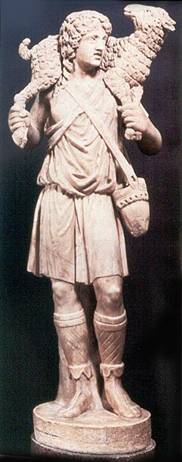
Let me close this post with a few samples of early Christian art:


A statue of the Good Shepherd from the Catacombs of Domitilla, circa 225 AD

http://img233.imageshack.us/img233/3876/madonnacatacombpriscill.jpg
A fresco of Mary and the Child Jesus from the Catacomb of St Priscilla, Rome, circa 2nd century AD

http://img233.imageshack.us/img233/565/fig48p173.jpg
 
😃 I’m surprised how sweet your post was compared to everyone who is enjoying starting arguments with me…well, check this out; :whacky:

God tells us that we should not sin. Why? Because sin takes us away from him.

I was in church last friday (weekday mass) and after mass I went into our special room for prayer to Mary. I sat down and in no time at all the room filled up with so many people that they had to queue out side and wait for others to finish praying and leave so that they could get in. Well after squeezing my way out I finally managed to exit the room, back into the chapel. When i broke free I went to the room with the sacred heart of christ and I was the only person in there. No one else came, there were only two candles lit in there even though Mary’s room was filled up with lots of candles lit. I stayed there for quite a while kneeling and not a single person came in.

God said do not make statues for your self… I think that this is why;

God tells us that we should not sin. Why? Because sin takes us away from him.

xxx zundrah xxx
I used to wonder about that myself until I realized that people wish to be closer to those who are apart from them,who they don’t have an intimate contact with.If you have the Eucharist you have a personal and intimate contact with Him. Focal points are unimportant if you are physicallly close to the One you love… Your photos of loved ones in your wallet aren’t so important when you are with that person as when you are apart. Same here.
 
Oh, probably idolatry. what’s your point.?
I think the Israelites would see it as idolatry also. Because of this, I’m not sure I understand the Catholic arguments that go back to the OT in support of the use of statues. Mainly because the Israelites did not use icons in the same manner Catholic do today and would surely see current Catholic piety as idolatry.
Are saying that attitudes, ideas, concepts, perceptions,don’t change? If some perceives idolatry through the prism of culture upbringing that makes him automatically correct.? Not all statues were worshipped. They were memorials, art, honors.Motive and belief make an idol just that…I have a statue of the Venus de Milo,I have a statue of Michaelangelo’s Pieta-do I worship them?
I am guessing that you don’t use the statues of Venus de Milo or Michaelangelo’s Pieta in the manner a Catholic parish would make use of say a statue of Mary on May day.
Some branches of Christianity see Photos and paintings of humans as idolatry, does that make it so?
No that doesn’t make it so, but why does it matter?
If we are to really obey what is taken for idolatry then no images should be allowed -period.
That is a very strong statement. Why do you believe that if “we are to really obey what is taken for idolatry then no images should be allowed -period”?
40.png
juliamajor:
Can’t something intangible become an idol? Power, lust greed etc?
Absolutely something intangible can be taken for idolatry.

ISTM that the manner in which Catholics make use of the various icons/statues borders on idolatry. Bowing down in front of a statue of a saint, lighting candles, etc. are all acts of worship that are reserved for God alone.
 
Zundrah, I too would like to apologize sincerely if I ever gave that impression. 😦

Let me close this post with a few samples of early Christian art:

http://upload.wikimedia.org/wikipedia/commons/c/c2/Good.Shepherd.Vatican.Museum.jpg
A statue of the Good Shepherd from the Catacombs of Domitilla, circa 225 AD

http://img233.imageshack.us/img233/3876/madonnacatacombpriscill.jpg
A fresco of Mary and the Child Jesus from the Catacomb of St Priscilla, Rome, circa 2nd century AD

http://img233.imageshack.us/img233/565/fig48p173.jpg
No worries there, let’s just forget the minor craziness! 😛 Let’s commence in the OP!

P.S. These pictures are nice, do you research history?
 
I agree that let’s leave it to Zundrah to research for himself and “test the spirits”, so to say. But I will say this. The so-called “Constantinian shift” - the one you mention - fails to take into account one tiny thing:

Proponents of the shift depict history as if during the time of Constantine, there was a perpetual time of peace where Church became increasingly more powerful - leading to the huge influx of pagans and all that. However, it was only later that ‘orthodox Christianity’ won out - its proponents are too kind to suggest that Christianity was no longer hindered since then! 😛 Constantine himself later also proved to be a burden of sorts to orthodox Christians during the Arian controversy.

Although he was committed to maintaining what the church had defined at Nicea, Constantine was also bent on pacifying the situation and eventually became more lenient toward those condemned and exiled at the council. First he allowed the Arian bishop Eusebius of Nicomedia, who was a protégé of his sister, and Theognis to return once they had signed an ambiguous statement of faith. The two, and other friends of Arius, worked for Arius’ rehabilitation. At the First Synod of Tyre in 335, they brought accusations against Athanasius, bishop of Alexandria, the primary opponent of Arius; after this, Constantine had Athanasius banished, since he considered him an impediment to reconciliation. Eusebius and Theognis remained in the favor of the Emperor and his family, and when Constantine accepted baptism on his deathbed, it was from Eusebius of Nicomedia.

After Constantine’s death in 337, open dispute resumed again. Constantine’s son Constantius II, who had become Emperor of the eastern part of the Empire, actually encouraged the Arians and set out to reverse the Nicene creed. His advisor in these affairs was Eusebius of Nicomedia, who had already at the Council of Nicea been the head of the Arian party, who also was made bishop of Constantinople.

Constantius used his power to exile bishops adhering to the Nicene creed, especially Athanasius of Alexandria, who fled to Rome. In 355 Constantius became the sole Emperor and extended his pro-Arian policy toward the western provinces, frequently using force to push through his creed, even exiling Pope Liberius and installing Antipope Felix II. As debates raged in an attempt to come up with a new formula, three camps evolved among the opponents of the Nicene creed, each preferring a different terminology over the other. The first group mainly opposed the terminology used in Nicea and preferred the term homoiousios (alike in substance) to the Nicene homoousios (same substance), while they rejected Arius and his teaching and accepted the equality and coeternality of the persons of the Trinity. Because of this centrist position, and despite their rejection of Arius, they were called “semi-Arians” by their opponents. The second group also avoided invoking the name of Arius, but in large part followed Arius’ teachings and, in another attempted compromise wording, described the Son as “being like” (homoios) the Father. A third group explicitly called upon Arius and described the Son as “unlike” (anhomoios) the Father. Constantius wavered in his support between the first and the second party, while harshly persecuting the third.

The debates between these groups resulted in numerous synods, among them the Council of Sardica in 343, the Council of Sirmium in 358 and the double Council of Rimini and Seleucia in 359, and no less than fourteen further creed formulas between 340 and 360, leading the pagan observer Ammianus Marcellinus to comment sarcastically: “The highways were covered with galloping bishops.” None of these attempts was acceptable to the defenders of Nicene orthodoxy: writing about the latter councils, Saint Jerome remarked that the world “awoke with a groan to find itself Arian.”
Thank you for the additional historical information.
 
(continued)

…text cut to fit the post…

Tell me, in the light of all this chaos and persecutions, would the huge flux of pagans still be a possibility?
I didn’t realize that you had a second post when I replied earlier…but yes, I do still believe that there was a significant pagan influence in the Roman Catholic Church. I lived in Italy for 6 years and was Roman Catholic most of my life and I witnessed that many of the practices are more obviously pagan in origin in the villages of Italy than you see here in the USA.

In my church, we are reading/studying Judges at this time and this passage made me think that God may have made this issue a thorn in the side of the Roman Catholic Church for not being obedient. What are your thoughts?

Judges 2
Israel’s Disobedience
1 Then the Angel of the LORD came up from Gilgal to Bochim, and said: “I led you up from Egypt and brought you to the land of which I swore to your fathers; and I said, ‘I will never break My covenant with you. 2 And you shall make no covenant with the inhabitants of this land; you shall tear down their altars.’ But you have not obeyed My voice. Why have you done this? 3 Therefore I also said, ‘I will not drive them out before you; but they shall be thorns in your side,[a] and their gods shall be a snare to you.’” 4 So it was, when the Angel of the LORD spoke these words to all the children of Israel, that the people lifted up their voices and wept.
5 Then they called the name of that place Bochim;** and they sacrificed there to the LORD. 6 And when Joshua had dismissed the people, the children of Israel went each to his own inheritance to possess the land.**
 
think the Israelites would see it as idolatry also. Because of this, I’m not sure I understand the Catholic arguments that go back to the OT in support of the use of statues. Mainly because the Israelites did not use icons in the same manner Catholic do today and would surely see current Catholic piety as idolatry.

i think people should use the common sense God gave them. Spouting scripture back and forth accomplishes nothing- it gets to be a damn tennis match- back and forth, forth and back. It makes my eyes bleed. If one cannot see the difference between the icons and idols then their knowledge of history and culture is flawed.Or their eyes are blinded by their bias for or against particular religious background.Piety should not include prejudice.or promote hatred or dislike.
I am guessing that you don’t use the statues of Venus de Milo or Michaelangelo’s Pieta in the manner a Catholic parish would make use of say a statue of Mary on May day.

Having seen both sculptures and peoples reaction to them -I’d say your wrong about that. Besides we’re honoring Mary in May not her statue. Since we are not in heaven to give Mary flowers we place them by her statue … Just like you leave flowers by a roadside shrine of someone who died in an accident.We know that they are not in that spot but we know they see us from heaven.From my cultural background and many others I have encountered this is suitable and acceptable behavior that is understood by the masses.
No that doesn’t make it so, but why does it matter?

Quote:
Originally Posted by juliamajor
If we are to really obey what is taken for idolatry then no images should be allowed -period.

That is a very strong statement. Why do you believe that if “we are to really obey what is taken for idolatry then no images should be allowed -period”?
No image of any likeness of what is in the heavens(angels, clouds, moon, the heavens, birds) or the earth below(humans, flora, fauna critters) or in the waters under the earth (more critters) if taken literally that doesn’t leave a heck of a lot that can pictured.If strictly enforced. the Amish do! Because anyone and anytghing can become an idol- which is true, if you think about it.
I find it is the last part of your missive that really gets in my craw and irritates me.It’s really denigrating (which is the point isn’t it)the Romans called us “atheists” to minimize us and make us pariahs- I see very little in that particular action or the slur that we are pagans, idolaters. A lot has to do with cultural .My cousins and relatives who fall into unchurch and non-believer category see lighting candles as respect as the bowing down, which in many cultures a sign of respect and honor-not worship. Worship requires thought,-no thought no worship. If you are not truly "there’ in mind and spirit-have you truly worshipped.By speaking words without understanding or consideration-can you really prayer. What looks like worship does’not mean it is .conscious thought mind and spirit must go into it to constitute true worship. Who is the object of that worship is really hidden in the soul of the worshipper. Outside demeanor does not mean one’s soul is true-or false.
 
I didn’t realize that you had a second post when I replied earlier…but yes, I do still believe that there was a significant pagan influence in the Roman Catholic Church. I lived in Italy for 6 years and was Roman Catholic most of my life and I witnessed that many of the practices are more obviously pagan in origin in the villages of Italy than you see here in the USA.

In my church, we are reading/studying Judges at this time and this passage made me think that God may have made this issue a thorn in the side of the Roman Catholic Church for not being obedient. What are your thoughts?

Judges 2
Israel’s Disobedience
1 Then the Angel of the LORD came up from Gilgal to Bochim, and said: “I led you up from Egypt and brought you to the land of which I swore to your fathers; and I said, ‘I will never break My covenant with you. 2 And you shall make no covenant with the inhabitants of this land; you shall tear down their altars.’ But you have not obeyed My voice. Why have you done this? 3 Therefore I also said, ‘I will not drive them out before you; but they shall be thorns in your side,[a] and their gods shall be a snare to you.’” 4 So it was, when the Angel of the LORD spoke these words to all the children of Israel, that the people lifted up their voices and wept.
5 Then they called the name of that place Bochim;** and they sacrificed there to the LORD. 6 And when Joshua had dismissed the people, the children of Israel went each to his own inheritance to possess the land.**

Do you know a lot of practices in OT have their roots in paganism. The Passover(a nomad shepherds feast) predates Israelite Passover. Just at the feast of unleavened bread is based on agricultural feast that again predates monotheism.I really don’t care who or what you saw(more then likely cultural feasts). the sacrificial offerings come from the canaanite method of worship. The horns of the altar are on every Canaanite altar also. Names of God were adapted from the surrounding nations. El, baal, elohim come from the pagans. The original calendar was replaced by the one they adapted from the babylonian.Asherah were common in israelite rural homes where YHWH was thought to have a wife. Become more aware of the evidence of archaeology, socio-cultural and historical facts before Blowing hot air around. I just happen to be one of those “paganesque” Italians.Six years apparently isn’t enough to disuade someone of his cultural pretensions.
 
I’m sure this has already been discussed but which council was it that dealt with the iconoclasts?
 
I’m sure this has already been discussed but which council was it that dealt with the iconoclasts?
It was the Second Council of Nicea in 787.

To make our confession short, we keep unchanged all the ecclesiastical traditions handed down to us, whether in writing or verbally, one of which is the making of pictorial representations, agreeable to the history of the preaching of the Gospel, a tradition useful in many respects, but especially in this, that so the incarnation of the Word of God is shown forth as real and not merely phantastic, for these have mutual indications and without doubt have also mutual significations.

We, therefore, following the royal pathway and the divinely inspired authority of our holy Fathers and the traditions of the universal Church (for, as we all know, the Holy Spirit indwells her), define with all certitude and accuracy that just as the figure of the precious and life-giving Cross, so also the venerable and holy images, as well in painting and mosaic as of other fit materials, should be set forth in the holy churches of God, and on the sacred vessels and on the vestments and on hangings and in pictures both in houses and by the wayside, to wit, the figure of our Lord God and Savior Jesus Christ, of our spotless Lady, the God-bearer, of the honorable Angels, of all Saints and of all pious people.

The more frequently they are seen in representational art, the more are those who see them drawn to remember and long for those who serve as models, and to pay these images the tribute of salutation and respectful veneration. Certainly this is not the full adoration in accordance with our faith, which is properly paid only to the Divine Nature, but it resembles that given to the figure of the honored and life-giving Cross, and also to the holy books of the Gospels and to other sacred cult objects. Further, people are drawn to honor these images with the offering of incense and lights, as was piously established by ancient custom. Indeed, the honor paid to an image traverses it, reaching the model, and he who venerates the image, venerates the person represented in that image.

So it is that the teaching of our holy Fathers is strengthened, namely, the tradition of the universal Church which has received the gospel from one end of the earth to the other. So it is that we really follow Paul, who spoke in Christ, and the entire divine apostolic group and the holiness of the Fathers, “clinging fast to the traditions which we have received (cf. 2 Thessalonians 2:15).” So it is that we sing out with the prophets the hymns of victory to the church:

“Rejoice greatly, O daughter Sion; Proclaim, O daughter Jerusalem! Rejoice and be glad with all your heart. The Lord has taken away from you the oppression of your adversaries; you are redeemed from the hand of your enemies. The Lord is a King in the midst of you; you shall not see evil any more,” and peace be to you forever! (Zephaniah 3:14-15)

Those, therefore who dare to think or teach otherwise, or as wicked heretics to spurn the traditions of the Church and to invent some novelty, or else to reject some of those things which the Church has received (e.g., the Book of the Gospels, or the image of the cross, or the pictorial icons, or the holy relics of a martyr), or evilly and sharply to devise anything subversive of the lawful traditions of the universal Church or to turn to common uses the sacred vessels or the venerable monasteries, if they be Bishops or Clerics, we command that they be deposed; if religious or laics, that they be cut off from communion.
 
Status
Not open for further replies.
Back
Top