Catholicism and Climate Change

  • Thread starter Thread starter jaserius
  • Start date Start date
Status
Not open for further replies.
AHHhhhhhhhhh At what value is lambda figured at? 🙂

Ludwig Boltzmann’s law, lambda’s true value is just 0.22-0.3C per watt. A century old law ].
Heh – I should have thought to Google your words beforehand. I didn’t realise you would be copying-and-pasting from the great Lord Monckton! 😃

All jokes aside about how reliable your “skeptical” radar is, the most important observation is that the only thing the value his lambda has in common with Gavin’s lambda is that they happened to choose the same name – lambda.

It’s as if I said “X marks the spot” and somebody else said “X marks the spot” and you assumed that both Xs must therefore be the same spot because we both called them “X”. 🙂

Monckton’s lambda has units of degrees C per Watts per m2 and it represents the climate sensitivity. The precise value of Monkton’s lambda in the real world is the subject of much research (and isn’t specified by Boltzmann – if only it were that simple!). Gavin actually goes on to calculate what Monkton calls lambda for this toy model under the heading “Climate Sensitivity” and comes up with the value 0.3 C per W/m2 – exactly the value you were looking for!

Gavin’s lambda is dimensionless – it’s simply the proportion of the radiation emitted by the ground that gets absorbed by the atmosphere, and it’s a value between 0 and 1.

The value for Gavin’s lambda comes from direct measurement and has been measured many times over decades.

Clearly you don’t really understand these things and are just parroting what you’ve read on your “trusted” sites. I really wish you’d actually try to understand because it really isn’t that difficult and I believe you could if you wanted to. Perhaps now that you know you could use Gavin’s model to derive the value you were looking for you will now be sufficiently motivated to understand how it works. You would then be in a position to give other information that you came across at least a basic “sniff test”. The only thing you’re being asked to accept on faith in that model is the value for lambda, but the value Gavin gave really is roughly what is measured (it, of course, changes based on whether it’s cloudy or not!) and you can freely search for independent verification if you want, or even try different numbers – all that it will do is change the surface temperature because, surprise surprise, the temperature at the surface depends on how much radiation is absorbed and re-emitted by the atmosphere! That’s what the model is really trying to illustrate.

I hope you understand now why that earlier site you pointed to that claimed this was “proof” that Gavin was “doubling the greenhouse effect” was so – well, wrong. It recreates the climate sensitivity that you were searching for.

Just to go back to the “Incoming must be equal to Outgoing because we’re at equilibrium” comments because you seemed to have difficulty with what was actually going on there as well – all that was saying is energy going in has to equal energy going out. No more, no less. Exactly that. If that’s not true then the temperature will be rising or falling. In our simple model we were assuming that there was no change (i.e. there had been enough time for the system to reach equilibrium) and we just wanted to figure out how big the energy flows were and therefore deduce temperatures using the Stefan-Boltzmann Law. You will note that nowhere is Monckton’s lambda to be found in the model – it’s something you derive from the model, just like in real climate models. When you construct a physics-based climate model you don’t know in advance what the climate sensitivity is going to turn out to be, that’s one of the reasons you are constructing it – to find out what it is. Hopefully, the more realistic you make the model, the more accurate the sensitivity calculation you derive from it will be.
 
The fact that you think that proves you didn’t understand. There is no disagreement between that video and NOAA.
No disagreement except that the video showed short term trends all being positive and NOAA showed the decadal trend as zero. I guess if you don’t think there is no difference between 0.00 and 0.12 your point is well taken.
Feel free to explain exactly what facts you disagree with and what you think is wrong with the conclusion.
That would be 0.00 vs 0.12 and the significance of short term trends.
Ah, see, this is why I wanted to be able to see the original material and find out what they actually said in context:
What context changes the value 0.00?
If we had 15 years of no trend, adjusting for ENSO, then we could say “Hmm… The actual data is “inconsistent” with this particular climate model.” But if that doesn’t actually happen then you can’t complain that the model is wrong – and that was just one of them.
Really, I understand the difference between a 15 year trend and a 10 year trend. The point we were addressing, however, was whether short term trends (in this case 15 years) were significant, and as NOAA points out - and contrary to the video - they may be.

Ender
 
Actually, since weather goes up and down all the time, time periods do account for a difference, especially when they’re too short. That’s the take-home message of both that video and the NOAA report.
I’m sure you can respond to my comments without having to change them first. Obviously the different time periods do account for some of the difference; they do not however account for all of it. Nor have I contended that there is no such thing as a time period too short to matter, but NOAA and your video do surely differ on their perception of what that period is.
But more importantly, NOAA were trying to remove the effect of ENSO. Jones was asked about his global temperature record. If he tried to change the subject and mention something about ENSO corrections you can guarantee that “skeptics” would have been all over him for trying to avoid answering the question.
If you mean that NOAA were trying to be accurate and Jones was trying to sell his position, I would agree with you.
Actually, Jones published a very interesting paper on what the temperature trend looks like if you remove known forcings with reasonable physical parameterisations, and, sure enough, when you remove extraneous factors you make the signal:noise ratio of the climate stronger and easier to see that yes, it has in fact kept climbing steadily.
Clearly something has to be done to explain away uncooperative data and a decade with 0.00 degrees of warming is surely uncooperative.
I’m sorry, but I think you completely misunderstand the situation.
That could be; I don’t have a degree in meteorology. Still, I’m pretty sure I can understand terms like “decade” and 0.00.
Firstly, you can’t just “correct for ENSO”. You have to use a physically-plausible parameter estimation technique to come up with a reasonable ENSO correction.
I can’t correct for ENSO under any conditions, that’s why I accepted NOAA’s assessment. If you think they’ve done it wrong, take it up with them.
(The huge irony of all this, of course, is that if you do apply those corrections then the global warming signal is stronger! Then everyone will say the global warming trend is because of bogus corrections for ENSO!)
You could be right but that conclusion isn’t the obvious one given that the uncorrected data shows a decadal trend of 0.08 degrees and the corrected data is 0.00. If the corrected data showed a stronger global warming signal shouldn’t it have been higher than rather than lower?
It is certainly not “disingeneous” to publish a temperature anomaly record that is, in fact, exactly that – a temperature anomaly record.
Once again you have to change the facts in order to find a response. We weren’t talking about what CRU’s mission is, we were talking about Jones’ reply to a specific question: *“do you agree that from 1995 to the present there has been no statistically significant global warming?” *In response Jones said yes, adding that the average increase of 0.12C per year over that time period “is quite close to the significance level.” The point here is that, in order to make it seem as if that fact was of little significance, Jones included in his global warming value the ENSO contribution - which no one is concerned about in relation to global warming. That’s what was disingenuous.
I think you’ll find that correcting for ENSO over the 15 year time period actually makes the trend more certain, not less. Look very carefully at the graph I posted above and see what happened in the years 1995-1999 when ENSO-correction is applied. What do you think the slope of the trend 1995-2008 will be compared to 1999-2008 using the ENSO-corrected data?
I’m sure I have no idea what the 15 year ENSO corrected trend would actually look like. I was working from the basic assumption that when you subtract from something it usually gets smaller, not larger. Are you suggesting that if the ENSO effect is removed from the 1995-2008 data that the trend would be greater than the 0.12 degrees Jones claimed? Color me skeptical.
You sent me down completely the wrong path because you said “2009 annual State of the Climate report” when in fact it is their 2008 report. So the dates are even more wrong than you thought.
No, it was their 2009 report - which summarized the decade ending in 2008. Nonetheless a decade is still the same size whether measured from 1999-2008 or from 2000-2009 so the significance of the data is unchanged.

Ender
 
No disagreement except that the video showed short term trends all being positive
OK, I assumed you knew the background to that video but apparently not. Here is the interview that spawned all of the headlines that there’s been no global warming since 1995: news.bbc.co.uk/2/hi/science/nature/8511670.stm#

Question A asked about the “global temperature record used by the IPCC” and, since his is one of the temperature records used by the IPCC I assume his answers are based on his record, although it wouldn’t make much difference.

Question B specifically asked “Do you agree that from 1995 to the present there has been no statistically-significant global warming?”

This was really a trick question, because if you start in 1994 with his data the global warming is statistically significant at the 95% confidence level, but if you start in 1995 it is “only” 92%. So Jones answered that the trend was 0.12 (which is correct) but that it was not significant at the 95% confidence level (it’s actually 92%) and that it’s because the period is too short.

That was turned into “Climategate U-turn as scientist at centre of row admits: There has been no global warming since 1995”, which is obviously not the same thing at all. dailymail.co.uk/news/article-1250872/Climategate-U-turn-Astonishment-scientist-centre-global-warming-email-row-admits-data-organised.html

The purpose of that video is to address the specific criticism that because there had been no statistically significant global warming since 1995 it meant that there was “no global warming”. It highlighted the fact that there have been multiple periods of 15 years of “no statistically significant global warming” and yet they are obviously embedded within a long term warming trend.

It didn’t show that there were also many short term trends within that overall warming period as well because that wasn’t the point.

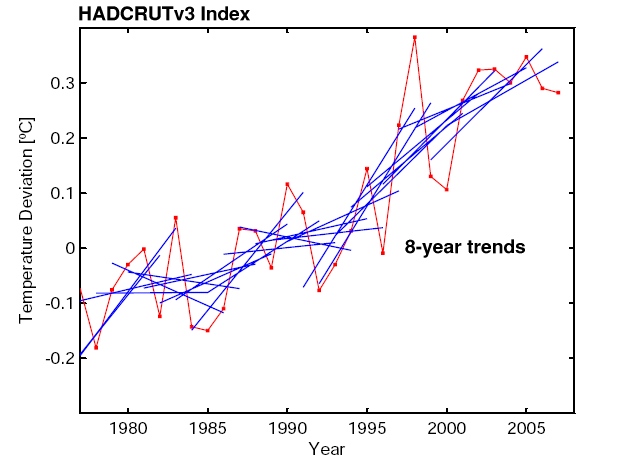
But I did. Here’s another, showing all the different eight-year trends you can get from Jones’ data since 1975:


Every single blue line you can see in there that’s going down is a negative trend. Every single blue line that’s flat is a zero trend. They happen all the time. And yet they are happening within a larger trend that’s steadily climbing upwards. That’s why there’s no point asking if a particular ten year trend means global warming has stopped.
and NOAA showed the decadal trend as zero. I guess if you don’t think there is no difference between 0.00 and 0.12 your point is well taken.
NOAA were not only showing a trend for a ten year period instead of the 15 year period, they weren’t even comparing the same thing. Jones was using his global temperature data set. NOAA did some additional processing to remove the effect of ENSO. If you do additional processing to remove the effect of ENSO from Jones’ 15 year period, the trend is much greater than 0!

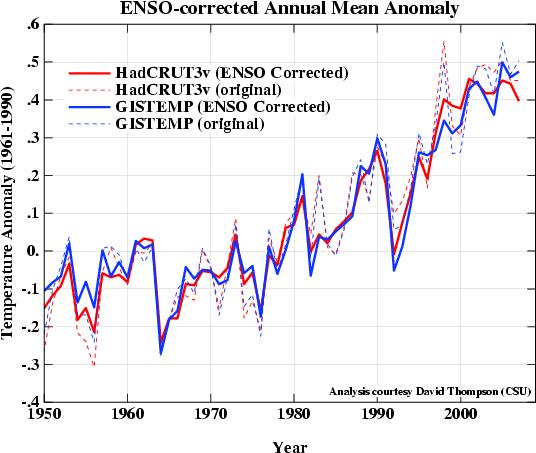
Look at the image I gave you before:


Look at the red line from 1999 to 2008. See how it looks like it has no trend? That’s the line NOAA were talking about. Now go back five years earlier and look at the red line from 1995 to 2009. It’ll start at around 0.25 and end at around 0.4. That’s the period Phil Jones was talking about. Why was he talking about that period? Because that’s the period the BBC asked him about. If he did use ENSO-corrected data, he still would have had a positive trend, and it would have had statistical significance. It would have been better for him to use ENSO-corrected data. Of course they wouldn’t have let him get away with that!
That would be 0.00 vs 0.12 and the significance of short term trends.
0.00 vs 0.12 are both indisputable facts. NOAA got 0.00 for 1999-2008 with ENSO-corrected data, Jones got 0.12 for 1995-2009 with his temperature data, and he would have still got about that if he used ENSO-corrected data. If you look at the graph above you can see why.

As for the significance of short term trends – if you can look at that first graph and see the blue lines going in any which way even while the long term trend is steadily climbing, how can you support the argument that short term trends are meaningful?

NOAA said “Near-zero and even negative trends are common for intervals of a decade or less in the simulations, due to the model’s internal climate variability.”

Is NOAA right or do you contest their report and reject their finding?
What context changes the value 0.00?
The fact that NOAA explicitly stated that near-zero and even negative trends are common for a decade or less, and that the trend would have to be near-zero or negative for at least 15 years to be significant. Didn’t you read what they actually said?
Really, I understand the difference between a 15 year trend and a 10 year trend. The point we were addressing, however, was whether short term trends (in this case 15 years) were significant, and as NOAA points out - and contrary to the video - they may be.
NOAA points out that using the one model they used there was only a 1 in 20 chance of a 15 year trend being negative. But we don’t have a 15 year trend that’s close to zero, let alone negative. If we get a 15 year trend with a zero or negative value, we’ll talk. Until then, let’s just wait and see if it happens, eh?
 
I’m sure you can respond to my comments without having to change them first. Obviously the different time periods do account for some of the difference; they do not however account for all of it.
Correct, that’s why I said “time periods do account for a difference” and later pointed out the rather obvious fact that ENSO had been accounted for. And I wasn’t aware that I had changed your comments.
Nor have I contended that there is no such thing as a time period too short to matter, but NOAA and your video do surely differ on their perception of what that period is.
And quite rightly. Because they’re talking about different things.

The video talked about four periods in the HadCRUT temperature series that were 15 years long and that were not statistically significant at the 95% confidence level. This is a fact that could be confirmed by any statistician (or even Excel) and is determined by the properties of the data itself. You give the same data to any statistician (or even Excel) and you’ll get the same answer.

NOAA did something different. They ran a climate model a whole bunch of times and checked how many times it produced a negative trend. They found that it would only produce a negative trend of 15 years or more about 5% of the time. So they concluded that you would need at least 15 years of near-zero or negative trend before you would start worrying about the model.

Note the first difference? One is talking about actual data, the other is looking at model runs.

Secondly, one is talking about positive trends that have too much noise in them to pass the 95% statistical significance test. There have been multiple such trends.

The other is talking about how long a zero or negative trend would need to be to call into question whether global warming was continuing. (Based on that one particular model did, I might add.) Since 1975 there have been none.

Of course, on top of that, the first was using the temperature data, the second was using temperature-data-adjusted-for-ENSO, which makes them even more incomparable.
If you mean that NOAA were trying to be accurate and Jones was trying to sell his position, I would agree with you.
I find it hard to believe anyone could come to that conclusion. His answer was absolutely correct and he was asked specifically about his temperature record. He got lambasted in the climate science community for falling for the trick question and not making sure his answer couldn’t be interpreted as there not being any warming, which it was.
Clearly something has to be done to explain away uncooperative data and a decade with 0.00 degrees of warming is surely uncooperative.
Nobody cares about a decade. Not even NOAA.

I really don’t understand, in one case your accusing Jones of trying to “sell his position” for answering the question truthfully instead of trying to make it look better by using ENSO, etc., and in the other case where he is trying to take out the effects of ENSO you assume his intentions are bad as well.
That could be; I don’t have a degree in meteorology. Still, I’m pretty sure I can understand terms like “decade” and 0.00.
Can you understand NOAA’s statement that a decade of 0.00 is not significant?
I can’t correct for ENSO under any conditions, that’s why I accepted NOAA’s assessment. If you think they’ve done it wrong, take it up with them.
I don’t doubt NOAA’s assessment of that 10 year period – all of the tests I’ve seen (like the graph I showed above) were over longer periods, where it quite obviously did straighten out the trend line, but in the graph I showed you can quite clearly see that HadCRUT declines in the last eight years or so.
You could be right but that conclusion isn’t the obvious one given that the uncorrected data shows a decadal trend of 0.08 degrees and the corrected data is 0.00. If the corrected data showed a stronger global warming signal shouldn’t it have been higher than rather than lower?
That would be true if ENSO plus AGW were the only things affecting the temperature readings. They are not. See how much the lines still wiggle up and down in the graph above even with ENSO removed?

So is the earth still warming? You tell me:

http://www.skepticalscience.com/images/Total-Heat-Content.gif
 
Once again you have to change the facts in order to find a response.
Please don’t assume malicious intent. I’m spending a lot of time to answer a lot of questions in the hope that it will be helpful.
We weren’t talking about what CRU’s mission is, we were talking about Jones’ reply to a specific question: *“do you agree that from 1995 to the present there has been no statistically significant global warming?” *In response Jones said yes, adding that the average increase of 0.12C per year over that time period “is quite close to the significance level.” The point here is that, in order to make it seem as if that fact was of little significance, Jones included in his global warming value the ENSO contribution - which no one is concerned about in relation to global warming. That’s what was disingenuous.
Once again you accuse someone of misdeeds for answering completely honestly.

If he used GISS temperature data instead of his own, he would have been able to say the warming was statistically significant.

If he used ENSO-adjusted versions of his own, he would have been able to say the warming was statistically significant, because with ENSO included it counts as “noise”, but removing it reduces the noise which increases the significance.

You are making the assumption that if he had taken into account ENSO that he would have been forced to say that he had a statistically-significant lack of trend, but you can see from the graph yourself that that wouldn’t have happened. Look at the graph! There was a strong rise in the ENSO-adjusted data from 1995 to 2001, then it wiggled down and up and down again. If you fit a trend from 1995 to 2009 the trend will be positive!

I can absolutely guarantee that the person who formulated the question wanted his answer to apply to Jones’ actual temperature data. How do I know? Because it came from here: wattsupwiththat.com/2008/03/11/a-note-from-richard-lindzen-on-statistically-significant-warming/ That’s Jones’ data!
I’m sure I have no idea what the 15 year ENSO corrected trend would actually look like.
I’ve shown you a graph, you can get a rough idea just by looking at it.
I was working from the basic assumption that when you subtract from something it usually gets smaller, not larger.
Climate is noisy. If global temperature was simply AGW + ENSO then removing ENSO would leave only AGW and your maths would be right. But it isn’t. Look at the graph. It’s still noisy. NOAA said that the noise left over after ENSO was removed could cause a zero or negative trend of up to nearly 15 years and still not be a surprise. That’s how much noise is still left.
Are you suggesting that if the ENSO effect is removed from the 1995-2008 data that the trend would be greater than the 0.12 degrees Jones claimed? Color me skeptical.
I don’t know the exact figure but I can guarantee that it would be positive and I can guarantee that it would be statistically significant. Why? Well, the first I can see just from looking at the graph, the slope would be around 0.1 (0.25 to 0.4 over a 15 year period); the second I can predict based on the fact that removing ENSO takes away something that is seen as noise in the original data (and noise is what determines how much data is required for statistical significance) and the original data was already statistically significant at the 92% level.

And to answer the question “Do you agree that from 1995 to the present there has been no statistically-significant global warming?” with a “No, I do not agree” all that he needed was a positive trend – any positive trend – that was statistically significant.
No, it was their 2009 report - which summarized the decade ending in 2008.
No, it was their 2008 report, which came out in 2009. There is now a separate 2009 report, which I downloaded and searched through first trying to find your information.
Nonetheless a decade is still the same size whether measured from 1999-2008 or from 2000-2009 so the significance of the data is unchanged.
The point is that they don’t include this analysis in the 2009 report so I couldn’t check what they said. Chances are the decade 2000-2009 will have a different trend again.
 
opinion mode on ]

IMHO, A Bigger problem with AGW’ers is a Bully Boy attitude. It seems, to me, that they are way TOO defensive. Here IMHO are ways to protect jobs / science…of AGW.

When Asked questions like why “lambda” values have to be increasing changed ] - to get a required result … Notice my post - It was a Question not an accusation ]…Well…I’ll let the responses speak for themselves.

IMHO, If one needs to keep setting different values either up or down ] to get wanted results - that says, the base equation is in error. In other words set the value - defend the reason for that value - stick to that value.

IMHO The second problem, is the use of circular reasoning - Or attempted “shift of evidence”.

IMHO The sole reason Mr Jason came here is to convince us of his claims - The 'burden of evidence" is solely his.

IMHO Until AGW’ers - Climatologists - IPCC, etc, etc, separate themselves from the likes of Greenpeace , WWF , etc, etc, and the hyperbole - Economics, and politicization, As far as I’m concerned, they are paid VERY handsomely, And should be the VANGUARDS of protecting their Science, If they don’t, or can’t, do this - they will continue to suffer from public opinions. When a false claim is made - They need to be the ones to debunk it - PERIOD. BUT debunking and suppression of opposing views are to quote ] “Poles Apart”.

IMHO They need to understand allowing false or shoddy claims to stand At ANY point within IPCC reports ] - INCLUDING “Solutions Offered” - Harms their whole credibility with the public.

IMHO It is not the skeptical public they should be debating - We are NOT the enemy. The real Enemy is what they allow themselves to be associated / Aligned with.

IMHO They need to understand the “Solutions” don’t "mitigate 1 C of temperature. AS far as I can tell, the Closest figure using their figures ] is approximately LESS than NINE - THOUSANDTHS of a degree C AND at that it, “SAVES NOTHING”. No Shrinkage, no animals, no oceans, etc, etc, etc,

IMHO They need to promote SOUND environmental ideas - NOT false Economics

IMHO At one time the Lawyer - Used Car Salesman - Politicians held this dishonorable distinction…ALONE

IMHO The credibility of AGW’s , would be, much more convincing - it attitudes - snark remarks - didn’t come to play …save that for your real enemies

Opinion Mode off ]
 
AS far as I can Tell, AGW"s are perfectly content to lecture the need to sweep our own houses… without cleaning their own houses meaning not just their own footprints BUT more their associations ]. THIS, IMHO is BAD Logic, and throws an air of dishonest credibility to the WHOLE of AGW.

I see nothing Christian about being expected to serve unelected officials of any body. Unless they be Church or Jesus.

I see nothing Christian about being expected to contribute to an unaccountable World Fund. Especially, when that Fund doesn’t even address Climate.
 
Hmmmmmmm

CO2 blocks IR =>
But CO2 emits IR =>

Therefore:

More CO2 warms =>
And more CO2 cools =>

Therefore:

More CO2 causes warming =>
More CO2 causes cooling =>*
  • IF Air heated at the surface rises by convective currents, and then is cooled by IR emission into space. The addition of CO2 to this warm air mass increases the rate of cooling thereby - increasing the rate of cooling of the atmosphere. ]
So, How do AGW’ers just attribute warming to CO2? 🙂
 
I don’t know the exact figure but I can guarantee that it would be positive and I can guarantee that it would be statistically significant.
The graph I showed before had ENSO-adjusted figures from 1950 to 2007. I decided to calculate the linear trend from 1995 to 2007 to get an idea of what Phil Jones would have been able to say if he had been able to answer with ENSO-adjusted figures, so that you can see he wasn’t being disingenuous in answering the way he did.

First, here is the linear trend using the annual totals taken from the graph I showed before:

http://img443.imageshack.us/img443/2402/ensoadjusted.jpg

As you can see, the linear trend for ENSO-adjusted HadCRUT figures from 1995 to 2007 is higher than what he quoted for his non-ENSO-adjusted figures – 0.16 degrees C/decade. This is not surprising because in his raw figures he had the big 1998 El Nino year right at the beginning (dragging the beginning of the linear trend higher) and that year is completely omitted in the NOAA trend that starts in 1999.

Unfortunately I don’t have the figure for 2008 in there because it wasn’t in the original chart, but hopefully you can see that adding it in won’t make much difference from the next graph:

http://img718.imageshack.us/img718/2124/noaa.jpg

These are the graphs taken directly from the NOAA report you were referring to and have an extra year’s worth of data in there.

Firstly, in the top graph, I have put in red lines to show the start date for Jones’ answer. Because that start date is lower than the start date for the NOAA analysis, the trend would have to have been positive. You can also see clearly that the trend that Jones calculated, 0.12, which came from the grey line, had to cope with the big 1998 figure near the beginning, whereas the trend he would have been able to calculate if he had used ENSO-adjusted figures would have missed most of that. Also, the big drop near the end in the grey line becomes smaller in the blue, ENSO-adjusted line. Therefore Jones’ 0.12 trend had a higher value near the start and a lower value near the end and still managed to be 0.12. Using the ENSO-adjusted figures it’s not surprising that the trend would be higher.

(You’ll also note that when the extra year is added in, in the NOAA chart, it’s actually rebounding upwards from the 2007 figure that my chart ended on.)

Secondly, NOAA actually answered this question about start dates in the very next graph, by calculating the change in temperature for the ENSO-adjusted figures for every starting year from 2007 to 1984.

I’ve drawn a red circle around 1999, the start date they chose. Note how the trend from that start date is 0? I’ve also drawn a red circle around the start date 1995. Sure enough, the change from 1995 is clearly positive.

So there was absolutely nothing nefarious or disengenous about Jones’ answer and the NOAA data quite clearly shows that with 15 years of data the trend is unambiguously positive. He would have been better off being able to answer with ENSO-adjusted values, but of course he could not because he was asked specifically about his own values and he answered correctly.

Those who turned his answer into “There has been no global warming since 1995” were the ones who were being disingenuous. To not be 95% confident in something is not the same as being 95% confident in something else. It was still in the order of 20 times more likely that there was global warming since 1995 than no global warming since 1995.
 
opinion mode on ]

IMHO, A Bigger problem with AGW’ers is a Bully Boy attitude. It seems, to me, that they are way TOO defensive. Here IMHO are ways to protect jobs / science…of AGW.
So if I see a whole bunch of information that is obviously not true being spread around by someone who obviously doesn’t know what they’re talking about, and I try to spell out in detail what’s wrong with that information and patiently answer accusations of improprietary and ask for evidence of that I’m being a bully?

The very idea that I’d be doing it “to protect jobs / science” rather than because I hate to see people led astray is highly offensive. If anything I have a vested interest in the opposite because I’m the MD of a small software company that provides products and services to both the mining industry (including coal mining) and the oil & gas industry. But I can see beyond my own self interest and see how important it is to respond to something that could be devastating.
When Asked questions like why “lambda” values have to be increasing changed ] - to get a required result … Notice my post - It was a Question not an accusation ]…Well…I’ll let the responses speak for themselves.
Excuse me? This is you asking a QUESTION???
AHHhhhhhhhhh At what value is lambda figured at?
Ludwig Boltzmann’s law, lambda’s true value is just 0.22-0.3C per watt. A century old law ].
… Lots of insinuations deleted …]
Why does every other scientific field useing Ludwig Boltzmann’s law - Use lambda’s true value at just 0.22-0.3C per watt. BUT Climate Models don’t?
But ignoring your misunderstanding of what lambda was, let’s look at the value you were talking about, which is climate sensitivity. The reason it changes over time is because science progresses. One of the active areas of research is to try to pin down exactly how sensitive the climate is. Despite what Monckton might claim, it isn’t defined by “Boltzmann’s Law”, and despite what you claim, it isn’t something that’s just made up and entered into models. People create a climate model with as much physics as they can throw at it and then ask it what the resulting climate sensitivity is. All that we can do right now is rule out values below a certain level and values above a certain level and give a “best estimate” of what the true value is. We can rule out certain values because if it was too high or too low then the history of the earth over the last half billion years or so would have been completely different, which is a point Richard Alley made very well in the talk I linked to earlier.

The key point here is that the most likely value is cause for concern; the smallest likely value is less concerning, but still something we should be very worried about and acting on. And if you think the science is wrong, then you have to realise that it could just as easily be wrong in the wrong way.
IMHO, If one needs to keep setting different values either up or down ] to get wanted results - that says, the base equation is in error. In other words set the value - defend the reason for that value - stick to that value.
This is the fundamental misunderstanding I was talking about. We don’t know what the value is. It is something that has to be measured. You don’t put it into the climate models as (name removed by moderator)ut.

You think that a different behaviour for relative humidity might be important? You model that behaviour in your climate model and then find out what the result is. This is how it’s done. You couldn’t put in a value for climate sensitivity if you wanted to because “climate sensitivity” is the end result of a huge number of complex, interacting physical equations.
IMHO The second problem, is the use of circular reasoning - Or attempted “shift of evidence”.
IMHO The sole reason Mr Jason came here is to convince us of his claims - The 'burden of evidence" is solely his.
And this is where we disagree. Why? Imagine we’re in a court case. Human-emitted CO2 has been charged with the crime of global warming. The prosecution has proven, using laboratory experiments, that CO2 is a greenhouse gas. The prosecution has proven that humans are emitting vast quantities of CO2 into the atmosphere and has proven that as a consequence the atmospheric concentration of CO2 is rising and, through isotope analysis, has proven that the concentration of CO2 from fossil fuel burning is rising. The prosecution has shown satellite measurements that show over the last three decades the outgoing radiation is lower in the frequency bands that CO2 absorbs and emits radiation. The prosecution has shown ground-based measurements that show a corresponding increase in the radiation coming back down to earth from the sky in the same frequency bands that CO2 absorbs and emits radiation. (It’s lower going out for precisely the reason that half is being emitted back to earth.) The prosecution has shown that other possible perpetrators have iron-clad alibis – the sun hasn’t increased output for 50 years, for example. And, finally, the prosecution has presented reams of evidence that not only is the earth actually warming, but it’s warming in exactly the same way that the theory predicted it would.

Then the prosecution rests its case.

Now it’s the defence’s turn. Our court system believes in innocent until proven guilty, but the prosecution has made a compelling case. The burden of proof has now shifted and the defence had better have either a good alibi or identify someone else responsible for the crime.
 
IMHO Until AGW’ers - Climatologists - IPCC, etc, etc, separate themselves from the likes of Greenpeace , WWF , etc, etc, and the hyperbole - Economics, and politicization, As far as I’m concerned, they are paid VERY handsomely, And should be the VANGUARDS of protecting their Science, If they don’t, or can’t, do this - they will continue to suffer from public opinions. When a false claim is made - They need to be the ones to debunk it - PERIOD. BUT debunking and suppression of opposing views are to quote ] “Poles Apart”.
Well, firstly, I do not accept the characterisation of your first sentence. If you want to claim that anything in WG1 is anything other than hard-core science then it’s up to you to provide evidence of that, and WG1 is the one you need to attack because that’s the one that makes the case for AGW.

Secondly, the IPCC reviewers were volunteers. They weren’t paid for that at all. And if you believe the scientists are in it for the money – how many BMWs do you see in the average science department parking lot? People do science because they love it.

You should really read these if you want to know the truth:

profmandia.wordpress.com/2010/03/11/taking-the-money-for-granted-%E2%80%93-part-i/

profmandia.wordpress.com/2010/03/22/taking-the-money-for-granted-%E2%80%93-part-ii/

Thirdly, you do see scientists debunking exaggerated claims about AGW. I’ve seen articles on RealClimate where they pointed out that the science did not support some exaggerated claims. You don’t see them very often because the overwhelming number of false claims are on the other side. And, when the Himalayan glacier error was pointed out, by one of the scientists, they immediately announced a correction.

“So the problem here is not that the IPCC’s glacier experts made an incorrect prediction. The problem is that a WG2 chapter, instead of relying on the proper IPCC projections from their WG1 colleagues, cited an unreliable outside source in one place.”

realclimate.org/index.php/archives/2010/02/ipcc-errors-facts-and-spin/

Mistakes happen. There were 90,000 reviewer comments on AR4, and many reviewers were “skeptics”. One of the recommendations in the recent enquiry was that they actually tighten up the review process because there were too many reviewers and it was simply impossible for the review editors to give each review comment the attention it deserved.
IMHO They need to understand allowing false or shoddy claims to stand At ANY point within IPCC reports ] - INCLUDING “Solutions Offered” - Harms their whole credibility with the public.
Sure. But the public needs to understand that none of the errors in any way affects the science. The public is right to question whether there is a problem, but when the explanations are provided the public needs to realise the true impact of the issues raised.

The debate needs to be about substance, not style. Society has gone too far along the path where the story becomes the story – reporting on how mistakes harm public perceptions rather than asking what impact do the mistakes actually have.
IMHO It is not the skeptical public they should be debating - We are NOT the enemy. The real Enemy is what they allow themselves to be associated / Aligned with.
Scientists don’t “allow” themselves to be aligned with anyone. It is not the scientists fault if the real world gives them data that supports a particular environmentalist movement. To lie about the data because it makes a particular group look good is definitely wrong.

Guilt by Association is a logical fallacy. I don’t hold it against you, for example, that one of the prominent “skeptics” on your side, Lord Monckton, who’s information you quoted, called a group of young Americans “Hitler Youth” because they dared to interrupt a talk he was giving the previous night, and he repeated the insult even after one of the boys pointed out that he was Jewish and his grandparents had escaped the NAZI regime and he found the label offensive. youtube.com/watch?v=ne-X_vFWMlw, timesonline.co.uk/tol/news/environment/article6954160.ece.

I also don’t hold it against you that, after an associate professor at a Catholic university dared to point out the scientific errors in one of Monckton’s presentations, Monckton called the head of the University, Father Dease, a “creep” for allowing one of his professors to criticise him, called the professor himself a “wretched little man”, and called the university a “half-assed Bible college”.
IMHO They need to understand the “Solutions” don’t "mitigate 1 C of temperature. AS far as I can tell, the Closest figure using their figures ] is approximately LESS than NINE - THOUSANDTHS of a degree C AND at that it, “SAVES NOTHING”. No Shrinkage, no animals, no oceans, etc, etc, etc,
Don’t take the fact that I haven’t responded to that claim yet as support for it. Given the errors you made about the climate model and the whole “x 2” thing, you might want to have a go at re-calculating that yourself.
IMHO They need to promote SOUND environmental ideas - NOT false Economics
Absolutely.
 
IMHO At one time the Lawyer - Used Car Salesman - Politicians held this dishonorable distinction…ALONE
IMHO The credibility of AGW’s , would be, much more convincing - it attitudes - snark remarks - didn’t come to play …save that for your real enemies
I would also like to make the observation that you should be careful to judge people by how nice they are to you.

Used Car salesmen trying to sell you an old bomb are really nice. So are politicians trying to get your vote. And you never hear people say “You know, I thought he was a conman right from the beginning, the whole time I was giving him my money.”

No. Everyone always says “But he was so nice!” You can’t be a successful conman unless people think you’re nice. Likewise with used car salesmen and politicians. They are nice to you because they are hoping you won’t look too carefully at what they’re trying to sell you.

Scientists, on the other hand, are not selected based on how well they can fool people. They are generally smart people who have a genuine passion for investigation. Often they have poor people skills, get irritated easily by stupid questions, and don’t like being accused of fraud.

So it’s not a good idea to judge the correctness of each side by how nicely they put their arguments.

BTW, I’m not trying to excuse any snark that crept into my responses. I apologise for that. You might want to also consider how your comments appear to someone who identifies with those on the receiving end, however.
 
Hmmmmmmm

CO2 blocks IR =>
But CO2 emits IR =>
The same IR.
Therefore:
More CO2 warms =>
And more CO2 cools =>
No. CO2 blocks IR heading up from the ground into space. CO2 re-emits that IR in random directions, half of which send the IR back to the ground from which it came.

That’s why it warms the earth. The earth isn’t benefitting from the “blocking” of IR.

(You could say that blocking IR that would otherwise head into space might “cool” space, but it doesn’t really work like that, either. The ground heats up until the IR that’s going into space is the same as the IR that would have gone into space if it weren’t for the CO2 in the first place. There’s an alternative explanation for the greenhouse effect based on optical thickness of the atmosphere and lapse rate that I can give that explains why, but the simple answer is because the energy that escapes at the top of the atmosphere must eventually equal the energy coming in. Since the energy going out has some of the IR blocked, more IR is required from the ground to overcome that “IR tax”, which it achieves by becoming warmer.)
So, How do AGW’ers just attribute warming to CO2? 🙂
They don’t, as I have stated multiple times. But most of the change in global warming is due to increased emissions of CO2, so if you want to stop global warming, CO2 is the obvious candidate. There are, of course, other forcings, that are all spelled out in great detail and quantified in the IPCC report. But there’s no point worrying about the small things and ignoring the elephant in the room.
 
Look, when the scientists at East Anglia revealed that for ten years they had been faking the AGW data and models and everything else, THAT WAS WHEN THE TITANIC HIT THE ICEBERG.

People can argue all day about a misplaced comma or the correct sixth significant figure in an exponent, but they ADMITTED full culpability in the Climategate 1000 emails that they had been and have been faking it all along.

Some guys faked a UFO video using a paint blob on a sheet of glass and then videotaping the sky through the glass. Looked very convincing. Some “UFO experts” then corroborated that it was indeed a legitimate UFO sighting. When confronted with the video of how the fake UFO video had been made, the “experts” continued to insist that the UFO video was real.

The point is that the Titanic has hit the iceberg. The AGW ship has sunk.

And all these arguments that AGW is real is just re-re-arranging the deck chairs on the Titanic.

Give it up.

Al Gore has gave it up. He has had to content himself with having a school named after himself and Janet Reno. On top of a toxic waste dump.
 
I had to do a screen capture - Sigh I’m still trying to get my programs, I paid for, to work on this new computer.

Hope this helps 🙂
http://forums.catholic-questions.or...s.org/picture.php?albumid=1061&pictureid=7272

http://forums.catholic-questions.org/picture.php?albumid=1061&pictureid=7272
It worked!!

Thank you, Kimmee.

The graph shows that there is a normal range for arctic ice extent and current ice extent is within normal range.

Sorry, Jason, but manipulative consolidations of data and averages and all that … nope.

Arctic ice is doing just fine, thank you.

On another forum, somebody switched the argument to ice density, until it was pointed out that there was NO HISTORICAL DATA on ice density.
 
Scientists don’t “allow” themselves to be aligned with anyone. It is not the scientists fault if the real world gives them data that supports a particular environmentalist movement. To lie about the data because it makes a particular group look good is definitely wrong.

Guilt by Association is a logical fallacy. I don’t hold it against you, for example, that one of the prominent “skeptics” on your side, Lord Monckton, who’s information you quoted, called a group of young Americans “Hitler Youth” because they dared to interrupt a talk he was giving the previous night, and he repeated the insult even after one of the boys pointed out that he was Jewish and his grandparents had escaped the NAZI regime and he found the label offensive. youtube.com/watch?v=ne-X_vFWMlw, timesonline.co.uk/tol/news/environment/article6954160.ece.

I also don’t hold it against you that, after an associate professor at a Catholic university dared to point out the scientific errors in one of Monckton’s presentations, Monckton called the head of the University, Father Dease, a “creep” for allowing one of his professors to criticise him, called the professor himself a “wretched little man”, and called the university a “half-assed Bible college”.
You seem to not understand a difference between a causal relationship and a chosen relationship. A Causual relationship, would indeed, fall under “The Guilt by Association Fallacy”. A Chosen relationship…is another story. One, that the public views - in much different ways. Especially, when some of these VERY funders ALSO reviewed IPCC reports

This is a partial list of Chosen Funding relationships of CRU
This list is not fully exhaustive, but we would like to acknowledge the support of the following funders (in alphabetical order): British Council,
British Petroleum,
Broom’s Barn Sugar Beet Research Centre,
Central Electricity Generating Board,
Centre for Environment,
Fisheries and Aquaculture Science (CEFAS),
Commercial Union,
Commission of European Communities (CEC, often referred to now as EU),
Council for the Central Laboratory of the Research Councils (CCLRC), Department of Energy,
Department of the Environment (DETR, now DEFRA),
Department of Health,
Department of Trade and Industry (DTI),
Eastern Electricity,
Engineering and Physical Sciences Research Council (EPSRC), Environment Agency,
Forestry Commission,
Greenpeace International,
International Institute of Environmental Development (IIED),
Irish Electricity Supply Board,
KFA Germany,
Leverhulme Trust,
Ministry of Agriculture, Fisheries and Food (MAFF),
National Power,
National Rivers Authority,
Natural Environmental Research Council (NERC),
Norwich Union,
Nuclear Installations Inspectorate,
Overseas Development Administration (ODA),
Reinsurance Underwriters and Syndicates,
Royal Society,
Scientific Consultants,
Science and Engineering Research Council (SERC),
Scottish and Northern Ireland Forum for Environmental Research,
Shell,
Stockholm Environment Agency,
Sultanate of Oman,
Tate and Lyle,
UK Met. Office,
UK Nirex Ltd.,
United Nations Environment Plan (UNEP),
United States Department of Energy,
United States Environmental Protection Agency,
Wolfson Foundation
World Wildlife Fund for Nature (WWF).
 
Hmmmm Correct?
Surface: S + \lambda A = G
Atmosphere: \lambda G = 2 \lambda A
Planet: S = \lambda A + (1-\lambda) G
???
 
Status
Not open for further replies.
Back
Top