
P
patrick457
Guest
Patrick, if I’ve understood you correctly, you’re saying that the “last straw” incident, the one that finally persuaded the Temple authorities that the death sentence was called for, was one or the other of these two:
Pretty much yes.If you go with the Synoptics’ timing of Holy Week, it was the cleansing of the Temple, with (perhaps) Jesus’ implied self-identification with God, “My house …” (Mark 11:17).
The thing is, the Temple incident by itself probably wasn’t really fatal. Speaking (ostensibly) of the temple’s destruction and performing a demonstration in the precincts is a serious matter and would have earned Jesus a degree of notoriety, but if taken alone, it wouldn’t really automatically merit Him a death sentence. Especially since at that time, He didn’t have a reputation yet: He was still just some random nobody. Quite a number of people have also expressed their misgivings about the temple; I mean, Jeremiah centuries ago (the prophet whom Jesus was quoting in the synoptics) also spoke out against it. Jesus wasn’t the first person to criticize the temple, nor would He be the last.
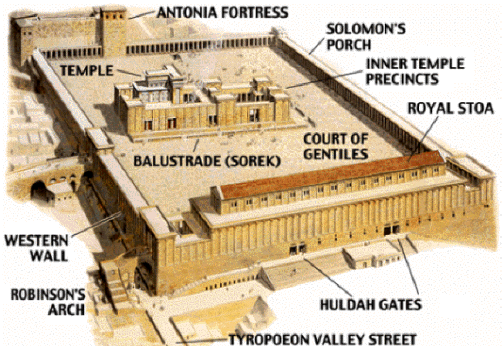
In fact, as some people point out, the place where the ‘cleansing’ would have happened is in the marketplace somewhere in the outermost court of the gentiles (probably within the royal stoa, a basilica along the southern part of the Temple Mount) - which was a mere extension of the original Temple Mount and thus, not considered part of the sanctuary proper. That explains why gentiles were allowed in it: it was not sacred ground. That explains why some scholars are hesitant to speak of the event as the ‘cleansing’ of the temple: because Jesus was technically not doing the action within the sanctuary itself, but ‘outside’.
Disrupting the temple market would have of course antagonized the priests, but it’s hardly likely that this was a big riot - Jesus going berserk and unleashing unbridled fury - like some people imagine it was: it was more likely to have been a calculated, symbolic action by Jesus (just like the triumphal entry). That, and the fact that Jesus was not in the sanctuary itself, I think explains why the temple guards - or the Romans in the Antonia Fortress - didn’t arrest Him then and there: there wasn’t a huge rebellion involved or anything. It was just one man prophesying and symbolically turning over some tables for good measure.
But by the raising of Lazarus, Jesus had already amassed a following who hail Him as a messianic figure. You would notice in Josephus that a number of messianic movements follow a similar pattern: the ringleaders do or claim to do something supernatural - usually something that has prophetic/messianic overtones (i.e. miraculously demolishing the walls of Jerusalem, finding long-lost artifacts buried by Moses, divide the rivers of the Jordan, etc.)
[A] man who made light of mendacity and in all his designs catered to the mob, rallied them, bidding them go in a body with him to Mount Gerizim, which in their belief is the most sacred of mountains. He assured them that on their arrival he would show them the sacred vessels which were buried there, where Moses had deposited them. His hearers, viewing this tale as plausible, appeared in arms. They posted themselves in a certain village named Tirathana, and, as they planned to climb the mountain in a great multitude, they welcomed to their ranks the new arrivals who kept coming. But before they could ascend, Pilate blocked their projected route up the mountain with a detachment of cavalry and heavily armed infantry, who in an encounter with the first comers in the village slew some in a pitched battle and put the others to flight. Many prisoners were taken, of whom Pilate put to death the principal leaders and those who were most influential among the fugitives.
===
It came to pass, while Fadus was procurator of Judea, that a certain charlatan, whose name was Theudas, persuaded a great part of the people to take their effects with them, and follow him to the river Jordan; for he told them he was a prophet, and that he would, by his own command, divide the river, and afford them an easy passage over it. Many were deluded by his words. However, Fadus did not permit them to make any advantage of his wild attempt, but sent a troop of horsemen out against them. After falling upon them unexpectedly, they slew many of them, and took many of them alive. They also took Theudas alive, cut off his head, and carried it to Jerusalem.
===
[A]bout this time, someone came out of Egypt to Jerusalem, claiming to be a prophet. He advised the crowd to go along with him to the Mount of Olives, as it was called, which lay over against the city, and at the distance of a kilometer. He added that he would show them from hence how the walls of Jerusalem would fall down at his command, and he promised them that he would procure them an entrance into the city through those collapsed walls. Now when Felix was informed of these things, he ordered his soldiers to take their weapons, and came against them with a great number of horsemen and footmen from Jerusalem, and attacked the Egyptian and the people that were with him. He slew four hundred of them, and took two hundred alive. The Egyptian himself escaped out of the fight, but did not appear any more.


