
Climate Change News 4

  • Thread starter Thread starter Theo520
  • Start date Start date
Status
Not open for further replies.
Oh I’m aware that every spurious counterpoint that can be brought to bear will be thrown at me. But really, short of producing some phenomenon that sees that energy escape, the strongest argument any skeptic can make is “we don’t know the effects of trapping additional solar energy.” To make a stronger statement than that is to basically deny what we know about thermodynamics, and it’s hard to imagine a more rigorous and confirmed set of physical principles. If the data, both direct and proxy, that has been gathered over the last half century is wrong, it does nothing to disprove the fundemental and underlying physical fact that raising thermal equilibrium will inevitably lead to both increased temperature and excitement in any system.

Every time you put a pot of water on the stove and turn on the element, water will boil. Every time.
Pointing out basic errors in logic is not spurious.

Skeptics don’t dispute the world is warming from CO2 radiative forcing.
The warming from doubling is undisputed at ~1C

Skeptics dispute the theory and models on feedbacks to the above.
The models say feedbacks will add another 0.5-3.5C in warming. You claimed this missing heat is ‘hiding in the oceans’ but the Argo buoys seem to not support this claim. The models also seem to have failed here has well. If the feedbacks only add 0.5C warming, then the skeptics are right.
 
Last edited:
Each molecule of CO2 absorbs a specific amount of radiation. We can calculate the amount of energy captured. If not the oceans, then where? You can’t just make the energy disappear.
 
Each molecule of CO2 absorbs a specific amount of radiation. We can calculate the amount of energy captured. If not the oceans, then where? You can’t just make the energy disappear.
You clearly don’t know your subject.

You are referring to radiative forcing as a warming function and the science agrees that doubling CO2 levels will result in a 1C warming from this mechanism.

This is not disputed by skeptics.

1C warming from increased CO2 levels absorbing more radiation.

But alarmists push figures of 3-8C warming. That’s an addition +2 to +7 degrees Celcius.
This comes from Feedbacks that are not proven, that are disputed by skeptics.
 
Last edited:
actual temperatures are much less than model projected temperatures … the theory is fake … does not work.
 
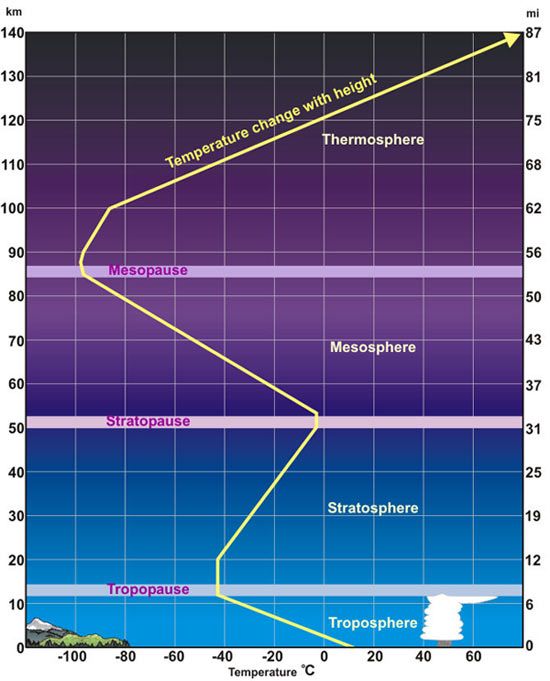
The atmosphere expands … and contracts …


Changes in the thermosphere’s density can change the amount of drag on a satellite, slowing it down when the density is higher. This can throw off estimates of where a satellite’s position should be at a given time, which can in turn lead to problems in avoiding collisions among spacecraft and space junk. Thayer and his colleague hope their discovery will lead to improved satellite tracking.
 
Last edited:
That expansion and contraction is nominal. The atmosphere is constrained by gravity . Venus, with orders of a magnitude more CO2 in its atmosphere, is only 20km thicker. Both earth and Venus, being of similar size and density, have atmospheres whose size and density constrained by gravity. This really is a non starter.
 
You can keep throwing that equation out. The atmosphere has an upper bound on size and density that is a function of gravity.
 
We have thermodynamics. There is in no getting around it. A pot of water will always boil when the elenent is turned on. Sophistry doesn’t make thermodynamics go away.
Yes, “we” have thermodynamics. What “we” don’t have is data that agrees with the theories.
 
You can keep throwing that equation out. The atmosphere has an upper bound on size and density that is a function of gravity.
uh … no…

Not an upper bound.

That’s why the ISS must be re-boosted. And it’s 300 miles up and still feels the effects of the expansion of the atmosphere.

Please read >>

The expansion and contraction happens way up in the Earth’s thermosphere, the layer of the atmosphere that extends from about 60 to 300 miles (96.5 to 483 kilometers) above the planet’s surface. The thermosphere is constantly interacting with the sun’s upper atmosphere as it expands out into the solar system, said one of the researchers who made the discovery, Jeff Thayer of the University of Colorado in Boulder, during a press conference at the annual meeting of the American Geophysical Union in San Francisco yesterday.

This interaction causes an energy exchange that can change the density of the thermosphere (how closely the gas molecules within it are packed together). As its density changes, the thermosphere expands and contracts.

5, 7 and 9

Extreme ultraviolet (UV) radiation from the sun was known to cause a 27-day expansion-and-contraction cycle by changing the thermosphere’s density through heating.

Thayer and his team analyzed data from the German Challenging Minisatellite Payload (CHAMP) and the NASA Advanced composition Explorer satellite and found that the thermosphere also appeared to breathe every five, seven and nine days, “which was unexpected,” Thayer said.

The researchers determined that the cause of these shorter expansions and contractions was high-speed winds generated by relatively cool pockets on the sun’s surface known as solar coronal holes, which periodically rotate around the solar surface.

Thayer said this finding could help improve satellite tracking, which was part of the aim of the study, which was funded in part by the U.S. Air Force. The thermosphere is heavily populated with spacecraft, including the International Space Station and more than 800 operational satellites.

Implications

Changes in the thermosphere’s density can change the amount of drag on a satellite, slowing it down when the density is higher. This can throw off estimates of where a satellite’s position should be at a given time, which can in turn lead to problems in avoiding collisions among spacecraft and space junk. Thayer and his colleague hope their discovery will lead to improved satellite tracking.


The added UV radiation heats up the atmosphere, in turn causing gaseous molecules to radiate that heat away in the form of infrared radiation.

Click on the Khan Academy discussion.
 
Last edited:
You can keep throwing that equation out. The atmosphere has an upper bound on size and density that is a function of gravity.
I think you are missing the point.

The expansion indicates absorption of significant energy, and the contraction indicates a release of the energy. It’s not being released into the oceans.
 
It’s not being released into the oceans.
If it was being released into the oceans, then it would show up in the Argo buoy data … 4000 buoys with telemetry … and the data show no such thing.


Here is the map of the 4000 Argo buoy location distribution; 3881 as of February 2018.

click here>>

https://www.google.com/search?q=argo+map&client=safari&rls=en&tbm=isch&source=iu&ictx=1&fir=WkRzQQROevdWvM%3A%2CRekC-Di6NrxIFM%2C_&usg=AFrqEzc78ia4DWIcqHvagFVAc9GAVOJ3nw&sa=X&ved=2ahUKEwj26_GH2fTcAhXIUt8KHbRCDTIQ9QEwBnoECAUQCg#imgrc=WkRzQQROevdWvM:
 
Last edited:
Here is the map of the 4000 Argo buoy location distribution; 3881 as of February 2018.
Those pesky high tech measurements, be it satellites to measure surface temp or Argo to measure the oceans.

They don’t confirm the hypothesis and must be discarded in favor of their highly manipulated thermometer readings.
 
[You’re going to confuse the poor guy]

[Can you get the Argo map to post?]
 
Well, we know where the extra heat has gone. It’s gone into the oceans, because we’ve been measuring oceanic temperatures.
Let’s start with this assertion. The question of where the heat went became a concern only in the last 20 years when global warming…paused. The issue then became one of finding where the “extra” heat went, because it had to go somewhere since everyone knew there must be extra heat. The only reasonable explanation was the ocean, therefore it was decided the heat went there, so that’s what was claimed even though the data were inadequate to confirm the claim (a common situation in the field of climate science).

While it is surely true that the ocean soaks up a lot of atmospheric heat there really is no convincing explanation for why it suddenly began taking it up aggressively only 20 years ago. A question that completely bypasses the issue of whether it is even possible to measure the heat content of the ocean, a topic incidentally touched on in a study just released this January:

Little is known about the ocean temperature’s long-term response to climate perturbations owing to limited observations and a lack of robust reconstructions." “A lack of robust reconstructions” has long been the single best description of climate science.
If you want to debunk climate change (and win a Nobel Prize), it’s not going to be handwaving and muttering about complex systems, because it doesn’t matter how complex the system is. Add energy to a system, and you will alter the system…
This is true, not to mention irrelevant to the question of whether or not energy is being added. You’ve simply assumed the answer to the question under debate.
But there is not a single physicist on the planet who is going to accept the notion that increasing GHG concentrations will not inevitably lead to an increase in solar radiation being absorbed by and trapped in the atmosphere and oceans.
Well, aside from the fact that CO2 concentrations have been steadily for the last two decades while the (once again uncooperative) data don’t show the increase thermodynamics demands.
 
Last edited:
Status
Not open for further replies.
Back
Top