
Climate Change News collection

  • Thread starter Thread starter Theo520
  • Start date Start date
Status
Not open for further replies.
What is called a “fatal flaw” by right-wing editorial writer, John Merline, is more accurately described as incomplete knowledge of the consequences of global warming. Mr. Merline points out examples from 2008 to 2011 of deductions made by everyone from the American Chemical Society to National Resources Defense Council regarding the consequences of a warming climate that now appear to be contradicted by new deductions from a University of Michigan Climate Scientist.

What this shows is that even scientists have an imperfect understanding of all the consequences of a warming climate. But calling this a “fatal flaw” implies that this imperfection threatens the entire theory, perhaps even the fact that the climate is warming at all!

Such a conclusion is not justified by the evidence. Since this is a very active field and there are many practitioners in it, there are many people trying to form deductions from a warming climate. If one wants to make these practitioners look bad, it would not be too hard to cherry pick instances where their deductions seemed off the mark. There certainly are a lot of them to choose from, which makes cherry-picking easier. Someone wishing to show that global warming is very well understood could similarly cherry-pick instances where outcomes matched predictions precisely. One only has to look at other writings of John Merline to see what sort of political conclusions he likes to draw.

But one thing is clear: The fact of a warming climate is in no way challenged, much less fatally, by the observations of John Merline.
 
What this shows is that even scientists have an imperfect understanding of all the consequences of a warming climate.
Spending trillions of dollars, and completely reorganizing our economy and lifestyles to mitigate consequences we don’t understand and can’t predict might be premature…
 
Last edited:
What this shows is that even scientists have an imperfect understanding of all the consequences of a warming climate.
But the science is settled!!! The 97% said so!!!

Baby steps off that pedestal from which you look down on the rest of us. It’s a start toward applying the same skepticism toward those pro-AGW scientists that you have strenuously applied to the anti-AGW contingent. You’re consistent there, I’ll give you that, how about applying the magnifying glass to your own side?

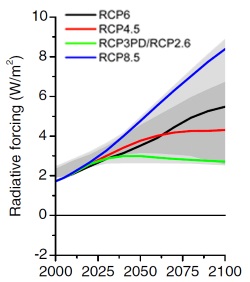
I can readily admit climate change happens, has always happened and always will happen. I can even admit we’ve been in a warming cycle, though that appears to be ending. What I strongly question is the degree to which man-made causes play such a critical part. The lousy predictions don’t help. The use of the RCP 8.5 case made by the IPCC as the sole basis of proposed policies doesn’t help. It must be tiring to have to constantly defend the AGW’ers who have made inaccurate predictions.
 
Here is a discussion of RCP 8.5 and why it is extremely unlikely

 
Your insult is totally uncalled for.
Ok I’ll take it back. Should probably have applied the sarcasm tag. You have been so strident for so long that at times that it’s easy to imagine you at a lectern on a podium and it’s not such a big leap from there to imagine a pedestal. Fine, I’ll take back the pedestal and the podium. But the lectern still applies.

This is for real: Skepticism is a very valuable quality to have, but skepticism toward one side only maybe not so much.
 
OK. Apology accepted. As for skepticism, I like to think I apply it equally to all cases. But I know my limitations. I am not a climate scientist. But I do trust the scientific method (which also includes a good deal of skepticism.) I know that the scientific community historically has been right on major theories more often than they have been wrong. Sure, one can cherry-pick instances of failed theories, but that is how the scientific method works.

Let’s step away from climate science for a bit and look at some less-controversial science, like Einstein’s theory of relativity. Can you see how one could be skeptical of relativity? How ridiculous it seems that time itself to an outside observer slows down when an object moves very fast. How unbelievable it is that two observers could disagree about the distance between two events and both of them be right. How crazy is it that objects seem heavier the faster they go. Yet all of these things are from the theory. And I’ll wager that you have never personally verified any of these things by direct observation. If you believe them, you believe them only because “scientists say” they are true. So what is the role of skepticism here? Does it mean I should disbelieve anything that I cannot personally verify by direct observation? Extreme skepticism would say yes. Are you that extreme? Or do you believe some scientific theories that you cannot personally verify, just because “scientists say?”

That’s the basis on which I trust the research that is agreed to by an overwhelming majority of scientists, and I reserve judgement on theories proposed by only a few scientists. Is there a better way to approach science? (Other than becoming a scientist yourself and doing the research yourself?)
 
Let’s step away from climate science for a bit and look at some less-controversial science, like Einstein’s theory of relativity. Can you see how one could be skeptical of relativity? How ridiculous it seems that time itself to an outside observer slows down when an object moves very fast. How unbelievable it is that two observers could disagree about the distance between two events and both of them be right. How crazy is it that objects seem heavier the faster they go. Yet all of these things are from the theory. And I’ll wager that you have never personally verified any of these things by direct observation. If you believe them, you believe them only because “scientists say” they are true. So what is the role of skepticism here? Does it mean I should disbelieve anything that I cannot personally verify by direct observation? Extreme skepticism would say yes. Are you that extreme? Or do you believe some scientific theories that you cannot personally verify, just because “scientists say?”
Believing or not believing in the Einstein’s theory has very little real world impact, because nobody has figured out a way for travelling at relativistic speeds. If that happens and somebody told me mitigating the risks from it were going to run trillions of dollars, you can be darn sure I’d want to see it verified before I committed the money.
 
Last edited:
Believing or not believing in the Einstein’s theory has very little real world impact, because nobody has figured out a way for travelling at relativistic speeds. If that happens and somebody told me mitigating the risks from it were going to run trillions of dollars, you can be darn sure I’d want to see it verified before I committed the money.
Yet the question remains: Should a person believe the science textbooks that say Einstein’s Special Theory of Relativity is true? Or should a person remain skeptical unless he can verify it personally? The question was about the proper role of skepticism, you have deflected from it by saying this one example I picked has “no real world impact”. Rather than arguing about whether relativity has real-world impact, let me ask you if there are any scientific theories at all that you accept without being able to verify them personally by direct observation? Anything at all? Anything in medicine? Chemistry? Physics? Biology? Anything that you accept just because all the scientists say it is true?

While you are thinking, let me mention a few that might qualify. DNA analysis that has been used to convict people of murder. (Real-world impact) Intraocular pressure measurements to detect iminent glaucoma. The science of RSA encryption that protects your credit card number when you make a purchase on-line. Have you personally verified any of these theories? If they are not true, you could be falsely convicted of murder, or go blind, or have your credit card information stolen. So they have real-world impact.
 
Last edited:
Should a person believe the science textbooks that say Einstein’s Special Theory of Relativity is true? Or should a person remain skeptical unless he can verify it personally?
In the real world, it depends. Believing or not believing Einstein’s Special Theory has no impact so being able to verify or not is an academic exercise. If suddenly it was hypothesized that doing or not doing something that the theory said should be done was going to cost trillions of dollars and/or billions of lives, finding some way to verify it before we take action would become a necessity.
 
Last edited:
40.png
LeafByNiggle:
Should a person believe the science textbooks that say Einstein’s Special Theory of Relativity is true? Or should a person remain skeptical unless he can verify it personally?
In the real world, it depends. Believing or not believing Einstein’s Special Theory has no impact so being able to verify or not is an academic exercise. If suddenly it was hypothesized that doing or not doing something that the theory said should be done was going to cost trillions of dollars and/or billions of lives, finding some way to verify it before we take action would become a necessity.
OK, quit deflecting and tell me if you believe in DNA analysis, RSA encryption, glaucoma tests, etc.
 
OK, quit deflecting and tell me if you believe in DNA analysis, RSA encryption, glaucoma tests, etc.
DNA analysis, RSA encryption, and glaucoma tests have all been verified by experiment. Climate change predictions haven’t.
 
40.png
LeafByNiggle:
OK, quit deflecting and tell me if you believe in DNA analysis, RSA encryption, glaucoma tests, etc.
DNA analysis, RSA encryption, and glaucoma tests have all been verified by experiment.
The question now is have you personally verified any of these theories by experiments you have conducted? Or do you just believe that they have been verified because someone told you they have been verified?
 
The question now is have you personally verified any of these theories by experiments you have conducted? Or do you just believe that they have been verified because someone told you they have been verified?
Nobody has personally verified climate change predictions, so I’m not sure the relevance of the question.
 
DNA analysis, RSA encryption, and glaucoma tests have all been verified by experiment. Climate change predictions haven’t.
Increased radiative forcing from changing CO2 and H20 levels has been verified by experiment (in the lab).

However, the assumption that increasing CO2 levels increase H2O levels as a feedback is not experimentally verified, and this is where the AGW models fall on their face, and why their predictions are likely so wrong.

increased H20 levels
 
40.png
LeafByNiggle:
The question now is have you personally verified any of these theories by experiments you have conducted? Or do you just believe that they have been verified because someone told you they have been verified?
Nobody has personally verified climate change predictions, so I’m not sure the relevance of the question.
Yes, they have. They have reported these verifications in their peer-reviewed publications. So let me return to the question you have not answered: Do you accept the validity of RSA encryption, glaucoma detection, and DNA analysis, just because someone told you they have been verified?
 
40.png
Guinness:
DNA analysis, RSA encryption, and glaucoma tests have all been verified by experiment. Climate change predictions haven’t.
Increased radiative forcing from changing CO2 and H20 levels has been verified by experiment (in the lab).

However, the assumption that increasing CO2 levels increase H2O levels as a feedback is not experimentally verified, and this is where the AGW models fall on their face, and why their predictions are likely so wrong.

increased H20 levels
Yes, there are many levels of global warming theory, some very well understood, some not so much. It makes sense to be more skeptical about the more extreme and less supported claims, without discarding the part you mentioned that has experimental support, not only in the lab but in the field. I know you understand this. Now if I could just convince Guinness.
 
Status
Not open for further replies.
Back
Top
