Climate Change News

  • Thread starter Thread starter Theo520
  • Start date Start date
Status
Not open for further replies.
Agreed, renewable can make a nice supplement but even then it’s value is very location dependent. Geothermal is reliable but only affordable in very few locations where the required drilling is shallow. Wind and solar will never be there when you need them most. If they aren’t damaged by severe weather, at a minimum they stop producing until the storm passes.
 
No such thing as a solar or wind installation that will fare well in a region that experiences hurricanes on a regular basis. Energy sources and infrastructure in Puerto Rico need to be rethought. Dunno if they’re doing that, but I think going back to just newer versions of what they had before is likely not enough.
 
Or we could give them a couple billion to pioneer wave generators?
I mean, they’re an island, right?

/sarc

Here’s their profile though, from EIA

Puerto Rico Territory Energy Profile

Puerto Rico Quick Facts
  • Petroleum products fuel transportation, electricity generation, and industry in Puerto Rico, supplying three-fourths of the energy consumed in the commonwealth.
  • In 2016, 47% of Puerto Rico’s electricity came from petroleum, 34% from natural gas, 17% from coal, and 2% from renewable energy.
  • Two wind farms supplied nearly half of Puerto Rico’s renewable generation in 2016; one of them, the 95-megawatt Santa Isabel facility, is the largest wind farm in the Caribbean.
  • As of June 2017, Puerto Rico had 127 megawatts of utility-scale solar photovoltaic generating capacity and 88 megawatts of distributed (customer-sited, small-scale) capacity. In the first six months of 2017, more renewable electricity came from solar energy than any other source.
  • Electricity fuel surcharges have decreased with world crude oil prices, but, in mid-2017, Puerto Rico’s retail consumers still paid more for their power than consumers in any state except Hawaii.
Last Updated: September 21, 2017
 
Last edited:
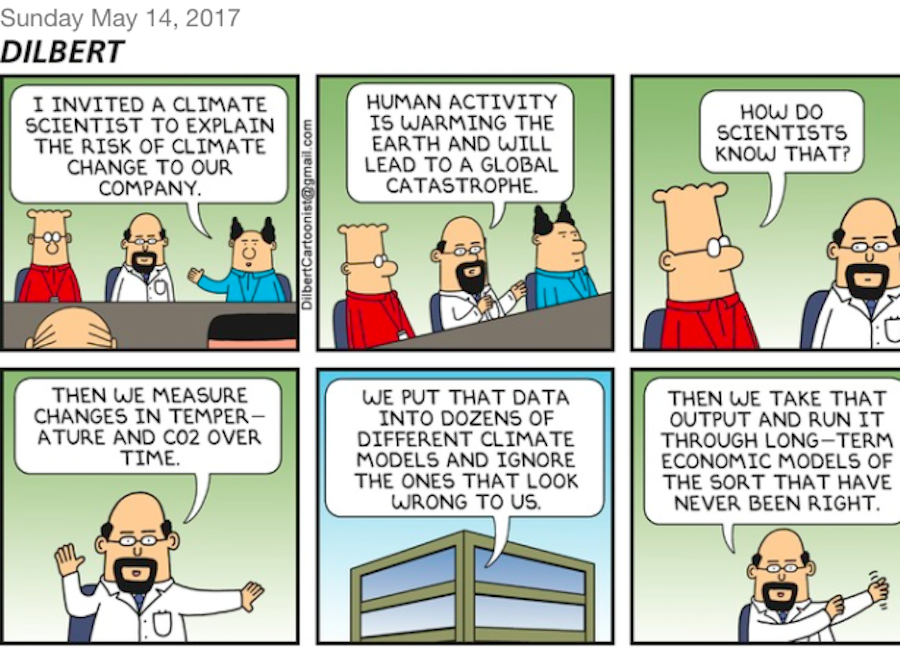
That comic deserves to be shared


In reading your link, I see that Michael Mann opted for the tried and proven ‘ad-hominem’ defense against the comic strip.
 
Last edited:
 
If you haven’t heard, data has been showing that sea level rise is deaccellerating instead of accelerating.

Not to be outdone with a key pillar of alarmism undermined, alarmists have come up with an explanation - the ocean floor is sinking, so it’s still a serious problem,

 
I was reading your article and some of the reports it linked to and came across this. It’s an old one (2010) but it still caught me by surprise.

https://wattsupwiththat.com/2010/11/18/ipcc-official-“climate-policy-is-redistributing-the-worlds-wealth”/

Ottmar Edenhofer was co-chairman of the IPCC Working Group III from 2008 - 2015.

But one must say clearly that we redistribute de facto the world’s wealth by climate policy. … One has to free oneself from the illusion that international climate policy is environmental policy. This has almost nothing to do with environmental policy anymore, with problems such as deforestation or the ozone hole.
 
I kinda thought this one was obvious, that through science and medicine we would control Malaria regardless of the climate. But the story did make for good alarmism.

 
Last edited:
I kinda thought this one was obvious, that through science and medicine we would control Malaria.
I’d like to see the graph of malaria deaths going back to the time before DDT was outlawed. Malaria was being controlled until the crisis-de-jour led to its banishment…and untold millions of deaths.
 
That’s why alarmism is so effective as a tool,
it gets your emotional brain in control and logic or reason go out the window.
 
Took me a while to refind this thread.

Anyway, just got the following newsletter from SEPP.


The Week That Was: 2018-02-17 (February 17, 2018) Brought to You by SEPP (www.SEPP.org)
The Science and Environmental Policy Project

minor excerpts:

[Amusing side comment: the latest satellite data shows a modest, uneven rise since 2016. Could one argue that the nomination of Donald Trump frightened the sea gods from uprising? Maybe Donald Trump is more powerful than King Canute!] See links under Seeking a Common Ground, Changing Seas, Communicating Better to the Public – Make things up and Laboratory for Satellite Altimetry / Sea Level Rise

Trump Budget: The Trump administration announced its first new budget, not an extension of the mid-year budget announced in 2017. Analysts on all sides immediately followed with their comments. Of course, one can only guess at what may come out of Congress. Among issues of note for TWTW readers are the Global Climate Change Initiative (GCCI) and the National Environmental Policy Act (NEPA).
 
Last edited:
Arctic Disturbances: Once again, fears built on claims that the warming of the Arctic is a threat to humanity are appearing. As with past claims that warming will cause massive releases of methane, thus greatly compounding the initial warming, the current claims fall apart with analysis. The current fear is a release of mercury threatening the globe. Writing in The Reference Frame, physicist Luboš Motl demolishes the claim; see link under Challenging the Orthodoxy. **************
Lowering Standards: The American Association for the Advancement of Science (AAAS) announced the recipient of its 2018 award for Public Engagement – Michael, “Hockey-stick”

Mann. On Climate Etc. Judith Curry cites the award and a few comments by Roger Pielke, Jr. including:
“My issue here is not with Mann. It is with the decision by AAAS to single out Mann as someone who embodies our highest values of the scientific community: a role model to emulate who engages in behaviors to celebrate.
“With this award, what message is AAAS sending to the scientific community and to the public?
“The AAAS is telling us that engaging in hyper-partisan, gutter politics, targeted against Republicans and colleagues you disagree with, using unethical tactics, will be rewarded by leaders in the scientific community.
“AAAS could work to help to defuse the pathological politicization of science. Instead, it has thrown some gasoline on the fire.”
Perhaps the purpose of AAAS is to intensify “pathological politicization of science” in hopes of gaining more financial support by promoting fear of humanity. In commenting on the speculative increase in sea level rise, discussed above, the staff writers of the AAAS publication EurekAlert stated: “Twenty-five years of satellite data prove climate models are correct in predicting that sea levels will rise at an increasing rate.” [Boldface added]
These data prove nothing, but the exaggerations by AAAS demonstrate disturbing trends. Note: Mr. Mann has claimed that Fred Singer and SEPP have received funding from Phillip Morris (tobacco), Texaco (oil) and Monsanto (chemical), without offering any evidence. Fred Singer and SEPP have received no such funding. See links under Lowering Standards and Seeking a Common Ground

 
100% Renewable: We have another study on how the nation can obtain 100% of its energy requirements from “renewables,” mainly solar and wind. As usual, the problems of storage and its costs are idealized and minimized – just ask South Australia.
Independently, Roger Andrews of Energy Matters may have hit on the solution for this problem – use the Great Lakes for pumped hydro storage. Surely the Canadians would not mind. Imagine the number of “green jobs” that will be created in just preparing, filing, and attacking & defending the required NEPA permits! See links under Alternative, Green (“Clean”) Solar and Wind and Alternative, Green (“Clean”) Storage.

Number of the Week: 3400% growth in eight years. According to data from the US EIA, prior to January 2010, monthly oil production from shale was miniscule, less than 300,000 barrels per day (b/d). It increased slowly then rapidly, with a downturn. By January 2018, it grew to 5.2 million b/d – over 34 times, or 3400% in eight years. This exceeds the 4.9 million b/d of US conventional oil production. Over 50% of total US oil production now comes from shale. Oil and gas production from shale is not a temporary “flash in the pan” as many “experts” claimed earlier. See article # 2 and last week’s TWTW.

NEWS YOU CAN USE:
 
Number of the Week: 3400% growth in eight years. According to data from the US EIA, prior to January 2010, monthly oil production from shale was miniscule, less than 300,000 barrels per day (b/d). It increased slowly then rapidly, with a downturn. By January 2018, it grew to 5.2 million b/d – over 34 times, or 3400% in eight years. This exceeds the 4.9 million b/d of US conventional oil production. Over 50% of total US oil production now comes from shale. Oil and gas production from shale is not a temporary “flash in the pan” as many “experts” claimed earlier. See article # 2 and last week’s TWTW.
Can we assume this will slide the “peak oil” date somewhat farther into the (unknown) future?
 
Status
Not open for further replies.
Back
Top