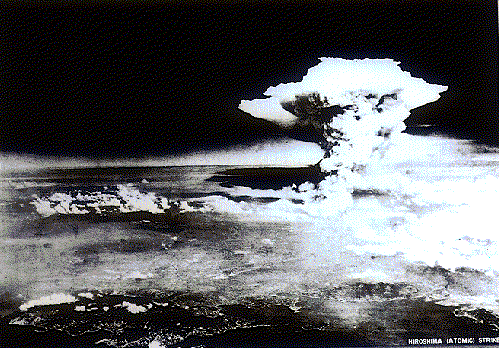
Cooperation with evil - nuclear weapons

  • Thread starter Thread starter FiveLinden
  • Start date Start date
Status
Not open for further replies.
Until both the Supreme Committee and the full cabinet had agreed to the surrender, Hirohito had no power, beyond suasion, to compel surrender. Even at the rigged gozen kaigan, where Hirohito was directly asked his preference (unheard of) his direction could have been denied, the government brought down, and no new governing power established,had the Army or Navy declined to fill their ministerial positions. It was the ultimate legitimate power Anami wielded.

Not only was he needed for the restructuring of Japan, he was needed to ensure a full compliance with the surrender, given the military’s instability. as evidenced by the attempted coup, and securing the Emperor in “protective” custody, safe from “evil advisors”. .

The impact of the Soviets, after less than a day in the field, sandwiched between the two bombs, was by far the lesser of the two factors. History is rarely severely reductionist; it wasn’t in this case. Both factors were involved, bombs first. Yonai, the Navy Minister, called them both Tenyu; gifts from the gods, to allow an escape from the war.

The unconditional condition was not really given up. The kokutai that was the aim of the Japanese to continue, as Herbert Bix noted, was not the constitutional monarchy which Japan got; not the continuation of the state conducted on theocratic premises of state Shinto.
 
Last edited:
Here is another more official film:


Google youtube B-36
 
Last edited:
Originally pure pusher props. From the D model on, early fifties, had two twin engine jet pods added.

Almost all were scrapped. One of the few static displays was at Chanute AFB, while I was stationed there. It was not complete, having a piece missing from the fuselage, so it was a little shorter. But still impressive.

It was central in the Revolt of the Admirals, over roles and missions, and a certain aircraft carrier, in the confusing years after WWII, when the formation of the DOD, and the issue of nuclear weapons, and politics, all got wrapped around each other.
 
I don’t know if this has been linked previously, but here is a summary of Rev. Wilson Miscamble’s defense of the bombings at Hiroshima and Nagasaki

 
Neither of you is correct. As I have posted above. No one, in the position to do so, was attempting to surrender in any sense, prior to the end of the gozen kaigen of 9-10 August. What they were arguing about was under what set of conditions they would be able to approach the Allies, of a negotiated end to the war. Until the Anami group was shut down by the Emperor’s stated preference for the acceptance of the Potsdam Proclamation, no further progress was going to occur. No one in a position to do so, neither the Saiko Senso Shido Kaigi, as the theoretical advisers to the throne, nor the full cabinet, as the body which actually had to approve the surrender. was ready to surrender, before the bombs dropped.
 
Last edited:
And his book, THE MOST CONTROVERSIAL DECISION, esp. chap 6, expands on that, in depth.
 
This isn’t a discussion. It’s instruction. It certainly is in my hands to leave you in your current state.
Um, no. We have already established that this is not “instruction”, but bragging. You have already admitted that much.

That is, you mention those factoids and books not because you want to persuade or teach anyone about something. You mention them because you hope that such mentions make you look like an expert.

Of course, in reality it, um, does not make you look as that much of an expert… After all, a real expert could be expected to actually choose relevant facts and put them together in an argument… And that is clearly missing here…

And one more thing… You keep repeating that you are trying to teach me and everyone else or something… Is there some reason why you think you are in position to actually do so, that teaching is necessary and that you are suitable for that…? I’m afraid that I do not remember you pointing out such a great number actual historical mistakes that you seem to claim to correct…
As long as we are speculating about how the war might have proceeded without the use of the two atomic bombs, here is my own speculation:

After FDR’s death, Truman becomes president. He is advised for the first time about the existence of the atomic bombs. (This much is history.)

Truman refuses to use the atomic bombs, and continues with the carpet bombing of Japanese cities.
Deliberately targeting civilians is a war crime and immoral. It doesn’t matter if spears, knifes, rifles, grenades, incendiary bombs or nuclear bombs are used for that.

If you want to explore what would have happened if some moral option was chosen instead, then actually choose some moral option.
He becomes the most vilified president in U.S. history,
We still would be having lengthy debate threads.
And why is that supposed to matter?
 
Class is dismissed. You may audit any subsequent posts.
 
Last edited:
The catechism says “indescriminate” destruction. There is no problem. Your questions are not relevant to CCC 2314.
 
Absolutely essential to not conflate geopolitics with any sort of personal animus.

In the 1950’s and 1960’s, the focus of the West was to deter Russian and Chinese invasions.

The promise of deterrence was to assure Russia and China that they would not survive an attack on the West by them.

Accordingly, the mission of the U.S. Strategic Air Command was to guarantee that the United States would be able to drop nuclear weapons on them if the need arose. THAT was deterrence.

The alternative was surrender.

From a position of retrospect, you can review the YouTubes of the B-36’s and other weapons which were designed and their crews exercised in a public way, so that the dictators that ran Russia and China KNEW for a fact that we were ready, willing and able to counter any invasion from them.

[As time went by, the various weapons systems changed with the times and the available technology.]

It was and is about geopolitics, not about personal animus.
 
After World War Two, there was a lot of international tension.

There were a lot of localized issues, but the biggie issue was the Berlin Blockade.

 
Last edited:
And then in 1950, there was the invasion of South Korea by North Korea.

It was a close thing. The U.S. had mostly demobilized its army and navy.

In fact, if North Korea had waited only a few months, the U.S. would not have had any of its aircraft carriers left.
 
President Eisenhower used a nuke to end the Korean War.

He ordered a nuclear warhead fired from an Atomic Cannon and then ordered a bunch of Atomic Cannons shipped to Korea.

Shortly thereafter, the North Koreans and Chinese stopped shooting.

The nuclear weapon was fired just north of Las Vegas, Nevada.

It was on television.
There’s one sitting at the entrance to the Yuma Proving Grounds in Arizona. It’s quite impressive - shoots a 600 lb round over 18 miles. I have a photo of me leaning on it somewhere around here.
 
40.png
AlNg:
don’t think so. The Japanese were ready to surrender…
This is another fantasy, having absolutely no basis in fact.
Adm. William Leahy, President Truman’s Chief of Staff,
President Dwight D. Eisenhower, and
General Douglas MacArthur, Commander of US Army forces in the Pacific
all say Japan was already defeated and ready to surrender.
 
Status
Not open for further replies.
Back
Top