Could you please explain Eastern Catholicism?

  • Thread starter Thread starter distracted
  • Start date Start date
Status
Not open for further replies.
D

distracted

Guest
i would like to know the important differences between Eastern and Roman Catholicism…

(i wasn’t taught such things while growing up… wasn’t catechized to speak of… )

Thanks… 🙂
 
The Eastern Catholic Church is the “other lung” of the Catholic Church, as Pope John Paul II once said. The Catholic Church is actually made up of 23 independent Catholic Churches, all united under the authority of the pope. The Latin Catholic Church is so large, however, that most people are unaware of the existence of the other 22 eastern branches, which are relatively small in membership. Almost all of them are formerly groups of Orthodox Christians that decided at some point in the past to reunite, en masse, with the Catholic Church. There is an equivalent Orthodox Church for every Eastern Catholic Church, with the exceptions of the Maronite Catholic Church and the Italo-Albanian Catholic Church, which never broke away from Rome. It is important to note that ALL of the branches of the Catholic Church are equally Catholic. They all obey the pope, and Catholics of any branch are welcome to participate fully in the services and sacraments of any other branch. Eastern Catholic Churches have their own canon law, and celebrate their own liturgical traditions, including different versions of the Mass, which are known in the Eastern Catholic Church as the Divine Liturgy. Their services would be virtually identical to those offered by the various Orthodox Churches.

Here is a listing of the various Eastern Catholic Churches:
*** Alexandrian liturgical tradition**
1) Coptic Catholic Church (patriarchate): Egypt (1741)
2) Ethiopian Catholic Church (metropolia): Ethiopia, Eritrea (1846)
** * Antiochian (Antiochene or West-Syrian) liturgical tradition**
3) Maronite Church (patriarchate): Lebanon, Cyprus, Jordan, Israel, Palestine, Egypt, Syria, Argentina, Brazil, United States, Australia, Canada, Mexico (union re-affirmed 1182)
4) Syriac Catholic Church (patriarchate): Lebanon, Iraq, Jordan, Kuwait, Palestine, Egypt, Sudan, Syria, Turkey, United States and Canada, Venezuela (1781)
5) Syro-Malankara Catholic Church (major archiepiscopate): India, United States (1930)
** * Armenian liturgical tradition:**
6) Armenian Catholic Church (patriarchate): Lebanon, Iran, Iraq, Egypt, Syria, Turkey, Jordan, Palestine, Ukraine, France, Greece, Latin America, Argentina, Romania, United States, Canada, Eastern Europe (1742)
** * Chaldean or East Syrian liturgical tradition:**
7) Chaldean Catholic Church (patriarchate): Iraq, Iran, Lebanon, Egypt, Syria, Turkey, United States (1692)
8) Syro-Malabar Church (major archiepiscopate): India, United States (at latest, 1599)
** * Byzantine (Constantinopolitan) liturgical tradition:**
9) Albanian Greek Catholic Church (apostolic administration): Albania (1628)
10) Belarusian Greek Catholic Church (no established hierarchy at present): Belarus (1596)
11) Bulgarian Greek Catholic Church (apostolic exarchate): Bulgaria (1861)
12) Byzantine Church of the Eparchy of Križevci (an eparchy and an apostolic exarchate): Croatia, Serbia and Montenegro (1611)
13) Greek Byzantine Catholic Church (two apostolic exarchates): Greece, Turkey (1829)
14) Hungarian Greek Catholic Church (an eparchy and an apostolic exarchate): Hungary (1646)
15) Italo-Albanian Catholic Church (two eparchies and a territorial abbacy): Italy (Never separated)
16) Macedonian Greek Catholic Church (an apostolic exarchate): Republic of Macedonia (1918)
17) Melkite Greek Catholic Church (patriarchate): Syria, Lebanon, Jordan, Israel, Jerusalem, Brazil, United States, Canada, Mexico, Iraq, Egypt and Sudan, Kuwait, Australia, Venezuela, Argentina (1726)
18) Romanian Church United with Rome, Greek-Catholic (major archiepiscopate): Romania, United States (1697)
19) Russian Catholic Church: (two apostolic exarchates, at present with no published hierarchs): Russia, China (1905); currently about 20 parishes and communities scattered around the world, including five in Russia itself, answering to bishops of other jurisdictions
20) Ruthenian Catholic Church (a sui juris metropolia, an eparchy, and an apostolic exarchate): United States, Ukraine, Czech Republic (1646)
21) Slovak Greek Catholic Church (metropolia): Slovak Republic, Canada (1646)
22) Ukrainian Greek Catholic Church (major archiepiscopate): Ukraine, Poland, United States, Canada, Great Britain, Australia, Germany and Scandinavia, France, Brazil, Argentina (1595)

 
We express the same Catholic faith, but with different liturgies and traditions, and some differing theology.

The Byzantine Catholics parallel the Eastern Orthodox. We use the same liturgies (with the exception of adding the Pope to the diptychs of all the liturgies), the same types and uses of vestments, the same calendar. Some Byzantine Catholics use slightly different forms of those vestments, especially the Ruthenian church.

Some call us “Orthodox in Communion with Rome”… others call us far less polite things.

Likewise, the Armenian Catholics parallel the Armenian Apostolic Church (Also called the Armenian Orthodox), the Coptic Catholics the Coptic Orthodox, the Etheopian Catholics the Etheopian Orthodox, the Chaldean Catholics the Assyrian Church of the East…

Each Catholic Church has separate bishops (or is supposed to; two currently lack bishops), and remains united to the pope.

Each church maintains its own system of parishes, its own liturgy, and its own traditions. So, while both Ukrainians and Ruthenians are Byzantines, there are subtle differences. (To some, those differences are major.) Both likewise differ from the Melkites and the Russians.
 
It would be inappropriate (as well as completely wrong) for someone to say that Eastern Catholics are “under the Pope.” When I look up, I don’t see him.😉

It’s more reflective of the ancient theology and ecclesiology of the Church to say that their Patriarchs are “with the Pope” as opposed to “under him.” Patriarch Gregorios of the Melkites said something similar, but much more eloquent, of course.

Alloho minokhoun,
Andrew
 
(i wasn’t taught such things while growing up

Don’t feel bad, distracted. Eastern Catholics seem to be one of the best kept secrets of the Church.
 
The Eastern Catholic Church is the “other lung” of the Catholic Church, as Pope John Paul II once said. The Catholic Church is actually made up of 23 independent Catholic Churches, all united under the authority of the pope. The Latin Catholic Church is so large, however, that most people are unaware of the existence of the other 22 eastern branches, which are relatively small in membership.)
wow… How do you know so much about it? Are you Latin Catholic?

Those 22 eastern branches… how is it they were ever separated from the Roman Church? (or am i understanding this?)

thanks… 🙂
 
We express the same Catholic faith, but with different liturgies and traditions, and some differing theology.

The Byzantine Catholics parallel the Eastern Orthodox. s.
what is the major difference?

Was it the byzantine that separated from Rome in about 1054, i think it was??

Sorry… you kinda have to assume i know 0 about this topic… cause i do…
 
It would be inappropriate (as well as completely wrong) for someone to say that Eastern Catholics are “under the Pope.” When I look up, I don’t see him.😉

It’s more reflective of the ancient theology and ecclesiology of the Church to say that their Patriarchs are “with the Pope” as opposed to “under him.” Patriarch Gregorios of the Melkites said something similar, but much more eloquent, of course.

Alloho minokhoun,
Andrew
that is what is causing my confusion - if they are “with the pope” why are they called something else?

Just how 'with the pope" are they??

Are they technically in schism? (Byzantines in particular)?
 
(i wasn’t taught such things while growing up

Don’t feel bad, distracted. Eastern Catholics seem to be one of the best kept secrets of the Church.
what is the best part of the best kept secret?? :confused:
 
wow… How do you know so much about it? Are you Latin Catholic?
I’m both a Latin Catholic and an Assistant Professor of History at a private Southern college.
Those 22 eastern branches… how is it they were ever separated from the Roman Church? (or am i understanding this?)
thanks… 🙂
In the Middle Ages, there began to be subtle differences between Christianity in the West and in the East. The West used Latin, the East used Greek. Politics also played a role (for example, when Western crusaders sacked the Eastern capital of Constantinople). This eventually led to the Great Schism, when the Eastern part of the Catholic Church separated from the West, forming the Orthodox Churches, which are in schism, but are not heretical. This occurred around the eleventh century. The major division between the groups is over the authority of the pope. The Orthodox tend to think of him as a “first among equals” rather than as someone capable of unilateral, infallible declarations. In other words, in a church council, he would be given the honor of a tie-breaking vote, but that’s about it. Over the years, some groups from each of the Orthodox Churches have reconciled with the West. Those that rejoined the Catholic Church are called Eastern Catholics, rather than Eastern Orthodox (or Oriental Orthodox). Eastern Catholics are 100% Catholic, and they recognize the legitimacy of the pope as the head of the Catholic Church.
that is what is causing my confusion - if they are “with the pope” why are they called something else?
They’re not… they’re all Catholic. The word “catholic” is simply a synonym of the word “universal”. There are 23 branches of a single unified church. While each have different traditions, they all share the same belief.
Just how 'with the pope" are they??
100% completely.
Are they technically in schism? (Byzantines in particular)
The Orthodox are technically in schism, as they do not recognize the authority of the pope in the same way Catholics do. Eastern Catholics are completely part of our church, and acknowledge the pope as their spiritual head.
what is the major difference?
Latin Catholics tend to be more legal with their definitions. For example, we use the word “transubstantiation” to describe the process by which the bread and wine transform into the Body and Blood of Christ. Both Eastern Catholics and the Orthodox prefer to leave the process a mystery and not define it at all, but generally recognize that Transubstantiation is a valid way to describe the process. The Divine Liturgy is also different than the Mass, using different rituals and prayers, some of which date to the earliest days of Christianity. The Divine Liturgy still has the same basic format, with the reading of scripture and the celebration of the Eucharist.
what is the best part of the best kept secret??
It’s a completely different expression of our same faith, with its own wonderful ancient traditions. (It’s also sadly relatively unknown, even to other Latin Catholics.) It tends to be more mystical, focusing a bit more on the divine aspect of Jesus, rather than His human aspect.
 
It’s a completely different expression of our same faith, with its own wonderful ancient traditions. (It’s also sadly relatively unknown, even to other Latin Catholics.) It tends to be more mystical, focusing a bit more on the divine aspect of Jesus, rather than His human aspect.
thank you so much for explaining. 🙂 I think i finally understand.

however… i don’t understand you saying that the Eastern Catholics (Is that the same as Byzantine… Oh oh… i’m confused again… :confused: )… Anyway, don’t understand you saying that one or both of those… is more mystical, focuses more on divine aspect of Jesus (??).

I feel the Protestants tend to focus more on the human aspect of Christ… (just my opinion)… probably because they don’t have the Real Presence… but i have been Roman Catholic all my life (soemtimes more “off” than “on” 😦 ) and i have - esp lately - found intimacy with a very supernatural Jesus… in the Real presence… which, by the way… i feel many Catholics neglect horribly!!! 😦
It seems that only 10% of the Catholics i know appreciate the RP… and spend time with Him there on a regular basis… 😦 - if that…
God bless…

Anyway…
 
thank you so much for explaining. 🙂 I think i finally understand.

however… i don’t understand you saying that the Eastern Catholics (Is that the same as Byzantine… Oh oh… i’m confused again… :confused: )…
Ok. If you look up at the top at the list of the various Eastern Catholic Churches, you will note that they are sub-divided into various liturgical traditions. They include the Byzantine, Alexandrian, Antiochian, Armenian, and Chaldean traditions. Basically, the churches in each of these groups share similar styles of liturgy and traditions. The Byzantine tradition is the largest and most common group.
Anyway, don’t understand you saying that one or both of those… is more mystical, focuses more on divine aspect of Jesus (??).
Well, there’s several aspects to this, and an Eastern Catholic could probably explain better than I can. However, you’ll find that in their services, there’s a lot of chant, incense, and ritual, perhaps even more so than in the West. The idea is to really present the physical idea of heaven on earth. Also, when I say mystical, I mean that Eastern Catholics don’t worry so much about explaining how things happen like we do in the West. It’s enough to accept it as a wondrous mystery and stand in awe of it.
 
** Originally Posted by bpbasilphx View Post
(i wasn’t taught such things while growing up

Don’t feel bad, distracted. Eastern Catholics seem to be one of the best kept secrets of the Church.
what is the best part of the best kept secret??**

**That you were apparently not taught about the Eastern Catholic Churches when you were growing up (and you were not alone in this) is why I say that Eastern Catholics are the best kept secret in the Church.

Which is the 'best part"? Which is the most beautiful star in the sky?**
 
what is the major difference?

Was it the byzantine that separated from Rome in about 1054, i think it was??

Sorry… you kinda have to assume i know 0 about this topic… cause i do…
Yes. Well, actually, the split starts around 800, and becomes highy established around 1400, and by 1600, several Byzantine National Churches were in union.

Further, one Byzantine church was STILL in union with rome; the Italo-albanians. Their history is one of fighting suppression and latinization whilst trying also to maintain some semblance of identity and Byzantine Rite Practice.

One thing about the Byzantines: our tradition, which arises from even before the schism, is one of autonomous national churches united with one OR MORE patriarchs. Some have their own patriarch as head of the national synod. Others have a primatial Archbishop/Metropolitan. A few had but a single bishop, elected by their priests! (A few catholic ones do…)

Even now, parishes sometimes choose to make the switch one way or the other… since the fall of the USSR, mostly in the Catholic direction. Just before WW I, it was going both ways… in different parts of the world.

We have a tradition of married AND celibate clergy both, and of monastics being a diocesan asset, not independent from the local bishop, and of monastic priests being the ideal for bishops.

The 17th century saw the Ukrainians and the Ruthenians both come to union with Rome. The Melkites were somewhat earlier.
 
someone said the ruthenians used slightly different eastern vestments… can anyone elaborate on that?
 
someone said the ruthenians used slightly different eastern vestments… can anyone elaborate on that?
The Ruthenians, for certain, have slight differences from the Russian Orthodox in the following vestments:
the Omphorion of the Bishops
the Phelonion (equivalent to the Roman Chasuble).

Here is a link to a Ruthenian bishop’s photo (Bishop George of Van Nuys, now retired and in need of prayers in his illness):
byzantines.net/moreinfo/bishop_george.jpg

And OCA Metropolitan Herman in the “Small Omophorion”:
ocaphoto.oca.org/filetmp/2007/August/1488/Image/_DSC0220.JPG

And a greek orthodox prelate in the larger omophorion.
boston.goarch.org/gallery/main.php?g2_itemId=20658

Note that the Large Omphorion is wrapped about the neck, and pinned to the Saccos (Tunic) and/or to itself. The small is worn like a roman priest’s stole, but over the Saccos. The “Catholic” omophorion is sewn into a yoke.

I’ve seen Ukrainian Bishops (Catholic and Orthodox) in both the large and catholic styles… tho’ the Kyiv patriarchate doesn’t seem to use the pre-sewn “catholic” style.

The omophorion is the bishop’s symbol of authority as a bishop.

And here are two Ruthenian Priests (Well, actually, one Ruthenian Mitered Archimandrite, Very Rev. Fr. Wes Izer, and one Roman priest w/Byzantine Faculties who works for the Eparchy of Van Nuys, Rev. Fr. Michael Hornig. This is from my home parish.)
ak-byz-cath.org/images/HolySaturdayBabyKath.JPG

And an OCA Priest
ocaphoto.oca.org/filetmp/2008/January/1516/Image/DSC_0052.JPG

Notice the difference in the necklines of the phelonion… Ruthenian ones conform to the shoulders (typically), while Russian Orthodox ones typically do not, providing a cowl-like appearance.

I have seen some Russian phelonions which are conformal. I have seen far more which are not.

Fairly trivial differences, but also fairly pervasive. Many Orthodox comment that our Catholic Bishops don’t wear “proper” omphorions.
 
I beleive that the different phelonians is attributed to one wearing a greek style and one wearing a russian style. I could be wrong though.
 
Okay, so the difference referred to was a different style of wearing the large omophorion (i noticed no difference between the small omophorions). That is not just a ruthenian thing, armenian orthodox and and other catholic byzantines (ukranians) wear more “catholic” omophorions too, more similar to the pallium; most eastern catholic omophorions seem to be a bit closer to “modern” on the timeline of omophorion/pallium development (keeping in mind they are basically the same vestment)

http://www.1911encyclopedia.org/images/8/80/Pallium-1.jpg

Most orthodox bishops wear the very first style (from the left–the oldest), with it folded over the shoulder, whereas most eastern catholics of various rites seem to wear the second or third. Latin archbishops wear the most modern, and pope Benedict XVI recently switched back to something closer to the second from the right.

Additionally, your pictures show that though the ruthenians are very close to the russians culturally, they wear a more greek-style phelonion.
 
The illustrations you show are of the pallium; it has evolved a different meaning than the omophorion, and should NOT be confused with it. Pallia indicate the archbishop’s or patriarch’s authority over their province (not their diocese), and their being answerable to Rome.

ALL bishops in the East wear the omophorion. Even auxiliary bishops.

Also, Ruthenians don’t wear the small omophorion.
We also don’t have (currently) subdeacons.

Here is a page showing the small and large omophoria better:
istok.net/manufacturers.php?manufacturerid=7&page=3&sort=title&sort_direction=0

Note also: Ruthenians eparchs tend not to take the omophorion off during the DL. A visiting Ukrainian eparch didn’t, either.

Mind you, since I live in a state where there are maybe 300 eastern catholics, and about 20,000 Roman Catholics, and 15,000 Russian Orthodox, and about 3000 other Orthodox… I’ve not seen much of the other EO and OO jurisdictions other than what’s on the web.

I see the Russians locally. I am in a Ruthenian parish, and have seen 3 Ruthenian Eparchs and one Ukrainian in the flesh.

But, as I said, the differences are fairly minor.
 
The illustrations you show are of the pallium; it has evolved a different meaning than the omophorion, and should NOT be confused with it. Pallia indicate the archbishop’s or patriarch’s authority over their province (not their diocese), and their being answerable to Rome.

ALL bishops in the East wear the omophorion. Even auxiliary bishops.
Excuse me, i think you would be able to understand what i was saying a bit better if you stuppoed assuming i didn’t know what i was talking about.

I know damn well that that is a picture of the pallium. The pallium and the omophorion are analagous in the same way that the chasuble and the phelonion are. They come from the same original vestment shared by both rites, and developed to look a little different and to have a slightly different purpose.

Furthermore, understanding the common history that the pallium and omophorion share is essential to understanding the differences we were discussing: between the eastern catholic and eastern orthodox styles of omophorion. The wide majority of byzantine-rite catholic bishops wear an omophorion that is much closer to the pallium that their orthodox brothers. Perhaps due to latinization, perhaps they chose to do it for some other reason, whatever. The point is, the pallium and omophorion were at one time the exact same vestment, and are still pretty much analogous. To say that the Latin pallium and the Byzantine omophorion are and always have been completely different is dumb.

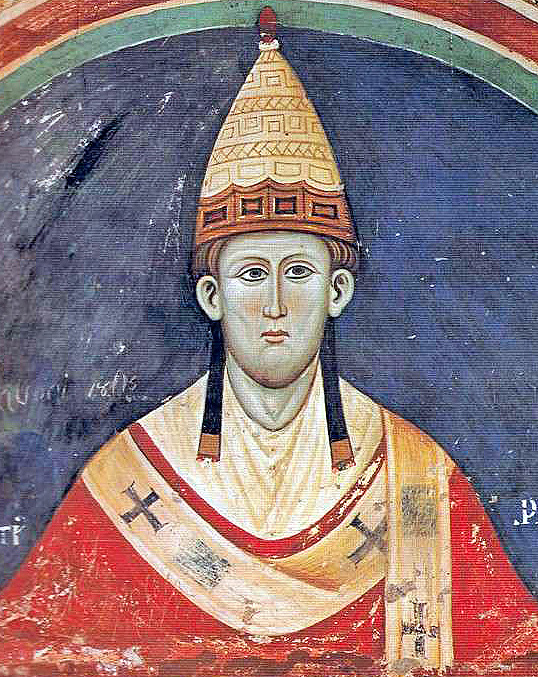
What, exactly, is this vestment, worn by Pope Innocent III:


Is it a pallium or an omophorion? Well obviously, its both; at that time someone in the east would use one word and someone in the west another. Its just a matter of vocabulary.

A cloak is a cloak whether its called a chasuble or omophorion

A stole is a stole even if its called a sticharion.

Same goes for the pallium and the omophorion.
 
Status
Not open for further replies.
Back
Top