Did early Christians use Crucifixes?

  • Thread starter Thread starter LoveGod102
  • Start date Start date
Status
Not open for further replies.
L

LoveGod102

Guest
My humanities book says that very early Christians used only plain crosses, not crucifixes. Is this true? If so when did this change?

 
My humanities book says that very early Christians used only plain crosses, not crucifixes. Is this true? If so when did this change?
In Herculaneum (one of the towns that were buried when Mount Vesuvius erupted in AD 79, another being Pompeii) there was this room in a house containing [.jpg"]what looks like a cross marking engraved on one of its walls]("http://www.ermaktravel.com/Europe/Italy/herculaneum/New folder (2)/00087b0s[1). Nail markings could be seen in and around this ‘cross’. Under the stucco surface a piece of furniture was found resembling a small cabinet, with a flat top surface and containing two rough clay lamps, a dice box and a die. Leaning against this cabinet was a small wooden stool. The measurements of the horizontal arms of this ‘cross’ are slightly unequal, and the top piece is not quite aligned to the base, which suggests that it was not an accurately made liturgical object of some kind. The nail marks however suggest that the ‘cross’ was originally made of wood and that it had been removed before the eruption of AD 79. These marks may also indicate that a moveable panel had once covered this marking. Now the thing is, it has been debated whether this was really a Christian cross at all: some have suggested that it may simply been, among other things, a miscellaneous wall marking.

Now it is true that we don’t have crucifixes (crosses with figures of Jesus on them) from the early centuries. Some even go so far as to claim that the early Christians never portrayed the crucified Jesus at all. But this is only half the truth.

We indeed only have a handful of portrayals of the crucified Christ predating the 5th century. The earliest of these, the so-called Alexamenos graffito (ca. 3rd century), is actually a crude sketch by a non-Christian who is mocking a certain Christian named Alexamenos. A few engraved gemstones (popular amulets in antiquity) also depict Jesus crucified, but the problem is we don’t precisely know exactly when they were made (a few of these could date from around the same time as the Alexamenos drawing: 2nd to 3rd century - such as this one - but the others may actually be later) or who created and ‘used’ them, whether they were orthodox or heterodox Christians or even whether they were Christian at all. Plus, in most surviving early Christian art, we do see a tendency to represent the crucifixion symbolically (using for instance, an empty cross) and to conflate it with the resurrection. On early Christian sarcophagi (coffins), such as the sarcophagus of Junius Bassus (AD 359) or the Dogmatic Sarcophagus or the Passion Sarcophagus (mid-4th century), scenes from Jesus’ passion were represented - but not the crucifixion.

Now here’s the thing. Early Christians used a symbol composed by the Greek letter tau (Τ) superimposed on the letter rho (Ρ), the so-called staurogram (so-called because of its resemblance to the cross -* stauros* in Greek). In very early New Testament manuscripts such as Papyrus 66 (ca. early 3rd century), Papyrus 75 (ca. AD 175-225) and Papyrus 45 (ca. mid-3rd century), the staurogram is used to abbreviate the word stauros or the verb staur (“to crucify”).


http://members.bib-arch.org/bswb_graphics/BSBA/39/02/BSBA390205002.jpg

http://members.bib-arch.org/bswb_graphics/BSBA/39/02/BSBA390205000.jpg

On the basis of this usage, a scholar named Larry Hurtado has disagreed with the idea that (orthodox) Christians did not visually portray the crucified Jesus until the 4th-5th century. He argues instead (see his article The Staurogram in Early Christian Manuscripts: The Earliest Visual Reference to the Crucified Jesus?) that the staurogram could actually be the earliest extant Christian visual reference we have to the crucified Christ (the T = the cross; the loop on the P = the head of the crucified). The staurogram, in his opinion, were not simply abbreviations to save space in manuscript but were visual expressions of Christian piety.
 
(Continued)

The thing is, the favorite art media of the early Christians were mostly two-dimensional: mosaics, paintings, book illustrations. Relief carving was okay, but three-dimensional sculpture in the round reminded them too much of the statues of emperors and Greco-Roman gods, which is why Christian artists mostly tended to avoid them. (In fact, the only examples of early Christian sculpture in the round we have before the 4th century are the Cleveland marbles [=field_artist%3Alate%20Roman%2C%20Asia%20Minor%2C%20early%20Christian%2C%203rd%20century"]from 3rd-century](http://www.clevelandart.org/art/collection/search?f[0) Asia Minor.) This is also the reason why the East mainly only has icons, with some Eastern Christians even having a negative perception of statuary; Western Christians only began to revive sculpture during the Carolingian and Ottonian periods (8th-10th centuries).

So much of the depictions of the crucifixion from between the 5th to the 8th century are either carvings or panel paintings or frescoes or book illustrations. Christians already used crosses, but crucifixes as we commonly understand it (crosses with a three-dimensional figure of Christ on it) only became popular at around the same time (Western) Christians have finally chosen to embrace sculpture.
 
(Continued)

The thing is, the favorite art media of the early Christians were mostly two-dimensional: mosaics, paintings, book illustrations. Relief carving was okay, but three-dimensional sculpture in the round reminded them too much of the statues of emperors and Greco-Roman gods, which is why Christian artists mostly tended to avoid them. (In fact, the only examples of early Christian sculpture in the round we have before the 4th century are the Cleveland marbles [=field_artist%3Alate%20Roman%2C%20Asia%20Minor%2C%20early%20Christian%2C%203rd%20century"]from 3rd-century](http://www.clevelandart.org/art/collection/search?f[0) Asia Minor.) This is also the reason why the East mainly only has icons, with some Eastern Christians even having a negative perception of statuary; Western Christians only began to revive sculpture during the Carolingian and Ottonian periods (8th-10th centuries).

So much of the depictions of the crucifixion from between the 5th to the 8th century are either carvings or panel paintings or frescoes or book illustrations. Christians already used crosses, but crucifixes as we commonly understand it (crosses with a three-dimensional figure of Christ on it) only became popular at around the same time (Western) Christians have finally chosen to embrace sculpture.
Thanks for the info and explanation. Quite helpful and very interesting. 🙂 You could write a Catholic history book, if this explanation is any indication.
 
We indeed only have a handful of portrayals of the crucified Christ predating the 5th century. The earliest of these, the so-called Alexamenos graffito (ca. 3rd century), is actually a crude sketch by a non-Christian who is mocking a certain Christian named Alexamenos.
I very detailed explanation, thank you.

I read somewhere that the early depictions of Jesus had him clean-shaven. Any truth in this?

Apparently, he only became bearded after the Turin Shroud emerged.
 
I very detailed explanation, thank you.

I read somewhere that the early depictions of Jesus had him clean-shaven. Any truth in this?
Apparently, he only became bearded after the Turin Shroud emerged.
I’m not sure of any ancient depictions of Christ clean-shaven, but I can tell you that the earliest known depiction of Christ Pantocrator from the 6th century in St Catherine’s Monastery show Him bearded. The widespread awareness of the Shroud of Turin can only be traced to the 14th century.

It is perhaps pertinent to remember that shaving was strictly forbidden in Jewish law, and Jesus was obedient to the word and spirit of the law. A clean-shaven Jesus is pretty much unthinkable. 🙂
 
I very detailed explanation, thank you.

I read somewhere that the early depictions of Jesus had him clean-shaven. Any truth in this?
That’s true. Most of the early depictions of Jesus do portray Him as a clean-shaven young man, almost like a Greco-Roman philosopher: dressed in a tunic and a pallium. It’s not really surprising: the artists (who are themselves part of Greco-Roman society) were simply depicting Jesus in terms of their own social context, as a quasi-heroic philosopher figure. Besides, depicting Jesus as a smooth-faced young philosopher also has another implication: proper dress, close-cropped hair and a shaven face are signs of good breeding in Greco-Roman society. Sometimes in fact these youthful representations could include some rather ‘feminine’ characteristics: sloping shoulders, wipe hips, long, curling hair and small protruding breasts.

It’s basically thought that these early representations of Jesus simply borrowed from established templates - namely the portraiture of Greco-Roman gods like Apollo, Dionysus and Orpheus. The common thing between these gods is that they are all portrayed as beardless young men. Plus, these gods who were featured in various mystery cults of Late Antiquity were imminent and personal gods with whom devotees had intense encounters, not unlike Jesus. Plus, they were usually associated with descents into the underworld and ‘resurrection’ in some way. It’s no wonder then that Christians adopted certain aspects of traditional representations of these gods to visual imagery of Christ, including the almost feminine beauty associated with such gods in particular.

At first the early Christians did not really portray Jesus ‘directly’ mind - instead they preferred to use other figures to symbolically evoke Him. There’s of course the famous fish (ichthys), the anchor, and monograms like the chi-rho and the staurogram. Jesus is also portrayed symbolically by depictions of things like Daniel in the lion’s den, Jonah being thrown overboard into the sea monster’s mouth, and even Orpheus charming the animals or a shepherd tending a flock of sheep, itself an already-established artistic motif: the kriophoros. (When Jesus is portrayed, He is either shown as a baby or a beardless young man.) This is actually the thing about ancient Christian art before the 4th-5th century: it was indistinguishable from that of other religious groups, whether conventional pagans following ancient Roman religion, Jews, or followers of mystery religions. (This is what makes it quite difficult to identify.) It’s possible that (at least at first) the early Christians did not think that the historical Jesus actually looked like that, that these are just symbolic depictions.


The healing of the paralytic (ca. AD 235) from the house church at Dura-Europos in Syria, the oldest known image of Jesus we have. Note the beardless, short-haired Jesus.


Shepherd from the same house church at Dura-Europos

http://images.bridgemanart.com/cgi-bin/bridgemanImage.cgi/400wm.DGA.7912240.7055475/419018.jpg
The raising of Lazarus and shepherd, Catacomb of the Giordani, Rome (3rd century)

http://img191.imageshack.us/img191/6327/w39c.jpg
Christ as Orpheus charming the animals, Catacombs of Domitilla, Rome (ca. AD 250-300)

http://img834.imageshack.us/img834/5766/8gls.jpg
(From left to right) Jonah resting under the vine, an orans with philosopher, shepherd, and baptism, Santa Maria Antiqua, Rome (ca. AD 270)


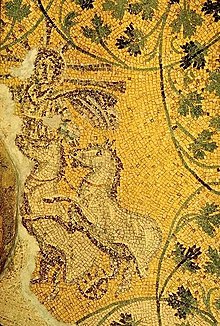
Christ as a solar deity (Helios or Sol Invictus), Tomb of the Julii, Vatican (late 3rd-4th century)


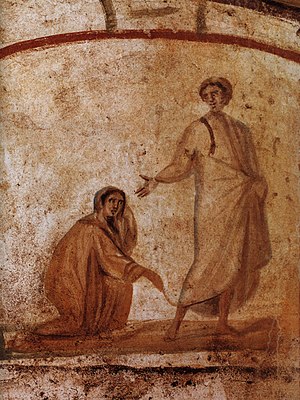
Jesus healing the bleeding woman (ca. AD 300-350)


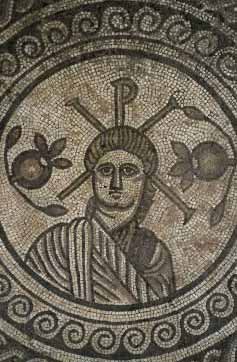
Christ with chi-rho, Hinton St Mary, England (early 4th century)
 
(Continued)

http://upload.wikimedia.org/wikipedia/commons/thumb/4/4b/1407_-Milano-_S.Lorenzo-_Cappella_S.Aquilino-Traditio_Legis-Dall%27Orto-18-May-2007.jpg/320px-1407-Milano-_S.Lorenzo-_Cappella_S.Aquilino-Traditio_Legis-Dall%27Orto-_18-May-2007.jpg
Christ with apostles, Cappella di Sant’Aquilino, Basilica of San Lorenzo, Milan (late 4th century)

https://upload.wikimedia.org/wikipedia/commons/thumb/7/75/1057_-_Roma,_Museo_d.civilt%C3%A0_Romana-Calco_sarcofago_Giunio_Basso-Foto_Giovanni_Dall%27Orto%2C_12-Apr-2008.jpg/319px-1057-_Roma%2C_Museo_d.civilt%C3%A0_Romana-Calco_sarcofago_Giunio_Basso-_Foto_Giovanni_Dall%27Orto%2C_12-Apr-2008.jpg
Sarcophagus of Junius Bassus (detail, AD 359)

http://img580.imageshack.us/img580/6568/7kk6.jpg
Traditio legis, Santa Costanza, Rome (ca. mid-4th century)

http://img90.imageshack.us/img90/4150/b0vx.jpg
Good Shepherd, Mausoleum of Galla Placidia, Ravenna (5th century)

After the late 4th and the 5th century, you have at least three possible ways to depict Jesus. There were of course still artists who portrayed Him as a young man (either with short or long hair), but this version is being eclipsed by two competing depictions. One shows Jesus as having a close-cropped, curly hair and a short beard, while the other showed Him with long, flowing hair and a long beard.

The Semitic-looking Jesus with short, frizzy hair (which somewhat appropriately enough, could be traced to Syria and Palestine) was the main competitor for the depiction of Christ with long hair during the early Byzantine period. An early 6th-century Byzantine historian, Theodorus Lector, reports an anecdote from the time when St. Gennadius was patriarch of Constantinople (458-471), wherein he opines that the earlier depiction was “the more authentic.”

At the time of Gennadius was withered the hand of a painter who dared to pain the Saviour in the likeness of Zeus. Gennadius healed him by means of a prayer. The author [Theodorus Lector] says that the other form of Christ, viz. the one with short, frizzy hair, is the more authentic.
  • Theodorus Lector, Historia Ecclesiastica 1.15 (ca 540s), from Theophanes the Confessor (ca. 810-15)
Theodore the historian of Constantinople, from his History of the Church, about Gennadius, archbishop of Constantinople:

I shall set down other things about him full of amazement. A certain painter, while painting an icon of Christ our Master, found that his hand shriveled up. And it was said that, as the work of the icon had been ordered by a certain pagan, in the adornment of the name of the Savior he had depicted his hair divided on his forehead, so that his eyes were not covered—for in such a way the children of the pagans depict Zeus—so that those who saw it would think that they were assigning veneration to the Savior.
  • Theodorus Lector as quoted by St. John of Damascus, Three Treatises on the Divine Images (720s-30s), Treatise 3, 130
http://img684.imageshack.us/img684/967/6thsinaipantocrator.jpg
 
(Continued)

http://img837.imageshack.us/img837/4673/baptismk.jpg
The baptism of Christ from the canon tables of the Rabula Gospels (AD 586).
Note Jesus’ short hair compared with John the Baptist’s flowing locks.

http://img571.imageshack.us/img571/6929/enthroned.jpg
Christ enthroned with four monks, from the same. Again, take note of the frizzy hair.

http://img835.imageshack.us/img835/1033/800pxmeisterdesrabulaev.jpg
The crucifixion, from the same. Now notice that Jesus’ hair has become long and dark.
A group of Florentine scholars led by Massimo Bernabò of the University of Cremona had recently argued based on UV analysis that most of the miniatures were actually extensively repainted at a later time to ‘standardize’ the original depictions.

Despite Theodore’s opinions however, the long-haired Christ eventually won out over the ‘Syrian’ Jesus. There was a notable exception though: in his first reign (685-95), then Byzantine emperor Justinian II introduced a radical change in the gold coinage of the empire: the head of the reigning emperor was removed from the obverse (front) to the reverse (back) to allow a portrait bust of Christ to be displayed. What Justinian portrayed back then on his coins was the long-haired version. Around 695, he was deposed in a popular uprising (during which he lost his nose), only returning to the throne in 705 with the help of a Bulgar and Slav army. Somewhat mysteriously, by the time of his second reign, Justinian preferred the image of the frizzy, Syrian Christ.

http://img194.imageshack.us/img194/972/dwi8r5nsswp4bx3enzt7f9a.jpg

http://img706.imageshack.us/img706/5329/sb1249.jpg

http://img822.imageshack.us/img822/4467/solidusjustinianiichris.jpg

http://img6.imageshack.us/img6/4547/03345z00.jpg

While Justinian again fell from power in 711 (with his death marking the end of the Heraclian Dynasty), Christ disappeared once again from the currency. The act however had an effect in society as a whole: the depiction of Jesus on coinage is said to be one of the reasons the Iconoclast controversy started. The image of Jesus would only make a true comeback on Byzantine coins by the 9th century, after the whole fiasco had died down, and even then, He is now almost always portrayed as the long-haired, heavily-bearded man of standard iconography. (In some areas in the West there were still a handful of artists who from time to time depicted a beardless, long-haired Jesus, but soon the bearded one also became the standard there as well.)

http://img838.imageshack.us/img838/439/53617q00.jpg
 
I’m not sure of any ancient depictions of Christ clean-shaven, but I can tell you that the earliest known depiction of Christ Pantocrator from the 6th century in St Catherine’s Monastery show Him bearded. The widespread awareness of the Shroud of Turin can only be traced to the 14th century.

It is perhaps pertinent to remember that shaving was strictly forbidden in Jewish law, and Jesus was obedient to the word and spirit of the law. A clean-shaven Jesus is pretty much unthinkable. 🙂
https://sphotos-a-atl.xx.fbcdn.net/hphotos-ash4/999753_566572693407109_293399399_n.jpg
 
Status
Not open for further replies.
Back
Top