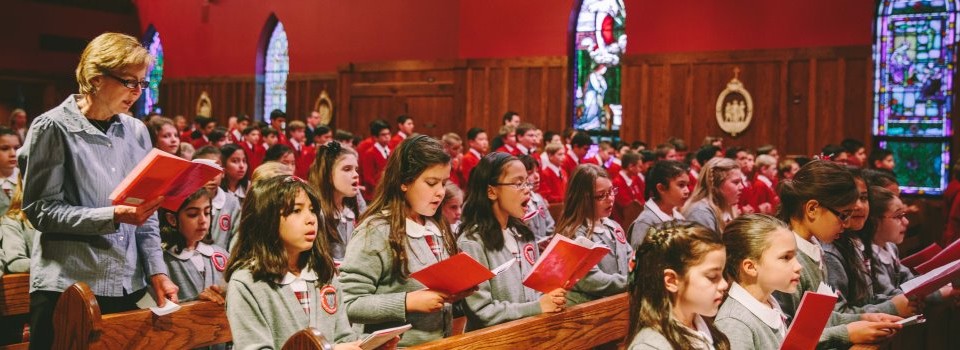
Does anyone here besides myself like the contemporary music at mass

  • Thread starter Thread starter SacredHeartBassist
  • Start date Start date
Status
Not open for further replies.
Not to mention, the problem of non-liturgical music at Mass, is all those kids essentially being catechized to think that such music is good and desirable for the liturgy. So this problem of non-liturgical music will be with us for the next 50-60 years…
What? If non-liturgically music is used at Mass, that is wrong and not the norm. Curious: how do you know the music is non-liturgical? Is is a song you hear outside the walls of the church, or is it your presumption? Can you cite examples. Seriously, no judgment, just curious.

@Bearself: he has a point though, especially if they are using non-liturgical music and not contemporary music meant for the church. Let’s see the answer.
 
Last edited:
I don’t think I’ve ever heard anything by the “Newsboys” at Mass (or maybe I just didn’t recognize it), but I do find that these Evangelical Protestant hymns are very theologically superficial. That’s not always a bad thing. There’s a time and a place for that… but I would want at least a decent proportion of liturgical hymns to have some theological meat to them.
 
Last edited:
“We Believe” is quite popular with our contemporary choir, which I believe is Newsboys.

I love the contemporary music. I do think if requires more effort on the part of the choir director to ensure it remains a choral arrangement and doesn’t become a performance piece for one or two people. So many of the pieces lend themselves to being big solo/duet pieces, and it bothers me personally when the choral element of a choir is lost, especially since I love to sing along to the songs.
 
Allow me to quote the following:
"Q. Isn’t this really just a matter of taste?
A: Nothing prevents us from preferring one form of music to another. What’s more, nothing prevents us from preferring one form of popular religious song to another. But music that is suitable for sacred liturgy must be of a special sort. No longer can personal preference be the sole criterion. “Not all musical forms can be considered suitable for liturgical celebrations,” says Pope John Paul II in his Chirograph on sacred music (2003). He quotes Pope Paul VI: “If music — instrumental and vocal — does not possess at the same time the sense of prayer, dignity, and beauty, entry into the sphere of the sacred and the religious is [thereby] precluded.”

In his general audience of February 26, 2003, Pope John Paul called on musicians to “make an examination of conscience so that the beauty of music and hymnody will return once again to the liturgy. It is necessary to purify worship of ugliness of style, careless forms of expression,
ill-prepared music and texts, which are not worthy of the great act that is being celebrated.”’
https://musicasacra.com/about-cmaa/faq/
 
Last edited:
"Q: What are the main liturgy books that I need?
A: At minimum, every Church musician needs the Liber Cantualis and the Gregorian Missal (both published by Solesmes). The Liber Cantualis contains chants for the prayers and responses of the Mass, including the most useful and beloved chants that the congregation sings, along with a selection of chants for the Ordinary. It also contains the four Sequences, seasonal Marian antiphons, and popular chants that have obtained highly valued status through frequent use at communion and as prelude and postlude.

The Gregorian Missal provides a full selection of Ordinary chants, and all the Latin Propers for Sundays and greater feasts. It includes English translations of the chants and prayers, as well as references for the three-year cycle of Scripture readings.

Musicians also might want to own the 1974 Graduale Romanum, which contains the Proper chants for the entire Church year. They will also need an authoritative guide to liturgical rubrics, such as one by Msgr. Peter Elliott. Those using the traditional Roman Rite (1962 Missal) will need an older edition of the Graduale or the Liber Usualis. A reprint of the 1952 Liber is available from Neri Publications."
https://musicasacra.com/about-cmaa/faq/
 
Last edited:
"Q: My parish has dreadful music. How can I change it?
A: Self-education is the first step toward the restoration of beauty and holiness in the liturgical life of your parish. Catholic musicians should learn to read neumes, and should begin to commit Latin hymns and settings of the Ordinary to memory. Then they can gather with others to form a schola, the traditional name for a choir that sings chant. It can take many months of practice before a new schola is prepared to sing at Mass.

In the meantime, the schola can find other opportunities to perform chant, including Benediction services and visits to hospitals or homes for the aged. In all of this, prayer and charity toward others are essential. Sometimes the pastor is open to the idea and sometimes he is not, but he is far more likely to be welcoming to a schola that is already serving the parish community. Slow and systematic work, done cheerfully and with attention to quality, will accomplish far more in the long run than rash protests and demands."
https://musicasacra.com/about-cmaa/faq/
 
Last edited:
“Q: Won’t a drastic change alienate people?
A: The liturgical upheaval of the late 1960s and onward confused and alienated many Catholics. Some people loved the new pop style and other people were embittered by it. Attitudes toward sacred music remain a source of division among Catholics today. While the need to restore the sacred is urgent, pastoral sensitivity is necessary to avoid the disorienting approach of the post-conciliar period. It will take time for the liturgical aesthetic to recover from the errors of the recent past so that it may be deepened and matured. The restoration of sacred music is a long-term project that requires years of relentless progress.”
Twenty-four Questions on Sacred Music | Church Music Association of America.
 
Last edited:
I still have “Tantum Ergo”, kazoo version still rolling in my head and that was 50, 60 posts ago.

Peoples musical choices are so individualist. Not sure it’s possible to please a plurality, no matter what.
 
I think we need to start the Sacred Kazoo Orchestra and start hiring out for parades, church fairs, and anywhere else where a good Tantum Ergo or Holy, Holy, Holy played by 25 kazoos would maybe bring some people to Jesus. Heck we could even throw in Amazing Grace and How Great Thou Art in a spirit of ecumenism.
 
I like hearing contemporary music at mass! Contemporary music is my natural voice and language - - so therefore so much easier to “connect” and sing and worship from the heart.

I do like the beauty of traditional chants as well and can imagine that it creates a very sacred experience during mass (Ive yet to attend traditional mass), but music is chosen ministry and “prayer” so being able to heartfully express in song as a participant in words that I actually understand is great too.
 
I don’t get this. Maybe it’s because I’m still coming into communion, but isn’t the point of mass to prayerfully accept the Eucharist and that special oneness with Christ? If the building is ugly just focus on Christ.
Easier said than done, at least for me. I find that beautiful church architecture and beautiful music helps me to focus on Christ, while ugly architecture and banal music serves as a distraction. Yes, Christ is and should be the focus of the Mass, and that’s why I gladly go to Mass, in spite of bad music, ugly architecture, bad homilies, or any other shortcomings of whatever particular parish church I am attending. But I don’t think that means that all those other trappings are completely unimportant and can so easily be mentally swept aside.
 
Last edited:
However, you must also realize that their are others celebrating Mass with you that find the music perfectly acceptable.
Absolutely! And if my parish had one Mass with traditional music and one Mass (or more) with contemporary music, I would be fine with that. I wouldn’t try to force traditional music on someone who doesn’t like it.
 
Last edited:
Well, you could have the problems of the lady who posted about not being able to attend Mass because people are shooting and bombing the Catholics who go to church.

It’s all about perspective.
Of course I am very thankful to live in a place and time where we have religious freedom and can go to Mass safely! But I don’t think it is valid to say that because we are free to go to Mass while others aren’t, therefore we should not care at all about the quality of church architecture, the quality of church music, the quality of the priests’ homilies, and so on. Of course these things are of lesser importance than the freedom of religion, but it is not wrong for people to care about these things and to place some importance on them.
 
Having a preference is fine. I have my own preferences for what I like to see in a church building and hear in the music. We all do.

However, we should be able to focus on Jesus no matter what the music and the building look like.
 
However, we should be able to focus on Jesus no matter what the music and the building look like.
I focus on Jesus at Mass. But I can focus on Him better in a setting where the church is beautiful and the music is reverent. Should I be able to focus on Jesus just as much when the church is ugly and the music is banal? You seem to think so, and perhaps you are right. But I am only human, and therefore I can not always so easily do what I “should be able” to do.

Bishop Barron has some good thoughts on how beauty can draw people closer to God:
 
Last edited:
Allow me to quote the following:
"Q. Isn’t this really just a matter of taste?
A: Nothing prevents us from preferring one form of music to another. What’s more, nothing prevents us from preferring one form of popular religious song to another. But music that is suitable for sacred liturgy must be of a special sort. No longer can personal preference be the sole criterion. “Not all musical forms can be considered suitable for liturgical celebrations,” says Pope John Paul II in his Chirograph on sacred music (2003). He quotes Pope Paul VI: “If music — instrumental and vocal — does not possess at the same time the sense of prayer, dignity, and beauty, entry into the sphere of the sacred and the religious is [thereby] precluded.”

In his general audience of February 26, 2003, Pope John Paul called on musicians to “make an examination of conscience so that the beauty of music and hymnody will return once again to the liturgy. It is necessary to purify worship of ugliness of style, careless forms of expression,
ill-prepared music and texts, which are not worthy of the great act that is being celebrated.”’
  1. You still did not answer my question: “How do you know that the music in non-liturgical?” Add: How do you personally determine that assumption?
  2. The quote above is what I do and take seriously, as well as @Tis_Bearself, as I read his posts. To post this to me makes me think that this is the lesson you think I need to learn. If so, you cannot be further from the truth. Be it a traditional hymn, a contemporary or modern song, I look at all aspects of the song and its fit in the liturgy I am planning for. Not everyone is going to be on board with every choice of music a music director chooses; it’s the nature of the ministry. “Personal preference” plays a part in my planning, yes, but is is NOT “the sole criterion.” Personal preference plays a part in knowing your parish and the people and I think I have the musical knowledge to choose songs that will “work well.” “Not all musical forms are considered suitable…” is correct, but what is meant by all musical forms? You can read that as contemporary music if you wish, but could it also mean the secular form that hints upon some liturgical value?
  3. As for the other 2 posts: It appears that you are trying to teach us all a lesson on proper music etiquette in church. Really don’t know your involvement in church ministry, but I’m good, thanks. I do some chant at specific times (Paschal Triduum), but it is not the norm. A steady habit of chant will empty the pews. I also use metrical style revised Grail Psalms only. After 36 years in this same parish, you know what the people like and prefer, and all is liturgically correct. If not, I would have been dismissed by the people long ago, just like the music director in a neighboring parish.
 
Last edited:
Absolutely! And if my parish had one Mass with traditional music and one Mass (or more) with contemporary music, I would be fine with that. I wouldn’t try to force traditional music on someone who doesn’t like it.
Paul, that’s good to hear. To take it one step further, would you mind if at the same Mass, there was some traditional and some contemporary? I have to believe that there must be some of each category that you like and dislike. It’s tough on music directors to please everyone. We had separate Masses for the two styles for years. It was a horror. People who could not make it to their traditional Mass complained and visa versa. Then there is the issue of combining the two together for special and Holy Day Masses, especially the holiday where a full compliment of musicians is desirable.
 
Last edited:
To take it one step further, would you mind if at the same Mass, there was some traditional and some contemporary?
That would at least be an improvement, in my opinion. I know that it is not possible to please everyone. But I also think that parishes should pay more attention to what the church has said about sacred music, including the proper place of Gregorian Chant.

But having said that, if my parish had all contemporary music for one or more Masses, I wouldn’t mind, as long as I had another option.
I have to believe that there must be some of each category that you like and dislike.
It isn’t only a matter of like and dislike. It is also a matter of what kind of music seems fitting for Mass, and what kind doesn’t. I believe that the music at Mass should be something different than what we hear in our everyday lives – something elevated, more sacred, more formal. I believe the same thing about the language at Mass, and that is one reason why I prefer the newer English translation of the Mass which uses a slightly more formal style than the older translation. It is probably also the reason that even some modern translations of the Old Testament still use “thee” and “thou” in some places, because those words, though archaic, have a more formal and perhaps more sacred sound to them, at least to many people.

But in terms of liking and disliking something in each category (traditional vs. contemporary), not so much. I honestly can’t think of any hymn that was written after about 1960 or 1970 that I like. That doesn’t mean that someone today couldn’t write a hymn that I would like, but just that most modern hymns (at least the ones I hear at Mass) tend to be written in a certain style that I would describe as banal or happy-clappy, and I simply don’t like that style and don’t see it as reverent. I see it as a huge step down from the music I listen to in everyday life, while ideally it should be a step up.

However, I can honestly say that there are a few older hymns that I don’t like very much. But even the ones that I don’t like, I at least feel that they are reverent, and that makes them much less annoying and much easier to hear in the context of Mass.

 
Last edited:
Here are two articles that are relevant to this conversation, and that I wish more pastors and music directors would take to heart:

First, Fr. Dwight Longenecker asks what is a hymn and what is it for:


And Roseanne Sullivan asks whether the “four hymn sandwich” is really the proper music for Mass anyway (regardless of whether the hymns are contemporary or traditional):

 
Status
Not open for further replies.
Back
Top