
Eastern Christianity Saints & Feasts

  • Thread starter Thread starter Edwin1961
  • Start date Start date
Status
Not open for further replies.
October 22
TWENTIETH SUNDAY AFTER PENTECOST
The Holy Bishop Abercius, Equal to the Apostles, Wonder-Worker

During the reigns of Emperor Antoninus and his son, Marcus Aurelius, St. Abercius was the bishop of the city of Hierapolis in Phrygia. The great majority in this city were pagans, and St. Abercius governed his sparse flock, sorrowing in his heart because of the great number of pagans and idolaters, and diligently praying to God that He would bring them to the light of truth. During a boisterous idolatrous festival, Abercius became inflamed with God’s zeal and entered the idolatrous temple, smashing all the idols. When the enraged pagans sought to kill him, three young madmen, foaming at the mouth and howling, fell down before this man of God, and he drove the demons from them. The young men became sane and calm. This turned the pagans’ anger into amazement at the wonderworker of Christ, and five hundred of them immediately desired baptism. Little by little, all of Hierapolis came to believe in Christ and were baptized. The proconsul of the province, Publius, had a mother who was blind. Abercius restored her sight by prayer, and Publius, his mother and many others believed in Christ. In old age, Abercius was summoned to Rome, where he healed the emperor’s daughter of insanity. The Lord Jesus Christ appeared several times to His faithful follower. People from near and far came to him for miraculous help when they suffered from incurable illnesses. The demons not only feared him, but also served him at his command. At the guidance of the Lord Himself, Abercius preached the Gospel throughout Syria and Mesopotamia. In great old age, St. Abercius presented himself to his beloved Lord in Hierapolis, at the end of the second century.

Today’s Readings:
Galatians 1:11-19
Luke 16:19-31
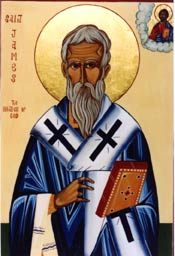
 
October 23

The Holy Apostle James, Brother of the Lord
James is called the Lord’s brother because he was the son of the righteous Joseph, the betrothed of the Most-holy Theotokos. When the righteous Joseph was near death, he divided his estate among his sons, and wanted to leave a portion to the Lord Jesus, the son of the Most-holy Virgin, but all the other brothers opposed this, not regarding Jesus as their brother. James greatly loved Jesus and declared that he would include Jesus in his share. That is why he is called the Lord’s brother. From the beginning, James was devoted to the Lord Jesus. According to tradition, he traveled to Egypt with the Most-holy Virgin and Joseph, when Herod sought to slay the newborn King. Later, as soon as he heard Christ’s teaching, James lived by it. It is said of him that he never ate fat or oil, but lived on just bread and water, and was a virgin to the end of his life on earth. He often kept vigil at night and prayed to God. The Lord numbered him among His Seventy Apostles. Following His glorious Resurrection, the Lord appeared to him especially, as the Apostle Paul testifies (I Corinthians 15:7). He was Bishop of Jerusalem for thirty years and zealously governed the Church of God. At the instruction of the Lord, James compiled the first Liturgy, which seemed very long for later Christians, and St. Basil and St. John Chrysostom shortened it. He converted many Jews and Greeks to the Christian Faith, and even the unbelieving Jews were amazed at his righteousness, referring to him as ``James the Just.’’ When Ananias became High Priest, he and other Jewish elders determined to kill James for being a preacher of Christ. Once, during the feast of Passover, when many people had gathered in Jerusalem, the elders forced James to climb onto the roof of the Temple, and tried to make him speak against Christ. He climbed up and spoke to the people of Christ as the Son of God and the true Messiah, of His Resurrection and His eternal glory in the heavens. The infuriated priests and elders pushed him off the roof; he fell and was severely injured, but was still alive. Then, one man ran up and struck him on the head with a fuller’s club with such force that his brains spilled out. Thus, this most glorious apostle of Christ died a martyr’s death, and went to live eternally in the Kingdom of his Lord. James was sixty-six years old when he suffered for Christ.

Saint Ignatius, Patriarch of Constantinople
Ignatius was the son of Emperor Michael Rangabe. He became patriarch after St. Methodius in 846. Then Ignatius was deposed in 858 and exiled. Photius, the chief secretary to the emperor, was made patriarch in his place. However, when Emperor Basil the Macedonian ascended the throne, he re-instated Ignatius to the patriarchal throne. St. Ignatius governed the Church with great zeal and wisdom. He built the Monastery of the Holy Archangels in which he reposed in the Lord in the eighty-ninth year of his life.

The Holy Martyr James of Borovichi
All that is known of this saint is what he revealed in a vision to people from the town of Borovichi after his repose. One day in 1540, his body floated down the river Meta, and washed ashore near Borovichi. Many miracles took place from his relics.

Today’s Readings:
Philippians 4:10-23
Luke 10:22-25
 
October 24
The Holy Martyr Arethas and His Companions

This holy martyr suffered for the Christian faith with more than four thousand other Christians: priests, monks and nuns, townsmen and women and children. Arethas was the local governor of the town of Negran, in the land of Omir in southern Arabia, and was ninety-five years old when he suffered. The land of Omir was governed by a Jew called Dunaan, a vicious persecutor of Christians. Resolving to exterminate Christianity completely in his land, he laid siege to the Christian town of Negran and told the citizens that, if they did not deny Christ, he would put them all to death. The citizens closed the gates, and Dunaan attacked the city wall for a long time without success. Then the iniquitous governor swore to the citizens that he would do nothing to them if they opened the gate for him to enter and take the tribute owing to him, saying that he would then go away at once. The Christians believed him, and opened the gates. Then the bloodthirsty Jew summoned the aged Arethas to him, along with his clergy and other eminent citizens, and slew them all with the sword, and then indulged in a riot of butchery through the town. Hearing of this, the Byzantine Emperor, Justin, was greatly distressed and wrote a letter to the Ethiopian Emperor Elesbaan, urging him to set out with an army against Dunaan and avenge the Christian blood that had been spilled. Elesbaan obeyed Justin, attacked the governor of Omir, overcame him, slaughtered his entire army and put him to the sword. A devout man called Abramius was installed as ruler of Omir by God’s revelation and, as archbishop, also by God’s revelation, St Gregory (see Dec. 19th). In Negran, the Christians rebuilt the Church of the Holy Trinity that Dunaan had burned, and built a church to the holy martyr Arethas and the other martyrs of that city. They suffered and received wreaths of martyrdom from the Lord in 523.

St Elesbaan, Emperor of Ethiopia
Inflamed with love for Christ, this devout Emperor raised an army against Dunaan, the wicked persecutor of Christians in the land of Omir, but he was unsuccessful in the early stages of the battle and many of his soldiers perished in the and desert. He then lamented bitterly to God, and promised to become a monk if God would help him overcome the shedder of Christian blood. Defeating Dunaan, Elesbaan returned to Ethiopia and immediately left the imperial court and went to a monastery, where he lived in strict asceticism as a true monk for a whole fifteen years, God giving him wonderworking gifts both before and after his death. He entered into rest in 555.

Today’s Readings:
Colossians 1:1-2 & 7-11
Luke 11:1-10
 
October 25
The Holy Martyrs Marcian and Martyrius

These saints of God were clergymen under Paul, the Patriarch of Constantinople, during the reign of Emperor Constantius. With the death of the great Emperor Constantine, the Arian heresy, which until then had been suppressed, revived and gained momentum. Even Emperor Constantius himself leaned toward this heresy. There were two influential noblemen at the emperor’s court, Eusebius and Philip, both of whom were ardent Arians. Under their influence, Patriarch Paul was ousted from the patriarchal throne and banished to Armenia, where the Arians strangled him. Then the dishonorable Macedonius seized the patriarchal throne. At that time Orthodoxy had two bitter struggles: against the pagans and against the heretics. Marcian and Martyrius interceded with all their strength and determination on the side of Orthodoxy. Marcian was a reader and Martyrius was a subdeacon at the cathedral church of Hagia Sophia; under Patriarch Paul they had been patriarchal notaries (secretaries). The Arians at first tried to bribe them, but when these holy men rejected this with scorn, the heretics condemned them to death. When they were brought to the executioner, they raised their hands and prayed to God, giving Him thanks for a martyr’s end to their lives: ``Lord, we rejoice that we depart from this life by such a death. Make us worthy to be partakers of eternal life. Thou art our life!’’ They placed their necks beneath the sword and were beheaded in the year 355. Later, St. John Chrysostom built a church in their name over their miracle-working relics.

The Holy Martyr Anastasius He was a cloth-maker and a zealous Christian. During Diocletian’s persecution of Christians, this man of God appeared before the judge in the Dalmatian town of Solin, and confessed his faith in Christ. He was inhumanly tortured and slain, and his body was thrown into the sea but was later found and honorably buried.

Saint Tabitha
St. Tabitha (which means ``gazelle’’) was a disciple of the apostles and lived in Joppa. She was full of good works and almsdeeds (Acts 9:36), but suddenly became weak and died. The Apostle Peter was then in the town of Lydda, and the grieving disciples sent for him, imploring him to comfort her kinsmen. Upon his arrival, the great Apostle of Christ told everyone to leave the room where the corpse lay, then knelt in prayer. Then, turning to the body, he said: Tabitha, arise (Acts 9:40) and Tabitha opened her eyes and stood up. Many believed in the Lord Jesus Christ because of this wonderful miracle.

Today’s Readings:
Colossians 1:18-23
Luke 11:9-13
 
**October 26

The Holy Great-martyr Demetrius**This glorious and wonderworking saint was born in Thessalonica of noble and devout parents. Implored of God by childless parents, Demetrius was their only son, and so was raised and educated with great care. Demetrius’s father was a commander in Thessalonica. When his father died, Emperor Maximian appointed Demetrius as commander in his place. As he appointed him, Maximian, an opponent of Christ, particularly recommended that he persecute and exterminate the Christians in Thessalonica. Demetrius not only disobeyed the emperor but openly confessed and preached the Lord Jesus Christ in the city of Thessalonica. When the emperor heard of this he became furious with Demetrius. Then, when he was returning from battle against the Sarmatians, Maximian stopped at Thessalonica to investigate the matter. The emperor summoned Demetrius and questioned him about his faith. Demetrius openly acknowledged his Christian Faith to the emperor and also denounced the emperor’s idolatry. Maximian cast Demetrius into prison. Knowing what was awaiting him, Demetrius gave all his goods to his faithful servant Lupus to distribute to the poor, and joyfully awaited his imminent suffering for Christ the Lord. An angel of God appeared to him in prison, saying: Peace be to you, O sufferer of Christ; be brave and be strong!'' After several days, the emperor sent soldiers to the prison to kill Demetrius. The soldiers found the saint of God at prayer and ran him through with lances. Christians secretly took his body and honorably buried it. Healing myrrh flowed from the body of the martyr of Christ, curing many of the sick. Soon, a small church was built over his relics. An Illyrian nobleman, Leontius, was afflicted with an incurable illness. He hastened, with prayer, to the relics of St. Demetrius and was completely healed. In thanksgiving, Leontius erected a much larger church on the site of the old church. The saint appeared to him on two occasions. When Emperor Justinian wanted to translate the relics of the saint from Thessalonica to Constantinople, flaming sparks sprang from the tomb and a voice was heard: Stop, and do not touch!’’ And thus, the relics of St. Demetrius have remained for all time in Thessalonica. As the protector of Thessalonica, St. Demetrius has appeared many times, and on many occasions has saved Thessalonica from great calamity. His miracles are without number. The Russians considered St. Demetrius to be the protector of Siberia, which was conquered and annexed to Russia on October 26, 1581.

The Venerable Martyr Ioasaph
Ioasaph was a disciple of St. Niphon, Patriarch of Constantinople, and labored in asceticism on the Holy Mountain. He had so great a love for Christ that all of his ascetic works seemed inadequate, and from love he desired to suffer for his Lord. For that reason he went to Constantinople, where he openly confessed to the Turks his faith in the Holy Trinity and the Son of God. The enraged Turks beheaded him on October 26, 1536.

The Commemoration of the Great Earthquake of Constantinople
In the year 740, during the reign of Emperor Leo the Isaurian, there was a terrifying and prolonged earthquake in Constantinople. The people considered this a punishment from God for their sins, and prayed with great repentance to the Most-holy Theotokos and St. Demetrius, until God showed mercy and the earthquake ceased.

Today’s Readings:
2 Timothy 2:1-10
John 15:17-27 John 16:1-2
 
October 27
The Holy Martyr Nestor

In the time of the suffering of St. Demetrius the Myrrh-gusher, there was a young man of Thessalonica, Nestor, who learned the Christian Faith from St. Demetrius himself. At that time Christ’s enemy, Emperor Maximian, organized various games and amusements for the people. The emperor’s favorite in these games was a Vandal by the name of Lyaeus, a man of Goliath-like size and strength. As the emperor’s gladiator, Lyaeus challenged men every day to single combat and slew them. Thus, the bloodthirsty Lyaeus amused the bloodthirsty, idolatrous Maximian. The emperor built a special stage for Lyaeus’s battles, similar to a threshing floor on pillars. Spears, points upward, were planted beneath this platform. When Lyaeus defeated someone in wrestling, he would throw him from the platform onto the forest of spears. The emperor and his pagan subjects cheered as some poor wretch writhed in torment on the spears until he died. Among Lyaeus’s innocent victims were many Christians: when no one volunteered to duel with Lyaeus, by the emperor’s orders Christians were arrested and forced to duel with him. Seeing this horrifying amusement of the pagan world, Nestor’s heart was torn with pain, and he decided to come forward for a duel with the gigantic Lyaeus. But first, he went to prison to see St. Demetrius and sought a blessing from him to do this. St. Demetrius blessed him, signed him with the sign of the Cross on the forehead and on the chest and prophesied to him: You will defeat Lyaeus, but you will suffer for Christ.'' Thus, young Nestor went to duel with Lyaeus. Maximian was present with a multitude of people; everyone felt pity for the young Nestor, who would surely die, and tried to dissuade him from dueling with Lyaeus. Nestor crossed himself and said: O God of Demetrius, help me!’’ and with God’s help, he overcame Lyaeus, knocked him down, and threw him onto the sharp spears, where the heavy giant soon found death. Then all the people cried out: ``Great is the God of Demetrius!’’ But the emperor, shamed before the people and sorrowing for his favorite Lyaeus, was greatly angered at Nestor and Demetrius, and commanded that Nestor be beheaded and Demetrius run through with lances. Thus, the Christian hero Nestor ended his earthly life and took up his habitation in the Kingdom of his Lord in the year 306.

The Venerable Nestor the Chronicler
At the age of seventeen, Nestor entered the Monastery of the Kiev Caves while St. Theodosius was still abbot. He wrote the first history of the Russian people, in which he intertwined the history of Russian asceticism. He was distinguished by unusual humility and meekness. In his literary work, he often referred to himself as unworthy, coarse, ignorant and full of every kind of sin. But God, Who knows the hearts of men, glorified this wonderful saint of His. When Nestor entered into rest on October 27, 1114, his relics performed many miracles.

Saint Andrew, Prince of Smolensk
Out of love for Christ, Andrew abandoned the glory and honor of the world, hid himself in a monastery and there, disguised and unknown, served as a sacristan for thirty years. He peacefully entered into rest in the Lord in 1390; his miracle-working relics were found in 1540.

Today’s Readings:
Colossians 2:1-7
Luke 11:23-26
 
October 28
The Holy Martyr Parasceva

She was born in the city of Iconium of wealthy and Christ-loving parents. After the death of her parents, the maiden Parasceva began to distribute her possessions to the poor and the less fortunate, all in the name of Christ the Lord. When a persecution began under Diocletian, Parasceva was brought to trial before the governor of that land. When the governor asked her for her name, she replied that she was called a Christian. The governor rebuked her because she did not give her usual name and Parasceva said to him: ``First, I had to tell you my name in eternal life, and then my name in this temporal life.’’ After flogging her, the governor cast Parasceva into prison where an angel of God appeared to her, healed her of her wounds, and comforted her. By prayer, Parasceva destroyed all the idols in the pagan temple. After prolonged and harsh tortures, Parasceva was beheaded with the sword and took up her abode in eternal life.

Saint Arsenije, Archbishop of Peæ
ièa for the archiepiscopal see. Arsenije chose Peæ, and built a monastery there and a church dedicated to the Holy Apostles (which was later renamed the Church of the Ascension of the Lord). Before his second departure for Jerusalem, Sava designated Arsenije as his successor to the archiepiscopal throne, and when Sava reposed in Trnovo on his way back from Jerusalem, Arsenije urged King Vladislav to translate the body of St. Sava to the Serbian land. He governed the Church prudently for thirty years and reposed in the Lord on October 28, 1266. On the wall of the altar in the church of Peæ is written: ``O Lord our God, hearken: visit and bless this church … and remember also me, the sinful Arsenije.’’ Arsenije is buried in the church at Peæ.

The Holy Martyr Terence
He was from Syria and suffered for the Christian Faith with his wife Neonilla and their seven children. After many tortures, during which the power of God was manifested, they were all beheaded with the sword.

Saint Stephen of St. Sava’s
He was the composer of many beautiful canons. He lived the ascetic life in the community of St. Sava the Sanctified. He was later ordained a bishop and peacefully entered into rest in the year 807.

Saint Athanasius, Patriarch of Constantinople
He was an opponent of union with Rome, in contrast to his predecessor John Beccus (1275-1282). He was an ascetic and a prayerful person from his childhood. Beloved by his people, Athanasius provoked the displeasure of certain priests by his moral strictness. He withdrew to his monastery on Mount Ganos, where he labored even more austerely than before. The Lord Jesus Christ Himself appeared to him and scolded him gently for leaving his flock to the wolves. When he foretold the day of the earthquake in Constantinople, Emperor Andronicus reinstated him to the patriarchal throne against his will. After that, he again secretly withdrew to the ascetic life. He entered into rest at the age of one hundred. He was clairvoyant and a miracle-worker.

Saint Dimitri, Bishop of Rostov
Dimitri was a great hierarch, preacher, author and ascetic. He was born near Kiev in the year 1651, and reposed in the year 1709. Among his many glorious works of instruction, he was known especially for his translation and publication of The Lives of the Saints. He foresaw his own death three days in advance, and died while at prayer. Dimitri was a great light of the Russian Church and of Orthodoxy in general. He had heavenly visions during his life. He served the Lord zealously and took up his habitation in the Kingdom of Heaven.

Today’s Readings:
2 Corinthians 3:12-18
Luke 8:16-21
 
October 29
TWENTY-FIRST SUNDAY AFTER PENTECOST
The Holy Venerable Martyr Anastasia
Our Venerable Father Abraham the Hermit
The Passing of our Venerable Father Abraham of Rostov, Archimandrite and Wonder-worker
Our -Holy Mother, the Martyr Anastasia

She was born in Rome of well-born parents and left an orphan at the age of three. As an orphan, she was taken into a women’s monastery near Rome, where the abbess was one Sophia, a nun of a high level of perfection. After seventeen years, Anastasia was known in the whole neighbourhood, to the Christians as a great ascetic and to the pagans as a rare beauty. The pagan administrator of the city, Probus, heard of her and sent soldiers to bring her to him. The good Abbess Sophia counselled Anastasia for two hours on how to keep the Faith, how to resist flattering delusion and how to endure torture. Anastasia said to her: ‘My heart is ready to suffer for Christ; my soul is ready to die for my beloved Jesus.’ Brought before the governor, Anastasia openly proclaimed her faith in Christ the Lord and, when the governor tried to dissuade her from the Faith, first with promises and then with threats, the holy maiden said to him: ‘I am ready to die for my Lord, not once but - oh, if it were only possible! - a thousand times.’ When they stripped her naked, to humiliate her, she cried to the judge: ‘Whip me and cut at me and beat me; my naked body will be hidden by wounds, and my shame will be covered by my blood!’ She was whipped and beaten and cut about. She twice felt a great thirst and asked for water, and a Christian, Cyril, gave her a drink, for which he was blessed by the martyr and beheaded by the pagans. Then her breasts and tongue were cut off, and an angel of God appeared to her and upheld her. She was finally beheaded with the sword outside the city. Blessed Sophia found her body and buried it, and Anastasia was crowned with the wreath of martyrdom under the Emperor Decius (249-251).

**Our Holy Father Abraham the Hermit. **
Under pressure from his parents, Abraham married, but on the very day of his wedding, he left his bride, his parents, his home and all that he had and went off into solitude to live in strict asceticism. He lived thus for fifty years, only leaving his cell twice in the whole of that time. Once it was at the command of the local bishop, to convert a pagan village to the Christian faith, and the other was to save his dissolute niece Maria. He entered peacefully into rest in 360, at the age of seventy.

Today’s Readings:
Galatians 2:16-20
Luke 8:26-39
 
October 30
The Hieromartyr Zenobius and his sister Zenobia

They were from the town of Aegea in Cilicia. They inherited the true Faith and great material wealth from their parents. Working zealously for the Faith and with great love, they distributed all their wealth to the poor. Because their hands were so generous, the hand of God shielded them from every evil intent of men and demons. The generous hands of Zenobius, which gave to the poor, were endowed by God with the gift of miracle-working, and Zenobius healed the sick of every kind of infirmity merely by touching them. Zenobius was appointed Bishop of Aegea. During a persecution, the Prefect Lysias arrested him and said: I offer you two choices: life or death; life if you worship the gods, or death if you do not.'' St. Zenobius replied: Life without Christ is not life but death, whereas death for the sake of Christ is not death but life.’’ When Zenobius was subjected to cruel tortures, Zenobia came to the judge and said: ``I also want to drink from this cup of suffering, and be crowned with that wreath.’’ After being tortured in fire and in boiling pitch, both were beheaded with the sword in about the year 285. Thus this brother and sister took up their habitation in the Kingdom of the Immortal Christ the King.

The Holy Apostles Cleopas, Tertius, Mark, Justus and Artemas
They were all numbered among the Seventy. The risen Lord appeared to Cleopas on the road to Emmaus (Luke 24:13-33). Tertius wrote down the Epistle to the Romans for Paul (Romans 16:22), and died a martyr as Bishop of Iconium after the Apostle Sosipater (November 10). St. Mark (or John) was the son of the devout Mary (whose home was a refuge for the apostles and the first Christians), and a kinsman of Barnabas (Acts 12:12). He became the bishop of the Samaritan town of Apollonia. Justus was a son of Joseph the Betrothed. Together with Matthias, he was one of those selected as a possible replacement for Judas the traitor, but he was not chosen. He suffered for the Gospel as a bishop in Eleutheropolis. St. Artemas was Bishop of Lystra in Lycaonia, and reposed peacefully.

The Holy King Milutin
I and Queen Helena and brother of Dragutin. He fought many battles defending his Faith and his people. He fought against Emperor Michael Palaeologus because Palaeologus accepted union with Rome and tried to force the Balkan peoples and the monks of Athos to recognize the pope. He fought against Shishman, King of Bulgaria, and Nogai, King of the Tartars, in order to defend his lands. All his wars were successful, for he constantly prayed to God and hoped in God. He built more than forty churches: beside those that he built in his own land-Treskavac, Graèanica, St. George in Nagoriè, the Church of the Holy Theotokos in Skoplje, Banjska and so forth-he also built churches outside of his land, in Thessalonica, Sofia, Constantinople, Jerusalem and the Holy Mountain. He entered into rest in the Lord on October 29, 1320. His body was soon shown to be incorrupt and miracle-working; and as such, it reposes even today in the Church of the Holy King in Sofia, Bulgaria.

Today’s Readings:
Galatians 2:13-20
Luke 11:29-33
 
**October 31

The Holy Apostles Stachys, Amplias, Urban, Narcissus, Apelles and Aristobulus**
They were all of the Seventy. Stachys was an assistant to St. Andrew the First-called. St. Andrew appointed him Bishop of Byzantium. He established the church in Argyropolis and governed his flock faithfully and zealously. After sixteen years as bishop, he entered peacefully into rest in the Lord. Amplias and Urban worked likewise with St. Andrew, and were ordained bishops by him-Amplias in Lydda of Odyssopolis in Judea, and Urban in Macedonia. Both died as martyrs for Christ the Lord. Narcissus was appointed Bishop of Athens by the Apostle Philip. St. Apelles was Bishop of Heraclea in Trachis. Aristobulus, brother of the Apostle Barnabas, preached the Christian Faith in Britain and reposed peacefully there.

The Holy Martyr Epimachus
He was born in Egypt and labored there in asceticism, ending his earthly life as a martyr. Imitating St. John the Baptist, he withdrew to the wilderness while still a youth. Because of his great love for God, the Spirit of God led him to every truth and, with no other teacher, taught him how to live a life of asceticism. Then, Epimachus learned that the unbelievers were torturing and killing Christians in Alexandria for the sake of Christ. All aflame with zeal for the Faith, he went to the city and smashed the idols. When the pagans tortured him for this, he cried out: Smite me, spit on me, put a crown of thorns on my head, put a reed in my hand, give me gall to drink, crucify me on a cross, and pierce me with a spear! This is what my Lord endured, and I too want to endure it.'' In the crowd of people who witnessed the torturing of St. Epimachus, there was a woman who was blind in one eye. She wept bitterly, watching the heartless torture of this God-pleaser. When the tormentors scraped the body of the holy martyr of Christ, blood spurted from him, and one drop of blood touched the blind eye of that woman. Suddenly, her blind eye regained vision, and was as whole as the other. Then she cried out: Great is the God in whom this sufferer believes!’’ After this they beheaded St. Epimachus and his soul took up habitation in eternal joy, in about the year 250.

The Holy Martyr Nicholas of Chios
Nicholas was a pious youth and a great zealot for the Christian Faith. He was born in the village of Karyes on the island of Chios, where he was tortured and beheaded by the Turks in the year 1754, and gave his righteous soul to God.

The Venerable Spyridon and Nicodemus
They were monks and prosphora-bakers in the Monastery of the Kiev Caves. Though illiterate, Spyridon knew the entire Psalter by heart and worked many miracles during his lifetime. He entered into rest in the year 1148.

Today’s Readings:
Colossians 2:20-3:3

20: If with Christ you died to the elemental spirits of the universe, why do you live as if you still belonged to the world? Why do you submit to regulations,
21: “Do not handle, Do not taste, Do not touch”
22: (referring to things which all perish as they are used), according to human precepts and doctrines?
23: These have indeed an appearance of wisdom in promoting rigor of devotion and self-abasement and severity to the body, but they are of no value in checking the indulgence of the flesh.
1: If then you have been raised with Christ, seek the things that are above, where Christ is, seated at the right hand of God.
2: Set your minds on things that are above, not on things that are on earth.
3: For you have died, and your life is hid with Christ in God.

Luke 11:34-41
34: Your eye is the lamp of your body; when your eye is sound, your whole body is full of light; but when it is not sound, your body is full of darkness.
35: Therefore be careful lest the light in you be darkness.
36: If then your whole body is full of light, having no part dark, it will be wholly bright, as when a lamp with its rays gives you light."
37: While he was speaking, a Pharisee asked him to dine with him; so he went in and sat at table.
38: The Pharisee was astonished to see that he did not first wash before dinner.
39: And the Lord said to him, "Now you Pharisees cleanse the outside of the cup and of the dish, but inside you are full of extortion and wickedness.
40: You fools! Did not he who made the outside make the inside also?
41: But give for alms those things which are within; and behold, everything is clean for you.
 
November 1
Our Venerable Bishop, Martyr Theodore Romzha


Saints Cosmas and Damian
Unmercenaries and wonderworkers, they were brothers in the flesh and in the spirit, born somewhere in Asia of a pagan father and a Christian mother. After their father’s death, their mother Theodota devoted all her time and energy to the bringing-up of her sons as true Christians. God helped her, and her sons grew as two choice fruits and as two holy lamps. They were skilled in medicine and ministered to the sick without payment, and so fulfilled Christ’s command: ‘Freely have ye received; freely give’ (Matt. 10: 8). They were so strict in their unpaid ministry to men that Cosmas became greatly enraged with his brother Damian when he took three eggs from a woman, Palladia, and gave orders that, after his death, he should not be buried with his brother. In fact, holy Damian had not taken those eggs as a reward for healing Palladia’s sickness, but because she had sworn by the Most Holy Trinity that he should have them. However, after their death in Fereman, they were buried together in obedience to a revelation from God. These two holy brothers were great wonderworkers both during their lifetime and after their death. A farm labourer, on lying down to sleep at one time, was attacked by a snake, which entwined itself around his mouth and stomach. This poor man would have breathed his last in the greatest torment had he not at the last moment invoked the help of Saints Cosmas and Damian. Thus the Lord glorified forever by miracles those who glorified Him here on earth by their faith, purity and mercy.

**The Holy Martyr Hermenegild the Heir. **
He was the son of the Gothic King Luvigeld, who held the Arian heresy. Hermenegild, however, did not turn from Orthodoxy, in spite of the flattery and threats of his brutal, heretic father. His father threw him into prison and, at Easter, sent a heretic bishop early in the morning to give him Communion. This man of God would not receive Communion at the hands of a heretic; a fact that the bishop passed on to the king. The king was furious, and ordered the executioners to cut off Hermenegild’s head, which came to pass in 586. Luvigeld later repented of having killed his son, abjured his heresy and returned to Orthodoxy.

**Our Holy Father, the Martyr James, with his disciples James and Dionysius. **
He was born in the diocese of Kastoria, of parents called Martin and Paraskeva. Working as a shepherd, James became rich and thus incurred the envy of his brother, who reported him to the Turks as having found some money in the ground. James fled to Constantinople, where he became poor. He was once the guest of a Turkish Bey. The Turks were eating meat, but James was fasting. The Bey said: ‘Your Christian faith is indeed great!’, and he related how his wife had been sick in mind and how, after trying all doctors and medicines, he had taken her to the Patriarch for prayers to be read over her. As soon as the Patriarch opened the book to read, a heavenly light filled the church. When the prayer was ended, his wife was made whole. James, hearing how the Bey extolled the Christian faith, gave away all that he had and went to the Holy Mountain, where he became a monk in the monastery of Iviron. He lived in asceticism on the Holy Mountain, and suffered for the Faith at the hands of the Turks in Jedrene on November 1st, 1520. His wonderworking relics and those of his disciples are preserved in the monastery of St Anastasia near Salonica.

(Continued)
 
November 1
Continued

Today’s Readings:
Colossians 3:17-4:1

17: And whatever you do, in word or deed, do everything in the name of the Lord Jesus, giving thanks to God the Father through him.
18: Wives, be subject to your husbands, as is fitting in the Lord.
19: Husbands, love your wives, and do not be harsh with them.
20: Children, obey your parents in everything, for this pleases the Lord.
21: Fathers, do not provoke your children, lest they become discouraged.
22: Slaves, obey in everything those who are your earthly masters, not with eyeservice, as men-pleasers, but in singleness of heart, fearing the Lord.
23: Whatever your task, work heartily, as serving the Lord and not men,
24: knowing that from the Lord you will receive the inheritance as your reward; you are serving the Lord Christ.
25: For the wrongdoer will be paid back for the wrong he has done, and there is no partiality.
1: Masters, treat your slaves justly and fairly, knowing that you also have a Master in heaven.

Luke 11:42-46
42: “But woe to you Pharisees! for you tithe mint and rue and every herb, and neglect justice and the love of God; these you ought to have done, without neglecting the others.
43: Woe to you Pharisees! for you love the best seat in the synagogues and salutations in the market places.
44: Woe to you! for you are like graves which are not seen, and men walk over them without knowing it.”
45: One of the lawyers answered him, “Teacher, in saying this you reproach us also.”
46: And he said, "Woe to you lawyers also! for you load men with burdens hard to bear, and you yourselves do not touch the burdens with one of your fingers.
 
November 2
The Holy Martyrs Acyndinus, Pegasius, Anempodistus, Aphthonius, Elpidephorus and others with them

They were Persian Christians, and suffered in the time of King Sapor, in 355. The first three were servants at the court of this king, but secretly served Christ their Lord. When they were arrested and brought to trial before the king, he asked them whence they came. To this they replied: ‘Our paternity and life is the most holy Trinity, consubstantial and undivided, the Father, the Son and the Holy Spirit, one God.’ The king gave them over to harsh torture, and they endured it all courageously, singing psalms and with prayer on their lips. At the time of their torture and imprisonment, angels of God appeared to them several times, and once the Lord Christ Himself, as a man ‘with a face radiant as the sun’. When one of the torturers, Aphthonius, saw with wonder that boiling lead did no harm to the martyrs, he believed in Christ and cried out: ‘Great is the Christian God!’ He was then immediately beheaded, and many others saw and believed. Then the King commanded that Acyndinus, Pegasus and Anempodistus be sewn into goat-skins and thrown into the sea. Then St Aphthonius appeared from the other world with three shining angels, and they bore the martyrs to dry land and set them free. Elpidephorus was a courtier. When he revealed that he was a Christian, and denounced the king for his slaughter of innocent Christians, the king condemned him to death, and Elpidephorus was beheaded along with about seven thousand other Christians. Then the three first-named martyrs were finally thrown into a burning furnace, along with twenty-eight soldiers and the king’s mother, who had also come to faith in Christ. And so, in the flames, they gave their righteous souls into the hands of the Lord.

Our Holy Father Marcian of Cyrus
He was from the town of Cyrus in Syria, and was distinguished by gentle birth and physical beauty. He left all for Christ, and withdrew to the desert of Halkis as a solitary. He was a contemporary of Patriarch Flavian of Antioch and the Emperors Constantius and Valens. A divine light, by which he read the Holy Scriptures, shone in his cell at night, and he never had need of any other light. being a great wonderworker both during his lifetime and after his death. At the time of his death, he commanded his disciple Eusebius to conceal his body and bury it in secret, to avoid veneration. He entered into rest in the Lord in the year 387.

**The Hieromartyr Victorinus, Bishop of Patav **
Many assert that he was a Slovene. Blessed Hieronymus cites him as a man learned and devout. He knew Greek better than Latin, and wrote commentaries on several books of the Old and New Testaments. He suffered for the Christian faith in about 303.

Today’s Readings:
Colossians 4:2-9
2: Continue steadfastly in prayer, being watchful in it with thanksgiving;
3: and pray for us also, that God may open to us a door for the word, to declare the mystery of Christ, on account of which I am in prison,
4: that I may make it clear, as I ought to speak.
5: Conduct yourselves wisely toward outsiders, making the most of the time.
6: Let your speech always be gracious, seasoned with salt, so that you may know how you ought to answer every one.
7: Tych’icus will tell you all about my affairs; he is a beloved brother and faithful minister and fellow servant in the Lord.
8: I have sent him to you for this very purpose, that you may know how we are and that he may encourage your hearts,
9: and with him Ones’imus, the faithful and beloved brother, who is one of yourselves. They will tell you of everything that has taken place here.

Luke 11:47-12:1
47: Woe to you! for you build the tombs of the prophets whom your fathers killed.
48: So you are witnesses and consent to the deeds of your fathers; for they killed them, and you build their tombs.
49: Therefore also the Wisdom of God said, `I will send them prophets and apostles, some of whom they will kill and persecute,’
50: that the blood of all the prophets, shed from the foundation of the world, may be required of this generation,
51: from the blood of Abel to the blood of Zechari’ah, who perished between the altar and the sanctuary. Yes, I tell you, it shall be required of this generation.
52: Woe to you lawyers! for you have taken away the key of knowledge; you did not enter yourselves, and you hindered those who were entering."
53: As he went away from there, the scribes and the Pharisees began to press him hard, and to provoke him to speak of many things,
54: lying in wait for him, to catch at something he might say.
1: In the meantime, when so many thousands of the multitude had gathered together that they trod upon one another, he began to say to his disciples first, "Beware of the leaven of the Pharisees, which is hypocrisy.
 
**November 3
The Hieromartyr Acepsimas, Bishop of Naeson, and others with him **
The eighty-year-old Acepsimas, filled with every Christian virtue, was sitting one day in his house with his guests when a child, filled with the Spirit of God, ran up to the aged bishop, kissed him on the head, and said: ‘Blessed is this head, for it will be martyred for Christ!’ This prophecy was soon fulfilled. King Sapor raised a fierce persecution of Christians throughout Persia, and St Acepsimas was seized and taken before a prince who was also a pagan priest. When the bishop had been arrested and bound, he was approached by one of his household, who asked him what he wanted done about his house. The saint replied: ‘It’s no longer my house; I’m going to a higher home, and shall not return.’ After long interrogation, he was thrown into prison, whence, the next day, were brought a seventy year-old priest called Joseph and a deacon, Aeithalas. After three years’ imprisonment and many sufferings, Acepsimas was beheaded, and Joseph and Aeithalas were buried up to the waist in the ground, being stoned by a group of men who were without mercy towards Christians. Joseph’s body, by God’s providence, disappeared that night, and above Aeithalas’s body there grew a tree, which healed all manner of disease and pain. Five years passed, then the wicked and jealous pagans cut down this tree. These soldiers of Christ suffered in Persia in the fourth century, in the time of the pagan King Sapor.

The Holy and Great Martyr George
On this day we celebrate the translation of St George’s relics from Nicomedia to the city of Lydda in Palestine, where he suffered in the time of the Emperor Diocletian (284-305). The sufferings of this wonderful saint are recorded on April 23rd. At the time of his death, St George asked his servant to take his body and carry it to Palestine, to the place where his mother was born, and where he had much land that he had given away to the poor. His servant did this. In the time of the Emperor Constantine (305-337), a beautiful church was built in Lydda by devout Christians, and. on the occasion of the consecration of that church, the saint’s relics were translated and buried there. Innumerable miracles have been wrought by the relics of St George, Christ’s great martyr.

**Our Holy Father Elias of Egypt. **
He lived in asceticism near Antinoe, the capital of the Thebaid. He spent seventy years on and inaccessible rocks in the wilderness. He ate only bread and dates and, as a young man, fasted whole weeks at a time. He healed all manner of pains and weaknesses. He became very shaky in old age, and entered into rest at the age of 110, going to the joy of his Lord. ‘Keep your mind from malicious thoughts of your neighbours, knowing that such thoughts are hurled by diabolical power, to keep your mind from your own sins and from seeking God’, he said

Continued
 
November 3
Continued

Today’s Readings:
Colossians 4:10-18

10: Aristar’chus my fellow prisoner greets you, and Mark the cousin of Barnabas (concerning whom you have received instructions – if he comes to you, receive him),
11: and Jesus who is called Justus. These are the only men of the circumcision among my fellow workers for the kingdom of God, and they have been a comfort to me.
12: Ep’aphras, who is one of yourselves, a servant of Christ Jesus, greets you, always remembering you earnestly in his prayers, that you may stand mature and fully assured in all the will of God.
13: For I bear him witness that he has worked hard for you and for those in La-odice’a and in Hi-erap’olis.
14: Luke the beloved physician and Demas greet you.
15: Give my greetings to the brethren at La-odice’a, and to Nympha and the church in her house.
16: And when this letter has been read among you, have it read also in the church of the La-odice’ans; and see that you read also the letter from La-odice’a.

Luke 12:2-12
2: Nothing is covered up that will not be revealed, or hidden that will not be known.
3: Therefore whatever you have said in the dark shall be heard in the light, and what you have whispered in private rooms shall be proclaimed upon the housetops.
4: "I tell you, my friends, do not fear those who kill the body, and after that have no more that they can do.
5: But I will warn you whom to fear: fear him who, after he has killed, has power to cast into hell; yes, I tell you, fear him!
6: Are not five sparrows sold for two pennies? And not one of them is forgotten before God.
7: Why, even the hairs of your head are all numbered. Fear not; you are of more value than many sparrows.
8: “And I tell you, every one who acknowledges me before men, the Son of man also will acknowledge before the angels of God;
9: but he who denies me before men will be denied before the angels of God.
10: And every one who speaks a word against the Son of man will be forgiven; but he who blasphemes against the Holy Spirit will not be forgiven.
11: And when they bring you before the synagogues and the rulers and the authorities, do not be anxious how or what you are to answer or what you are to say;
12: for the Holy Spirit will teach you in that very hour what you ought to say.”
 
**November 4
Our Holy Father Joannicius the Great **
This great spiritual light was born in the village of Marykata in the province of Bithynia, of his father Myritrices and his mother Anastasia. He was a shepherd as a youth. Whilst tending his sheep at pasture, he would often retreat into solitude and remain in prayer the whole day, having encircled his flock with the sign of the Cross so that it should not wander off and get lost. After that, he was called into the army, and caused men to marvel at his courage, particularly in the wars against the Bulgarians. After his military service, Joannicius withdrew to Olympus in Asia Minor, where he became a monk and gave himself entirely over to asceticism, persevering in it till his death in great old age. He laboured in the ascetic life for over fifty years in various places, and had from God most abundant gifts of wonderworking: he healed all sicknesses and pains, drove out demons, tamed wild beasts, possessing a particular power over snakes; he walked dryfoot through water, became invisible to men when he so desired and foretold future events. He was distinguished by an outstanding humility and meekness. In outward appearance, he was like a giant, huge and strong. He took an active part in the destiny of God’s Church, for, during the iconoclast period he was at first deluded, but then tore himself away and became an ardent defender of reverence towards the icons. He had a great friendship with Patriarch Methodius of Constantinople. Joannicius lived for ninety-four years, and entered peacefully into rest in the Lord in 846. He was a great wonderworker both during his lifetime and after his death.

**The Hieromartyrs Nicander, Bishop of Myra, and Hermas the Priest. **
Both were ordained by the Apostle Titus. They were distinguished by their great zeal for the Faith and their great labours in winning pagans for Christ the Lord. Because of this, a complaint was brought against them before a certain magistrate, Libanus, and he gave them over to fierce torture. They were stoned and dragged over stones; they underwent imprisonment and suffered hunger, and endured many other tortures which no mortal man could endure without God’s special aid. The Lord appeared to them in various ways and, when they were thrown into a fiery furnace, sent them His angel to soothe the flames for them. They were finally buried alive by their soul- less tormentors and covered with earth. But it is in vain that men put others to death when the Lord gives life, and they dishonour in vain those whom the Lord glorifies.

Today’s Readings:
2 Corinthians 5:1-10

1: For we know that if the earthly tent we live in is destroyed, we have a building from God, a house not made with hands, eternal in the heavens.
2: Here indeed we groan, and long to put on our heavenly dwelling,
3: so that by putting it on we may not be found naked.
4: For while we are still in this tent, we sigh with anxiety; not that we would be unclothed, but that we would be further clothed, so that what is mortal may be swallowed up by life.
5: He who has prepared us for this very thing is God, who has given us the Spirit as a guarantee.
6: So we are always of good courage; we know that while we are at home in the body we are away from the Lord,
7: for we walk by faith, not by sight.
8: We are of good courage, and we would rather be away from the body and at home with the Lord.
9: So whether we are at home or away, we make it our aim to please him.
10: For we must all appear before the judgment seat of Christ, so that each one may receive good or evil, according to what he has done in the body.

Luke 9:1-6

1: And he called the twelve together and gave them power and authority over all demons and to cure diseases,
2: and he sent them out to preach the kingdom of God and to heal.
3: And he said to them, “Take nothing for your journey, no staff, nor bag, nor bread, nor money; and do not have two tunics.
4: And whatever house you enter, stay there, and from there depart.
5: And wherever they do not receive you, when you leave that town shake off the dust from your feet as a testimony against them.”
6: And they departed and went through the villages, preaching the gospel and healing everywhere.
 
November 5
TWENTY-SECOND SUNDAY AFTER PENTECOST
The Holy Martyrs Galaction and Episteme
The Passing of the Blessed Martyr Gregory Lakota, Auxiliary Bishop of Peremyshl (1950)

Our Holy Father Galaction and our Mother Episteme, Martyrs

They were born in the city of Edessa in Phoenicia, both of pagan parents. Galaction’s mother was barren until she was baptised. After her baptism, she brought her husband also to the true Faith and baptised her son Galaction, bringing him up a Christian. When the time came for Galaction to marry, his devout mother Leucippe died, and his father betrothed him to a maiden called Episteme. Galaction did not wish to enter into marriage at all, and he quickly urged Episteme to be baptised and then to become a nun at the same time as he became a monk. Both went away to the mountain of Publion, Galaction to a men’s monastery and Episteme to a women’s, and each of them became a true light in the monastery. They were first in labours, in prayer, in humility and obedience, and first in love. They did not leave their monasteries, and neither saw the other until the time of their death. A fierce persecution arose, and they were both brought to trial. While they were mercilessly whipping Galaction, Episteme was weeping, and they then whipped her also. They cut off their hands and feet, and finally their heads. One Eutolius, a man who had been a servant of Episteme’s parents and then a monk together with Galaction, took their bodies and buried them. He also wrote the Lives of these two wonderful martyrs for Christ, who suffered and received their heavenly crowns in 253.

The Holy Apostles Patrobus, Hermes, Linus, Gains and Philologus
They were of the Seventy. Patrobus was bishop of Neapolis; Hermes was in Philipopolis (Rom. 16:14), Linus in Rome (II Tim. 4:21), Gaius in Ephesus (Rom. 16:23) and Philologus in Synope (Rom. 15:16). All of them fulfilled the Law of Christ with love and went to His Kingdom.

St Jonah, Archbishop of Novgorod
Born in Novgorod and orphaned early, he was taken and educated by a God-fearing woman. Michael the Fool for Christ of Klops saw him once as a young boy and said to him prophetically: ‘Ivan, my little one, be diligent in your studies, for you will be archbishop in Novgorod the Mighty’. And so it came to pass, for later, after the death of Archbishop Euthymius, this Jonah was elected and consecrated to the throne of Novgorod. Jonah was God-fearing and merciful, such as is rare in a mortal man. He built churches and monasteries and cared for his flock as a true and good shepherd. He was offered the throne of Moscow as Metropolitan but declined, excusing himself because of his great age. He entered into rest peacefully on November 5th, 1570, and went to the joyful, heavenly mansions. One hundred years after his death, a great fire broke out in Novogorod. The relics of this holy hierarch did not catch fire among the flames, but on the contrary, began to show healing powers and to give off a sweet and wonderful fragrance.

Today’s Readings:
Galatians 6:11-18
Luke 8:41-56
 
November 6
St Paul the Confessor, Patriarch of Constantinople

When the blessed Patriarch Alexander was lying on his deathbed, the lamenting faithful asked him whom he would leave to follow him as chief pastor of the flock of Christ. Then the sick Patriarch said to them: ‘If you want to have a shepherd who will teach you and whose virtues will illumine you, choose Paul; but, if you want a suitable man as a figurehead, choose Macedonius.’ The people chose Paul. This was not acceptable to the Arian heretics, nor to the Emperor Constantius, who was at that time in Antioch, and so Paul was quickly deposed and fled to Rome together with St Athanasius the Great. There, both Pope Julian and the Emperor Constans gave them a warm welcome and upheld them in their Orthodoxy. The Emperor and the Pope sent letters which restored Paul to his episcopal throne, but, after the death of Constans, the Arians raised their heads again and drove the Orthodox Patriarch off to Cucusus in Armenia. While Paul was celebrating the Liturgy one day in exile, he was set on by the Arians and strangled with his pallium. This was in the year 351. In the time of the Emperor Theodosius, in 381, his relics were translated to Constantinople, and, in 1236, to Venice, where they still lie. * His beloved priests and secretaries, Marcian and Martyrius, suffered soon after their Patriarch, on October 25th, 355 (see their lives on that day).

Our Holy Father Varlaam of Chutinsk, the Wonderworker
Born and brought up a Christian in Novgorod the Great, he became a monk on the death of his parents and devoted himself to strict asceticism. He founded a monastery on the bank of the Volkhov river, on a site shown to him by a heavenly light. He was a great wonderworker both during his lifetime and after his death, being able to penetrate human secrets, to drive out unclean spirits and to heal all sicknesses. A servant of Prince Vasilii Vasilievitch was taken seriously ill, and he asked to be carried to the grave of St Varlaam, and further asked that, if he should die on the way, they should take his dead body to the saint. And so it came to pass: he died on the road, and they brought him dead into the monastery, where he was restored to life, stood up and prostrated himself before the tomb of the saint. In 1471, Tsar Ivan the Terrible gave orders that the saint’s grave be dug up. As soon as they had begun to uncover it, a flame sprang from the grave and blazed along the walls of the church. The Tsar was so terrified that he fled from the church and, in his haste, forgot his staff, which is kept to this day beside the saint’s tomb. In commemoration of this wonder, St Varlaam is also remembered on the Friday after the Sunday of All Saints.

Commemoration of the falling of ash from the air
This occurred in Constantinople in 472 (or 475, according to the Greek Synaxarion), during the reign of the Emperor Leo the Great and Patriarch Gennadius.

Today’s Readings:
1 Thessalonians 1:1-5
Luke 12:13-15 & 22-31
 
November 7
The Holy 33 Martyrs of Melitene

He was born in the Cappadocian city of Tijane of a good and God- fearing mother, Stratonica, who was blind. Hieron was a very zealous Christian, and cared for his blind mother with a truly filial love. Because of both his faith and his mother, he refused to go into the army, and fended off and drove away those who were sent to take him, for he was loth to leave his helpless, blind mother and be forced as a soldier to bow down and offer sacrifice to idols. Finally, Hieron was seized and taken before the governor of the city of Melitene, along with other Christians. While they were on the road, a man in white apparel appeared one night to Hieron and said to him: ‘Behold, Hieron, I reveal to thee thy salvation: thou shalt not wage war for any earthly king, but shalt engage in a battle for the King of heaven, and quickly shalt thou come to Him and receive from Him both honour and glory.’ Hieron’s heart was filled with ineffable joy at these words. When they reached Melitene, they were all thrown into prison, where Hieron strengthened them all in their faith with great ardour, exhorting them that not one should fall away but that all should freely give their bodies over to torment and death for Christ. To a man, they all confessed their faith in Christ the Lord before the judge, except for one kinsman of Hieron’s called Victor, who repudiated his faith. Hieron’s hands were cut off , then he was flogged and tortured in various ways, until he was finally beheaded with the sword together with the others. Going out to the place of execution, the thirty-three martyrs sang the psalm: ‘Blessed are those that are undefiled in the way, and walk in the Law of the Lord’ (Ps. 1:1). Let us remember by name these honourable martyrs, who are inscribed in the Book of Life: Hesychius, Nicander, Athanasius, Mamas, Barachius, Callinicus, Theogenes, Nikon, Longinus, Theodore, Valerius, Xanticus, Theodulus, Callimachus, Eugene, Theodochus, Ostrichius, Epiphanius, Maximian, Ducitius, Claudian, Theophilus, Gigantius, Dorotheus, Theodotus, Castrichius, Anicetas, Themilius, Eutychius, Hilarion Diodotus and Amonitus. A certain man called Chrysanthus found Hieron’s severed head and gave it burial, and he later built over it a church in honour of St Hieron. One of the martyr’s hands was taken to his blind mother. St Hieron suffered with his companions in 298, and entered into the glory of Christ.

The Holy Martyr Thessalonica, with Auctus and Taurion
This maiden was the daughter of Cleon, a pagan priest, a rich and arrogant man. Because of her faith in Christ, her father drove her from the house and the city. Two respected citizens, Auctus and Taurion by name, reproached Cleon for his inhuman treatment of his daughter, and Cleon thereupon denounced them as Christians. They were savagely tortured and beheaded for Christ, and the maiden Thessalonica was tortured and killed soon after. They suffered in the Macedonian city of Amphipolis, near present-day Kavala, and so these martyrs were found worthy, by their sufferings, of the immortal Kingdom.

Our Holy Father Lazarus of Mount Galesius
A pillar of light appeared above the house where he was born. He left his village in Magnesia and went to Jerusalem on pilgrimage to the holy places, becoming a monk there in the monastery of St Sava the Sanctified. After ten years, he settled on Mount Galesius and toiled in asceticism upon a pillar as a stylite, and was a wonderworker both during his lifetime and after his death. The Emperor Constantine Monomachus had great respect for him. St Lazarus entered into his eternal home at the end of the eleventh century.

Today’s Readings:
1 Thessalonians 1:6-10
Luke 12:42-48
 
**November 8
The Holy Archangel Michael and all the Bodiless Powers of Heaven **
The angels of God have been commemorated by men from the earliest times, but this commemoration often degenerates into the divinization of angels (IV Kings 23:5; A.V. II Kings). Heretics always wove fantasies round the angels. Some of them saw the angels as gods and others, if they did not so regard them, took them to be the creators of the whole visible world. The local Council in Laodicea, that was held in the fourth century, rejected in its 35th Canon the worship of angels as gods, and established the proper veneration of them. In the time of Pope Sylvester of Rome and the Alexandrian Patriarch Alexander, in the fourth century, this Feast of the Archangel Michael and the other heavenly powers was instituted, to be celebrated in November. Why in November? Because November is the ninth month after March, and it is thought that the world was created in the month of March. The ninth month after March was chosen because of the nine orders of angels that were the first created beings. St Dionysius the Areopagite, a disciple of the Apostle Paul (that Apostle who was caught up to the third heaven), writes of these nine orders in his book: ‘Celestial Hierarchies’. These orders are as follows: six- winged Seraphim, many-eyed Cherubim, godly Thrones, Dominions, Virtues, Powers, Principalities, Archangels and Angels. The leader of the whole angelic army is the Archangel Michael. When Satan, Lucifer, fell away from God, and carried half the angels with him to destruction, then Michael arose and cried to the unfallen angels: ‘Let us give heed! Let us stand aright; let us stand with fear!’, and the whole angelic army sang aloud: ‘Holy, holy, holy Lord God of Sabaoth; heaven and earth are full of Thy glory!’ (See on the Archangel Michael: Joshua 5:13-15 and Jude v.9). Among the angels there rules a perfect unity of mind, of soul and of love; of total obedience of the lesser powers to the greater and of all to the holy will of God. Each nation has its guardian angel, as does each individual Christian. We must keep in mind that, whatever we do, openly or in secret, we do in the presence of our guardian angel and that, on the Day of Judgement, a great multitude of the holy angels of heaven will be gathered around the throne of Christ, and the thoughts, words and deeds of every man will be laid bare before them. May God have mercy on us and save us at the prayers of the holy Archangel Michael and all the bodiless powers of heaven. Amen.

Today’s Readings:
Hebrews 2: 2 - 10
Luke 10: 16 - 22
 
Status
Not open for further replies.
Back
Top