
English Propers for EVERY SUNDAY

  • Thread starter Thread starter TheMc
  • Start date Start date
Status
Not open for further replies.
T

TheMc

Guest
From the Chant Cafe, by Jeffrey A. Tucker:
There are no words to express my excitement about what is happening with the Simple English Propers. Tomorrow is the day that the print run will begin. And then: we will all have a book, one book, we can hold that provides chanted English propers for the modern ordinary form of Mass. This will take some getting used to - just the reality seems too good to be true. I can hardly believe that this is really happening.

I know that the post seems pointless. But I really just wanted to share the joy.

That’s right, the collection of propers for every Sunday and Feast is complete. These are ground breaking, not only because they are in english, but also because they are very simple to sing.

The “Full” version from the GR:
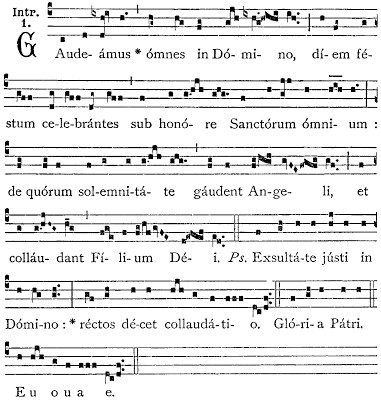

The version from SP:
(Please Note: This uploaded content is no longer available.)

Now, that first one is the ideal introit for whatever day this is from (I’m not sure 😊), but how many parishes would be ready to sing that starting next week? Mine might, but I would imagine not many would.

But, with this new book of simple propers, not only is it in english, but you can learn them in about 5 minutes! This is amazing for any parish that is trying to get back to what the church wants for the sacred music used at Mass.

The other amazing part is that in almost every case, the simple proper retains the same “feel” as the original. I can attest to this first hand, after singing a GR introit, and then the same introit from SP. The link between the two is actually kind of eerie, but gregorian chant excels at the mystical.

When it is made public, I will post to this thread again when information on where and how to buy the book.

This is great for all you cantors that are able to make your own music choices, and also an excellent resource for when there is no organist, as they require/include no accompaniment.
 
This is a lot easier to read, but I wonder why they didn’t put it in modern notation. I think if that was done, it would be more accessible for those who have a difficult time reading this notation. Basically, I’m all for doing the propers, and am very happy to see them in English. But I also think that they could have even gone a little further in making it easier to read for all involved in the music ministry. I know that many music directors (even those who are classically trained) who have had no training in this kind of music will not have it easy. On the other hand, if the music director can read it, then he/she could teach it to their choirs. Also, parishes whose main repertoire is more on the folk, rock-like, P&W music will have more of a challenge. There are a few music ministers in those parishes that could do the chant, but many have no experience in it, so to me, making it as accessible as possible to learn, especially for those kinds of parishes, is important. Otherwise, it will either not even be attempted or will be dropped within a few weeks.
 
But the thing is, especially when it’s this simple, it’s not hard, and anyways, catholics should know neumes, especially choirs. If a choir director can’t read the official music book of the church, there would seem there is something wrong with that.

At this level, it’s all in the clefs. Just see “Do, Re, Me” and think “C, D, E”. It’s that easy:
(Please Note: This uploaded content is no longer available.)
 
But the thing is, especially when it’s this simple, it’s not hard, and anyways, catholics should know neumes, especially choirs. If a choir director can’t read the official music book of the church, there would seem there is something wrong with that.

At this level, it’s all in the clefs. Just see “Do, Re, Me” and think “C, D, E”. It’s that easy:
http://yankehome.com/guide/INDEX_files/image009.jpg
http://yankehome.com/guide/INDEX_files/image006.jpg
But that’s the way it is and you simply have to accept it. Telling people that it’s easy when it isn’t is like talking louder around someone who doesn’t speak your language. They still won’t understand your language.

I play piano, classical piano, and I’m very good. But I can’t read those square notes.

Also, I am not comfortable with solfege, and many don’t have any clue what solfege is or what you are talking about when you say, “Do, Re, Mi.” To them (and me), it’s a song that Julie Andrews sang. I’ve sat through many classes on solfege and I respect the fact that many children learn how to read music with this method. But it has never clicked with me.

I am probably misreading the notes, but it looks to me like the example you posted contains some pretty high notes! So why is this easier to sing than the old Haugen and Haas songs, which everyone complains are “too high?” I see an interval from E to high D or E (they are stacked, so I’m not sure which one is to be sung)–that’s quite a leap. And is that a high F? I assume that all the people who complain that the D in On Eagle’s Wings is way too high for them will complain about this? Or does the fact that it isn’t “folk music” make it easier for them to hit that high F? (I can’t hit a high F, BTW, even if I sing in a head voice or try falsetto, and I doubt most men can hit it.)

Honestly, I wish that those who are so enthusiastic about the “new old music” would open their eyes and realize that this is NOT easy stuff for musically-illiterate people to learn or to like. It’s hard enough for people like me who read music, and if I can’t do it, I doubt that most people in the pews will have a clue.

Rather than belittling all of us, or simply saying, “But it’s so easy!”, it would be much better for the “new old music” proponents to work on a plan to teach people, and THAT will be a major challenge, since it’s unlikely that people will come to “classes” and it’s even more unlikely that the Mass will become a “class” for learning “new old music.”

I frankly don’t have a lot of optimism about this whole thing. I hope I am wrong, but I truly think that this “music reform” will drive people away from the Church, and that’s a shame. I predict that within a few years, when the pews and the treasuries are empty, the Church, including Pope Benedict XVI, will re-establish the “new” music and put out a call for even newer music.

Yes, it’s sad that Jesus isn’t enough for people. But we have to live in reality. People like good music. In the U.S., people carry their music around with them and listen to it constantly. Random square notes are not “good music,” even though the lyrics are excellent.
 
But the thing is, especially when it’s this simple, it’s not hard, and anyways, catholics should know neumes, especially choirs. If a choir director can’t read the official music book of the church, there would seem there is something wrong with that.

At this level, it’s all in the clefs. Just see “Do, Re, Me” and think “C, D, E”. It’s that easy:
http://yankehome.com/guide/INDEX_files/image009.jpg
http://yankehome.com/guide/INDEX_files/image006.jpg
For myself, it is easy. But that’s because I’m a musician AND I was fortunate enough to have a music director who trained me in reading the neumes. He, in turn, also had a music director who trained him when he was young.

The problem is that most Catholics today, including the musicians, don’t know neumes. Most have never seen neumes. Some, like myself, may have seen them on old manuscripts in museums and on history shows and maybe a chapter on music history when in high school. Otherwise, the first time I actually had to work on reading the neumes was in college at the parish where I sang in the choir. It was a cathedral parish and it did chant almost every week. At that time, it was VERY unusual to see it anywhere else.

And, yes, I agree that there is something wrong with that picture, when many, if not most, choirs, musicians, music directors do not know what they are. It showed a huge lacking in education for quite a while - I would say a few generations at the very least. So, although I do agree that the updated notation in the English is “easy” for you, myself and those who have had experience with it, for many it would not be as simple as it would seem to us. When I first taught some of the simple chants to my children’s choir, the first thing I used was something with the modern notation since those kids had some or no actual formal training in music. That was most comfortable for them to learn in. Eventually, if I had stayed conducting the choir, I would have moved on to neumes, because I knew that a lot of music had this notation - even some of the polyphonic music that I sang. But I had to start with the most simple way of teaching.

When you begin to teach someone music, you don’t start them off with the intermediate to difficult exercises and repertoire. You begin with the most simple, then as they master each level, you move on to the next more challenging level because you know that they can handle it. It’s the same as teaching these chants to the choirs and congregations… and it’s especially important when many of those people won’t even know how to read music.

I hope I’m not coming across as argumentative, as that is not my intent, but I’m looking at this from the perspective of someone who has been working as a musician for many years in both the secular world and the church world and have had the experience of working with people of all various backgrounds and training. That said, if the parish is fortunate enough to have someone who knows this notation and can teach it to the choirs/congregation, then that’s a different story.
 
For myself, it is easy. But that’s because I’m a musician AND I was fortunate enough to have a music director who trained me in reading the neumes. He, in turn, also had a music director who trained him when he was young.

The problem is that most Catholics today, including the musicians, don’t know neumes. Most have never seen neumes. Some, like myself, may have seen them on old manuscripts in museums and on history shows and maybe a chapter on music history when in high school. Otherwise, the first time I actually had to work on reading the neumes was in college at the parish where I sang in the choir. It was a cathedral parish and it did chant almost every week. At that time, it was VERY unusual to see it anywhere else.

And, yes, I agree that there is something wrong with that picture, when many, if not most, choirs, musicians, music directors do not know what they are. It showed a huge lacking in education for quite a while - I would say a few generations at the very least. So, although I do agree that the updated notation in the English is “easy” for you, myself and those who have had experience with it, for many it would not be as simple as it would seem to us. When I first taught some of the simple chants to my children’s choir, the first thing I used was something with the modern notation since those kids had some or no actual formal training in music. That was most comfortable for them to learn in. Eventually, if I had stayed conducting the choir, I would have moved on to neumes, because I knew that a lot of music had this notation - even some of the polyphonic music that I sang. But I had to start with the most simple way of teaching.

When you begin to teach someone music, you don’t start them off with the intermediate to difficult exercises and repertoire. You begin with the most simple, then as they master each level, you move on to the next more challenging level because you know that they can handle it. It’s the same as teaching these chants to the choirs and congregations… and it’s especially important when many of those people won’t even know how to read music.

I hope I’m not coming across as argumentative, as that is not my intent, but I’m looking at this from the perspective of someone who has been working as a musician for many years in both the secular world and the church world and have had the experience of working with people of all various backgrounds and training. That said, if the parish is fortunate enough to have someone who knows this notation and can teach it to the choirs/congregation, then that’s a different story.
I can understand what you are saying, but don’t forget, these are quite simple chants. The most complicated thing that happens is the fourth word. Other than that, it is almost like a hymn, one note per syllable, with some phrasing and pauses, and an occasional flourish (like the end of the second line).


The thing is, even for people that don’t read neumes, this is an excellent stepping stone into chant. In my schola, one year ago, most of us could read modern notation (somewhat), but no chant literacy. Instead of starting us on modern notation, our director started us with chant notation, and we learned by rote, with the music (neumes) in our hands. After a while, he explained the clefs, and some other things. Now, we are singing propers from the GR. AFTER LESS THAN A YEAR! Now, I know not everyone may be able to do this, or even sing from the GR on a regular basis. But it isn’t as far from MN as many people think.
 
I can understand what you are saying, but don’t forget, these are quite simple chants. The most complicated thing that happens is the fourth word. Other than that, it is almost like a hymn, one note per syllable, with some phrasing and pauses, and an occasional flourish (like the end of the second line).

The thing is, even for people that don’t read neumes, this is an excellent stepping stone into chant. In my schola, one year ago, most of us could read modern notation (somewhat), but no chant literacy. Instead of starting us on modern notation, our director started us with chant notation, and we learned by rote, with the music (neumes) in our hands. After a while, he explained the clefs, and some other things. Now, we are singing propers from the GR. AFTER LESS THAN A YEAR! Now, I know not everyone may be able to do this, or even sing from the GR on a regular basis. But it isn’t as far from MN as many people think.
I don’t disagree with you. My children’s choir also learned how to sing the simple chants within the first year I was there.

That said, your choir is blessed with a music director who was able to teach this. There’s the difference between your parish and the typical parish. I’m also guessing that your parish is enthusiastic and supportive of this, which can make a world of difference.

We have to think… how many parishes have a director or any kind of musician, for that matter, who can do this? This is why, that although I think these are simple and great for those who can read it and has experience with it to use and to teach (I am actually going to be letting some of my colleagues know about it - again they work in parishes where there is experience with chant and these guys/gals know how to read the neumes), there still should have been modern notation made for those who have zero experience with it.

What do we do for those music directors and musicians who have no one to help them with learning how to read the neumes? Although the on-line assistance can be very helpful, some people don’t learn well that way. What about those parishes which use the more folk-like, rock-like, P&W music for masses? Again, even if it is simple and can be taught simply, you still need someone there who knows how to use it, can facilitate it and teach it. For a more traditional parish, you will probably find that they will be determined to learn it and perhaps spend the money for some workshops/training etc. in order to learn it* RIGHT* and then teach it to the choirs and eventually the congregation. For a parish that is not so traditional, I have seen and heard of people giving up on using chant for the parish after a few weeks, months, etc. Some parishes don’t want to put the money into taking the workshops, some have parishioners who complain and often the pastor will take that into account, whether we musicians like it or not.

Firstly, you do need the support from the pastor for it. Secondly, you need a music director or whoever will be in charge to be enthusiastic about it and to learn it, if he/she doesn’t already have experience and training with it. Without those two, it can be an uphill battle. If you don’t have the support from the pastor and priests, then the musicians need to facilitate this music as successfully as possible to show that it can be done well. You don’t want it done wrong, and if you leave it up to someone who has no experience in it, that’s might be what they’ll get.
 
The McC, I think you need to learn to empathize!

Just because something is easy for you doesn’t mean that it’s easy for others.

Try this. Find a book in a language that you do not understand. In fact, ideally, a langauge that you don’t even know what language it is. Then sit and try to read and enjoy it for a full hour.

If you are a linguist, you might enjoy this exercise. You will look upon this as a fun cryptogram, just waiting for you to solve it.

But most of us would NOT enjoy this exercise or get anything whatsoever out of it. We would stare at the gibberish and wonder what the heck the book is about.

Well, that’s the way many people feel about the music that you say is “easy.”

I hope this illustration helps you to understand about empathy. You simply have to get in the skin of other people and understand how they are seeing this “new music” thing. It is strange and unpleasant for them

If you don’t attempt to empathize with others, you will just make a lot of people upset and even angry as you keep intoning, “It’s so easy!” You will be very unpopular, and you won’t accomplish your goal, which is to get people to sing the “new” music or at least not hate the new music. Also, your goal is to try to keep people from walking away from the Catholic Church because of the new music.

And then you have to take it a step further and try to sympathize with them. Just a little. There’s no need to baby someone along. I agree that we shouldn’t have to be dragged kicking and screaming into something new. But you have to realize that people in the U.S. LOVE “their” music, and it’s like losing old friends to let go of the familiar and walk away with something new and not especially pretty.

It’s your job to cajole and convince people that the new music IS good and pretty and that it really can be sung by anyone, even people who don’t read music. It’s NOT your job to tell people off because they don’t see it your way.

I just received the information and schedule for the Masses after Easter (summer).

The music director of our parish, who is an organist but not a conductor, said that the parish will take on some of the new music, but very very slowly.

I think he is wise. He is well aware of the megachurch right down the road, the Willowcreek church plant with the professional band and singers–if our people are not happy with the music, they will make tracks for this church. Or there are quite a few Lutheran churches in town where the organists still play Bach and Buxtehude and the great old German hymns.

Yes, I know–these people are giving up Jesus Truly Present in the Eucharist for music. Shocking.

But that’s reality. Are we OK with that? Is it better that these “lukewarm” Catholics walk away and let all of us “catechized Catholics” who understand what is happening at Mass go on without them? I get the feeling sometimes that people on CAF would prefer this. Well, I don’t. I don’t want to see anyone leave the Catholic Church because of music.

So I agree with our music director–we will be very slow about this changeover so that people aren’t shocked out of the pews.
 
But that’s the way it is and you simply have to accept it. Telling people that it’s easy when it isn’t is like talking louder around someone who doesn’t speak your language. They still won’t understand your language.

I play piano, classical piano, and I’m very good. But I can’t read those square notes.
Cat,

the problem is not see easy.

The advantage of the 4 line notation is that it is independent from the actual pitch. If you transcribe it to five line notation, you loose this feature. Also the five line notation w/o the metrical separators is awkward, and the Gregorian chant has no metrics.

Otherwise with some imagination you can ‘see’ the 4 line notion in the regular five line space: For the most usual ‘clefdo on the top line’ case, simply add one more line to the top, and shift the lines up half position, keeping the notes. Each note has the same length, even inside the quilismas; except that the horizontal line above multiplies the length by half, and the dot following the notes doubles the length.
 
Considering that a lot of people here know about music I would like to have a simple explanation on why in the US when people use the solfège syllables they use Ti instead of Si? 🙂
 
Considering that a lot of people here know about music I would like to have a simple explanation on why in the US when people use the solfège syllables they use Ti instead of Si? 🙂
Huh? I’m not understanding your question.
 
Huh? I’m not understanding your question.
In English (German) A,B,C,D,E, F, and G correspond to Do, Re, Mi, Fa, Sol, La, Ti however in the countries where Romantic languages are spoken the solfège syllables are Do, Re, Mi, Fa, Sol, La, Si. Did it start with the Tonic sol-fa in England vs. the Fixed Do sol-fa of France and Italy?
 
I’m happy to see this come out and look forward to having it implemented. This will go a long way in my view towards making the OF of the Mass what it could be. I’m even happier to see it in English.

Thanks for sharing!

Jason
 
In English (German) A,B,C,D,E, F, and G correspond to Do, Re, Mi, Fa, Sol, La, Ti however in the countries where Romantic languages are spoken the solfège syllables are Do, Re, Mi, Fa, Sol, La, Si. Did it start with the Tonic sol-fa in England vs. the Fixed Do sol-fa of France and Italy?
Question: When the notes are stacked, do you pick which one you want to sing or do you sing the top one and then immediately go to the bottom one?
 
Question: When the notes are stacked, do you pick which one you want to sing or do you sing the top one and then immediately go to the bottom one?
When they are stacked, you start with the bottom one, and then the top one. Other than that, almost all neumes can be simply read “left to right”. (such as “son” and “God” on the last line).

Good question!

Here’s a handy little chart:
(Please Note: This uploaded content is no longer available.)
 
Now THAT is VERY HELPFUL for those who don’t know how to read them. 👍
I believe I should have linked to this in the original post. I hope it is of some help to some of you. Please post or PM if you have improvements or suggestions for it. I want to make this as good as I can.

Basic Guide to Reading Chant

The image above is from this guide I created.
 
It’s your job to cajole and convince people that the new music IS good and pretty and that it really can be sung by anyone, even people who don’t read music. It’s NOT your job to tell people off because they don’t see it your way.
I don’t believe TheMc was telling anyone off. He is actually very enthusiastic which is needed whenever new music is introduced, but as you and I both have mentioned, there does need to be some practical issues to look at, especially in terms of parishes. For some parishes, it actually will be as simple as saying “It’s so easy”. Those are the parishes which will be the most open to it. I’ve seen it happen. You’ll have those in charge who have the experience and will be able to implement it well. But, this enthusiasm for other parishes (I believe they are many) which aren’t as open to it will also need as much help as possible. One way is to put the modern notations. We can still have the neumes, but also provide the modern notation so that at least these types of musicians and parishes will have an easier start.
Yes, I know–these people are giving up Jesus Truly Present in the Eucharist for music. Shocking.
No, not shocking. Quite common. Most people I know or have met have stopped attending mass because of the band-type of music and folk music. These aren’t even people who listen to classical or traditional music in general. They are mostly people who listen to rock music, but they are totally turned off by what they hear at mass. They’d rather have no music or the more traditional/classical/chant rep. I remember people who came to my wedding which had polyphony and chant say to me that they’d go back to mass if the music was like that again. Is it sad that they use music as a reason to leave or come to church? Yes. Does it make it right for them to leave because of what they believe is “garbage” music? No, of course, but in some way I can understand how frustrating it is and distracting it can be. I know in my early 20s I was tempted myself along with my friends. We’d attend mass and then go to an Anglo-Catholic high church service. Of course, we knew and realized that this was not the reason to be Catholic, which is why I never left. But I’m also an optimist and believe in never saying never. There’s a couple sayings my mother always said which she followed and has always been successful (and I’m glad she followed them, otherwise, she’d never have come to this country and I wouldn’t have been born. haha! I’m so thankful to have had such an optimistic mother and father because I certainly would not be where I am today. God bless them.). One was never say never, but the other was in order to change the system, you have to be in the system. In this regard, in order to better the music liturgy, you’ve got to be involved in it, which I am and I do my little part to try to make it better. There are certainly different ways in making it better and you definitely need optimistic, encouraging people to be in charge.
 
I believe I should have linked to this in the original post. I hope it is of some help to some of you. Please post or PM if you have improvements or suggestions for it. I want to make this as good as I can.

Basic Guide to Reading Chant

The image above is from this guide I created.
I think for those who read music, it should be very helpful. Most people I know who have good training would be able to handle this, I believe. Although I never had a little hand-out like that, that is basically how I broke it down for myself when learning it originally.
 
So I agree with our music director–we will be very slow about this changeover so that people aren’t shocked out of the pews.
I also think your music director is wise in his choices. He knows the congregation best and is doing what is best for that parish.
 
Status
Not open for further replies.
Back
Top